A Nanjing Local’s Take on Nanjing – Qiqiao Old Street in Gaochun
Time: April 2020
Route: Lvjia Village, Shiweiqiang Village, Dashan Village in Gaochun Cittaslow — Qiqiao Ancient Village
Address: No. 1 Qiqiao Old Street, Qiqiao Town, Gaochun District, Nanjing
We wandered through several villages in the Cittaslow area. Actually, there are many more interesting villages in the Slow City, but we only chose three to explore. We didn’t cover them all in one go—partly because time didn’t allow, and partly because we didn’t want to tire of the village scenery all at once. Appreciating nature’s varied beauty prevents aesthetic fatigue. Today’s plan was to explore Gaochun by combining villages and old streets. We had intended to visit an old street, but after gauging the time, I felt going to the richly packed Gaochun Old Street would be too rushed. On the map I spotted Qiqiao Old Street—a 500-meter lane with nearly 2,000 years of history. So we decided on this one! Around sunset, we could then detour to the Shijiu Lake Bridge, and if lucky, catch a beautiful sunset.
Starting from Dashan Village, we followed the navigation all the way to the southern end of Qiqiao Old Street. There’s a parking lot here, and the few cars told us that visitors were scarce. Parking was free. After parking, we checked out the guide map of Qiqiao Ancient Village and an introduction to Qiqiao’s old town.
A towering Nanling Pass gateway stands at the southern entrance to the old street.
The old street is surrounded by water on three sides: east, south, and west. Where there’s water, there’s a bridge. A small stone arch bridge spanned the river, and the lazy sunlight made the water’s surface alluring.
In such a mood, I left a retro silhouette of myself.
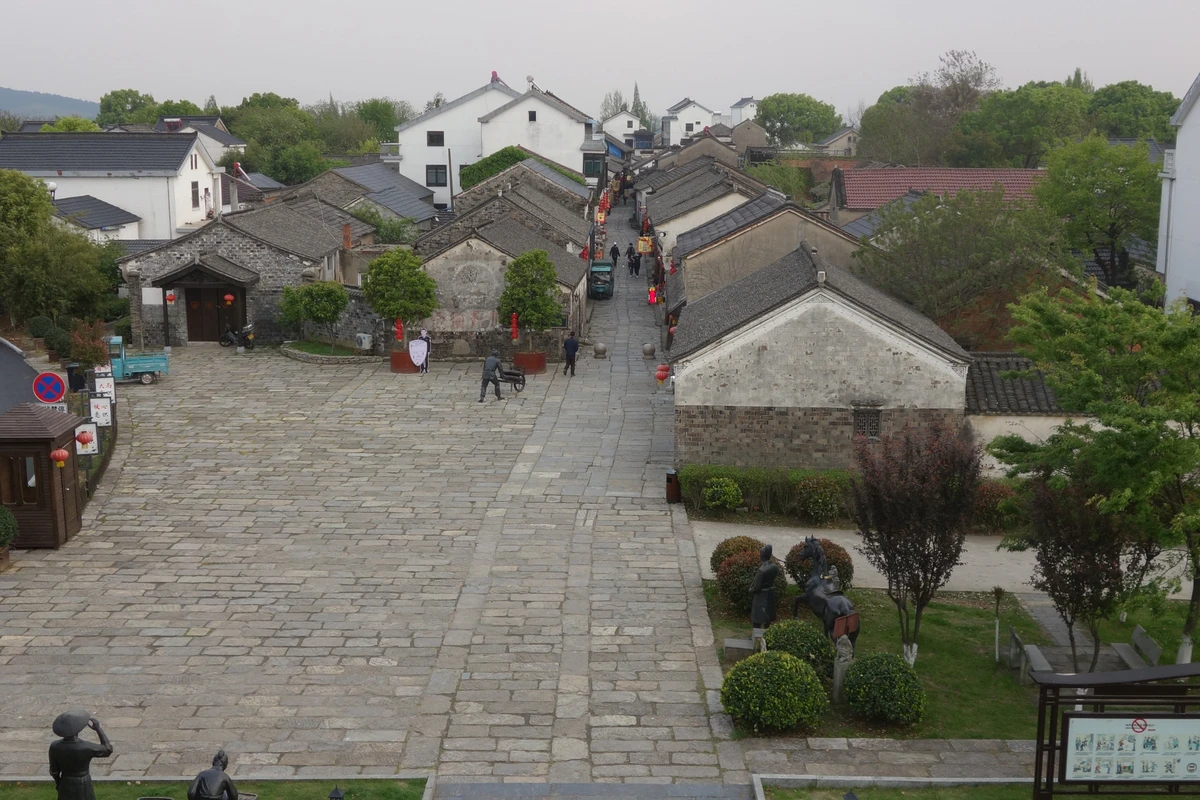
We climbed the gate tower to look down at the old street running north–south. Over 400 meters long, it wasn’t arrow-straight as we’d imagined; instead, it curved gently, with symmetrical lanes, the whole layout resembling a centipede.
A close look revealed a deep groove on the flagstone road of Qiqiao Old Street—said to be the rut left by the single-wheeled carts that once carried goods north and south. I added nostalgic tones to the photo, imagining the scene during the Jiajing reign of the Ming dynasty, when Qiqiao Town was one of the ‘Seven Great Markets of Gaochun,’ bustling with merchants and thriving trades.
From the gate tower, we took in a corner view: the river, the little bridge, the sun hidden behind clouds still straining to cast its light over the ancient village, wrapping it in an ambiance of time-honored tranquility.
Passing through the city gate, we stepped onto the blue-stone path and entered the old street, searching for flavors of the past.
Walking along Qiqiao Old Street, time seemed to flow backward. Known as ‘the First Ancient Village of Jinling’ (Nanjing), Qiqiao Ancient Village still preserves clusters of Ming- and Qing-era streets and buildings. Along the main street, residential houses, shops, and temples remain intact.
The old street’s architecture is of brick-and-wood structure. Looking up, you see overhanging eaves, and the distance between facing doors is less than a meter. Some sides are walled with wooden planks, and street-facing storefronts still keep low wooden walls. On the second floor, there are arcades and fancy lattice windows.
A bluestone plaque on one wall tells us that the village shop was built in the Qing dynasty—a two-story wooden building with three bays. The ground floor was a shop, the upper floor a residence. The frontage had removable door panels, a typical traditional shop style of Gaochun’s market streets.
Black bricks, gray tiles, flowered lattice windows, and horse lanterns whisper of past prosperity. This bluestone house is now the visitor center, which was closed because of the pandemic.
A wall featured lattice windows in a strong Chinese style, flanked symmetrically by two Western-style wall lamps—a simple blend of East and West.
Every village must have its Earth God Temple. The symmetrical round lattice windows on both sides were very artistic; if not for the sign above the door, you wouldn’t know it was a temple.
From the layout of this winery, you can see a typical old-street pattern: shop in front, residence behind, two stories high, extending over a hundred meters deep.
Some traditional shops still have removable door panels at the front today.
Venturing deeper into the lanes and looking up, many old houses still keep brick ventilation windows set symmetrically, known as ‘high eyebrow, low eye.’ Wealthy households had thick walls with door hoods—a Ming-style feature now rare and hard to find in Jiangnan’s ancient folk residences.
Numerous alleyways on both sides of the old street tempted us to turn in, to step deeper into ordinary people’s courtyards.
Many houses in the village now lack the warmth of habitation. The weathered look shows that most able-bodied workers have gone elsewhere to make a living, while elderly left-behind villagers run small businesses.
There were also some delicately built village houses.
The village lanes along the river were clean and tidy,
and the greenery on both sides was beautifully tended.
The riverside scenery and the pastoral views blended harmoniously, forming a picture-perfect composition. Qiqiao’s ancient town is described like this: ‘Two creeks flank one street; lanes lead to water steps. Homes perch by the water; shops stand at the bridgehead.’ This geography explains why Qiqiao Old Street had already become a famous market by the late Southern Song dynasty, and why it peaked during the Ming dynasty’s Jiajing reign, with merchants gathering, lively streets, and boats coming and going.
As we took photos by the river, I glanced at my phone’s weather app. The real-time forecast said rain would pour down in ten minutes. Looking at the gorgeous scene before me, I thought, how could that be? I continued to wander at my own pace.
Here was the village’s Slow Food Square, a thatched-roof colonnade with rows of long benches beneath it. Opposite the colonnade stood a big stage. Many shops along the old street sell food. Here, you can slow your pace, sit under the colonnade watching performances or just chatting, enjoying local snacks and a taste of slow living—a lovely way to relax. But due to the pandemic, the square was quiet and deserted.
We exited Slow Food Square back onto the old street and glanced back at it.
Opposite was the villagers’ activity center, with Qiqiao’s village rules written on the wall. This building reminded me of the supply-and-marketing store in Lantian Village, which was right next to my childhood factory—it felt very familiar.
I liked the subtle vibe here. The old street is basically undeveloped; everything remains natural, a purely original ancient township street.
The modest 500-meter stone-paved road is etched with traces of history. On both sides, the buildings are old brick-and-wood shop houses.
Weather-beaten over time, the wood grain on the doors has grown indistinct, but if you look closely, the overhanging eaves and door lintels still show delicate carvings.
Most old houses along the street, long unmaintained, wear a quaint, ancient look. Some window frames and door lintels, though showing the decay of long neglect, stir the imagination even more about times interlaced...
In reality, the old street is lined with traditional shops one after another: Kong’s Candy Workshop, Tao’s Osmanthus Cake, a vermicelli mill, a bamboo ware shop, a winery, a tofu factory… Many handicrafts and old trades that have gradually faded away are inherited and displayed here. But due to the pandemic, most doors were tightly shut. By mid-April the economy was slowly reviving, but travelers were still few, which is probably why the shops remained closed. It’s truly commendable that the area still preserves traditional handicrafts. Here you find local specialties: fine tea, fermented tofu, pickled vegetables, bamboo crafts, artisan wares, pastries… Wandering among them feels like time is rewinding. It also made me realize I’ll come back to this old street in a better season—when ‘spring warms and flowers bloom’—to see those precious handcraft traditions again and taste the handmade local treats.
The ancient town has two Song-dynasty wells: one called ‘Bao’an’ (Protective Peace), the other ‘Baoping’ (Preserving Peace), guarding the town for generations without cease, bringing prosperity.
Then something interesting happened. Without warning, the sky suddenly darkened, and a fierce wind whipped up. The narrowness of the street made the wind feel even more violent, swirling. The few shops still open hastily packed up, and a resident joked, ‘Evil wind is coming!’ I suddenly remembered the weather alert I’d seen: ‘Rain in ten minutes.’ Incredible. To protect the camera, my companion wrapped it in his jacket, and we hurried back to the car.
We lingered in the car a while, checked the forecast again: the rain would stop in half an hour. So we waited a bit, then set off. We gave up the shorter return route and chose to take the Shijiu Lake Bridge instead—still hoping to catch a sunset, just to try our luck.
Shijiu Lake is beautiful, but we didn’t capture any sunset glow today. A bit of a pity, but it means I’ll come back again.


