A Nanjing Local’s View of Nanjing – Hydrangeas Bloom at Wuchaomen
Getting there: Metro Line 2, Xi'anmen Station. Visiting time: April 2020. Wuchaomen Park: Address: 27 Yudao Street (Minggugong Ruins).
Due to the pandemic, I had not yet returned to work. Each day I enjoyed the luxury of sleeping in and waking naturally. The first thing I did after turning on my phone in the morning was to check WeChat and my Moments. Today, a friend posted photos from Wuchaomen Park first thing in the morning. The gorgeous, massive, eye-catching hydrangeas instantly captivated me. Because of the pandemic, I rarely took the bus or went into the city, but I remembered I had an appointment at Sanshan Street at noon. The hydrangeas prompted me to get up and get ready right away. I could first visit Wuchaomen and then head to Sanshan Street – the timing would work perfectly. A ten-minute metro ride brought me to Xi'anmen Station. Emerging from Xi'anmen station, you step onto the eastern section of Nanjing’s central axis – Zhongshan East Road. The bus stop here is also called Minggugong Station. Minggugong (the Ming Palace) lies on both the north and south sides of Zhongshan East Road. Nanjing's Minggugong can be considered the blueprint for Beijing's Forbidden City; it was the imperial palace of the first unified dynasty in Nanjing's history. After Ming Taizu Zhu Yuanzhang conquered Jiqing (Nanjing), he renamed it Yingtian Fu. To become emperor, he ultimately selected this feng shui treasure land described as 'a coiled dragon on Bell Mountain' and 'the residence of emperors'. A three-minute walk from the station brought me to the north gate of the park. Wuchaomen Park is located at the northern end of Yudao Street inside Zhongshan Gate, south of Zhongshan East Road. The park is named after the Wumen (Meridian Gate) of the Ming Palace, commonly known as Wuchaomen, at its southern end.
In front of the park's north gate stands a pair of witty and adorable stone lions.
Across the street from Wuchaomen Park lies Minggugong Ruins Park. Now that the outer red walls have been removed, Minggugong has lost some of its mystique, and you can see its appearance clearly from the main road. Yet the red pillars and golden-glazed tile roofs still reveal its grandeur, after all, this site served as the imperial palace during the early Ming's Hongwu, Jianwen, and Yongle eras, for as long as 54 years.
Entering through a small side gate, the park follows a symmetrical central axis layout. On the central stone-paved path stands a stone tablet inscribed with 'Wuchaomen Park'. In 1958, the government transformed the area around Wumen and Fengtian Hall into a park.
The open area on the east side is now a public activity zone. Wuchaomen Park no longer wears the heavily guarded look of the former imperial palace; it has become a city park. Apart from the very few who come for its fame or, during this season, flower photographers like me drawn specifically by the hydrangeas, most daily visitors are locals who exercise here regularly.
Mask-wearing dancers, regardless of age or style, danced with serious dedication. I was drawn in by their earnest expressions.
An elderly man on the side watched the dancers on the square with deep affection, clapping his hands. I couldn't tell if he was keeping rhythm or applauding a dancer he admired. Here, you can truly feel the happiness of Nanjing's residents.
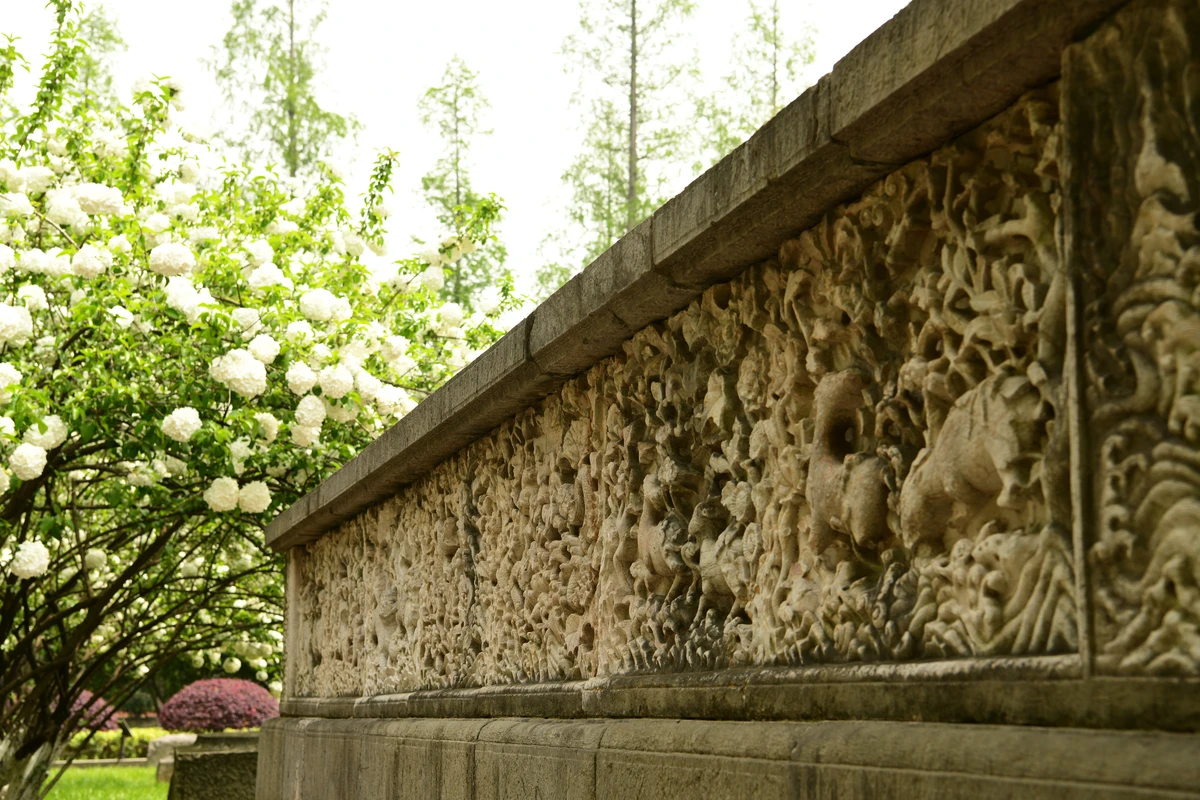
Heading south from the north gate, about ten meters along the path, I came across this weathered yet exquisite stone wall carved with clouds, dragons, birds, and beasts.
At this time of year, hydrangea trees line both sides of the wall, in full bloom.
The wall is carved with patterns of dragons and phoenixes amidst auspicious clouds, fish leaping over the Dragon Gate, and fairy deer in forests – all exquisitely crafted.
Flanking the wall on both sides are a pair of stone lions, clearly original pieces from the imperial palace, exuding an extraordinary presence.
Behind the wall, a stretch of verdant lawn hosts a row of Chinese snowball viburnum trees (also known as 'wood hydrangeas').
As spring warms and flowers bloom, beautiful Nanjing dresses in a riot of peach pinks and willow greens. The wood hydrangeas in Wuchaomen Park quietly burst into bloom, their elegant white adding a distinct beauty to Nanjing's colorful spring.
The white hydrangeas are at their peak.
Clusters of snow-white flowers form into fluffy balls, weighing down the branches with their lush profusion.
The abundance looks as if the branches might bend under their weight.
Upon closer inspection, each hydrangea is made up of countless tiny flowers. Each tiny bloom has only four petals, unremarkable on its own, but when they gather cluster upon cluster, like a big family huddling together, they form a beautiful, giant snowball.
Many such clusters group together, turning the whole tree into an even larger and more beautiful mega-hydrangea.
Once an imperial palace, the stone steles here still convey the grandeur of those days. Aside from the lush green lawn, there aren't many flowers or plants, keeping everything solemn. The various stone tablets and plinths silently hint at the history that once was.
And this 'bloodstain stone', spattered with Fang Xiaoru's blood, lies side by side with the Danbi stone (imperial step stone), as if telling a tale of how glorious history can be, and how merciless.
The great Confucian scholars of the Ming Dynasty were men of unyielding integrity. When Zhu Di captured Nanjing, he demanded Fang Xiaoru draft an edict and threatened to exterminate his nine familial relations. Fang Xiaoru shouted, 'So what if you exterminate ten relations!' He faced death calmly, and his nine relations were wiped out. Faced with Zhu Di's power, four thousand officials at court and in the provinces resigned rather than serve, enraging Emperor Yongle into a killing frenzy. What a blood-soaked storm that was! No wonder Zhu Di relocated the capital to Beijing after just a few years.
Iron railings enclose the pillar bases, stone steles, and hydrangea trees.
The carved stone wall with clouds, dragons, birds, and beasts, together with stone lions, stone vats, stone drums, and other fine Ming Dynasty stone artworks, are among the sights of Nanjing.
The huge hydrangea trees canopy over this garden. On the lush green lawn, stone plinths and steles stand silently. Outside, towering, verdant fir and pine trees embrace the scene. Everything is so harmonious, the mood solemn and slightly heavy, yet the embellishment of hydrangeas adds a touch of freshness.
We each carried our cameras, walking around the iron railings, capturing the beauty inside and outside the garden from different angles.
Because of the different quality of cameras, the resulting images varied significantly.
I captured the perfect combination of historical culture and natural scenery through my lens, hoping friends who couldn't see this in person could also get a sense of the feeling.
Beyond the iron railings, the open area is the Fengtian Gate Stone Carving Garden, the site of the original Fengtian Gate.
Fengtian Hall is what people commonly call the 'Jinluan Hall' (Hall of Supreme Harmony), where Zhu Yuanzhang held grand ceremonies and received homage from civil and military officials.
Fengtian Gate and Fengtian Hall are long gone, leaving only some massive foundation stones, ample proof of the stability of the realm at that time, and testament that this was once an imperial city's Fengtian Hall.
Near the pillar bases, a few masked students sat on the ground, sketching.
From their spot, they had a full view of the stone steles, pillar bases, and the beautiful hydrangeas – so much material to inspire their art.
Beside the stone plinths and under the fir trees, aside from the sketching students and photo-taking tourists, there were the regular park-goers. They danced, played badminton, and a group of saxophone enthusiasts gathered, with a teacher earnestly instructing and students earnestly learning. All this fills the once imposing and grand imperial palace with a down-to-earth, local vibe, yet it doesn't feel out of place at all. Everything is natural, exactly as it should be.
Further south from the Fengtian Gate stone carving site, to the north of Wuchaomen, stand five stone bridges – the 'Inner Wulong Bridges'.
The Wulong Bridges, five bridges lined up over the Jinshui River, are also called Jinshui Bridges. With Wumen as the boundary, the Jinshui Bridge outside Wumen is called the Outer Wulong Bridge, while inside Wumen, there are five more stone bridges, known as the 'Inner Wulong Bridges'.
A small stream gurgles beneath the bridges; this is the Inner Jinshui River, also known as the Inner Imperial River. The Wulong Bridges lie across the imperial river, the water calm, yet enough to reflect 600 years of past and present.
Looking at Wumen from the Wulong Bridges. Wumen is the southern main gate of the Ming Palace. Including its three central gates and the two side gates, it has five gates in total, all used for court entry. The majestic Wumen ruins before me, along with the Fengtian Gate ruins we just passed behind, together form the core of Wuchaomen Park.
South of the Wulong Bridges stands a tablet inscribed 'Stele of Dredging Ditches in the Wanli Period of Ming', recording the efforts to clear waterways and control floods during the Wanli reign.
From the south end of the Wulong Bridges, I looked back at the Fengtian Gate we had just left. This is a central axis, flanked by towering pine trees. Gazing along the straight axis, I imagined: Wumen as the southern grand gate (main entrance) – the central passage used only for the emperor and empress's palanquin, while the left and right side gates were the daily path for civil and military officials going to court. I could faintly sense the grandeur of the imperial palace that once stood here. Today, only some broken stone foundations remain of the three main halls – Fengtian, Huagai, and Jinshen – and the 'rear court' where the emperor, empress, and consorts lived, scattered throughout this ruins park.
Beneath the big trees near the city gate, locals played card games, both players and onlookers enjoying themselves.
This is the Wuchaomen that gives the park its name. Now, after enduring 600 years of wind and rain, its towering and majestic walls and archways still inspire awe.
Wumen is an imposing structure with three archways and double watchtowers on either side.
Wumen is grand and magnificent, wider at the base narrowing toward the top, ancient and dignified. It sits on a marble Sumeru pedestal. Today, the gate retains its original appearance, with the white marble Sumeru base and three arched portals well preserved.
The carved patterns and designs on the platform are still clearly visible. Judging by the exquisite intertwining branch and ruyi (scepter) patterns on the Sumeru pedestal, the simple and elegant decoration represents the architectural style of the early Ming.
The gate is tall and mighty. On its north side, a row of towering fir trees is now sprouting fresh green. The weathered city walls and the fresh young greenery display the sedimentation of history and the passion of new life.
The back view of a grandfather and grandson was a lovely scene.
Don't you think a woman from the Republican era, time-traveled here, would be a perfect match for such a picture and setting?
Standing beneath the high city wall and straight trees, I felt very small.
The mottled wall reveals rich historical traces.
Stone steps on either side lead up onto the wall.
The characters carved into the bricks of the Ming city wall primarily record which prefecture, county, or district manufactured each brick, so that officials could be held accountable for the quality. This was how responsibility was implemented in the Ming Dynasty.
Ascending to the top of Wumen, tall fir trees surround the gate tower. On this spacious platform once stood five 'Wufeng Towers' with yellow glazed tiles, golden roofs, double eaves, and crimson decorations. Now, the Wufeng Towers have long since vanished along with the palaces, leaving only orderly rows of massive stone bases that let us imagine their former splendor.
The tall trees only block our view, but they cannot block the boundless emotions stirred by this place, once a dragon's lair and tiger's den, now surpassing even its glorious past!
On the gate tower, the melodious sound of a saxophone floated in the air, played by a stylish lady.
How delightful it must be for the ancient city wall to listen to the saxophone's melody!
As I walked down the steps, I felt a bit of emotion. In a historically rich city like Nanjing, Wuchaomen, as the core and most significant imperial gate of the Ming city wall, sits in a bustling area yet remains remarkably low-key.
Under the green canopy of the busy city, this former imperial palace site has long transcended worldly glitz. Walking here, one feels a serene detachment, a lightness. From the surviving gate, the city wall, and the huge stone bases, you can imagine its past.
The dominant color in the park is green – green lawns, green leaves. Apart from green, there are only the stone steles and plinths, and the bluish-gray of the city wall. It's lush, elegant, with a sophisticated monochromatic feel.
This former royal site has now comfortably transformed into a city park brimming with local life.
Right now, the hydrangeas in the park are in full bloom, ushering in the most beautiful floral season. They set off the stone carvings of Wuchaomen Ruins Park charmingly, making one linger and delighting in the spring atmosphere!
The park has no other potted flowers besides this row of hydrangea trees. This floral arrangement feels clean and generous to me, perfectly matching the imperial aura of the place. Walking here, despite the music from the square and the saxophone melodies in the woods, you can still feel that sacred and magnificent atmosphere.
If it weren't for the hydrangeas blooming so conspicuously this season, tourists like me probably wouldn't visit. As a Nanjing local, back when there was no metro and I took bus No. 5 between Xinjiekou and Xiaolingwei, I passed by here every day. The park, with no enclosing walls, was fully visible from the bus, so it lost its mystery and I never felt the urge to come specially.
In a city rich in historical culture and natural landscapes like Nanjing, Wuchaomen Park is not particularly eye-catching. In many people's eyes, it might just be a remnant of broken walls and ruins. But it's precisely this royal-style simplicity and weightiness, coupled with a touch of pride, plus the freshness brought by the snowy white hydrangeas now, that gives this place an abundance of charm.


