2020 Self-Drive Westward Travelogue, Part 8: Weinan, Gongyi, Zhengzhou, Huaiyang, Luyi, Nanjing (Final Chapter)
2020 Self-Drive Westward Travelogue Part 1: Lingbi, Xuchang, Sanmenxia
Part 2: Yuncheng
Part 3: Hancheng, Sanyuan, Xianyang, Baoji
Part 4: Tianshui, Lanzhou, Jingtai, Wuwei, Zhangye, Jiuquan, Jiayuguan
Part 5: Minle, Xining, Jianzha, Tongren, Xunhua
Part 6: Gannan, Longnan
Part 7: Hanzhong
This is Part 8: Weinan, Gongyi, Zhengzhou, Huaiyang, Luyi, Nanjing (Final Chapter)
Day 34, May 16, from Hanzhong to Weinan: 335 km, 4:41
From an altitude of over 500 meters to 1600 meters, crossing the Qinling Mountains, one tunnel after another. Shortly after leaving downtown Hanzhong, the speed limit was 80.
Originally planned to stay in Weinan, but after seeing the Drum Tower, the city seemed quite ordinary. Seeing it was only 14:15, we decided to head towards Zhengzhou. So, 171 km, 2:18, we arrived at Sanmenxia. Today we drove 7 hours. Stayed in downtown Sanmenxia.
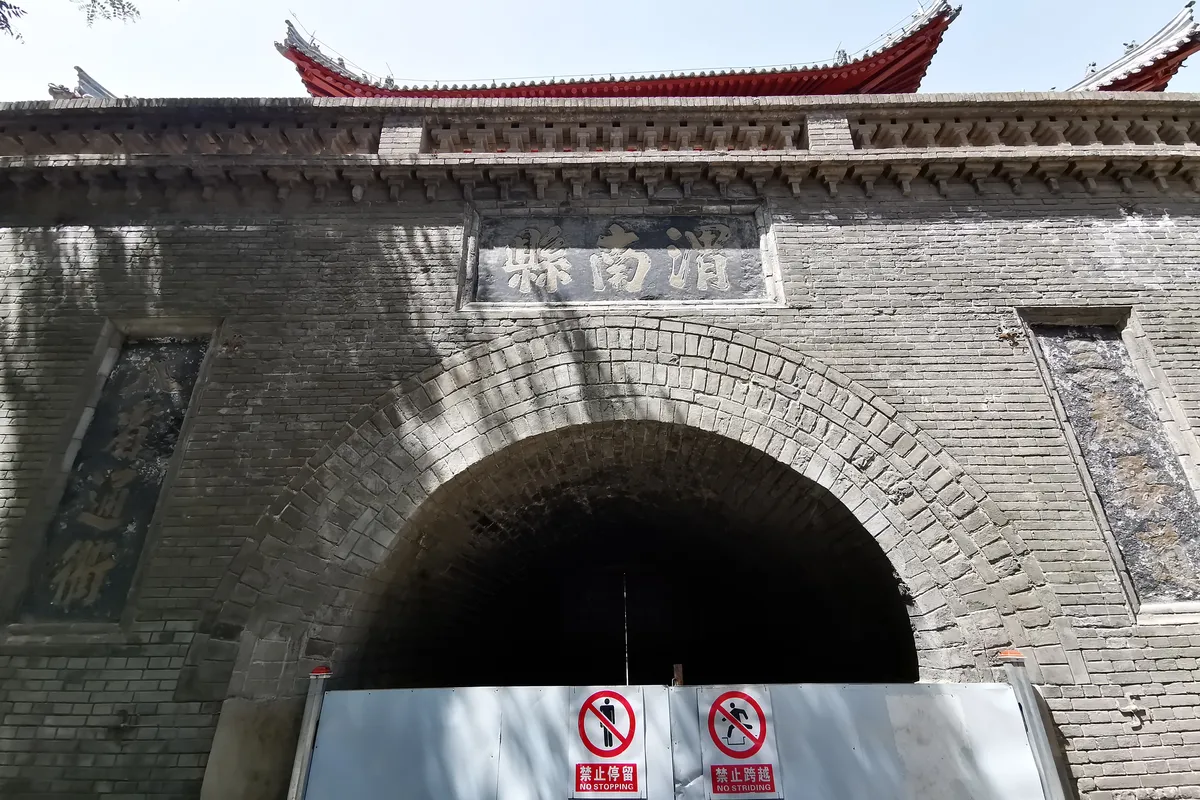
It faces south, with a platform about seven meters high at the bottom, and a double-eave hip-and-gable glazed tile roof on top. According to legend, this tower was first built in the 9th year of Daye of the Sui Dynasty (613 AD), situated in the center of the county seat at that time. It was expanded during the Hongwu reign of the Ming Dynasty. In December of the 34th year of Jiajing (1556), it was destroyed in the Huazhou earthquake, and rebuilt the following year, with repairs also carried out in the Qing Dynasty.
In the center beneath the drum tower, there is an arched passageway running north-south. Above the arch are inscribed three characters 'Weinan County', and on either side of the arch are inscriptions reading 'Key Thoroughfare of Sanqin' and 'Gateway to Eight Provinces', all written by Zhang Guojun, the magistrate of Weinan County in the early Guangxu period. These inscriptions not only became symbols of Weinan, but also demonstrated its strategic geographical location, a hub connecting all directions and a contested spot for military strategists.
When we arrived in Sanmenxia, we went to the same place where we had lamb skewers on our outbound trip:
Day 35, May 17, from Sanmenxia to Kang Baiwan Manor in Gongyi: 184 km, 2:16
to Song Tombs 6.3 km, 0:16;
to Du Fu's Hometown.
1. Kang Baiwan Manor:
Admission 53 yuan, parking 10 yuan.
4A-level, national key cultural relic protection site. Along with Liu Wencai Manor in Sichuan and Mou Erhei Manor in Shandong, it is known as one of China's Three Great Manors, ranking first among them. It is hailed as the spiritual home of Henan merchants and a model of ancient architecture in the Central Plains.
Located in Kangdian Town, Gongyi City, Henan Province, 4 km from the city center, the manor was first built in the late Ming and early Qing dynasties. Comprising 19 parts, it covers over 240 mu (about 16 hectares) and is a representative example of feudal fortress-style architecture on the Loess Plateau of North China during the 17th and 18th centuries. Its stone, wood, and brick carvings are considered masterpieces of Central Plains art. Moreover, the Kang family's ambition to amass wealth from all under heaven and their drive to chase profits across the four seas endured for over four hundred years without decline, making them a model of success for Henan merchants. Kang Baiwan Manor is thus also honored as the 'Home of Henan Merchants'.
'Kang Baiwan' is a collective title for the family of Kang Yingkui since the Ming and Qing dynasties. The Kang family of Gongyi, from their sixth-generation ancestor Kang Shaojing down to the eighteenth-generation Kang Tinglan, were bold pioneers and innovators, remaining wealthy for twelve generations and over four hundred years. Historically, figures like Kang Dayong, Kang Daoping, Kang Hongyou and more than ten others were all called 'Kang Baiwan' by locals. In 1900, when the Eight-Nation Alliance invaded Beijing, Empress Dowager Cixi and Emperor Guangxu fled westward in panic. The following year, in 1901, they returned to Beijing via Gong County (now Gongyi). Because Henan was suffering from famine and the treasury was depleted, the local magistrate could not afford to host them. So the Kang family was asked to finance the reception. After Cixi and Guangxu arrived in Gongyi, they stayed one night in a 'temporary palace' built by the Kang family. The next day before leaving, the family head Kang Hongyou donated one million taels of silver to Cixi through Li Lianying. Delighted, Cixi remarked, 'I didn't know there was a millionaire in such a place!' From then on, the title 'Kang Baiwan' became even more famous, thanks to Cixi's offhand comment.
Kang Baiwan Manor preserves the form of residential dwellings on the Loess Plateau and northern-style quadrangle courtyards, while also incorporating features of official buildings, gardens, and military fortresses. Following the traditional philosophy of 'harmony between man and nature, learning from nature,' the manor was sited with cave dwellings built into the hillside, multi-story buildings facing the street, a dock by the river, and defensive walls built on strategic terrain. It became a large-scale landlord estate that integrated agriculture, officialdom, and commerce, with separate functional systems, comprehensive facilities, a cautious layout, and strict hierarchy. Its stone, wood, and brick carvings are celebrated as extraordinary Central Plains art. The entire manor occupies over 240 mu, with well-preserved sections including the residential area, warehouse area, workshop area, South Courtyard, ancestral hall area, etc., totaling ten parts, 33 courtyards, 53 multi-story buildings, 97 bungalows, 73 cave dwellings—571 rooms in total, with a floor area of 64,300 square meters. Surprisingly, such an enormous complex has only one entrance. Without a guide who knows the way, a stranger would find it extremely difficult to locate the exit, winding through the manor as if lost in a giant maze. Unlike most wealthy families' homes, Kang Manor's architectural style is uniquely striking. Its gate entrance can rival ancient city gates, supported by main walls on both sides. Inside the gate, there is a high observation deck modeled after a Beijing Great Wall watchtower. Climbing the steps up to the deck, one can gaze far into the uninterrupted Mangshan mountain range and gradually hear the gurgling of the Luo River in the distance—truly a superb scenic spot!
The Central Plains has always been a contested region, plagued by frequent wars. To protect their immense wealth and in keeping with their philosophy of 'leaving room,' the Kang family designed several treasure-hiding caves during the manor's construction. Currently open to the public are an underground gold and silver vault in the warehouse area and a 'Treasure Cave' in Courtyard No. 1 of the main residential area—two of the Kang family's original treasure hiding spots. These were secret passages that served the dual purpose of 'hiding treasure in times of wealth' and 'escaping during chaos.' Historically, the Kang family capitalized on six major opportunities: the Ming and Qing government salt monopoly under official supervision and merchant operation; marriage alliances with descendants of the Ming imperial family; the development of canal transport to reach Shandong; taking advantage of the Qing court's suppression of the White Lotus Rebellion and Nian Rebellion; and hosting Empress Dowager Cixi and Emperor Guangxu. Through bold operations and continuous expansion, they combined agriculture, commerce, and official connections, mutually reinforcing each other. Their core approach can be summed up in 16 characters: seize business opportunities, grasp golden chances, bold pioneering, and extensive land acquisition. Ultimately, the Kang family became the richest in the Central Plains and the foremost Henan merchants.
The tombs of the Northern Song emperors (960-1127) and their buried family members are a national key cultural relic protection site and one of the largest and best-preserved imperial tomb complexes with ground remains in China.
As the saying goes, 'Born in Suzhou and Hangzhou, buried on Beimang.' This auspicious feng shui site is the largest imperial tomb complex in central China, covering about 156 square kilometers with over 300 tombs. Over 700 exquisite stone carvings still stand on the surface, holding significant cultural and artistic value. This vast tomb complex encompasses almost all Northern Song emperors. Except for Emperors Huizong and Qinzong, who were captured by the Jurchens and died in captivity beyond the Great Wall, the other seven emperors are all buried in Gongyi, along with the tomb of Zhao Hongyin, father of Zhao Kuangyin, collectively known as 'Seven Emperors and Eight Tombs.' The tombs of famous ministers such as Kou Zhun and Bao Zheng are also here. Surrounding the eight imperial tombs are nearly one thousand tombs of empresses, imperial relatives, and renowned officials, with nearly a thousand extant stone carvings on the ground—making it a vast historical museum of the Song Dynasty.
The Song Tombs pioneered several practices in tomb area design. All the emperors of one dynasty were buried in a single location, reflecting earthly rituals and the hierarchical order of the imperial family, giving rise to a well-structured and distinctive royal burial culture.
The seven emperors and eight tombs of Northern Song, in chronological order of burial, are: Yong'an Tomb of Emperor Xuanzu, Yongchang Tomb of Emperor Taizu, Yongxi Tomb of Emperor Taizong, Yongding Tomb of Emperor Zhenzong, Yongzhao Tomb of Emperor Renzong, Yonghou Tomb of Emperor Yingzong, Yongyu Tomb of Emperor Shenzong, and Yongtai Tomb of Emperor Zhezong. Together with the tombs of empresses, imperial clansmen, princes, and meritorious officials such as Gao Huaide, Zhao Pu, Cao Bin, Cai Qi, Kou Zhun, Bao Zheng, Di Qing, and Yang Liulang, there are nearly 1,000 tombs in total, developed over more than 160 years. Among the Northern Song imperial and empress tombs, the eight imperial mausoleums are well preserved. The empress tombs are mainly distributed in four areas—Xicun, Caizhuang, Xiaoyi, and Baling—covering more than 30 square kilometers, forming a grand and imposing imperial necropolis.
The imperial tombs face south. From south to north, there are the que platforms, ru platforms, and the spirit way lined with stone statues. North of the spirit way is the upper palace. Around the upper palace is a square sacred wall of rammed earth with a perimeter of about one kilometer, with sacred gates in the middle of each side, and watchtowers (corner towers) at the four corners. In the center of the upper palace is a truncated pyramid-shaped tomb mound with a base perimeter of over 200 meters, beneath which is the underground palace. The empress tombs are northwest of the imperial tombs, similar in layout and architecture but smaller in scale and with fewer stone carvings. The lower palace, used for daily offerings, was located north or northwest of the upper palace; its surface structures have completely disappeared.
Yong'an Tomb is the first of the seven emperors and eight tombs of Northern Song, the tomb of Zhao Hongyin, the biological father of Emperor Taizu, Zhao Kuangyin.
Yongchang Tomb is the second imperial tomb in the Northern Song necropolis and effectively the primary one. It belongs to Zhao Kuangyin, the renowned Song Taizu, founder of the Northern Song Dynasty.
All the above is from reference materials. Our navigation took us to 'Song Tombs,' and the sign at the gate read 'Yongzhao Mausoleum.' When we asked a passerby, they said this one is the best preserved.
3. Du Fu's Hometown:
Admission 50 yuan.
In the first month of the year 712 AD, Du Fu was born here. His great-grandfather was the county magistrate of Gong County, so he came from a family of officials. He grew up in his aunt's home. He started writing at the age of 9. The picture below shows the cave dwelling where Du Fu was born. Below is Brush Rest Mountain (a friend from Fujian commented: 'This is called a mountain?').
To Zhengzhou: 81 km, 1:15. Stayed in downtown Zhengzhou.
Day 36, May 18, from Zhengzhou to Huaiyang to Luyi
Henan Museum: Parking 10 yuan
Taihao Fuxi Mausoleum in Huaiyang County, Zhoukou City, 4A: Admission 40 yuan per person
A large mausoleum and temple commemorating Taihao Fuxi, the first of China's legendary Three Sovereigns and the ancestor of Chinese civilization. It is thus called the 'Number One Mausoleum Under Heaven.' First built in the Spring and Autumn Period, expanded during the peak Tang Dynasty, and perfected in the Ming and Qing Dynasties.
The picture below shows an ancient cypress from the Song Dynasty, from the middle of which a sandalwood tree sprouted in the 1970s.
The following 4 pictures are of Yue Fei Temple.
Laozi's Hometown in Luyi County, Zhoukou City, 4A:
Admission 30 yuan (half-price), parking 10 yuan, electric cart 2 yuan.
5 km east of the county seat.
The birthplace of Laozi and also the origin of the Li surname, one of the famous Taoist temples in China. First built in the Eastern Han Dynasty, in 165 AD.
Below is a tree said to have been planted by Laozi himself.
The following 4 pictures show the place where Laozi lived.
Below is Laozi Square.
Stayed in Luyi County town.
Day 37, May 19, from Luyi, Henan to Nanjing, Jiangsu: 448 km, 5:15
Below is the famous Xinjiekou Department Store.


