2-Day Trip to Gaochun, Nanjing's International Slow City: Lotus Viewing, Amusements, and Getting Lost in Its 'Slow Life'
Gaochun, the southernmost district of Nanjing, is renowned as 'Nanjing's Back Garden.' It is China's first 'International Slow City.' Many people may not be very familiar with slow cities; it refers to a place with a slow pace of life and excellent ecology, exactly the dreamy travel resort everyone longs for. Today, Gaochun, the International Slow City, is drawing more and more visitors.
Gaochun has a long history and numerous tourist attractions, most of which focus on slow life and pristine eco-tourism experiences. If visiting Gaochun in summer, the thousand-mu lotus pond at Gucheng Lake Water Slow City, the viral glass slide rafting at Yaxi Slow City, the ancient villages of Youzi Mountain, and the picturesque rural scenery are all well worth a visit.
I spent two days touring Gaochun, with a rough itinerary as follows:
DAY 1: Admire lotuses at Gucheng Lake Water Slow City — Experience treetop adventures, tree canopy drifting, and rainbow slide at Yaxi Slow City — Night tour of Gaochun Old Street.
DAY 2: Visit ancient villages, homestays, and the ten-thousand-mu tea garden at Youzi Mountain.
Gucheng Lake Water Slow City is located on the west bank of Gucheng Lake, about a 15-minute drive from Gaochun Station on Nanjing Metro Line S9. The scenic area is huge, covering over 8,000 mu, and features a wedding garden, Golden Beach, Hundred Lotus Garden, wetland zoo, reed marshes, and more. A summer visit here centers on the Hundred Lotus Garden, the perfect season for admiring lotuses.
A ticket is required for Gucheng Lake Water Slow City, priced at 80 yuan per person (currently discounted to 40 yuan). Given the vast area, you can take a mini train or eco-friendly shuttle to get around, with stops at each attraction for convenience.
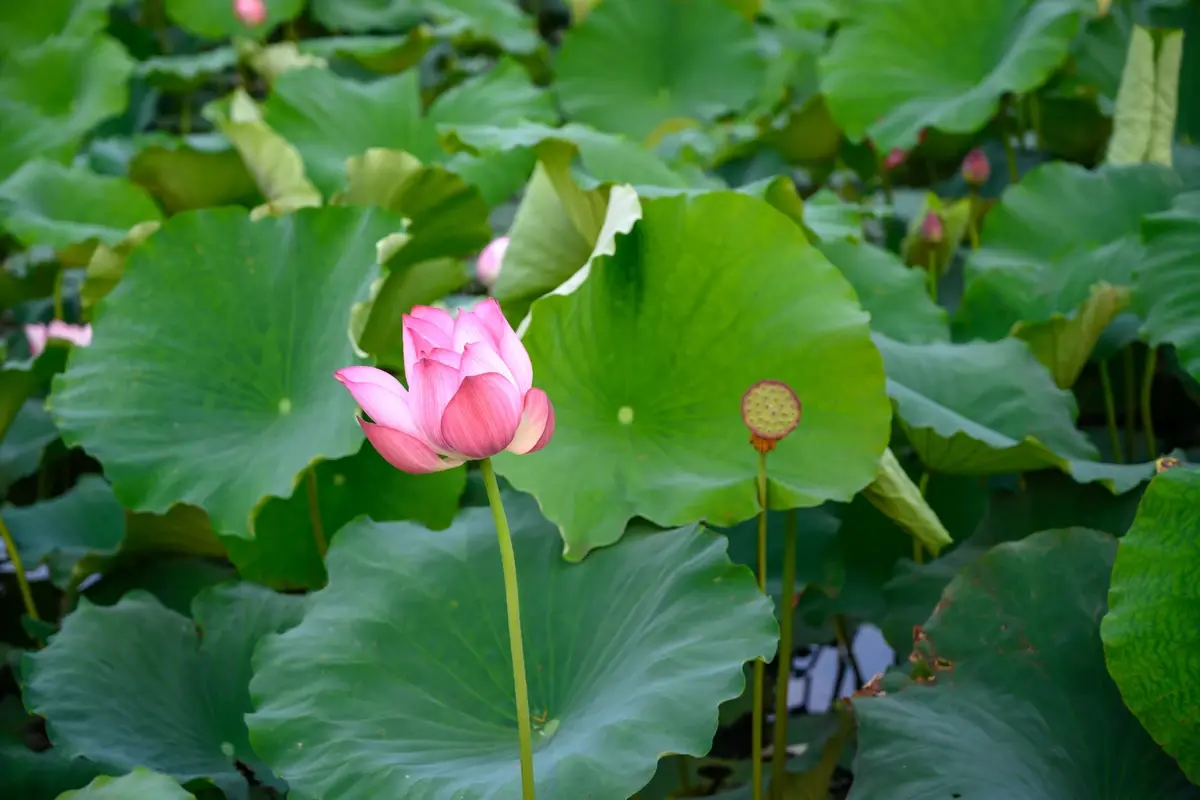
The Hundred Lotus Garden is one of the core attractions, boasting nearly a thousand mu of lotus ponds—summer is the season to enjoy them. There are two ways to view the lotuses: by boat or along the wooden walkways that wind through the ponds. The waterways and walkways interweave, creating a water maze.
The garden is not only vast but also boasts great variety, with 99 different lotus cultivars such as 'Sword Dance Lotus,' 'Drifting Girl,' and 'Friendship Peony Lotus,' in shades of pink, red, and white. Though I'm no expert on lotus varieties, the blooms here are impressively large and a delight to behold.
Actually, lotus viewing at Gaochun's Gucheng Lake Water Slow City has a history—this is the 12th Gucheng Lake Water Slow City Lotus Festival. The theme this year is 'Where Love Belongs, Water-Side Slow City.' Coincidentally, the weather during the Dragon Boat Festival was superb, drawing many visitors to admire the lotuses.
At the Hundred Lotus Garden, I didn't rush for a boat but launched a drone. From a bird's-eye view, the garden was a scene of vibrant life. Whether on a boat or a walkway, you're surrounded by lotuses, like a stunning ink-wash painting.
For water tours, there are three boat types: bamboo rafts, viral transparent boats, and retro Chinese-style boats. Families might opt for a bamboo raft or Chinese-style boat, while couples can choose the transparent boat. Bamboo rafts can be self-rowed or with staff assistance, typically charged by the hour; about an hour is enough for a circuit.
Our group of eight could only take a bamboo raft. Drifting slowly through the thousand-mu lotus pond, the scenery was gorgeous and stirring. Generally, the best time to visit is June to September, when lotuses are in bud or full bloom, and the endless green is a powerful visual feast.
Along the way, we saw many people paddling the viral transparent boats, which hold just two—perfect for couples. Sitting in them feels like floating on water, both thrilling and fun.
For families, renting a bamboo raft and slowly poling through the vast lotus pond, sitting back and gazing at the blooms, must be a moment of pure happiness.
While lotuses are common, such a large-scale pond is rare. For visitors from around Nanjing, this is definitely the top lotus-viewing spot. Ladies, consider wearing a dress and strolling among the lotuses—like a lotus fairy, it's both beautiful and evocative.
Beside the Hundred Lotus Garden is a water park. Summer weather is hot, so after lotus viewing, you can enjoy the park's 50-meter water challenge course and slides, suitable for all ages. Completing the challenge earns you a gift.
Since I live in Nanjing, getting to Gaochun is easy—just take the metro. I've been here many times before, mostly to Gucheng Lake Water Slow City. I'd been to Yaxi Slow City too, but back then there were no amusements. This time, I came for these thrilling and fun rides.
After soaking in Gaochun's slow life, experiencing exciting amusements adds a different kind of fun that will make you linger.
Yaxi Slow City has three main recreational areas: Slow Paradise, Rainbow Slide, and Tree Canopy Drifting, with difficulty levels graded as wood, forest, and jungle. Slow Paradise is the first stop, with activities like treetop adventures, glass walkways, tree canopy walks, and real-life CS.
I've done treetop adventures abroad—different challenges set among trees, requiring professional gear to navigate. It's thrilling and challenging, and being up in the forest feels wonderfully unique.
If that's not high enough, try the tree canopy walk, with two sections: a hanging bridge walk and a glass walkway, totaling 228 meters. The high hanging bridges are near the tree canopy; walking on them, swaying, you feel like a monkey moving through the treetops.
Even if you're a bit timid, the tree canopy walk is worth experiencing. For the brave, there's little challenge, but the sensation of being among the treetops is magical. Plus, it makes for great forest-style photos.
After about 100 meters of hanging bridges, you reach a 130-meter glass corridor built at canopy height—a major challenge for those with a fear of heights. Walking on it, you feel like a martial arts master with lightness skills. Near the exit, a cracking-glass sound effect will startle even the boldest. So thrilling!
There's also a kids' area, but it's no easy feat: ropes wrapped around trees and wobbly logs make it exciting for little ones. I recall a child shouting to her sister, 'I'm so scared!' making everyone laugh. So much fun.
The Rainbow Slide is familiar to many. Here it's 110 meters long with a roughly 40-degree slope, designed as a wave. Sliding down from the top, wind whooshing in your ears, you feel free, with screams echoing around.
Both adults and kids enjoy it. The slide lasts just seconds, but the thrill lingers for minutes.
This Dragon Boat Festival, Gaochun's International Slow City gained a new Instagram-worthy spot: Tree Canopy Drifting, essentially glass slide rafting.
On the shuttle bus, you'll see a sculpture of a 'kettle pouring water,' with a path leading to the Tree Canopy Drifting attraction. Reportedly, this path will become an 'automated walkway' for convenience.
Yaxi International Slow City is free to enter, but the recreational activities are ticketed.
Many scenic areas now have glass slide rafting, and summer is the perfect season. I've tried several before, but none with scenery as beautiful as Tree Canopy Drifting. The glass slide snakes like a dragon over the hillside; even before riding, my legs felt shaky.
The ride is built above the canopy of towering, straight pine trees—hence the name. The 500-meter slide drops 18 meters. Sitting in the raft, you first glide through the pine forest, then emerge suspended above a vast tea garden—a signature feature. It's thrilling and the view is picturesque.
To boost the thrill, there are two 360-degree turns, and the slide's color design is lovely. A drone view shows it like a roller coaster. A companion tried it first and came down saying, 'Thrilling, beautiful!'
In the past, I came to Gaochun mostly for a getaway, strolling tea gardens or lakesides. Now it's different: you can feel the 'slow life' and enjoy heart-racing amusements that add a unique 'slow' vibe.
I've been to Gaochun more than once, each time rewarding. From Water Slow City, hairy crabs, and Gaochun Old Street to the new amusements at Yaxi International Slow City, it shows Gaochun welcomes visitors from everywhere.
Youzi Mountain is a national 4A scenic area, named after Confucius's travels, and a place of beautiful scenery and deep cultural heritage.
Near Youzi Mountain is a village straight out of a paradise: Longshang Village in Gaochun. It lies in the south of the Santiaolong area of Yaxi International Slow City, bordering Youzi Mountain Scenic Area to the west, about a 25-minute drive from central Gaochun. It's named because the village sits on a ridge (longshang).
Entering Longshang Village, you see slogans like 'Clear waters and green mountains are mountains of gold and silver; revitalize the countryside and keep the nostalgia of our beautiful hometown.'
The village isn't big, with 51 households and 141 people. Situated on hilly terrain, it's ideal for tea growing; every family has a tea garden. In spring, you can smell the refreshing tea fragrance before entering the village. The scenery is like the 'Peach Blossom Spring' described by Tao Yuanming.
Like many villages, most young people used to leave for work, leaving the elderly and children to tend the tea gardens, and the beautiful environment wasn't well utilized.
In recent years, Longshang has transformed. Leveraging the Qingshan tea culture, it's been built into a characteristic pastoral-style beautiful village. Roads are wide and clean, the environment is lovely, attracting many tourists and holidaymakers.
There are many old houses with strong local character and Hui-style white walls and grey tiles. Over ten old houses have been protectively renovated and shine anew; village roads were replaced from concrete to stone or brick paths, giving an antique charm.
Though small, facilities are complete: a visitor center, homestays, tea culture spaces, tea snack shops, and a pottery experience area. To learn the village's history, go to the visitor center. Its two-story wooden building is decorated with village photos and historical info. Tired? Rest or sip tea there.
The pastoral countryside revitalization not only beautified the village but also brought young people back, contributing to their hometown's development while boosting tourism and locals' income.
For me, the most charming part of a village is old houses. Many in Longshang have been turned into small shops but kept their original exteriors, giving a back-to-basics feel.
Interiors are also quaint. Many love nostalgic decor, especially old objects with stories, adding a special ambiance to a room.
Longshang is surrounded by lush tea gardens, one being Chunqing Tea Garden. You might not have heard of it, but it's a big deal: named one of 'China's 30 Most Beautiful Tea Gardens' and Jiangsu's first such garden. Its vast, open area makes it a top self-drive destination for visitors from Nanjing and beyond.
Gaochun isn't new to me; I've visited many times, but Chunqing Tea Garden was a first. I recall it going viral online during the hit TV show 'In the Name of the People,' where some scenes were filmed here—the inspection of the ten-thousand-mu tea garden by Secretary Dakang and Sha Ruijin.
Additionally, many may not know there's a wooden walkway built from old ship planks in the tea garden: the 'Ten-Li Ancient Ship-Plank Confucian Clean Culture Walkway.' As Confucius once traveled here, this walkway adds cultural depth to the landscape.
Built in 2015 within the Longshang Scenic Area of Youzi Mountain National Forest Park (navigate to Chunqing Tea Garden), the walkway is over 10 li long, using over 10,000 old ship planks. Winding through the tea garden, it's a scenic viewing path.
The walkway is made of recycled old ship planks, treated against decay, symbolizing 'anti-corruption' as indicated by the 'clean culture' in its name.
Youzi Mountain isn't tall; its highest peak, Da You Mountain, is just over 180 meters, but the undulating terrain makes the tea garden and walkway rise and fall with the landscape, blending seamlessly and beautifully.
Compared to Gucheng Lake Water Slow City or the Old Street, fewer tourists come here, perhaps because summer scenery isn't as vibrant as spring. Entry is free. If interested, walk the entire walkway—you'll be rewarded.
If in the mood, stop at the tea space by the walkway for a cup of tea. On hot summer days, it's a great way to beat the heat and quench thirst.
When Nanjing's tourist spots are mentioned, most think of Fuzimiao (Confucius Temple), not only China's first national academy but also its largest traditional market street, historically a gathering place for noble families. There's another ancient street many might not know: Gaochun Old Street, known as 'the Second Fuzimiao of Jinling,' also a national 4A scenic area.
Gaochun Old Street, also called Chunxi Old Street, lies in Chunxi Subdistrict, Gaochun. It has been the commercial center since ancient times and still preserves numerous ancient buildings, the best-preserved Ming-Qing old street in East China, hailed as 'the First Ancient Street of Jinling' and listed among the 'New Forty-Eight Views of Jinling.'
As Gaochun's main trade thoroughfare, it has always attracted merchants and scholars. Its history dates to the Song Dynasty over 900 years ago, developing through the Ming and Qing dynasties into today's culturally rich street.
Originally over 1,100 meters long, now about 800 meters of 5-meter-wide stone pavement remains. The street runs east-west in a straight line, hence called 'Yizi (Straight) Street,' very easy to tour from one end to the other. Entry is free.
If you've visited before, the cobblestone road might be memorable. Unlike other ancient streets, the pavement uses two colors of stone: longitudinal green flagstones on the sides and horizontal carnelian stones in the middle, with drainage inlets. After centuries, it remains sturdy.
Strolling along, shops line both sides—about 300 in total. The buildings are Ming-Qing style double-story brick-and-wood structures, blending Hui and local features with flying eaves, upturned corners, and white walls with grey tiles, simple yet elegant.
The Hui-style architecture stems from the Hui merchants who traded here from southern Anhui, bringing goods and their architectural style, creating the quaint look we see today.
I think the best time to explore is dusk, when the sky isn't fully dark and lights begin to glow, the temperature pleasant. Walking slowly, soaking in the lively atmosphere, your mood lifts.
Many overlook the exquisite wood and brick carvings on the buildings, especially on wooden elements and walls—figures and animals with smooth, lifelike lines, showcasing the craftsmen's skill.
Beyond the main street, there are many minor sites: Guanwang Temple, a folk museum, folk performance hall, Qianlong Ancient Well, the former site of the New Fourth Army's Gaochun office, etc., all worth visiting to understand the old street.
When visiting a place, exploring its old street helps you learn its history and buy local specialties. Gaochun offers many: Chunxi liquor, feather tribute fans, Yunxi fragrant goose, smoked tofu, Gucheng Lake crabs, etc. The feather fans date back over 1,700 years.
During my two days in Gaochun, though short, I savored many local delights—from street snacks to hotel banquets, all satisfying.
After leaving the Hundred Lotus Garden, we dined at a nearby hotel (Gucheng Lake Happy Fishing Hotel). Not only was the food unique, but the hotel itself was special (pity we didn't stay). As the name suggests, it's fishing-themed.
We arrived just as a dozen people were in a fishing competition; they were catching fish incredibly fast, the moment the hook hit the pond.
If you stay, you can fish for free and even take your catch home~
We ordered many dishes: stir-fried shrimp with green peppers, sweet and sour ribs, farmhouse crispy rice, lotus leaf chicken, 'Wealth in Bloom,' stir-fried baby bok choy, Gucheng Lake fish head soup, steamed clams with shrimp paste, and more.
What impressed me most was 'Wealth in Bloom'—petite stir-fries served in lotus petals, then wrapped in small pancakes. Yes, real lotus petals, with a subtle fragrance.
As an International Slow City, Gaochun has many guesthouses and hotels, mostly for leisure and vacation. I love homestays the most.
At No. 21 Xiaomaoshanjiao Village in Dongba Town, I came across a Floral Hotel. Unlike others I've stayed in, this one focuses on 'luxury.' Its name has deep meaning, inspired by ancient 'Du Fu Thatched Cottage' and 'Lushan Thatched Cottage.'
The style is minimalist with white walls and grey tiles, hidden in the village, set against bamboo groves, trees, bridges, and streams, creating a profound, picturesque scene.
Entering the room, you immediately feel the 'luxury'—spacious with high ceilings, flooding the room with light. A retro-nostalgic mood instantly takes hold; this is the kind of ambience a vacation should have.
I've stayed in many folk inns around Nanjing, but this one instantly felt like my ideal homestay.
The decor is simple and quaint, with artistic touches everywhere, blending Chinese classic elegance with modern literary style. I love it.
Also, in the pine forest of Yaxi International Slow City, I found a 'fairyland hotel': Nanjing Slow City Pillow Pine Resort. Nestled on a quiet pine-covered hill, the Nordic wild-luxury forest cabins blend with nature. Log cabins dot the pine woods—a perfect photo spot, especially for forest-style shots.
Rooms are categorized as wood, forest, and jungle (1, 2, or 3 bedrooms).
Though we didn't stay, stepping inside, you can feel the comfort. The cabins and trees create a unique spatial relationship: 'Houses in the forest, trees in the houses.' Love it.
1. Gucheng Lake Water Slow City: 80 yuan/person, currently 40 yuan.
2. Gaochun Old Street: Free entry.
3. Yaxi Slow City: Free entry; amusements separately ticketed.
From Nanjing to Gaochun, take the metro: from Nanjing South Station, take Line S1 then transfer to S9 to Gaochun Station, then a bus.
Self-driving is recommended. Gaochun is about experiencing slow life; the scenic areas are vast with beautiful ecology. Even on the road, you'll spot stunning views, like Shijiu Lake en route—super beautiful. Driving offers more flexibility.
Travelogue Contents
1. Introduction
2. Lotus viewing at Gucheng Lake Water Slow City
3. Amusements at Yaxi Slow City
4. Ancient villages & ten-thousand-mu tea garden at Youzi Mountain
5. Gaochun Old Street, 'The First Ancient Street of Jinling'
6. Travel tips (food & homestays)
Travel Info | Hotel Index | Guide Index | Flight Ticket Index | Website Navigation | Travel Index | Cruise Index | Corporate Travel Index | Partnership | Distribution Alliance | Friend Links | Corporate Gift Cards | Procurement | Insurance Agency | Agency Cooperation | Hotel Joining | Destination & Scenic Area Cooperation | More Cooperation | About Ctrip | About Ctrip | Ctrip Hot Topics | Contact Us | Career Opportunities | User Agreement | Privacy Policy | Business License | Security Center | Ctrip Content Center | Intellectual Property | Trip.com Group | Algorithm Disclosure


