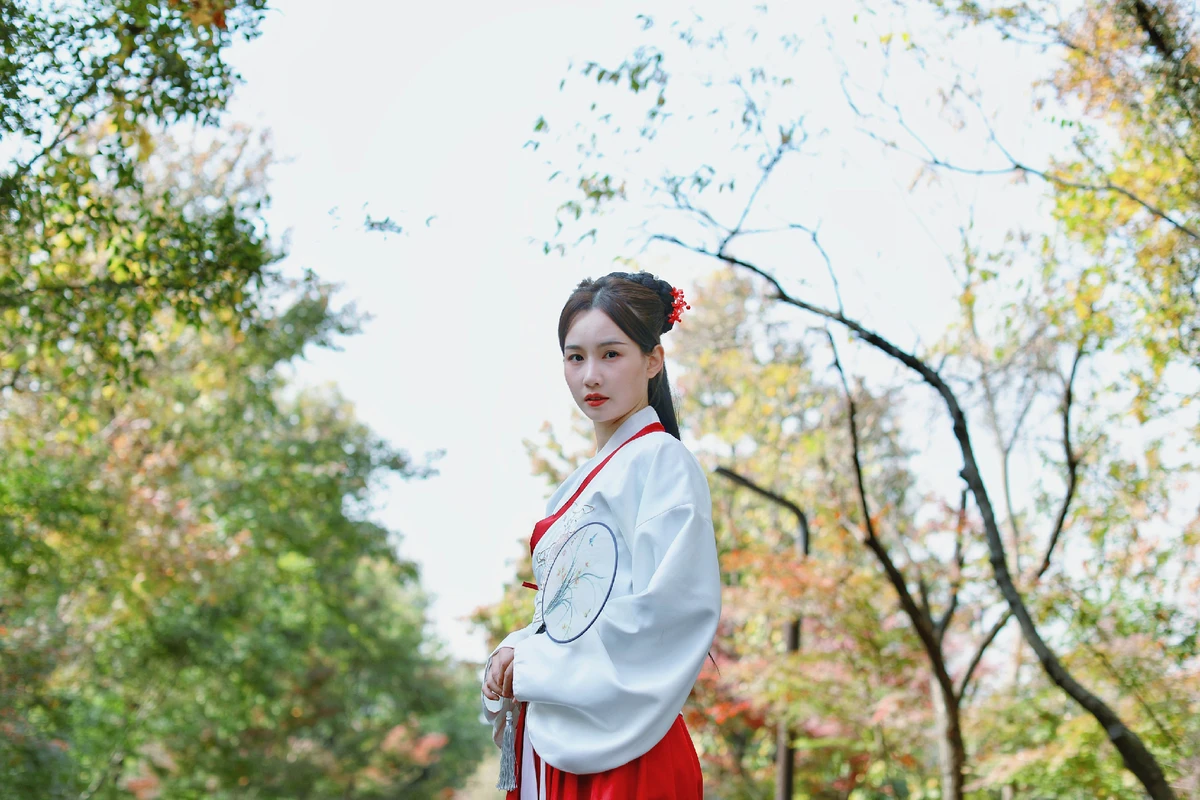
Seize the Tail of Autumn and Wander Through the Colorful World of Qixia Mountain
Meeting you in the quiet beauty of autumn leaves—green like jade, yellow like gold, red like fire—interwoven into a kaleidoscopic picture, letting loveliness settle in the heart.
Autumn is not only the season when osmanthus fragrance drifts, but also the time when maple leaves shine most brilliantly. The Tang dynasty poet Du Mu praised them generously: “I stop my carriage to adore the maple woods at dusk; the frost-covered leaves are redder than the flowers of early spring.”
Appreciating autumn, in a sense, is appreciating maple leaves, and Qixia Mountain excels at this.
The very name “Qixia Mountain” sounds beautiful. It comes from the Qixia Abode built on the mountain during the Southern Dynasty. Initially, however, the mountain was called “Sheshan,” meaning “Nourishing Mountain.” It is said that in ancient times the mountain abounded with wild ginseng, angelica, fleeceflower root, poria, licorice, and other medicinal herbs that had life-nourishing effects—hence the name.
Qixia Mountain has three peaks. The main summit, Sanmao Peak, rises 286 meters above sea level. In height alone, it cannot compare with Zijin Mountain, but it is endowed with graceful scenery and dotted with historic sites, celebrated as “Jinling’s most beautiful mountain.” Especially in late autumn, the maple groves blaze like fire and the entire mountain turns crimson, as if sunset clouds have settled upon it. The spectacular sight attracts countless visitors, making it one of China’s four great destinations for viewing red leaves.
For Nanjing, Qixia Mountain is a very special mountain. In the Ming dynasty it was listed among the “Forty-Eight Scenes of Jinling” as “Splendid Realm of Qixia,” and in 2012 it was again listed among the “New Forty-Eight Scenes of Jinling” as “Crimson Maple of Qixia.” With over 80 historical relics and sites, it brings together religious culture, imperial culture, green culture, folk culture, geological culture, stone-carving culture, and tea culture. It enjoys the high praise that “One Qixia Mountain holds half the history of Jinling.”
Precisely because Qixia Mountain is so renowned, in history five kings and fourteen emperors ascended it. The most famous among them was the Qianlong Emperor, who on his six southern tours stayed five times at Qixia Mountain and composed a total of 119 poems there.
In 1634, the Ming dynasty painting master Zhang Hong took Qixia Mountain as his subject and created a painting titled “Qixia Mountain,” vividly capturing the mountain’s appearance in the Ming era. It is the only surviving Ming painting of Qixia Mountain.
Even before entering the scenic area, you will see an imposing memorial gate made of marble. It stands 11.4 meters high and 12.45 meters wide, with a single eave, four columns, and three bays. The plaque bears four large gilded characters “Qixia Chan Temple,” inscribed by Zhao Puchu, president of the Buddhist Association of China. On the two central pillars is carved a couplet by Venerable Mingshan: “At the famous Qixia sanctuary Master Lang expounded the Sanlun doctrine; at this Six Dynasties wonder we revere the founders’ mind-seal in the two monasteries.”
After entering the scenic area, you will discover two especially delightful spots.
The first is the wind chimes, a distinctive feature of Qixia Mountain. They serve as a “wishing wall,” hung with beautiful hopes. Whenever an autumn breeze passes, the wind chimes tinkle out a melody that is exceptionally pleasant to hear.
The second is the antique-style covered corridor, adorned with lanterns and calligraphy, brimming with classical charm—perfect for taking photos in traditional style.
Because the scenic area is very large and the sights are countless, routes can be roughly divided into cultural heritage paths and natural scenery paths.
Qixia Temple, the Sarira Pagoda, and the Thousand Buddha Cliff are undoubtedly the representatives of cultural heritage.
In fact, Qixia Mountain was not very famous at first. It was not until the second year of the Yongming era of the Southern Qi Dynasty, when the lay Buddhist Ming Sengshao retired to Qixia Mountain and donated his residence, the “Qixia Abode,” to Chan Master Fadu. Master Fadu converted the residence into a temple and named it “Qixia Temple,” which became the ancestral temple of Buddhism’s Sanlun School. From then on, Qixia Mountain’s fortunes soared.
Enlarged over successive dynasties, Qixia Temple grew vast in scale and magnificent in halls. It became known as one of the four great Buddhist monasteries, together with Lingyan Temple in Shandong, Yuquan Temple in Hubei, and Guoqing Temple in Zhejiang.
Regrettably, at the end of the Qing dynasty, Qixia Temple was destroyed by war. It was not rebuilt until 1919. Covering over 40 mu (about 6.6 acres), its main structures include the mountain gate, Maitreya Hall, Vairocana Hall, Dharma Hall, Chanting Hall, Sutra Library, Jianzhen Memorial Hall, and the stone Sarira Pagoda. It is the largest temple in the Nanjing area.
It is worth noting that Qixia Temple’s mountain gate is a traditional-style red gate that gives a sense of the Forbidden City, attracting many visitors to stop and take photographs.
Time may have passed, but Qixia Temple remains a pure land in people’s hearts, with incense burning ceaselessly throughout the year. During the Spring Festival holiday, crowds rush here to ring the bell and pray for blessings.
Of course, Qixia Mountain’s fame across the Jiangnan region comes not only from Qixia Temple but also from the Sarira Pagoda and the Thousand Buddha Cliff.
The Sarira Pagoda stands east of Qixia Temple. First built in the first year of the Yongming era of the Southern Qi Dynasty, the stone pagoda seen today was reconstructed during the Southern Tang dynasty of the Five Dynasties period.
The pagoda is made of white limestone, compactly structured and elegantly carved. From bottom to top it consists of a base, a body, and a spire, reaching a total height of 18 meters. It is the largest sarira pagoda in China.
The Thousand Buddha Cliff lies on the cliff northeast of Qixia Temple. It was gradually carved from the second year of the Yongming era of the Southern Qi to the tenth year of the Tianjian era of the Liang dynasty. Further carvings were added at Shamao Peak during the Tang, Song, Yuan, and Ming dynasties. In total there are 700 Buddha statues—some standing several zhang tall, others barely a foot high.
Research shows that although the stone cave statues of Thousand Buddha Cliff were created 31 years later than the Yungang Grottoes in Datong, they were carved 17 years earlier than the Longmen Grottoes in Luoyang, earning it the title “Jiangnan’s Yungang.”
In addition to its profound cultural heritage, Qixia Mountain also boasts stunning natural scenery.
Mingjing Lake is the number one sight on Qixia Mountain. Covering about 3,000 square meters, it is the collecting place for Peach Blossom Stream. Its clear emerald water, glinting and rippling, represents the water beauty of Qixia Mountain.
The lake brims with Jiangnan style. A pavilion stands in the middle, connected to the shore by a zigzag bridge. In the center there is also a stone Guanyin statue, which seems to be looking down at the water lilies floating on the surface—a particularly eye-catching scene.
Reaching the summit, you gain a “God’s-eye view.” The cityscape of Nanjing, the endless Yangtze River, and the Qixia Mountain Bridge all unfold before your eyes, giving a refreshing sense of peace.
A “Sky Street” has been specially built on the mountain for visitors to rest. On a scale far smaller than Guling Street on Mount Lu, the red-brick, grey-walled buildings nonetheless carry a distinct Republican-era flavor and are just as perfect for photos.
And the crimson maple represents the mountain colors of Qixia Mountain. Both the Maple Ridge and the Red Leaf Valley are ideal spots for enjoying them.
Qixia Mountain can be called a kingdom of maple trees. There are more than ten varieties of red-leaf trees, including fragrant maple, red maple, Japanese maple, trident maple, ash-leaf maple, zelkova, and Chinese pistache. Over 500 maple trees are more than a century old, and there are over 500,000 trees of all kinds with colorful foliage.
As the saying goes, one leaf tells autumn. When the maple leaves change color, it means autumn has truly arrived.
When we came, the maple leaves had not fully turned the mountain entirely red, yet the scene was still uniquely charming: green like jade, yellow like gold, red like fire—intertwining into a beautifully layered beauty.
With such lovely scenery, all you need is the right angle and a good pose to capture a satisfying photo. If you come dressed in hanfu, it adds even more splendor, enough to leave an unforgettable memory.
The beginning of winter has arrived, and autumn has added its most splendid final note. The colors flow freely, rendering the forest into an oil painting. The wind threading between the trees carries the same fragrance as when it came.
Admission: Regular ticket: 25 RMB; Red Maple Festival: 40 RMB.
Opening hours: 07:00–17:30.
Transportation:
1. Take bus 206 from Nanjing Railway Station.
2. Take Nanjing Metro Line 2 to Xuezhelu Station, then transfer to bus 138.
3. Take bus 140 from Gulou Beijige to Yaohuamen Station, then transfer to bus 197.


