Nanjing | Experience the Autumn-Only Colors! Follow the Annual Pass to Explore Nanjing – Discover Hidden Gems in Zhongshan & Confucius Temple!
Since buying a Nanjing tourist annual pass, I’ve mustered the courage to visit many places I’d wanted to see but dared not, like Yuejiangge and Mochou Lake, as well as Da Bao'en Temple with its super expensive tickets. Last time, I only managed to use it for attractions worth less than 200 yuan, so this time I planned a trip to really make the most of it.
This time, I skipped Nanjing’s artsy bookstores and headed for a few Instagram-worthy spots: the north gate of Ninghai Middle School, which offers a magical view of Zifeng Tower, and Huanya Katherine Square, filled with quirky installations. Both are classic photo-op spots—only one or two scenes really shine, while the rest are just backdrop.
Entering Zhongshan, Seeking Unforgettable Autumn Splendor
Purple Mountain Observatory
The Purple Mountain Observatory, built during the Republican era, houses ancient timekeeping instruments and celestial observation devices, as well as more modern star-gazing telescopes. Though no longer used for astronomical observations, it now serves as a science museum. Interestingly, it’s open even on Mondays—maybe because it charges admission.
In the meteorite museum inside the observatory, exhibits can even be priced for sale! There are all kinds of related merchandise… Such museums are quite rare. The road up Purple Mountain is steep and narrow, making the ascent a bit challenging. Many visitors hire cars to get here, and the drivers often double as unofficial guides. The ticket is not expensive—only 15 yuan—and it’s part of the Zhongshan Scenic Area.
White Horse Park at the foot of Purple Mountain focuses on stone carving relics, featuring folk stone engravings from the Song, Ming, and Qing dynasties—even some from the Ming dynasty’s ‘cold palace’! These stones, once deeply meaningful to their owners, are now scattered throughout the park, giving an incredibly authentic feeling, as if they’ve been there since ancient times. Despite looking somewhat neglected, the park still charges admission—10 yuan per person.
Meiling Palace, located near Ming Xiaoling Mausoleum and Sun Yat-sen Mausoleum, was once the official residence of the Nationalist Government Chairman and a place where Chiang Kai-shek and Soong Mei-ling stayed, worked, and received guests. Originally built in 1931 at great expense, it was hailed as the ‘Number One Villa in the Far East.’ Surrounded by trees, the villa resembles a brilliant gem set in a necklace, dazzling and eye-catching!
The interior is meticulously laid out, with most arrangements designed according to Madame Soong Mei-ling’s personal tastes and habits. The three Soong sisters were all talented, and Madame Mei-ling especially loved painting. Inside Meiling Palace, you’ll find many of her artworks and her private studio.
While not overly opulent, the choice of materials shows the level of care put into the décor. The reception rooms are tastefully done, with a predominantly Western style. Surprisingly, next to the couple’s bedroom is a sizable chapel, which shows their devout faith.
In the exhibition room plastered with photos and stories of the Chiang and Soong families, you can learn about many historical tales from the Republican era, along with some gossip about the couple. Their union of a handsome man and a beautiful woman was the envy of many!
Ming Xiaoling Mausoleum – Stone Elephant Spirit Way
Nanjing’s autumn is absolutely breathtaking! I visited in spring for the flowers before and wasn’t that impressed, but coming back in autumn, seeing the brilliant colors everywhere, I finally understood why poets and scholars have raved about Nanjing.
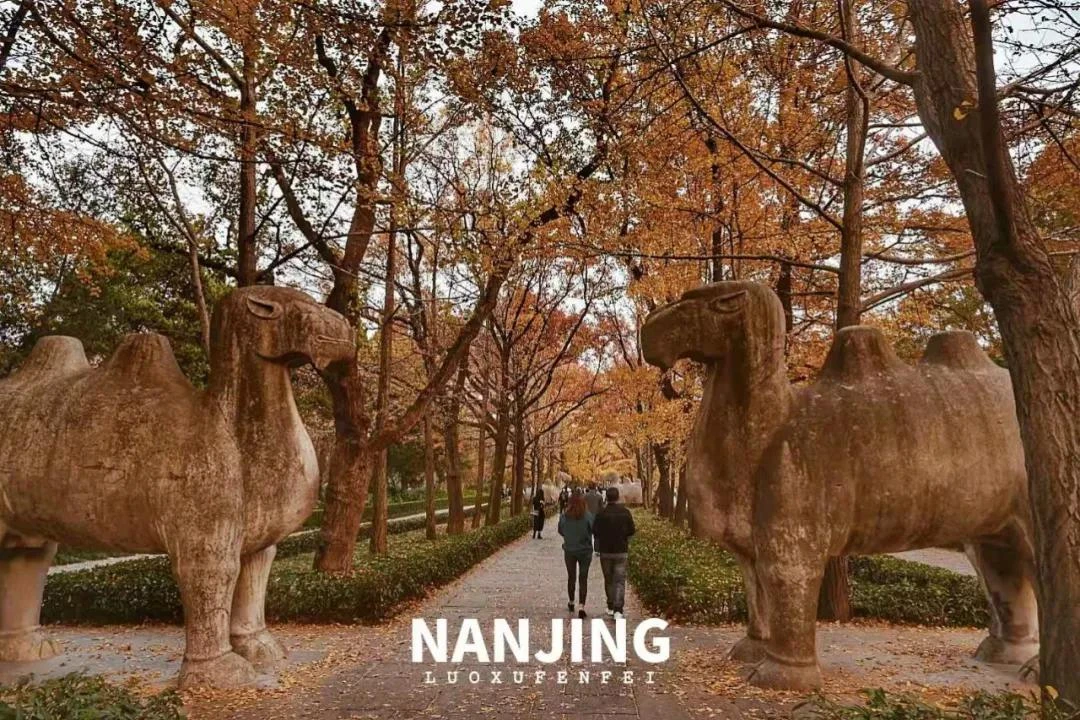
Ming Xiaoling is a must-visit for autumn appreciation in Nanjing. Entering from Gate 3, you’re greeted by a delightful scene: rows of trees in blends of red, yellow, and green reflecting in the water, creating a dynamic beauty within a seemingly still picture. It looks just like a postcard I remember from childhood.
The famous Spirit Way boasts a perfect gradient of colors. Stretching over 600 meters of beauty, it embodies over 600 years of history. The stone animal statues lining the path have guarded the tomb of the Ming Dynasty founder for centuries. Honestly, I’ve forgotten the mausoleum itself from my first visit; every subsequent trip to Ming Xiaoling has been all about revisiting this enchanting Spirit Way.
Recommended Accommodation Near Zhongshan Scenic Area:
Novotel Nanjing Central Suning
Every trip to Nanjing brings a pleasant surprise. This time I stayed at the Novotel Nanjing Central Suning. Although it’s an Accor business hotel, the design clearly pays attention to detail and character. It incorporates local basalt elements to create a contrast of warm and cool tones. The clean, crisp style feels sharp and perfectly suits the business travel vibe.
The hotel is right next to the Suning headquarters, with a direct shuttle bus from Lukou Airport right to the doorstep. It’s less than a five-minute walk to the metro station—extremely convenient!
The rooms are cozy and spacious, with everything you need. My room had a large balcony where I could sit in an armchair and gaze at Purple Mountain in the distance—so relaxing!
The Past and Present of Confucius Temple: Witness to Countless Joys and Sorrows
Nanjing, an ancient historical and cultural capital, has numerous museums and former residences, especially around the Confucius Temple area. The annual pass covers several of them, each with admission at least 10 or 20 yuan, though the quality of exhibits varies. Personally, I think the larger sites are worth visiting, but you can skip those roadside ‘former residences’ – their displays often make little sense, and they double as Hanfu rental and experience shops for extra income.
Recommended Spot 1: Ganxi Residence
A real aristocratic family simply must have a mansion with ‘ninety-nine and a half rooms.’ There aren’t many well-preserved gardens like this left in downtown Nanjing. The Gan family was a prominent clan in the Jiangnan region, and the vast compound has only a single main gate for all family members. Its layout and design are highly valuable for architectural study.
It has now been turned into the Nanjing Folk Museum, showcasing many Nanjing-specific intangible cultural heritage items: gold foil, cloud brocade, and velvet flower making; traditional storytelling performances that you can listen to for free; and exhibitions on customs like weddings, funerals, childbirth, and village festivals. It’s a great place to broaden your knowledge!
Recommended Spot 2: Zhan Garden
Since you’ve come to Jinling (an ancient name for Nanjing), how can you miss the Number One Garden? This was once the mansion of King Zhongshan of the Ming Dynasty and later the office of the Provincial Administration Commissioner of Jiangning. Being a king or an official in the prosperous and bountiful Jiangnan region was certainly a cushy job.
Hong Xiuquan of the Taiping Heavenly Kingdom also set his eyes on this place and made Nanjing his capital. This era, ‘where kings were everywhere, brief yet brilliant,’ laid the groundwork for the Self-Strengthening Movement and provided lessons of failure for later revolutionaries.
Although I personally think the scenery of the ‘Number One Garden’ isn’t better than that of the Presidential Palace, it’s these captivating legends that give this Jiangnan garden—imbued with an air of ‘nobility’—a deeper significance.
Recommended Spot 3: Museum of the Six Dynasties
People say Nanjing is the capital of six dynasties, but which six? They are: Wu, Jin, Song, Qi, Liang, and Chen—not counting the Southern Tang, Ming, and the brief Taiping Heavenly Kingdom and Republic of China that followed. Those six dynasties alone left Nanjing with countless treasures: not only in tomb artifacts but also in cultural and artistic achievements, as well as religious influences. It’s clear that Nanjing is a blessed land.
The museum is located on part of the ancient Jiankang city of the Six Dynasties. It is China’s most comprehensive museum for Six Dynasties relics and the most systematic thematic museum reflecting Six Dynasties culture. I really love its exhibition design, especially on the top floor, which uses a maze-like layout to narrate the stories of the Six Dynasties.
Honestly, without the annual pass, I would never have entered the following spots. They are mostly reconstructed buildings, quite small, with little to see. If you want to understand the history and culture of Qinhuai, you’re better off spending money on a day or night cruise along the Qinhuai River—you can enjoy the views from a boat while hearing tales of talented scholars and beautiful ladies.
Li Xiangjun, one of the ‘Eight Beauties of Qinhuai,’ was a famous courtesan from the early Qing Dynasty play ‘The Peach Blossom Fan’ by Kong Shangren. This is probably the most popular ‘former residence’ in the Confucius Temple area. The name ‘Meixiang Lou’ (Charming Fragrance Building) certainly stirs the imagination, and many tourists buy a ticket on the spot just to see the boudoir of a Qinhuai beauty.
Wang Dao and Xie An Memorial Hall
The memorial hall displays scenes from the political lives of the families of two prominent Eastern Jin ministers, Wang Dao and Xie An. This site was once the barracks of the imperial guard in the city of Jianye, capital of Eastern Wu. Because the soldiers wore black uniforms, the lane was named ‘Wuyi’ (Black Clothes) Lane. The Tang Dynasty poet Liu Yuxi wrote about these two powerful families in his poem ‘Wuyi Lane,’ with the lines: ‘Swallows that once nested in the halls of Wang and Xie, now fly into the homes of common folk,’ lamenting the vicissitudes of life.
This small attraction can be toured in no time. I picked up an interesting fact here: in ancient times, if someone passed the highest imperial examination (zhuangyuan), the lane near their home would be named after them. Qin Dashi not only won this honor but later became a tutor to princes—truly a man of great talent.
Even frequent visitors to Nanjing may never have been to these places. While not particularly famous, these sites and former residences preserve pieces of Nanjing’s urban memory. In particular, the ‘99 and a half rooms’ mansion design showed me the might and grandeur of a high-ranking family. Visiting these ‘museums’ one after another, I found that reading ten thousand books truly isn’t as good as traveling ten thousand li.


