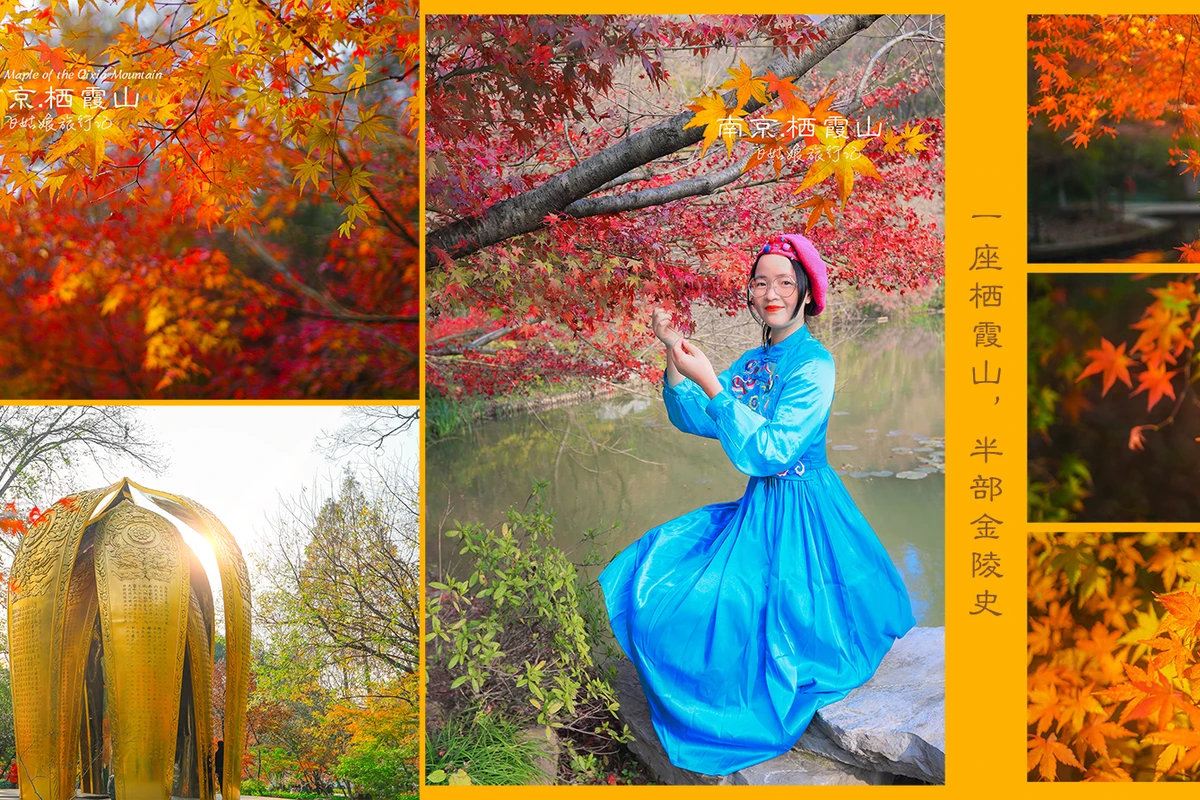
Nanjing's Most Beautiful Maple Spot: Qixia Mountain's Red Leaves Are a Fairy Tale—Miss It and You'll Wait a Year
In early December 2020,
Qixia Mountain in Nanjing, hailed as one of the "Four Great Maple Viewing Destinations in China,"
has entered its prime maple-viewing season.
These days, Qixia Mountain's vibrant maple forests are absolutely stunning:
Emerald green, pale yellow, golden, crimson, and delicate gradients...
Everywhere you look, it's a dazzling painting!
This is Qixia Mountain at its most enchanting. Miss this month, and you'll have to wait a whole year.
So, are you ready to soak up the autumn splendor on Qixia Mountain this year?
Right now, the colors in the maple woods are incredibly rich, with layered gradients that feel like five-color peonies embroidered on green brocade—an exquisite embellishment that makes you feel as if you've stepped into a fairyland.
This is my first visit to Nanjing's Qixia Mountain,
and I'm fortunate to see Qixia Temple at its most colorful.
The green mountain forests are dotted with fiery red, the woods gradually dyed in autumn hues.
Ah! Have I wandered into a beautiful dreamscape?
Qixia Mountain lies in Nanjing's Qixia District.
It is a national AAAA-level scenic spot and one of China's four great maple-viewing destinations.
Historically known as She Mountain, it was praised as "Jinling's most luminous and elegant mountain."
Legend has it that in ancient times, the mountain abounded with wild ginseng, angelica, fleeceflower root, poria, licorice, and other medicinal herbs that nourish and preserve health (which is yangsheng in Chinese), hence the name "She Mountain" (a name implying nurturing).
Qixia Mountain was little known originally. Starting from the Southern Dynasties, it gained fame because of a temple and became a Buddhist holy site. During the Southern Qi, Ming Sengshao, a native of Pingyuan, donated his residence "Qixia Abode" to Master Fadu, who converted it into a temple and named it "Qixia Temple," and She Mountain was thus renamed "Qixia Mountain" after the temple.
"One Qixia Mountain, half of Jinling's history"—
Throughout history, five kings and fourteen emperors climbed Qixia Mountain; among them, Emperor Qianlong of the Qing Dynasty visited six times and stayed here on five occasions.
Qixia Mountain has always been known as a "scenic legacy of the Six Dynasties," and in the Ming Dynasty it was listed as one of the "Forty-Eight Sights of Jinling." It is said that "one Qixia Mountain holds half of Jinling's history." There are over 80 historical sites and relics, gathering together religious, imperial, ecological, folk, geological, stone-carving, and tea cultures. The ancient temple of Qixia, a millennium-old monastery, the ancestral home of the Three Treatise School of Buddhism, and one of the "Four Great Buddhist Monasteries," sits at the western foot of Qixia Mountain.
Since the Ming Dynasty, there has been a saying: "Spring on Niushou Mountain, autumn on Qixia Mountain." "Qixia's crimson maples" are one of the new Forty Sights of Jinling. The maple ridge on the western side of the mountain, with its vast groves of maple trees, is the main attraction for visitors and one of China's four top maple-viewing destinations. Qixia's red leaves come in many varieties, predominantly Chinese sweetgum, along with red maple, Japanese maple, trident maple, feather maple, zelkova, Chinese pistache, and more. Every late autumn, the entire mountain blazes red, as if sunset clouds have settled—an awe-inspiring spectacle.
Red leaves, a lake, reflections, and me, the maple admirer—together we compose a beautiful picture.
On Qixia Mountain in deep autumn, maple trees all over the mountain are hung with leaves of every shade. Vast stands of Japanese maple, dense sweetgum trees stretching up the slopes, set the mountain on fire—impossible to tear your eyes away.
The maples, tall and low in beautiful disarray, resemble a great blazing flame, dyeing the horizon red.
Surrounded by ancient maples, it is brimming with poetic charm and endless appeal.
In early December, the maples on Qixia Mountain have not yet fully reddened. Along the main walking trail from Rainbow Mirror to Peach Blossom Fan Pavilion, Peach Blossom Lake, and Huashan Pavilion, the Japanese maples are still half red, half green—rich in layered hues. The gradient colors are actually quite lovely.
Rather than the all-red mountain at its peak, I prefer this time of multicolored splendor. Crimson shot through with gold, or emerald green tinged with gold; it feels as though every single maple leaf is a different color.
Red as blazing fire, breathtakingly beautiful.
The best maple-viewing spot on Qixia Mountain is Red Leaf Valley. This valley lies at the junction of the Imperial Garden and the southwestern slope of Phoenix Peak. Untouched for years and shaped by water erosion, the exposed rocks reveal spectacular karst formations, while the rest consists of dense woods and wetlands. The unique microclimate gives this place its jagged boulders, towering ancient maples, and tangled old vines.
The design of Red Leaf Valley carefully integrates landforms, water, plants, and amenities, with an emphasis on restoring the ecological functions of Qixia Mountain. The environment is continually beautified, enhanced, and enriched with color, and water features have been created to improve the local ecosystem. Covering about 50,000 square meters, the valley boasts lovely natural scenery and is characterized by unique rocks and red leaves—a new maple-viewing area that combines mountains, rocks, water, woods, and pavilions.
"I stop my carriage to admire the maple forest in the evening; the frosted leaves are redder than flowers in early spring."
Climb the stone steps up Red Leaf Valley until you reach Maple Forest Lake. Once the entire mountain turns red in a little while, the crimson reflections in the green lake will be utterly beautiful.
Abundant maple allure, brimming with poetry.
This being my first trip to Qixia Mountain, I didn't make any plans or map out a route. I simply wandered wherever a path led, like strolling inside a painting—gorgeous scenery no matter where I went. Mingjing Lake lies west of the main gate of Qixia Temple and covers about 3,000 square meters. It was built during the Qianlong reign of the Qing Dynasty. There is a mid-lake pavilion, linked to the shore by a zigzag bridge, elegantly crafted. The spot is called "Rainbow Mirror," and a stone tablet inscribed with those words stands by the shore. To the east there is a crescent pond, then the main gate of Qixia Temple.
Statues of Guanyin, the rainbow-curved bridge, the late-autumn lakeside—on the shore, the scenery outshines even the reflections in the water.
Lost in a kaleidoscope of enchanting "maple views," like brilliant brocade, overwhelmingly beautiful.
Visitors come in an endless stream.
Once you're on Qixia Mountain, besides admiring the maples, the ancient Qixia Temple is a must-see.
Pray and make a wish at this millennium-old temple, and while you're there, enjoy the giant ginkgo trees in front.
The two ginkgoes before the Mahavira Hall have already shed their leaves, and the two in front of the red wall haven't yet turned full gold, but they are still a wonderful sight.
At the foot of Qixia Mountain stands Qixia Temple, an ancient monastery of the Southern Dynasties and a "Six Dynasties legacy." Golden ginkgoes, gradually reddening dawn redwoods, crimson maple groves… beauty beyond words.
Qixia Temple in Nanjing, together with Lingyan Temple in Changqing, Shandong, Yuquan Temple in Dangyang, Hubei, and Guoqing Temple in Tiantai, Zhejiang, are known as the Four Great Monasteries.
Come to Qixia Temple to ring the bell and pray. The ancient temple with its red walls, the gilded ginkgo trees, these sacred trees of the Buddhist gate extending their grace—standing here amid such beauty, a glance feels like an eternity.
Colorful maple leaves, golden ginkgoes—Qixia Mountain right now is simply too beautiful!
The recent weather has been splendid. With blue skies and sunlight, the maple forests on Qixia Mountain are lovelier than ever. You should hurry over!
At the entrance, a flock of trendy wishing bells hangs, swaying in the breeze—a particularly charming sight.
Write down your blessing and hang it in this blessed place, and your wish is sure to come true!
A little bonus at the end: here is a set of maple-forest photos I took for the pretty young lady traveling with me.
After seeing so many vividly colored maple groves, I edited them in a dreamy, Instagram-like aesthetic.
Do you like this tone?
This golden autumn, I was lucky enough to encounter Jinling's riotous fall colors and enjoy the Chinese sweetgums, maples, and ginkgoes on Qixia Mountain—a graceful dance of hues, each vying to be the most beautiful. My one small regret is that in early December the red leaves on Qixia Mountain had not yet fully blazed over the whole mountain. The very best time is right now, these recent days. If you're reading this, please go and make up for my regret—go see the most beautiful crimson maples on Qixia Mountain this autumn!
Text and photos: Fei Guniang Travelogue nbvlog. Do not reproduce without permission.


