Jinling Travelogue
December 15–17, 2020
'Smoke veils the cold water, moonlight veils the sand; at night we moor near a tavern on the Qinhuai.' Du Mu’s poem 'Mooring on the Qinhuai' has stirred the interest of so many in Jinling and their longing for the Qinhuai. Although Nanjing is not far from our Zhejiang, I had never taken the time to explore it properly. I recall visiting once when I was young, but without photos or records, the memory has faded. This year, with the sudden pandemic keeping us at home, it was the perfect chance to travel nearby. So I drove myself to Nanjing for a brief trip.
Nanjing is one of China’s four great ancient capitals. Its history is deep and filled with stories. From the ancient capital of the Six Dynasties to the founding of the Ming Dynasty, it even served as the Heavenly Capital of the Taiping Heavenly Kingdom. It was a place of tumultuous change, leaving behind countless relics. Above all, Nanjing was the most important center of the Xinhai Revolution that overthrew the Qing Dynasty and unified the nation through the Northern Expedition—a truly era-defining role. Many tragic and romantic tales remain. Today it is a key southeastern city and the capital of Jiangsu Province.
With such a rich historical culture, beautiful scenery, and the regal aura of a crouching tiger and coiled dragon, a three-day self-drive tour barely scratches the surface. I darted from Yuhuatai to Xuanwu Lake to the Yangtze River Bridge, then on to Sun Yat-sen Mausoleum, Ming Xiaoling Mausoleum, and the Presidential Palace, snapping photos and moving on. My focus, however, was on Fuzi Miao (Confucius Temple) and the Qinhuai River.
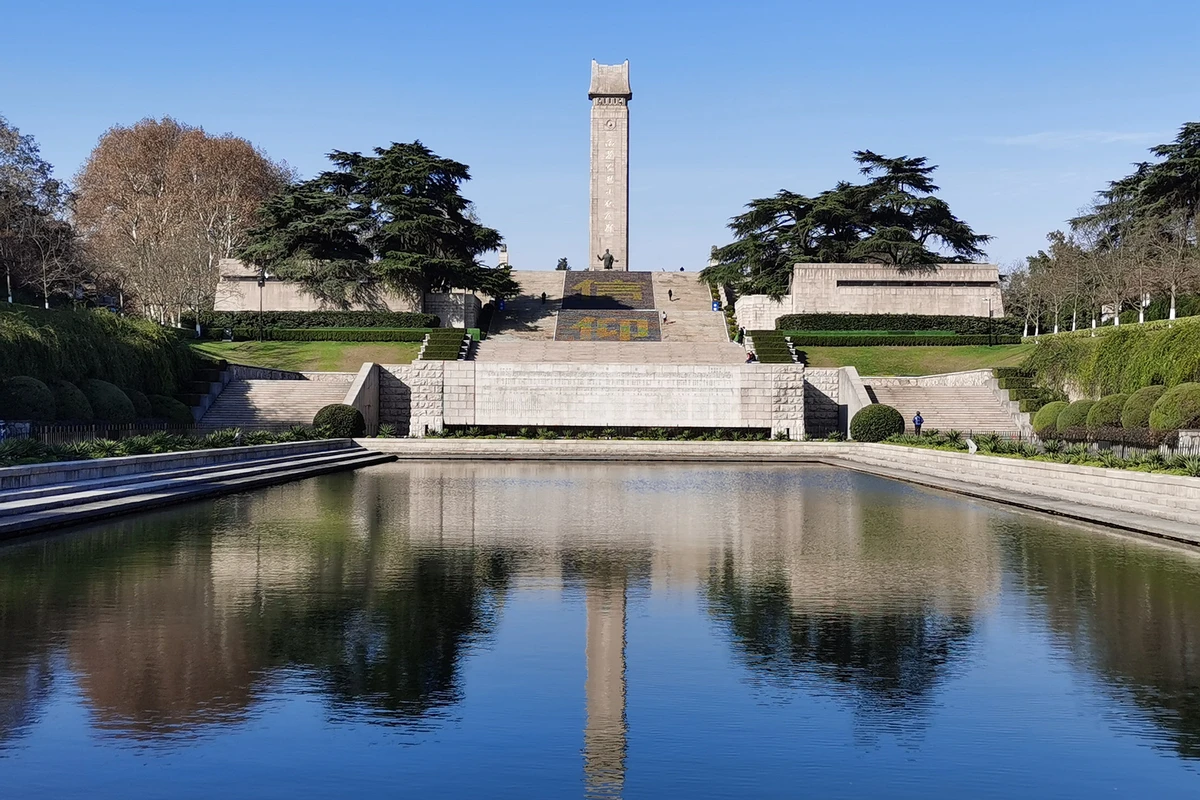
Yuhuatai sits on a hill in the Yuhua district. It’s a place of scenic beauty with many historical sites. Its name comes from a story that a revered monk during the Southern Dynasties so moved the Buddha with his brilliant sermon that flowers rained down from heaven and turned into stones—hence the lovely name. But the colorful, pretty rain-flower pebbles sold here actually don’t come from this spot. The area is shaded by greenery and very picturesque, with sites like the Yuhua Pavilion and the 1,600-year-old Manna Well. Yet its main feature is a grand, solemn martyrs’ cemetery, commemorating the Communists who were killed in the struggle between the Nationalists and Communists. So it serves as an important memorial.
Xuanwu Lake is a large lake inside Nanjing, resting against Zijin Mountain to the east and the Ming city wall to the west. It’s roughly diamond-shaped and covers 5.13 square kilometers, making it the largest city park in the Jiangnan region. Bridges and causeways complement each other; the lake is wide and lined with tall trees casting reflections. It’s a lovely spot for relaxing and enjoying the view. I envied the elderly folk sitting and taking in the scenery; watched couples strolling hand in hand; listened to children playing and laughing; and gazed out at boats skimming the far waters. A wonderful, heartwarming scene.
Dr. Sun Yat-sen is the greatest and most revered figure in modern Chinese history. He led the Xinhai Revolution, rallying people to overthrow the decaying Qing dynasty and establish a republic. He promoted the Three Principles of the People. His mausoleum is located at the southern foot of Zijin Mountain. From the Gate of Universal Love, a straight axis leads through the spirit way, the mausoleum gate, stone steps, the tablet pavilion, the sacrificial hall, and finally the tomb chamber. It is solemn, simple, and majestic. Together with Ming Xiaoling Mausoleum, the Music Platform, the Scripture Library, Liuhui Pavilion, and the Underwater World, they form the vast Zhongshan Scenic Area. On a beautiful day, with spring breezes or autumn colors, the scenery here is truly boundless. Ming Xiaoling, also on Zijin Mountain, is the tomb of the Ming dynasty’s founding emperor Zhu Yuanzhang and his empress Ma. It is the first imperial mausoleum of the Ming and Qing dynasties, rising tier upon tier in magnificent splendor, fully displaying royal grandeur—though now it carries a sense of age and stillness.
The Presidential Palace was once the center of power in China. It served as the office of the Viceroy of Liangjiang during the Qing dynasty, with a history of 600 years. It later became the Heavenly King’s Palace of the Taiping Heavenly Kingdom. Sun Yat-sen was inaugurated here as provisional president, and it remained the seat of the Republic of China government after the Xinhai Revolution. All the offices have a somewhat modern feel, but the waterside pavilions and gardens still retain their traditional charm. This is the most iconic site of modern Chinese history. Naturally, after the Nationalists were overthrown, it remains only a place for later generations to visit and reflect.
It’s rather curious. Although Nanjing is one of China’s four ancient capitals, the dynasties that based themselves here were never very strong and did not enjoy lasting peace and stability. Despite its auspicious terrain of a crouching tiger and coiled dragon, it often makes one sigh. Yet this city was twice the crucial place where foreign rule was overthrown and Han Chinese rule restored. Perhaps due to the constraints of a historic city, I felt that Nanjing’s urban layout is not very grand and lacks a commanding aura. I made a special trip to see the Nanjing Yangtze River Bridge. When it was built, it was hailed as the first bridge over the Yangtze, and during the Cultural Revolution it was trumpeted as a monumental achievement. Now, just look at Hangzhou—it has over ten bridges and tunnels crossing the Qiantang River. Although Nanjing is the provincial capital, in terms of economic influence and urban development, it probably can’t even match Suzhou. It feels a bit like an impoverished noble.
Visiting Nanjing's Presidential Palace:
At the call from Zhongshan, the Qing Empire fell,
From then on, China had no imperial dynasties.
Alas, the fate of kingdoms is predestined,
Nanjing's throne never held firm.
For me, the greatest pleasure of visiting Nanjing was to soak in the charm of the Qinhuai River. Traveling to Jinling is all about feeling the elegance of the Six Dynasties and the prosperity of the Tang. So I booked a hotel right by the Qinhuai, so I could sleep with its waters flowing beneath my window. The Qinhuai runs through the city, but its most scenic stretch is along Fuzi Miao. In front of the temple stands a statue of Confucius. The stately, elegant temple, the academies, and the examination hall where scholars took the imperial exams—this was the nation’s highest seat of learning, educating countless students and producing many pillars of society. It was the most important cultural center and the heart of the civil service examinations. Ancient buildings abound: temples, schools, examination halls. And there are streets, alleyways, bustling markets with all sorts of shops, eateries, and snacks, full of bustle and glamour. Across the river lie Wuyi Lane and Zhuque Street, both famous for their legacy of the Southern Dynasties. I didn’t come here just to soak up atmosphere; I came to experience the mood evoked by those classic poems.
The Qinhuai River at Fuzi Miao is the most eye-catching and splendid. On one side, a square, old streets, and archways; on the other, a huge nine-dragon screen wall and the striking sign ‘Qinhuai Renjia’ (Qinhuai Family). The rich antique flair transports you to the charm of bygone days. The Qinhuai is not very wide and flows gently. The distinctive arched bridges offer the best vantage points, and visitors always stop to take photos and admire the view. In the glow of sunset, see upturned eaves and painted boats drifting slowly. At night, watch red lanterns light up, casting colorful reflections on the shimmering water as boats weave back and forth. With music floating in the air and singing girls, the atmosphere is intoxicating. I finally found a riverside inn where I could lean on the railing, watch the lanterns, and fall asleep to the river’s murmur; I could even play a flute by the water, pretending to be a refined poet. Bask in morning light and evening shadows, keep company with the night’s lanterns. At Fuzi Miao, I not only sampled all the local Jinling snacks but also indulged in a bit of refined elegance. Even though I visited in the cold of winter, it felt like a spring breeze. Truly wonderful!
At Zhongshan, the noble spirit of the Great Man remains,
While the imperial aura of Xiaoling has dimmed.
Though I sought not the Southern Dynasties’ air,
I fell asleep to the Qinhuai’s flow, dreaming on the river.


