An Hour from Nanjing: Gaochun’s Slow City Spring Beauty – 5 Unmissable Spots
**Before the Trip**
March, with spring breezes brushing the face, is the perfect time for misty rain in Jiangnan. This season's spring carries a dreamy filter: the murmur of flowing water, the dance of flowers, even the birds' songs sound so graceful. The ink-wash charm of misty Jiangnan emerges, swaying in the slow spring days.
About an hour from downtown Nanjing, there is a small town known for its slowness—quiet yet lively, peaceful and beautiful. Now, during the grand Golden Flower Festival, come with me to Gaochun to experience the spring of this Cittaslow, to escape the city and embrace nature's idyllic charm.
**Itinerary**
Day 1: Youzi Mountain – Yaxi Slow City
Day 2: Ceramic Museum – Gucheng Lake Slow City – Gaochun Old Street
**Youzi Mountain**
When you think of mountains in Nanjing, which ones come to mind? Qixia Mountain covered in red maple leaves? The splendid Niushou Mountain? Or Zijin Mountain beloved by astronomy fans? Today we're heading to another mountain in Nanjing, only 188 meters high, yet it brings together Confucianism, Buddhism, and Taoism, and houses the largest stone Buddha in East China. Do you know where it is?
Right, it's Youzi Mountain in Gaochun. The mountain got its name because Confucius visited and longed to return home. It has a deep historical and cultural heritage, and is praised as "a mountain with a thousand-year history of sightseeing." The core scenic area covers 3,678.3 hectares, with vegetation coverage as high as 89%, earning it the nickname "Gaochun's Green Lung." The most worthwhile visit is to the three halls symbolizing the three religions.
Zhenru Chan Temple is one of the highlights of Youzi Mountain, a branch of Mount Jiuhua, one of China's four sacred Buddhist mountains. Covering 7 hectares, it is the most representative among the branches.
Entering Zhenru Chan Temple, the first thing you see is not the temple but a stone Buddha. This gilded Amitabha Buddha is 21 meters tall, weighing over a thousand tons, guarded by the Four Heavenly Kings. Known as the "largest stone Buddha in East China," standing close makes you feel small.
Additionally, three main halls are hidden in the mountain. The central Mahavira Hall, the foremost among all branches, enshrines the Three Buddhas of the Three Times, with eighteen arhats on the sides and Nanhai Guanyin at the back. The east and west halls respectively enshrine Ksitigarbha Bodhisattva and the Thousand-Armed, Thousand-Eyed Guanyin, called the Great Vow Hall and the Great Compassion Hall.
The Blessing Garden at Youzi Mountain is also the largest blessing site in East China. The other two halls are inside. From the entrance, take the scenic area's electric car along a winding 3-kilometer mountain road to the highest point of the main peak Dayou Mountain, elevation 188 meters—the highest peak in Gaochun, known as "the finest scenic spot of Laizhu."
Wensheng Hall sits on this peak. The hall's main shrine is Confucius, the great sage of ancient China, and the mountain's name is linked to him. Flanking him are his outstanding disciples, known as the "Four Associates and Twelve Philosophers." Now it's a place where students pray for academic success.
Zhenwu Hall is behind Wensheng Hall, a Taoist retreat. During the Qing dynasty, Taoist followers found the mountain "tranquil, peculiar, elegant, and spiritual," with an air of immortality, so they built the Taoist temple "Xuanwu Temple" on the summit. Later, to avoid the name taboo of Emperor Kangxi, it was renamed "Zhenwu Temple."
The hall covers about 680 square meters, a typical Huizhou-style building. The main deity is Emperor Zhenwu, stepping on the turtle and snake generals, with the twelve zodiac gods on either side.
After seeing the three halls, take a walk on the Yunqi Plank Road, or you'd miss the mountain's "green lung" fame. The plank road is 1.5 kilometers long, built along Dayou Mountain and Xiaoyou Mountain, wrapping around like a silk scarf. When mist rises and you walk on it, you feel like you're resting among clouds—hence the name "Yunqi Plank Road" (Cloud Rest Plank Road).
Along the road, an ecological interpretation system lets visitors get up close with nature, understand it, and enjoy a unique forest experience.
Another important part of Youzi Mountain is the Santiaolong Ecological Leisure Resort, composed of forests, bamboo groves, orchards, tea gardens, and ponds, a vital urban green lung. Seen from above, it looks like three coiling dragons, hence the homophonic name "Santiaolong" (Three Ridges).
The key spot here is Chunqing Tea Garden, covering 4,000 mu, the only state-run tea farm in Gaochun. It became famous not only for its tea but also because it appeared in the TV drama "In the Name of the People," where Secretary Dakang did an inspection, attracting many visitors.
**Tips**
(1) Address: No. 6 Huanshan Road, Youzi Mountain, Dongba Town, Gaochun District, Nanjing, Jiangsu Province.
(2) Transport: Take Gaochun Bus 209 to Youzi Mountain stop, then walk 1,300 meters to reach the scenic area.
(3) Opening hours: 09:00–17:00.
(4) Admission: Free.
**Yaxi Slow City – A Golden Flower Extravaganza**
Nanjing Gaochun Yaxi International Cittaslow is in the northeastern part of Gaochun District, east of Youzi Mountain, very close. This agro-tourism scenic area combines sightseeing, leisure, entertainment, and eco-agriculture, shaped by hilly ecological resources. "Crisscrossing paths, chickens and dogs within earshot"—this is ordinary village life across the six administrative villages of Yaxi Slow City. Sometimes by mountains and water, sometimes through forests and over hills, the route is lush, with birdsong and flower fragrance, offering idyllic rural charm and mountain delights.
"Garden breezes blow, peach leaves green; spring dew weighs on the ridges, rapeseed flowers yellow." Gaochun's spring belongs to golden flowers—the rapeseed we know. Every March, over 200,000 mu of high-quality rapeseed fields burst into bloom, that lingering golden hue painting the entire slow city. Visitors can't help but stop and admire, as butterflies and bees join the floral scene.
The flowering season lasts until late April/early May, enchanting with tea gardens, bamboo groves, and wheat fields. If you have time during the Qingming short holiday, come and embrace the golden flowers.
Beyond the flowers, the treetop water slide is now open. Over 500 meters long with an 18-meter drop, the slide is made of high-transparency glass—very thrilling. And no need to worry about getting wet; they'll provide a fully sealed raincoat, letting you whoosh down through nature's fantastical scenery, a rush of speed and passion.
The Wenfeng Pagoda is the highest point in Yaxi Slow City. First built in the early Ming Dynasty, it was destroyed in war and rebuilt on the original site in October 2012. The octagonal seven-story pavilion-style pagoda is in a Tang-dynasty style, with eaves sweeping up, dragons and beasts, wind-bells at each corner. The pagoda complements the slow city's most beautiful skyline, tall and graceful.
If you catch a sunset or sunrise, climb the stairs, lean on the railing, and take in the panoramic view—absolutely stunning.
**Tips**
(1) Address: No. 6 Shengtai Road, Yaxi Town, Gaochun District, Nanjing, Jiangsu Province.
(2) Opening hours: 09:00–17:00. (Dashan Village has farmhouse accommodations.)
(3) Admission: Free; small attractions inside charge extra.
**Ceramic Museum**
When you mention ceramics, many think of Jingdezhen, but Gaochun also produces ceramics. The exquisite craftsmanship has earned high praise, even appearing at many state banquets. Fine workmanship and luxurious materials make Gaochun ceramics a model.
This Ceramic Museum records the entire process of Gaochun ceramics from scratch. It's more like an art museum than a traditional museum. The spiral staircase and layout are perfect for photos; ladies can strike any pose and look great.
Don't miss the second-floor exhibition hall. It showcases the pinnacle of Gaochun ceramics—custom-made tableware for various high-end meetings, with a single set priced over 30,000 yuan, beyond luxurious.
Here, besides admiring various ceramics, you can also try making your own. In the factory behind, you can experience every step of ceramic production and make a unique piece to take home.
**Tips**
(1) Address: No. 8 Jingshan Road, Economic Development Zone, Gaochun District, Nanjing, Jiangsu Province.
(2) Opening hours: 09:00–17:00.
(3) Admission: 40 yuan.
**Gucheng Lake Slow City – Lost in Tulips**
Gucheng Lake, in southern Gaochun, also called Xiaonan Lake, was historically part of ancient Danyang Lake along with Shijiu Lake. Here is Gucheng Lake Slow City, where March is tulip season, and the gardens are full of tulips waiting for us.
Gucheng Lake Slow City is a resort destination integrating science education, eco-sightseeing, water entertainment, water sports, and leisure. There are many attractions; to fully experience them, you'd need a whole day.
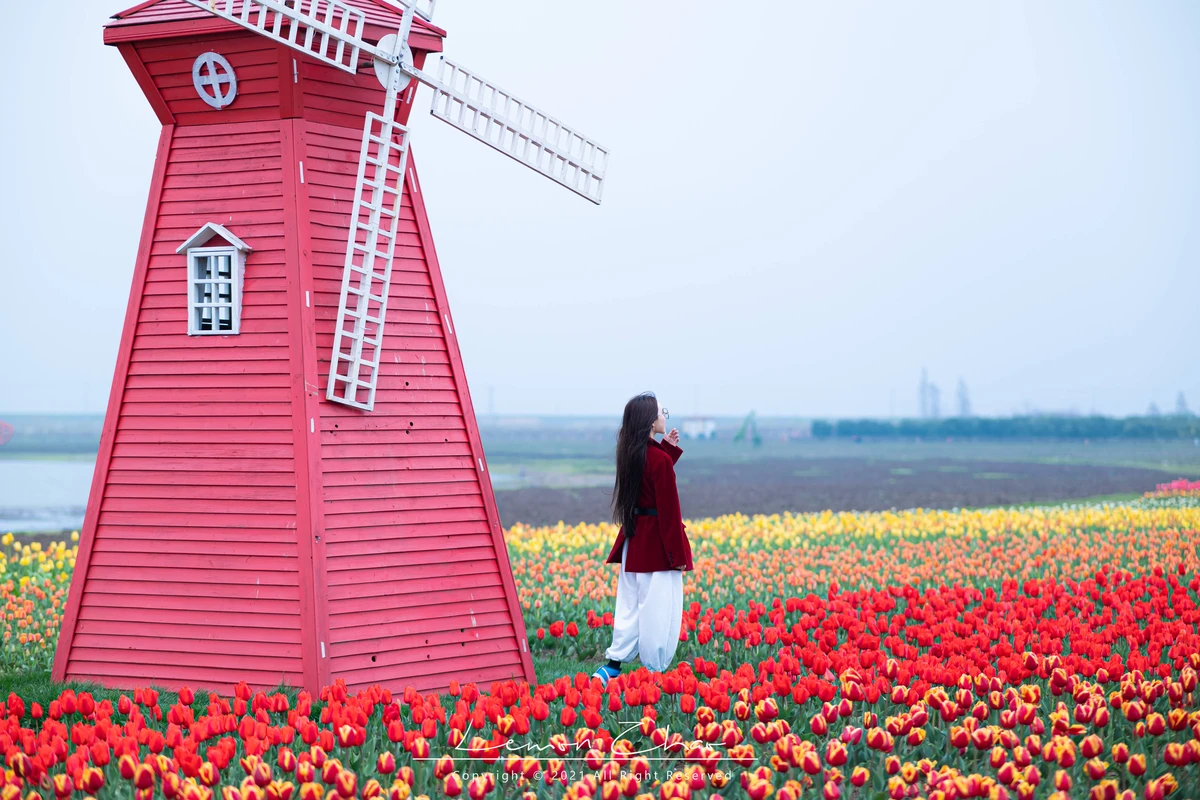
Taking the scenic electric car, we arrived at the tulip fields. Everyone was amazed by the profusion of blooming tulips, with pink windmills—like stepping into a fairy tale, instantly transported from a bustling metropolis to the Dutch countryside.
Unfortunately, the weather was overcast, but it had a different kind of beauty. When I went to see tulips in Holland, it was similar weather, so there was a wonderful déjà vu, making me feel for a moment I was back in Holland, kissing the tulips.
The tulips come in a wide range of colors, planted in orderly patches by color, a delightful sight. Photography lovers shouldn't miss this; who can resist an invitation from beautiful flowers?
Another must-see at the Slow City is the zoo, a Gaochun branch of the internet-famous Hongshan Zoo. The star flamingos with their brilliant feathers captivate everyone; no visitor can resist their stunning beauty.
My favorite is the parrot house. It recreates a micro tropical rainforest, where parrots fly freely. The common macaws are the most seen, and if you're lucky, a parrot might fly onto you, interact, and dance along—so cute.
The large swan pond houses many bird species. Spring brings many newborns, and the "ugly duckling" from fairy tales appears right before your eyes—their adorable, clumsy looks melt your heart.
**Tips**
(1) Address: No. 9 Yinghu Road, Gaochun District, Nanjing, Jiangsu Province (Gucheng Lake Slow City).
(2) How to get there: Take Gaochun Tour Bus 2 to Gucheng Lake Slow City (International Fishing Center) stop, walk 310 meters.
(3) Opening hours: 09:00–17:00.
(4) Admission: 80 yuan.
(5) Other: Electric car 10 yuan per person.
**Gaochun Old Street – The First Ancient Street of Jinling**
If you're tired of Fuzimiao and Laomendong in Nanjing, come take a walk on Gaochun Old Street with me. Gaochun Old Street is a brilliant pearl among Chinese ancient streets, one of the well-preserved Ming-Qing streets in Jiangsu, and an important part of local life.
Located west of the vast Gucheng Lake and south of the meandering Guanxi River, the street has many aliases: Zhengyi Street, Zhongshan Street, Heping Street, but popularly called "Yizi Jie" (One-character Street). Running east-west, it originally stretched nearly 1,000 meters; now 505 meters are well-preserved.
The old street retains Ming-Qing shops and residences, steeped in an antique cultural atmosphere. Notable spots include the Qianlong Ancient Well, Guanwang Temple, Yang Hall, Christian Church, Panchi Park, a classical Gucheng Lake tour boat, Gaochun Folk Museum, Folk Performance Hall, and the former sites of the New Fourth Army headquarters and office.
Walking into the street, shops and houses line up closely; the pavement is paved with volcanic ma-shi stone, exuding a rustic, secluded charm of "deep alleys hiding homes," and a unique antique flavor of "double-fronted shops elbow to elbow, deep alleys a sliver of sky." The mottled brick walls, long lanes, creaking wooden doors, and occasional passersby—time seems to have stopped here. What you see and hear is a living, fragrant Gaochun Old Street "Along the River During the Qingming Festival"!
There are 314 shops, all two-story brick-wood structures with double fronts, featuring upturned eaves, dougong brackets, crenelations, walls, beams, and lattice windows—elegant and unique, mostly built in Ming and Qing dynasties, combining Huizhou style with distinct local traditions.
Make sure to visit Guanwang Temple; wearing Hanfu here makes for wonderful photos.
The street is packed with delicacies: hairy crabs, rice wine, crab roe soup dumplings, steamed cakes, qingtuan, and more—each a specialty. You can eat your way from one end to the other without repeating.
**Tips**
(1) Address: Gaochun Old Street, Gaochun District, Nanjing, Jiangsu Province.
(2) Transport: Take Nanjing Gaochun Bus 105 Ring 2 to Jiangongju stop, walk 320 meters to Gaochun Old Street.
(3) Opening hours: All day.
(4) Admission: Free.
**Accommodation**
Gaochun offers many hotels and B&Bs, with great environments and not too pricey. I stayed at Nanjing Guchengwan Kaiyuan Resort Hotel, a hidden paradise just opened. Its understated, elegant wooden exterior is simple yet stylish, noble and tasteful. Facilities include an outdoor pool, gym, restaurant, etc. Access to guest areas is separated by keycard, ensuring privacy and quiet.
Our room had a balcony overlooking a man-made lake—an instant delight. The interior follows a minimalist wood style, simple yet exuding a sophisticated charm that left me very satisfied.
Toiletries are from my favorite brand, Re, and soft bathrobes (plus a child-sized one) are thoughtfully provided. The spacious circular bathtub sits at the best view spot, so you can bathe while admiring the scenery.
The welcome pastries and fruit were delicious, and breakfast was delivered to the room exactly at the requested time. Eating on the balcony, enjoying the view, was pure bliss.
Have you decided where to go for the upcoming Qingming or May Day holidays? Why not join me in Gaochun for a spring date?


