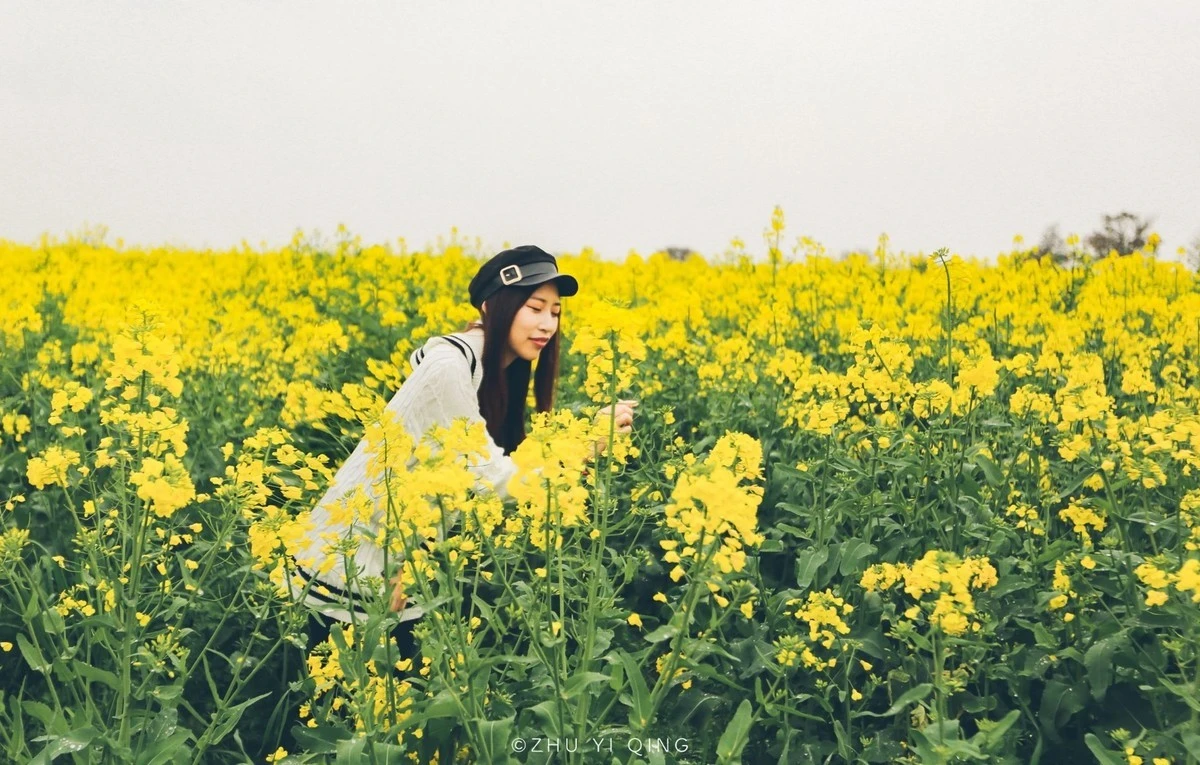
Encounter Golden Blooms on a Vibrant Gaochun Journey
Heading into Gaochun, Nanjing
Nanjing, a place I know all too well. In previous years, I would come to Nanjing around March or April, at the start of spring, to see the cherry blossoms. Though I’ve been to Nanjing several times, I never knew it still hides a remarkably off-the-beaten-path and fun district. This time, I set my sights on Gaochun, Nanjing, to search for its unique food flavors and unlock a different way to enjoy Nanjing. It turns out that beyond being an ancient capital of six dynasties and its cherry blossoms, the city holds many extraordinary sights. Stepping into Gaochun this spring when the golden flowers are in full bloom, I begin by discovering its beauty.
In the slow living town of Gaochun, one not-to-be-missed spot is Youzi Mountain, a sacred site of three teachings. Legend has it that when Confucius traveled throughout the states, he once lectured on this mountain, hence the name Youzi Mountain (Wandering Son Mountain). The most striking sight on Youzi Mountain is the largest stone Buddha in East China, standing 21 meters tall and weighing a thousand tons, assembled from 135 pieces and named Amitabha. Because the statue is entirely gilded, some also call it the First Golden Buddha.
Diagonally opposite this giant Buddha stands the Jade Buddha Hall, housing three nationally rare jade Buddhas, funded by a lay Buddhist from Tianjin and invited from Myanmar. The hall is majestic, with eighty-one steps flanked by pure white marble balustrades. As part of the Buddhist tradition among the three teachings, it exudes the profound serenity of a Buddhist sanctuary, offering a peaceful and tranquil atmosphere.
Youzi Mountain integrates Confucianism, Buddhism, and Taoism, with undulating slopes and waterscapes interwoven. The exquisite natural scenery and the unique cultural depth of the three teachings give the area a sense of Zen tranquility. On the southern foothills of Youzi Mountain lies the grand Zhenru Chan Temple, originally advocated by eminent monks from Mount Jiuhua. Today, Zhenru Chan Temple serves as the lower branch of Zhantanlin Monastery on Mount Jiuhua, one of the three sacred Buddhist mountains.
From the open-air Buddha, a path leads directly up the mountain to the Mahavira Hall. Like the route to the Jade Buddha Hall, it is lined with white marble balustrades, and it has a total of 129 steps. Every 27 steps there is a large platform. The center of the first platform features a stone-carved Nine-Dragon Screen, and the second has a stone-carved Nine-Phoenix Screen, with dragon and phoenix intermingling. On either side of each platform stands a stone-carved qilin.
In this sanctuary of three teachings, whether Confucian buildings, Buddhist temples, or Taoist shrines, all display exquisite decorations – painted beams and carved rafters, graceful flying eaves, and delicate murals and carvings, all well worth savouring slowly.
Originally, Youzi Mountain housed only Confucian and Buddhist sites. During the Qing Dynasty, Taoist followers, drawn by its tranquility, uniqueness, and beauty, with fertile fields at the foot and lush pines and bamboos on the mountain, built a Taoist temple, the Xuanwu Temple, on the summit. This gave rise to the present scene where all three teachings coexist on one mountain. They coexist harmoniously, allowing people of different faiths to gather here.
A pathway that feels like a bamboo forest’s hidden realm has naturally made this place an Instagram-worthy photo spot, evoking the atmosphere of the film “House of Flying Daggers.” When a breeze blows, the bamboo leaves rustle softly, creating a serene and peaceful ambience.
In San Tiao Long Village, Dongba Street, Gaochun, Nanjing, spreads a boundless tea plantation: the San Tiao Long Tea Garden. Thanks to rich natural resources and unique geographical conditions, the tea produced here has a distinctive taste. Scenic spots such as the vast tea fields, Xiaomao Mountain, Qingshan Reservoir, organic rice paddies, ecological wetlands, and early bamboo groves form the rural landscape of San Tiao Long Tea Garden. Among these, the Qingshan ten-thousand-mu tea plantation has been rated China’s Most Beautiful Tea Garden, and San Tiao Long Village has truly become a slow-paced garden village.
The tea fields offer not only splendid scenery but also deep cultural heritage, with sites such as ancient mound tombs, Quanshui Nunnery, and Jiuxing Pond, all embodying distinctive pastoral features. Here you will find the Qing Tea Space, a tea culture exhibition hall and teahouse specially built by the Youzi Mountain Leisure Tourism Zone around the themes of growing, picking, processing, and tasting tea. You can experience a whole range of tea-related activities, from planting and picking to making and tasting tea, and soak up the rustic charm of the tea fields. You can even take home the tea leaves you have processed yourself.
March belongs to rapeseed flowers. In many places, rapeseed blooms are quietly unfolding, and people take advantage of the warm spring days to go “yellow hunting.” In Nanjing, there is also a sea of golden rapeseed flowers stretching as far as the eye can see, a riot of yellow that fills the gaze. This is Yaxi Slow City in Gaochun. When the first tender breezes of March blow, lifting the hems of girls’ skirts and ruffling their hair, those spring zephyrs are no match for searching out the fresh charm of rapeseed flowers at Yaxi Slow City in Gaochun.
Pleasant March, enjoying the slow city. Though the name Yaxi Town in Gaochun, Nanjing, was new to me, it carries a label that resounds beyond the province: China’s First International Slow City. In the small town of Yaxi Slow City, golden rapeseed flowers are now in glorious bloom. The so-called slow city embodies an attitude of slow living; life here unfolds at a very unhurried pace. Admiring flowers, playing on the water – it is a favourite weekend getaway for many Nanjing residents.
This year, the 13th China·Gaochun International Slow City Golden Flower Tourism Festival has just opened. The rapeseed flower sea here is one of Gaochun’s most beautiful and spectacular sights. Yaxi Slow City epitomizes slow living, and the rapeseed flower ocean is its greatest feature: golden terraced rapeseed blooms contrast with distant white walls and black tiles. The flowers spreading over hills and fields are like a natural scroll painting, outlining the spring charm of the town.
Though Nanjing is not traditionally a major province for rapeseed flowers, the sea of blooms at Yaxi Slow City is quite spectacular. The pollen is rich in nectar, so bees frequently dance among the blossoms, and a gust of wind carries a sweet floral fragrance, adding a pastoral touch. People from Jiangsu, Zhejiang, and Shanghai especially enjoy visiting Gaochun to embrace spring, for here city dwellers can return to simplicity and enjoy a true taste of the wild.
For many fans of golden seas of rapeseed flowers, Yaxi Slow City in Gaochun, Nanjing, may be a great choice. After all, among rapeseed-planting areas in the Yangtze River Delta, Yaxi Slow City is among the first to begin the flower-viewing season. Wearing light-coloured clothes, you can take stunning photos, and aerial photography lets you take in the entire expanse of blooms at a glance.
Beyond the beautiful rapeseed flower sea, the area offers a wealth of entertainment activities to enrich a getaway: a glass corridor, aerial boardwalk, tree canopy drift, rainbow slide, and more. I tried the tree canopy drift, seated in a rubber boat plunging down from a height – faster than expected and very exhilarating. A raincoat keeps you from getting wet, so thrill-seekers should definitely come and check it off their list.
Apart from being a city of slow living, Gaochun is also a national porcelain town. To understand Gaochun’s ceramic culture, the Ceramics Museum is the best place. It tells the splendid, thousand-year-old story of Chinese ceramics and displays the brilliance of contemporary Chinese national porcelain. The museum is huge, covering about 10,000 square metres, with four main exhibition areas: Historical Chinese Famous Porcelain, Contemporary Chinese State Porcelain, Masterpieces of Chinese Ceramic Art Masters, and Gaochun Ceramic Brand Porcelain. It exhibits over ten thousand pieces, including works from the five great kilns – Ge, Guan, Ru, Ding, and Jun – as well as Jingdezhen, Cizhou, Yaozhou, Yixing purple clay, and more.
Ancient ceramics over 5,000 years old, works by a hundred master ceramists, the allure of state banquet porcelain… At the Gaochun Ceramics Museum, you can see exquisite Chinese ceramic wares. The museum lies at the foot of Xiushan Mountain and by the shore of Gucheng Lake, in a beautiful and ecologically sound environment. Comprised of three interconnected buildings, its interior features high-tech materials forming pristine white walls – translucent, warm, elegant, and thoroughly modern.
The interior design of the museum is exquisite. In the atrium, spiralling white staircases rise in circles, clean and impressive in their modern aesthetic. Each exhibition area displays a great number of fine and rare ceramic works; wandering through them feels like entering an ocean of porcelain, allowing me to gain a thorough understanding of Chinese ceramic culture, both ancient and modern.
I was dazzled by the array of exquisite ceramics in the museum. Truly, the pieces are exceptionally beautiful, with unique forms, and every single one looks priceless.
Various display cabinets showcase representative works by nearly a hundred Chinese ceramic art masters, including Li Shoucai’s “Phoenix among Peonies” vase, Huang Zhiwei’s “Leisurely Laozi,” Yan Baoshan’s black-glazed carved peony vase… Thousands of pieces of daily-use, artistic, and high-tech ceramics reveal the incredible diversity that can be achieved with porcelain.
The Contemporary Chinese State Porcelain exhibition on the second floor impressed me most. It displays the state banquet porcelain used for events hosted in China since the 21st century – APEC, G20, Belt and Road, BRICS summits, and others – showcasing the elegance and high artistry of contemporary Chinese national porcelain. Viewing these exquisite state banquet pieces up close felt almost like being present at those diplomatic gatherings.
On the other side of the Ceramics Museum, you can walk into a ceramic factory and witness with your own eyes how each piece of porcelain is made.
The patterns on Gaochun ceramics are not printed by machine; they are painted stroke by stroke by hand, meticulously created as true works of craftsmanship. For this reason, Gaochun’s ceramic products are particularly treasured.
To truly experience Gaochun’s slow life, the Water Slow City at Gucheng Lake is a genuine slow-living resort. Gucheng Lake Water Slow City is located on the west side of Nanjing Gucheng Lake International Tourism Resort, blending science education, eco-sightseeing, water entertainments, water sports, and leisure holidays into one destination.
The Water Slow City spans a vast area, covering 8,000 mu of land and water. It offers a Flower Valley, equestrian field, zoo, Golden Beach, and more. Hop on a sightseeing vehicle from the entrance; it stops at each station, allowing you to get on and off freely, which is very convenient.
Right now, a thousand-mu lakeside flower sea in Water Slow City is abloom with tulips, like a splendid brocade carpet draped along the lake shore. Set against the sparkling water, the blooms are vibrant and breathtakingly beautiful, making it a favourite photo spot for young women.
Vast expanses of blooming tulips form a sea of flowers in Water Slow City. The tulip colours are especially vivid and rich – oranges, yellows, reds – arranged together like a nature’s palette, adorning the spring landscape with colourful vibrancy. Water Slow City has finally welcomed spring amidst the tulips.
The presence of a Dutch windmill adds a European touch by the side of Gucheng Lake.
On a sunny day, the scenery at Golden Beach must be absolutely stunning.
The Wetland Zoo is a unique feature of Water Slow City. It is a zoo richly characteristic of water towns. In its 243,000 square metres live nearly a thousand animals of dozens of species, housed in nine themed sections: Crocodile Pavilion, Beast Area, Primate Pavilion, Herbivore Garden, Flamingo Garden, Parrot Hall, Crane Garden, Swan Lake, and Peacock Garden.
As its name suggests, the Wetland Zoo hosts many wetland animals, with birds being the most numerous. Set against the wetland backdrop, buildings are constructed on the water, with waterways threading through the park. You can take a boat and tour the park by water, getting even closer to the animals and nature, while watching peafowl fly, feeding animals, and trying crocodile angling up close.
Ordinarily, parrots in a zoo might not draw much attention, but the Wetland Zoo at Water Slow City has built a large, temperature-and-humidity-controlled hall specially for them, recreating their living environment with trees and jungle. The parrots here have bright plumage and are not very afraid of people, allowing you to interact with them at a very close distance.
As the saying goes, spring's warmth is first known by the ducks. In the Wetland Zoo, besides ducklings, there are elegant black swans. Compared with traditional zoos, the animals here enjoy a better, more ecological living environment, with a large body of open water to splash around in freedom. Their lives seem so leisurely and contented, as if they were not in a zoo but in the wild.
In the Wetland Zoo you can also see a relatively rare animal: the flamingo, the star of the whole park. You used to have to go abroad to see flamingos; now, unexpectedly, they can be seen right at your doorstep. Flamingos belong to the class of birds and generally inhabit shallow saline tropical lakeshores. With short, thick beaks, long, curved necks, and extraordinarily long, bare legs, their brilliantly coloured plumage blazes like fire, adding a splash of brightness to the park.
On the riverbank, large, clumsy ducks waddle about, incredibly cute. In the wetland park of Water Slow City, you feel the harmonious coexistence of people, nature, and animals. Unlike ordinary zoos, the animals here are closer to nature, which puts people in a more relaxed mood.
When talking about Nanjing’s history, people immediately think of the Confucius Temple and Qinhuai River area. Yet hidden in Gaochun, Nanjing, is also the First Ancient Street of Jinling – Gaochun Old Street. Walking into Gaochun Old Street under a drizzling rain, this is, to me, the place that best represents the history and culture of Gaochun. As the First Ancient Street of Jinling and the Second Confucius Temple of Jinling, it is a street brimming with human warmth. Shops along it sell an array of simple, authentic Gaochun snacks.
Red lanterns hang high under the eaves. The old street’s bookshop harbours the scent of books. A millennium of passing time has not changed the flavours of the old street. Guanwang Temple, the folklore museum – walking here feels like stepping back in time. On Gaochun Old Street, you won’t encounter the bustling noise of Fuzi Miao; the shopkeepers here are unpretentious, preserving ageless charm.
Gaochun Old Street is Gaochun’s oldest commercial centre and a witness to its history over a thousand years. Formed 900 years ago during the Song dynasty, when southern China’s economy boomed and many previously uninhabited places gradually turned into market towns, Gaochun Old Street came into being at that time. Now 800 metres long, it prominently features Ming- and Qing-style architecture.
Today, both sides of Gaochun Old Street are lined with neatly arrayed shops – 314 in total – all of two-storey brick-and-wood construction. The ground floor serves as a shop for business, while the upper floor is for daily living. Most of the surviving old buildings date from the Ming and Qing dynasties; Song-dynasty dwellings are hard to find now, but you can still sense their ancient grace.
Strolling along Gaochun Old Street, I noticed the unique beauty of the pavement underfoot. The centre of the street is laid with horizontally arranged granite slabs in warm rouge tones, while the sides are paved with bluish-grey flagstones. The contrast of cool flagstone and warm granite creates a distinctive aesthetic.
Although the houses on both sides seem crowded together, they have been well preserved over the long years, with their overall architectural form and façades largely undamaged. The sculptural decorations under the eaves are exquisitely lifelike – flowers, birds, fish, insects, kings, nobles – all intricately rendered, carrying great artistic value and historical significance.
Gaochun Old Street is not only steeped in history but also dotted with historical relics. In particular, the local delicacies along the street are worth tasting. For example, the recently sold qingtuan (green rice balls) have a shape quite different from what we are used to, possessing a unique character endemic to Gaochun Old Street.
There is a bookshop on the old street with an incredibly serene atmosphere, perfect for sitting inside on a drizzly day, reading and sipping tea, and enjoying a cosy afternoon.
When visiting Gaochun Old Street, be sure to pay respects at Guanwang Temple. It is said that prayers here are very effective, whether for love or safety, and it has also become a popular photo spot.
On Gaochun Old Street you will find the Gaochun Intangible Cultural Heritage Exhibition Hall, which showcases Gaochun’s intangible heritage. As the saying goes, the water and soil nurture the people. For centuries, the diligent and ingenious people of Gaochun have created numerous outstanding folk customs and cultures through long years of production and life, building a rich cultural accumulation. The countless items of Gaochun’s intangible cultural heritage allow me to better understand the stories of its past and the traditional culture that endures today.
On this trip to Gaochun, the hotel I stayed at on the first night was the newly opened Gucheng Bay Kaiyuan Resort Hotel. Its elegant Chinese style is very impressive, conveying a serene repose that hides within the city, with the deep, winding charm of a Jiangnan water town. When vacationing at Gucheng Lake, Kaiyuan is the natural choice.
The lobby design is simple yet grand, making the weary traveller feel almost at home. Through the windows, a panoramic view of Gucheng Lake unfolds, offering a full sweep of natural scenery.
Most guest rooms at Gucheng Bay Kaiyuan Resort Hotel are waterfront, emphasizing quality and minimalism. The lake-view rooms feature minimalist natural wood textures, high floor-to-ceiling glass, and a terrace facing the lake. The transparent windows frame the scene, bringing the delicate elegance of Jiangnan gardens right into the room.
The bathrooms are spacious and bright. The porcelain-white washbasin is stocked with all necessary amenities, and the extra-long mirror is sleek. With two sinks, there’s no worry about crowding. Soaking in the bathtub by the floor-to-ceiling window washes away the day’s fatigue, offering warmth and comfort.
Seasonal fresh fruit and local specialty pastries are delivered to the room. From the moment I checked in, I felt the thoughtful care, and my introduction to the city began with delicious treats.
The hotel’s Chun Restaurant specializes in local cuisine blended with Anhui influences, incorporating characteristics of Hangzhou and Cantonese dishes. Many offerings are innovative, such as duck tongues in red fermented bean curd sauce, spicy sea cucumber mapo tofu, jasmine-scented smoked fish, stir-fried pig intestines, Yaxi-style braised pork belly, pork floss pumpkin soup… A rich dinner with diverse flavours left me deeply impressed by Kaiyuan’s cuisine.
On my second night in Gaochun, I stayed at Bancheng Dashan Resort Hotel, located right at the foot of Slow City. The accommodation comprises small wooden cabins; the wooden furnishings make it feel very cozy.
Opening the window reveals a direct view, as if living in the midst of nature. Though the room is small, it is full of warmth.
At the foot of Youzi Mountain, I savoured a unique Gaochun meal, featuring the Four Delicacies of Gaochun, fish head tangyuan (soup balls made with fish head broth from Gucheng Lake), square rice cakes, and other Gaochun flavours hard to find elsewhere. Here, you can taste the most authentic versions – healthy, delicious, and not at all greasy.
One dish was particularly unusual: beneath the eggs, stones were used to assist in the cooking, making it truly different from anything I’ve had before.
There were also original-flavour chicken, a pot of fresh mixed treasures from the Old Street, crispy pork belly, and more – all letting me taste the unique flavours of Gaochun.


