Checking Into Nanjing’s Back Garden: A Spring Feast in Gaochun
The wind is gentle, the flowers are romantic — spring truly is the season when all beauty comes to life. The tedious gloom of winter is swept away, replaced by an irrepressible joy and excitement.
In such a splendid season, how can we stay cooped up at home instead of embracing the great outdoors?
I'd heard that Gaochun is known as Nanjing's back garden, and with flowers in full bloom right now, after some thought I immediately decided to spend a wonderful weekend there.
Gaochun is not far from downtown Nanjing. Taking the popular S8 metro line to Gucheng Bay in Gaochun, it took just over an hour to get there. After settling into the Kaiyuan Hotel Gucheng Bay Nanjing that I'd booked online in advance, I couldn't resist taking a good stroll around the surroundings after dinner.
The Kaiyuan Hotel is nestled between mountains and water, with a lake right beside it. In the afternoon, the sun was just right, the lake water glistening with sparkling ripples. Sitting on the lawn by the lake to soak up the sun was an absolute delight.
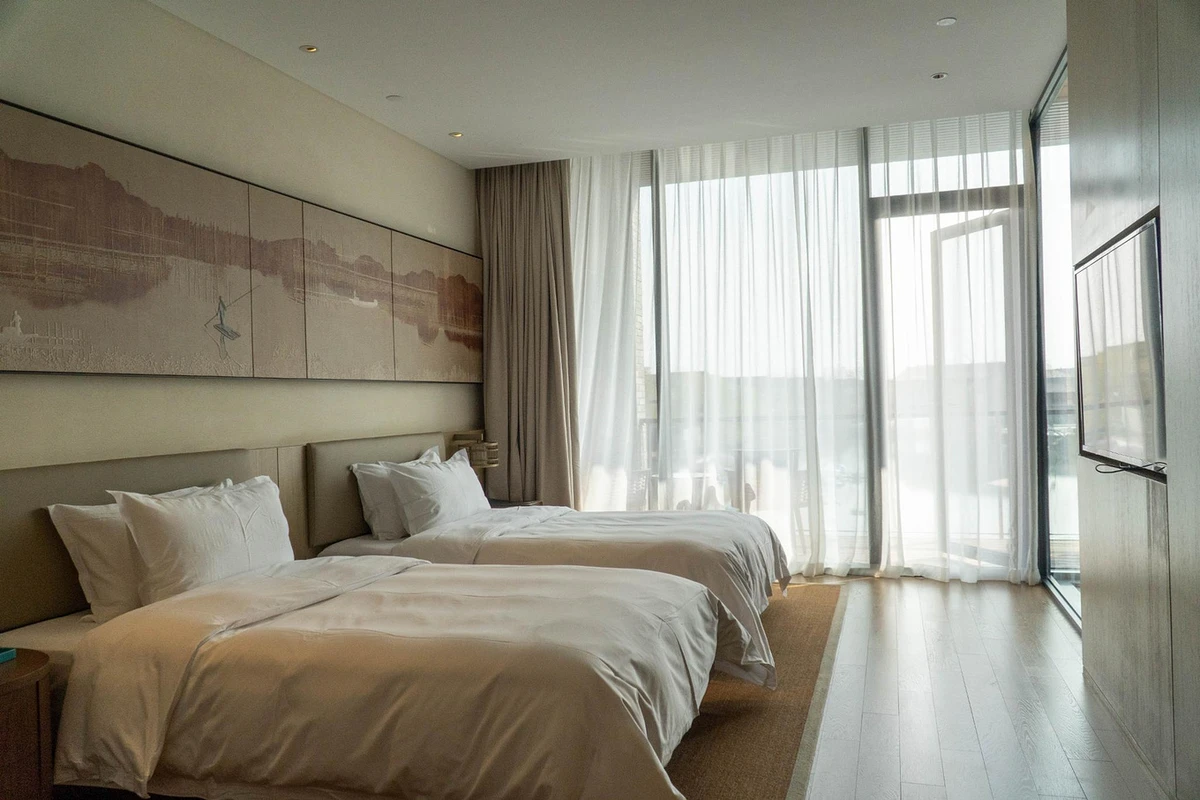
I booked a lake-view room, whose balcony directly faces the lake. The hotel also thoughtfully placed a bathtub there, so in the evening I could soak in the tub while admiring the enchanting reflections of lights on the lake, enjoying a moment of leisure and tranquility — the perfect touch of a leisurely, refined lifestyle.
After breakfast at the hotel the next day, I set off for Youzi Mountain.
Youzi Mountain was originally called Liangshan or Mianshan. According to local inscriptions, Confucius climbed this mountain during his travels through the states and, struck by a wanderer's homesickness, the mountain was renamed Youzi ('Wanderer's') Mountain by later generations.
At the foot of the mountain lives a community of 30,000 bearing the Kong surname, the largest settlement of Confucius' descendants outside Qufu in Shandong.
Following in the footsteps of Confucius from over 2,000 years ago, I traversed the lush, layered peaks of Youzi Mountain, soaking in the cultural depth and charm of Confucianism, Buddhism, and Taoism.
The 'Fuzi Stone' (Master's Stone), named for the long sit Confucius took here, seemed to emanate the sage's thousand-year contemplation. Shaped like two dragons playing with a pearl, Youzi Mountain cradles Zhenru Chan Temple within its embrace. Gazing at the majestic and solemn temple, a surge of devout reverence welled up from my heart.
Walking along the Yunqi Plank Road, lush vegetation flanked me on both sides. Amidst the swirling clouds and mist, breathing in the fresh scent of grass and trees, my body and mind were deeply relaxed.
I have always harbored a genuine curiosity and love for Chinese tea culture. In the gentle morning light, the tea leaves in Santiaolong Tea Garden glistened with dewdrops, tempting one to pluck them. Strolling along the narrow paths between the tea ridges, bending down to breathe in a hint of tea fragrance, I could snap refreshingly pretty photos in no time.
In the afternoon, I arrived at Yaxi Slow City. Only the fragrance of flowers, no talk of joy or sorrow — this is where poetry and distant dreams find their home. In our hurried lives, we are always rushing to get things done, constantly in a state of 'on the road', feeling anxious and panicked whenever we pause. We never consider that slowness has its own scenery, its own splendor.
Yaxi Slow City earned the title of 'International Slow City' a decade ago, the first in China. Here, I tried the thrilling rainbow slide, challenged myself on the glass walkway, wobbled along the aerial plank road — amidst laughter and joy, it was a rare moment of carefree letting go. Vast expanses of bright yellow rapeseed flowers bloomed brilliantly. Plunging into the sea of blossoms, I joined the bees in celebrating spring and frolicked with butterflies.
Slowness is an attitude. After all, life is long; racing ahead only makes us miss more scenery and leads to more regrets.
That evening, I checked into Bancheng Dashan Hotel. A vast expanse of lakeside grassland belongs to the hotel — it's hard to imagine such a novel concept: each RV forms its own private courtyard. Sitting in the yard at night, barbecuing and sipping a few drinks — what a delightful experience. Built by the lake, the view and openness are simply unbeatable.
Watching moonlight and starlight pour in through the skylight, quietly emptying my mind, it was a uniquely beautiful memory.
On the morning of the third day, I explored the Gaochun Ceramics Museum.
The exquisite cups, plates, and bowls reflect the pride of Chinese culture. Ceramics, as a traditional craft and a source of pride for China, have been renowned overseas since ancient times.
The Gaochun Ceramics Museum has three floors, displaying representative works from China's five famous kilns — Ge, Guan, Ru, Ding, and Jun — as well as from Jingdezhen, Cizhou, Yaozhou, and Yixing's 'Five Golden Flowers'. It offers an in-depth exploration of ceramics through the ages.
Whether it's the opulence of state banquet porcelain, the understated elegance of celadon, or the graceful subtlety of blue porcelain, they all embody the perseverance of artisans and our heartfelt admiration. At the museum, you can also experience the joy of making ceramics, from throwing on the wheel to shaping — what you create becomes your own personal work of art.
Shuiman City, like something out of a fairy tale, restores the truest form of the fantasy world I've dreamed of. Vast seas of flowers in brilliant, captivating colors, and a Dutch-style windmill — so perfect for photos!
The wetland zoo is home to many animals: cute flamingos preening their pink feathers, proud peacocks shaking out their beautiful plumage, drawing many children to stop and stare.
The park is huge; walking alone can be quite tiring. In addition to the scenery, Shuiman City has all kinds of amusement rides, so you can spend a whole day enjoying it.
Nanjing, anciently known as Jinling, served as the capital for six dynasties. Its unique historical and cultural heritage and relics are undeniably abundant, yet ancient towns are relatively rare. Gaochun Old Street dates back to the Song Dynasty, with a history of nearly 900 years.
Unlike other ancient towns with their many alleyways and lanes, the Old Street consists of just one straight road cutting through the town. Lined with architecture from the Ming and Qing dynasties, the thick stone walls are mottled with age, which only adds to the charm.
Vendors along the street sell all sorts of local delicacies and specialties: Chunxi old wine, dried tofu, Gaochun tea, Yunxi fragrant goose, and more. Dried fish and smoked ducks hanging out to dry in doorways add a touch of everyday life to this ancient town — not overpowering, but present everywhere.
Strolling along the bluestone path of Gaochun Old Street, the weather-beaten doors tinged with the marks of time enhance the character of the ancient Huizhou-style architecture. Gaochun is a place abundant in crabs, and fried crab is a must-try specialty on the Old Street. The crispy, crunchy crab is incredibly fragrant — best enjoyed hot.
After finishing the stroll through Gaochun Old Street, I headed straight back to Nanjing, marking the end of an unforgettable slow-city journey.
Willows are turning green, rapeseed flowers yellow — spring's brilliance is not late, summer not yet early; everything is just right. The slow pace of Gaochun, I look forward to encountering you once more.


