Nanjing Ming City Wall: Zhongshan Gate to Taiping Gate
Walking route: Zhongshan Gate – Mingling Road – Qian Lake – Hou Banshanyuan – Pipa Lake – Zhongshan Botanical Garden
Walking method: On foot
Because I live in the eastern suburbs, when my child was little, we often strolled around this area. The foot of the city wall was also a place where we frequently spent time. This time, I decided to make the city wall a dedicated theme, so I gathered the photos I've taken occasionally over the years, sorted them out, and re-enjoyed the mountain, forest, and water scenery along the city wall section from Zhongshan Gate to Taiping Gate.
Leaving Zhongshan Gate, right next to the city wall, Mingling Road runs south to north, threading deep into the Purple Mountain towards Ming Xiaoling Mausoleum. The roadside trees along Mingling Road are tall and upright. In early spring March, the colors here have gradually turned green.
Along Mingling Road: light green on the branches, dark green of the shrubs, tender green of the grass — all shades of green are on display. Walking in this natural oxygen bar is a delight for the eyes and the soul.
The mottled city wall reveals the weight of history, while the February orchids at its base make the place lively and heartwarming.
In May, Mingling Road is lush with verdant trees, and the bright sunshine illuminates the green leaves, making them translucent.
Looking up at the tall and imposing Ming city wall. In March, the bare branches match the wall's temperament even better.
The ancient bricks, mottled with age, and the lush weeds growing from the cracks are so admirable.
Viewing the city wall from different angles. On this section of the wall, you can clearly distinguish which bricks are original historical bricks and which are later restorations. The evidence of Nanjing's efforts to preserve its history is clearly visible here.
The city wall, over 600 years old, has witnessed Nanjing's history, and beneath it, countless vows of love have also been witnessed.
A few hundred meters along, there is an 'X'-shaped intersection.
Continuing straight leads to Ming Xiaoling Mausoleum; branching off to the left, a greenway follows the city wall northwestward. At this bend, the wall appears gentle yet grand.
Leaving Mingling Road, turn left to follow the city wall and head northwest.
In May, the lush vegetation sets off the ancient wall, giving Nanjing a touch more spirituality and an extra sense of ease and freedom compared to other cities.
On the right side of the wall, there are two walking paths: one is a small path paved with bluish stones, the other a red trail.
The red rubberized trail leads us into a jungle-like path. The same trail presents a different charm depending on the month.
Nanjing people are extremely fond of trees. They will even hold discussions over the relocation of a single tree. That's why this pathway design has done well to preserve every tree.
At a bend in the wall, a clear lake comes into view — this is Qian Lake. The rolling mountains in the distance are Zhongshan (Purple Mountain). In the scene, the undulating mountains, the layered greenery, and the shimmering lake surface create a serene beauty that combines stillness and motion.
The white shell-like building amidst the green trees by the lake is the flower greenhouse of Zhongshan Botanical Garden. The botanical garden cultivates a variety of rare tropical plants indoors, artificially creating a tropical rainforest landscape. These two photos were taken almost at the same spot, but the overall feeling differs because of the different months and weather.
The green of May is brilliantly sparkling green.
Leaning here to gaze at the green hills and the emerald lake, what a sense of release it is. I love the carved stone balustrades of Qian Lake.
Auspicious clouds drift across the stone balustrades, which tightly embrace the gentle water of Qian Lake. Under these auspicious clouds, the stone rails take on a romantic, dream-like vividness.
Playful thriving vines creep and twine among the square bricks.
This is not a tourist attraction; there is no constant stream of visitors, only the local residents who truly love it. The rare peace and quiet allow us to pause freely, daydream, and lean on the railings to gaze into the distance.
These are my favorite adorable Nanjing citizens; their candid expressions are quite lovely, aren't they?
Because of this love, nature is equally generous with all it has. Here, blue skies, green trees, and air so fresh it seeps into your heart. I greedily take deep breaths, wanting to hold onto the fragrance of the leaves for as long as possible.
In May, the azaleas wrap around the green belts like silk ribbons.
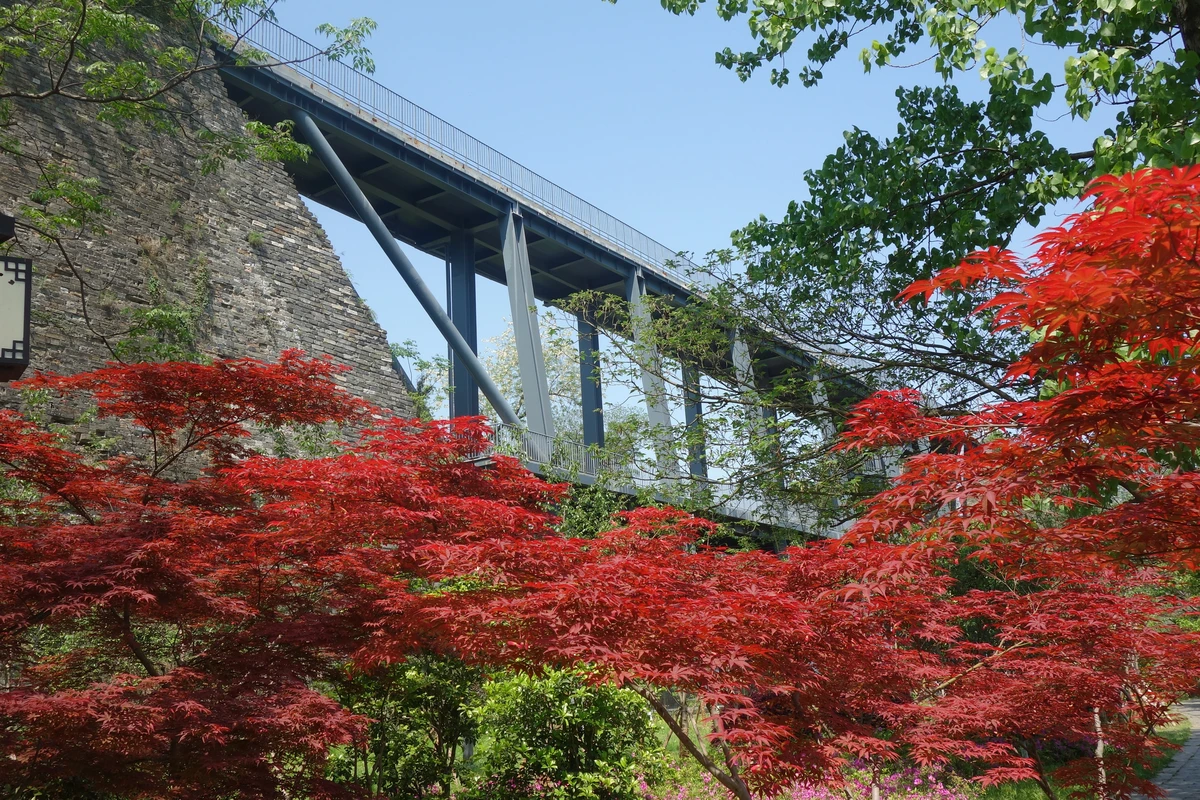
This section of the city wall is special; it is connected by a steel frame structure.
The gap at Qian Lake was caused by a heavy rainstorm in Nanjing in 1991, when this part of the Ming city wall collapsed, forming a breach over 50 meters long. To protect and restore the wall, a steel framework was erected to bridge the gap.
At the gap created by the collapse, cultural heritage authorities unexpectedly discovered a 'wall within a wall': inside the thick city wall, there was another section of a shorter wall about 10 meters high. Experts found that this shorter wall was built in the early Ming Dynasty, only half the height of the current wall, with widths varying from 2 to 4 meters. They also found numerous bricks from earlier dynasties, such as the Six Dynasties and the Song Dynasty.
To protect this 'wall within a wall,' a light steel double-decker skywalk was erected at the gap. The upper deck connects the two ends of the wall for visitors to traverse, while stairs lead down to a lower observation platform where you can view the Ming Dynasty 'short wall' that was originally hidden inside the main wall. A small house was built under the bridge—was it originally intended for ticket sales? For now, it seems that the stairs to the wall are not accessible.
When the relevant departments investigated the wall at the breach, they also discovered a water gate. According to the inscription, this water gate was built in the early Ming Dynasty and was an important water supply system leading to the inner city's Yudai River. In 2015, this Ming Dynasty water gate underwent protective restoration and was named 'Banshanyuan Water Gate.' Its display adds to the historical depth.
The combination of the brick-and-stone city wall with the steel connecting bridge is an innovation, possessing a unique kind of beauty. In May, nature's rich colors lend a touch of softness and charm to this otherwise sturdy wall.
The red trail stands out strikingly in a world of green.
Here, the city wall makes a graceful arc, turning from northwest to due north. A beautiful curve, a beautiful angle of the wall. The two bends we passed along the way reveal the unique design concept and exquisite construction craftsmanship of the wall.
In May, the city wall is draped in a green coat. Vines quietly clamber up, infusing the ancient wall with the green of life.
This section of the wall nestles between mountains and water, winding along Fugui Mountain like a giant dragon quietly coiled amidst the green hills and clear waters.
Such a scene reminds me of a line from a poem: 'The tiger crouches, the dragon coils, today surpassing the past.' Nanjing is indeed a place where tigers crouch and dragons coil!
Nanjing's Ming city wall was built during the Ming Dynasty. Unlike other city walls that are square and straight, it winds like a lively dragon through the beautiful landscape of Nanjing. Following its curves, I can see the integration of wall, mountains, and water from different perspectives.
The wall then turns westward again, and overall it looks like a straightened 'Z' shape. Walking along the quiet path, a bit of liveliness appears ahead.
It turns out there is a small gate here—Hou Banshanyuan. On the other side of the wall is the bustling urban area—Banshanyuan and Fugui Mountain. Yet here, there is a unique tranquility. One city wall quietly separates the bustling city from the silent mountain forest, splitting the area into two completely different worlds. Inside the wall: noise and clamor; outside: peace and freshness.
The tree canopy completely covers the small bluish-stone path, as if we've stepped into a forest. Walking along the tree-covered trail, you can smell the scent of trees, the fragrance of leaves, the aroma of the forest, and a faint hint of history.
Walking alongside the wall, after just a few steps, a shimmering, crystal-clear emerald is nestled in a mountain hollow. It has a lovely name—Pipa Lake. Pipa Lake is slightly smaller than Qian Lake. It lies at the foot of the scenic Zhongshan Mountain, nestling beside the majestic and solid city wall.
The sprawling city wall embraces the southwestern side of Pipa Lake. The clear lake water and the mottled wall are tightly connected, reflecting each other. The natural landscape of mountains and water meets the profound historical relics here.
A beautiful picture of the city wall, mountain forest, and lake combined. You can feel the lake's grace, beauty, and seclusion, and the grandeur revealed in its softness. You can also feel the wall's majesty, its weathered character, and its weightiness, with a sense of inclusiveness within its solidity.
Pausing by the lake, the breathtaking scenery amazed me. I simply stopped and sat quietly on the wooden boardwalk. Being so close, I could touch the city wall and the lake water. Here, I fully enjoyed a pleasant and leisurely time. In a big city, having such a place where I can slow down, breathe deeply, shed impatience, and relax my mind makes me feel grateful.
On the eastern side of the lake, several small wooden boardwalks extend into the water.
There are treasures hidden in the water!
This section of the wall on the south side of Pipa Lake is the only part of the Ming city wall that directly borders the water. Accompanied by the heavy, ancient Ming wall and the swaying duckweed and water plants of Pipa Lake, with green willows like dancing maidens, the water's liveliness makes this the most beautiful city wall in Nanjing.
What is even more marvelous is that on the water surface beside the wall, a long wooden footbridge connects the two banks. Nanjing is located in the rainy Jiangnan region, with rolling hills, a network of river bends, and scattered lakes and ponds. The terrain where the wall was built varied: some sections were on craggy rocks, some on low-lying soft ground, and others on flat surfaces. To prevent the tall wall from sinking, cracking, or toppling, the builders adopted different scientific approaches according to the engineering needs. Some sections were built following the mountain contours, with the wall and the rock mass forming an integrated whole; other sections had deep foundations dug down to the native soil, with massive stones laid as the base. Just imagine: a towering wall over 600 years old, standing in water. Not to mention the uniqueness and difficulty of the design, the requirements for building materials and craftsmanship during construction were superb and excellent. Whether walking on the wall or alongside it, from each distinctive section, you can see that Nanjing's Ming city wall is a masterpiece of ancient Chinese military defense facilities and wall construction techniques in terms of historical value, aesthetic value, architectural design, scale, and functionality.
The lake water comes right up to the foot of the wall, and a boardwalk allows passage along it. With verdant green in the distance and emerald water close by, the boardwalk meanders along the lake, seeming to melt into the green woods by the water—so peaceful and detached that you can't bear to take your eyes away. Walking on the bridge lets you come into zero-distance contact with this ancient wall and the tender lake water.
Looking up at the city wall through layers of colorful leaves, the rich array of colors in one frame enchants me. The new green of May is so beautiful, and the bright but not scorching May sunlight gives the green leaves and red maples an incredible luminosity.
Different angles also bring different light effects.
I came here in early spring in March, and I approached it again in early summer in May. The changing seasons bring changes to the scenery. Walking through a natural environment like this, I see beautiful scenery everywhere, hear the pleasant sounds of nature, and breathe incredibly fresh oxygen. I feel completely at ease, both body and mind, and all worries vanish.
Whether it's Qian Lake or Pipa Lake, the beauty of the scenery is secondary; what touches us most are scenes like these: families, loved ones, fishing together, having picnics, walking together. Or just sitting quietly, simply being together.
A group of photography enthusiasts diligently capturing the beauty of the landscape.
Looking at the city wall from the eastern shore of Qian Lake. Here you can see a panoramic view of the steel bridge connection. A weathered gap, bridged with modern technology, allowing passage where the wall was once broken. This is a perfect blend of classical and modern, a unique kind of beauty.
This is a scene from April this year (2021) when I visited the South Garden of the Zhongshan Botanical Garden, gazing at the city wall across Qian Lake.
The modern, exquisitely transparent glass exhibition hall of the botanical garden and the ancient city wall shine against each other, connecting Nanjing's past and present.
I took this photo from the small plaza at the entrance of the glass house exhibition hall. In the foreground, colorful tulips and Japanese maples; in the middle ground, the blue water of Qian Lake; in the distance, the towering silhouette of the city wall. Rich colors, rich layers.
This section of the wall, unlike the one centered around Taicheng, is not a conventional tourist spot; it's merely a favorite haunt of locals. Stepping in here means leaving behind the hustle and bustle of the city, as if entering a timeless, ethereal realm. In an instant, your soul is captured by the tranquility of history and the beauty of mountains, water, city, and forest.
Nanjing's city wall nestles beside mountains and waters; it doesn't follow the old convention of square or rectangular layouts for ancient capitals but instead winds for over thirty kilometers. Nanjing people have an inexplicable affection for their city wall. They love to stroll atop it and take in the cherished city-and-forest scenery. They love to walk along the greenways beside the wall, admiring the different beautiful views. There are still sections of Nanjing's city wall that I haven't set foot on; I will continue to measure them with my footsteps, experiencing the distinctive and unique Nanjing city wall.


