Nanjing Ming City Wall – A Walk on the 16th Day of the First Lunar Month
Walking Time: February 2021
Walking Mode: on foot
Walking Route: Yifeng Gate → Yijiang Gate → Huayangang Gate → Dinghuai Gate (Wall Climbing Entrance)
Address: Northwest section of the city wall, Gulou District, Nanjing
On New Year's Eve, we happened to climb up the Zhonghua Gate tower. Inside, the former garrison tunnels held several exhibitions that gave us a deeper appreciation not only of the gate's architecture and military design but also a good deal of knowledge. I learned about Nanjing's Spring Festival customs, for instance. Though I've lived in Nanjing for decades, I knew precious little about those old local traditions. One of them is "walking off all ills on the 16th of the first lunar month": on that day, Nanjing people ascend the city wall to walk away sickness, carrying hopes of warding off a hundred diseases and enjoying health and peace in the year ahead. So we made an early plan to choose a stretch of the wall to walk on that day. My child picked Yifeng Gate in the north part of the city to start.
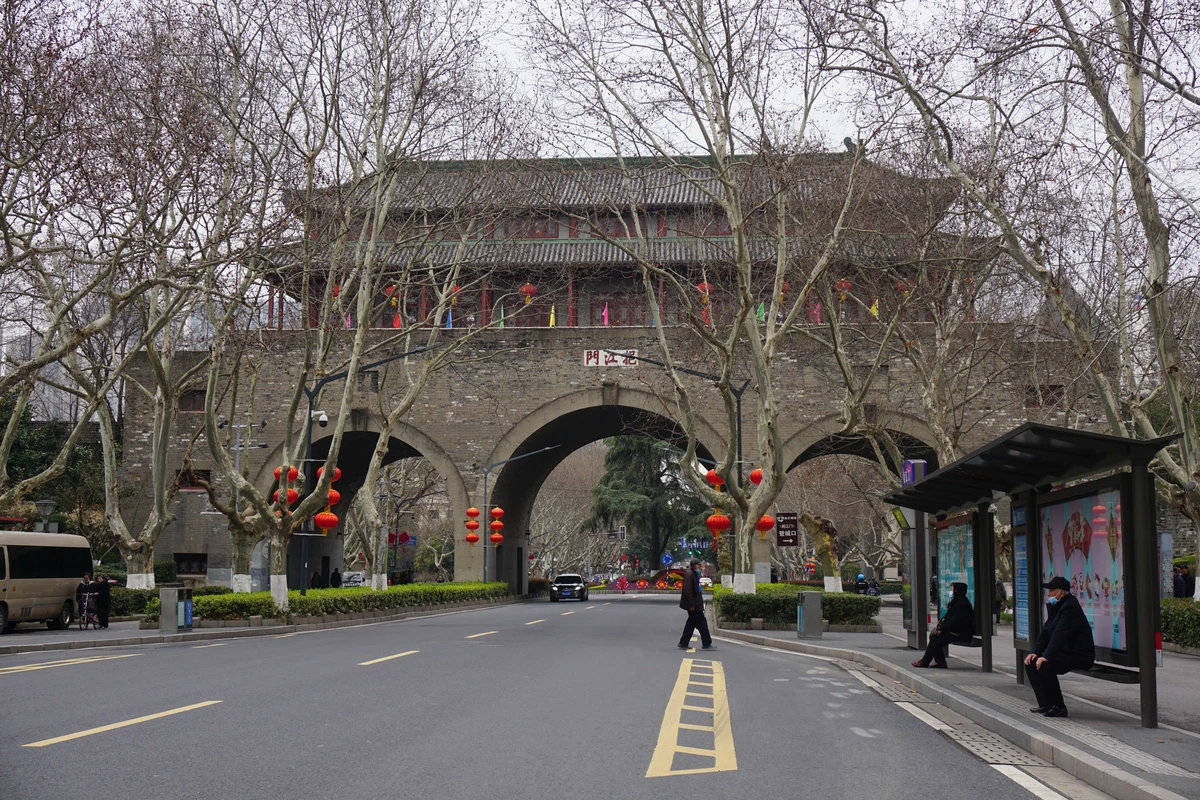
Yifeng Gate, which straddles Jianning Road, is one of the thirteen original Ming-dynasty city gates of Nanjing. Built in the early Hongwu period of the Ming dynasty, it was named Yifeng—literally "welcoming the phoenix" —to symbolize an auspicious sign of dragon and phoenix bringing good fortune. The gate faces west. In olden times, it was a single-arch gateway. The walls on both wings were constructed following the terrain: on the north side, the wall hugged Lion Hill (Shizishan); on the south side, it encircled Hydrangea Hill (Xiuqiushan). The gate sat in the saddle between the two hills, gaining a topographical advantage. Two water sluices were built beneath it—its military importance was considerable. In 1958–1959, a nationwide wall-demolition movement reached Nanjing, and Yifeng Gate was torn down. However, the walls on either side survived intact. In 2006, the gate was reconstructed and the walls on both sides reconnected. The rebuilt Yifeng Gate, for traffic convenience, became a three-arch gateway: the middle arch, slightly larger, carries motor vehicles; the two side arches are smaller and for non-motorized traffic. On top stands a gate tower in the official Ming architectural style.
To the north of the gate is a decorative archway inscribed "A Grand View of the River". Behind it is the South Gate, the southern entrance to the Yuejiang Tower Scenic Area. A ticket is required to enter and visit Yuejiang Tower. We didn't go there; instead, we headed straight for the ramp up onto the Ming city wall and ascended the tower. On the platform stands a richly decorated, double-eaved tower with a hip-and-gable roof. The tower now houses Yifeng Book Pavilion, but it was locked tight.
From beneath the tower, we looked down at Jianning Road. To its north is Tianfei Palace, and further in the distance Jinghai Temple. Yifeng Gate was the main route from the northern part of the city to the Yangtze River. Historically, it was a vital gate for officials crossing the river; those heading north or departing for military campaigns all used it. When they returned victorious, locals would arrange grand welcome ceremonies near the gate for the triumphant soldiers. Today, it remains one of the main north–south thoroughfares.
On one side, the wall encloses Lion Hill, with Tianfei Palace and Jinghai Temple nestling at its foot. Everything here speaks of centuries of history and accumulated experience. From the wall, we gazed at the streetscape; climbing up gives the city a much more majestic appearance.
The wall to the north leads to the Yuejiang Tower scenic area but the path is blocked, so we walked southward along the wall. At a bend, we turned back to look at Lion Hill and the serpentine wall. The gate tower on the wall and Yuejiang Tower on the hill echoed each other from afar. A few more steps and the wall stretched out grandly while Yuejiang Tower stood aloof, like two majestic guardians keeping watch. The imposing wall followed the contours of the hill.
Delicate little flowers bloomed on the wall. Down below was Yifeng Square. Walking south from Yifeng Gate, the path on the wall was relatively narrow, with lush greenery and ancient-looking bricks. The wall rose and fell; this northwestern corner of the Nanjing wall, girded by hills and water, is a highly strategic location. History has left many memories here.
With each step we took, a backward glance revealed a different view – the scenery changed with every shift in distance and angle. A academy nestled against the wall. Where the brickwork atop the wall had become damaged, a one-metre-high guardrail had been installed. On the outer side, a black railing added a different touch.
Strolling along the wall, we could see Xiuqiu Park bathed in spring colours at its foot. East Lake in the park shimmered, its shores encircled by green trees. Trees with clusters of tiny white flowers at the wall's base dotted the greenery and adorned the ancient wall. Gazing north, Yuejiang Tower still hovered on the horizon. This stretch of the wall is particularly well-preserved, with legible inscriptions on the bricks. The construction of the Ming city wall and these inscribed bricks are imprints of their era; through them we can catch glimpses of early Ming political systems, brick-making techniques, calligraphy, and seal carving.
In what seemed no distance at all—about five or six hundred metres—we reached Yijiang Gate. At our feet was the ornamental archway at the entrance to Xiuqiu Park. The gate tower atop Yijiang Gate, with its double eaves and upturned corners, is rich in traditional ethnic style. The door was locked, so we couldn't enter or walk through; we had to descend from one side.
Address: Gulou District, Xiaguan area, Nanjing. We descended to Zhongshan North Road for a frontal view of Yijiang Gate. Yijiang Gate is not an original Ming-dynasty city gate but a later opening. In 1921 (the 10th year of the Republic of China), the wall was breached to allow Zhongshan Avenue to enter the city, providing a key route from Zhongshan Pier and Xiaguan Railway Station into town. It was a single-arch gate at first; in 1929, in preparation for the state funeral of Sun Yat-sen, it was widened to three arches. A gate tower was built in 1930. During the Japanese attack on Nanjing in 1937, the tower was destroyed. It was rebuilt in 1945. Although Yijiang Gate dates from the Republican era, its spacious archways and imposing tower still convey the charm of that period's city gate.
Along Zhongshan North Road, there is the Hongxinglou Hotel. We crossed the road to the south side of the gate, where a small hillside path led back up onto the wall. The wall here runs alongside Bazishan Park. Yijiang Gate essentially links Lion Hill and Bazishan.
Back on the wall, we could see the distant TV tower. The wall hugged the curves of Bazishan, with the hill on one side and the gentle waters of the moat on the other.
A footpath runs alongside the wall, where locals strolled leisurely. The wall merges seamlessly with Bazishan Park, making it a popular recreational spot. This section is a "hill-embracing wall", following the contours of the slope, snaking grandly.
A row of blossoming peach trees decorated the green hillside brilliantly. From this spot, the curves of the hill, the wall, and the blossoms entwined in graceful, flowing lines.
The time-worn wall, modern buildings in the distance, a little pavilion atop Bazishan—layered and arranged pleasingly. On the left, evergreen Bazishan rises; outside the wall, lush green belts stretch.
Strolling along the wall and appreciating the view, each section had its own character. With the arrival of spring, the yang energy stored through winter gradually spreads outward, and shades of peach pink and willow green colour the landscape. Looking down, we saw the lake beyond the wall.
The wall beyond Yijiang Gate continues south. Along its base, Xiaotaoyuan Park and Xiuqiu Park face each other, forming a long, narrow strip that follows the Qinhuai River southward. With the wall, the river, and the wooded hills, the scenery is beautiful and the area serves as an open public green space.
Between the wall and the moat lies a large citizen's square. The colourful plaza has plenty of facilities catering to kids, young people, and older folks, each group enjoying themselves in their own way. The park was bustling: old-timers chatting, young people running on the sports grounds, children having a great time in the sandpit.
This scenic corridor gives us the choice of walking either on the wall or along the moat – two parallel routes with different perspectives and views. From here, we looked back at the top of Bazishan and, further away, Yuejiang Tower on Lion Hill. Setting out from Yifeng Gate, passing Yijiang Gate, Xiuqiu Park, Xiaotaoyuan, we traversed centuries; standing on the wall, we could also look down at the natural beauty below.
Time has left marks, shallow and deep, on the wall. Some bricks remain intact, some broken, but none of that detracts from the wall's solid, weighty presence. When I gazed at this hill-embracing stretch, I felt its firm strength. The mighty wall is power; the gentle Qinhuai River creates a scene blending hardness and softness.
Xiaotaoyuan (Huayangang Gate) Address: Yijiangmen Subdistrict, Gulou District, Nanjing. Here stands a new gate—Huayangang Gate. It was built on 1 October 2007, when the Chaha'er Road western extension was opened to traffic, creating a gate at the foot of Dingshan along the Ming wall. We didn't go down to see the gate's exterior but simply kept walking south on the wall.
All along the way, we admired the northwestern scenery of Nanjing from the wall. The wall links a series of hills and parks, and from the gates we could see each other in the distance. Most of the area at the foot of the wall now has lovely walking paths. Not only can we look down from above, we can also walk the greenways alongside, seeing the landscape from different angles. The experience felt like shifting between history and modernity.
A city, like a person, needs its own living memories, and the ancient wall has long been part of Nanjing people's lives. Nanjingers take pride in the Ming wall; they stroll here, children grow up beside it...
I love walking on the wall. Each brick seems to whisper stories of an age-old history, making you feel the deep cultural heritage of this ancient and weighty city. In just a few days, my child would be heading north to university. Today's wall walk was both to follow the "16th of the first month" custom and also, I think, to symbolise stepping onto the wall as a way to start a new journey. We made a new pact: from now on, every year just before he leaves for the new term in the north, we'd pick a stretch of the wall to walk together, to measure with our footsteps and remember the beautiful city we live in, this land that no foreign foe dared to tread lightly.
Approaching Dinghuai Gate, the bricks began to look different; a few more steps and they took on an even wilder character. Soft flowers peeked from cracks in the wall. Spring scenes unfolded on the wall.
Here we reached Dinghuai Gate, the southernmost point of this section. We had come from Yifeng Gate, via Yijiang Gate and Huayangang Gate, to Dinghuai Gate. Dinghuai Gate, one of the thirteen original Ming gates, was a single-arch gateway with one arch tunnel. In the 23rd year of the Daoguang reign (1843), because the outer Qinhuai River silted up, the gate fell out of use. It was torn down during the nationwide wall-demolition movement of 1958, but the place name survives. Today, though it's called Dinghuai Gate, it's no longer what we'd normally picture as a city gate.
Descending the wall, we reached Dinghuai Gate Street. At the intersection, the towering Nanjing TV Tower on Shitoucheng Road came into view, along with the lovely Sancha River and its banks. The fresh green of early spring filled us with tender feelings.
Today's walk had a purpose, a sense of ritual. The choice of this northwestern stretch for the "walking off all ills" custom was my child's idea. Only after coming did we realise it's one of the longer free sections of the Nanjing wall. Every day, many local residents come up to exercise or stroll and enjoy the views; the happiness index of nearby folks must be off the charts. Through its enduring watch over the ages, the Ming wall has helped shape a generous, tolerant Nanjing. It's a place worth treading, pacing out, and learning to understand—the wall, and the city of Nanjing.


