Where to Go for a Holiday? A 3-Day Self-Drive Itinerary for Nanjing Lishui
My family said, for my birthday this year, take a break from work, let's go to Nanjing to have some fun and find a relaxing place. That's how this trip to Lishui came about. Lishui is in the southeastern suburbs of Nanjing. If your idea of Nanjing is limited to downtown's Fuzimiao and Qinhuai River, then Lishui is the perfect getaway—far from the fast pace and the crowds. Public transport isn't recommended for many of Lishui's attractions; it's more time-consuming. Driving is better because the sights are scattered, especially for a loop around Shijiu Lake—there's nothing like cruising along the lakeside road.
When dining in Lishui, forget fine dining; the farmhouse restaurants here will make you forget to go home. My first experience of overeating at a farmhouse happened right in Lishui. Whether you're coming from Shanghai or downtown Nanjing, it's best to arrive around noon. If you're local, drive yourself; if not, pick up a rental car at the high-speed rail station.
Day 1: Arrive Lishui at noon; Lunch: Pinghu Fresh Fish Restaurant; Afternoon: Explore Shijiu Lake (Yigongqu, Luoshan, Zhangxu, Chenbian); Dinner: Farmhouse meal at Tian Jie Jia; Accommodation: Tian Jie Jia homestay.
Day 2: Morning: Rose Garden; Lunch: Shili Guoxiang Orchard (cherry picking); Afternoon: Tiansheng Bridge Scenic Area, Wuxiang Mountain; Dinner: Farmhouse meal at Zhushang Yunxiang; Accommodation: Zhushang Yunxiang homestay.
Day 3: Morning: Menghua Yuan; Lunch: Rong Yue Lou; Afternoon: Wuxiang Water Town.
I'm the type who always gets bad luck with weather on trips. Shijiu Lake is called the "Mirror of the Sky," but on a rainy day you can't see a thing. I might be the only person touring the lake in the rain—I didn't meet a single other photographer along the way. I consoled myself that at least I didn't have to fight for photo spots.
Our first stop was Yigongqu. From Tian Jie Jia, head west along the lake—the views are lovely. Whatever you do, don't follow the navigation on the lower road; you must stick to the lakeside! Drive right along the water. The lighthouse at Yigongqu is a social-media hotspot, capable of channeling a mini Kenting vibe. You'll have to use your imagination because there was no sunshine or blue sky, just a moody, misty drizzle.
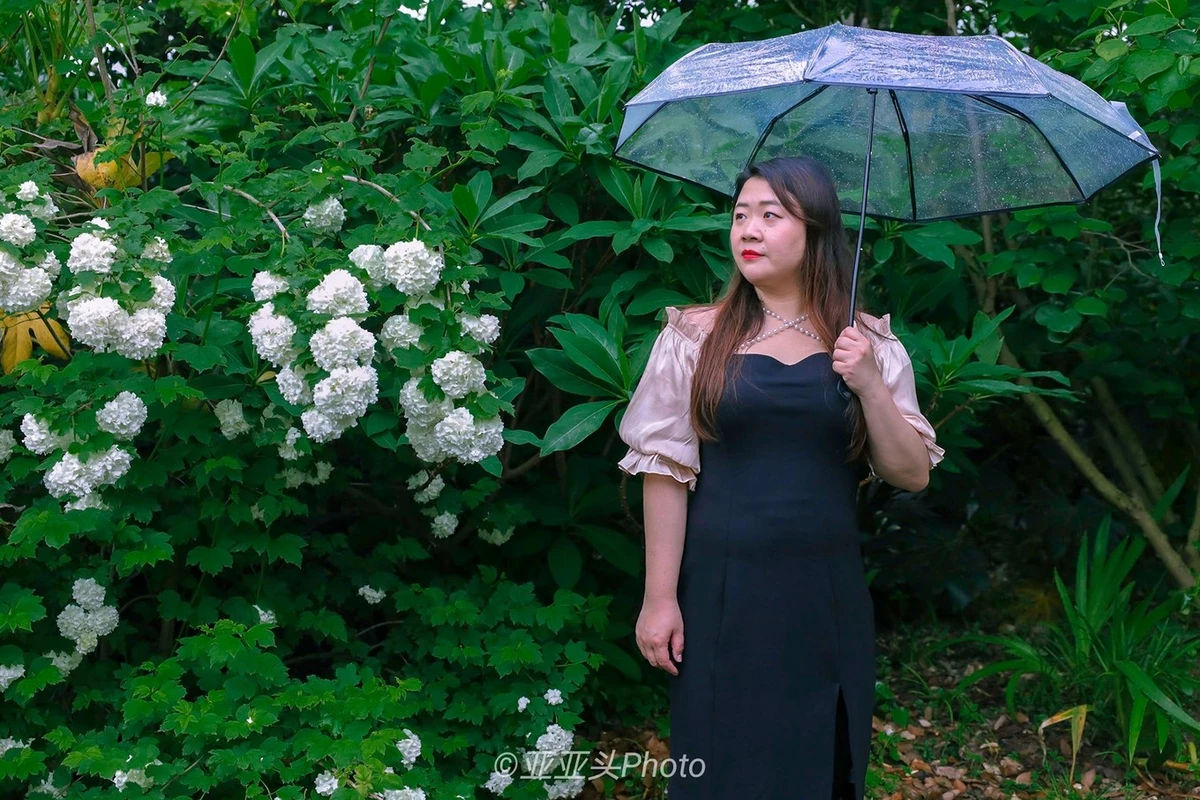
Luckily, I was wearing a colorful outfit and carrying a transparent umbrella—it looked pretty good. Next to the lighthouse there's a lone tree. It's not even a real attraction, just that everyone feels sorry for how solitary it is. Don't take a couple's photo with it; it'll feel even lonelier. So I decided to share my umbrella with it, give it some warmth.
After driving to Luoshan Village, again follow the lake shore. You'll see a bridge, a pavilion, an embankment, and a sign marking a swan conservation area. Probably due to the weather, we didn't spot a single swan—maybe they were all hiding from the rain? Be careful climbing the embankment; the slope is steep, so wear non-slip shoes.
Set your GPS to Zhangxu; once you're nearby, you'll spot that much-photographed wooden pier. It's on abandoned private property, so you need to climb a wall to get in, but it's not difficult and almost anyone can do it. Zhangxu is one of the more famous photo spots around Shijiu Lake. In early April, the Totoro sea grass is spectacular. By late April, it looked like what I saw. I heard the water level rises in May, so visiting the pier in summer would still be nice.
When I went, the Totoro sea grass was already sparse and toppled over. I really envy those beautiful videos of the grass swaying in the wind, like scenes from Spirited Away. There were quite a few little bugs in the grass, but they didn't bite me. Still, I'd recommend bug spray or long pants.
Tickets: Free. Recommended photo spots: lighthouse at Yigongqu, embankment and swans at Luoshan Village, pier and Totoro sea grass at Zhangxu.
This is Nanjing's first rose-themed manor. I could hardly believe Lishui had such a large-scale rose garden until I saw it with my own eyes. By late April, some roses and ramblers were beginning to bloom, but many were still buds. In May, the garden must be absolutely stunning.
There are many rose varieties here, such as French Damask rose, Yunnan Dianhong rose (often used for tea), Mohong rose, and Bulgarian Damask rose (commonly used for essential oils). Near the exit, there's a shop selling homemade rose products—you can smell the fragrance as you approach.
The garden is divided into several areas, both indoor and outdoor: three-dimensional flower borders, a romantic flower stream, a marriage path, a love tunnel, a lovers' lane, heart-shaped displays, a sea of flowers with a windmill, and a rose maze.
The maze is planted with climbing roses. I just came too early—when everything is in full bloom, I imagine it would be like Alice in Wonderland in Nanjing. Even now, it's already quite pretty.
Around any casual corner you'll find lovely scenes. The rose garden is a place where girls can't stop taking photos; allow plenty of time, wear light, solid-colored clothes, and bring a straw hat or other accessory.
Tickets: 30 yuan. Suggested time: 2 hours.
It's cherry-picking season again! From late April to early May is the best time for our Chinese cherries. A local friend recommended this orchard, close to Tiansheng Bridge Scenic Area.
There are several varieties of cherries—some deep red, some orange-yellow, and some pinkish-orange. I found the pinkish-orange ones the sweetest, with a nice tangy-sweet taste. It had rained that morning, so the cherries were so clean you could pop them straight into your mouth.
My picking tip: go for the big ones high up—they're the sweetest. And taste one first before adding it to your basket. Birds sneak into the orchard a lot, and the tree they peck at is often the sweetest. The farmer said they have to rescue dozens of birds from the netting every day—no idea how they get in.
The orchard also has a farm-to-table restaurant, with different fresh vegetables and meats each day; you can choose directly from the kitchen. Besides cherries, there are other fruits, so it seems every season has something to pick.
Price: ¥150 per person, including one basket of cherries to take home, and all-you-can-eat in the orchard. Free entry. Address: Jiutang Village, Lishui District, Nanjing, Jiangsu. Tip: For larger groups, book in advance. Don't wear white shoes—they'll get muddy.
This is a Jiangsu Provincial Key Cultural Relic Protection Site and a 4A-level scenic spot—a must-see in Lishui. It's hailed as one of the "New 48 Scenes of Jinling," with the Yanzhi River known as the "Little Three Gorges of Jiangnan" and Tiansheng Bridge. Be sure to buy a boat ticket to cruise the "Little Three Gorges."
The area isn't huge, and public transport is convenient—Lishui's tourist bus lines 2 and 3 both stop here. If you're not driving, this is a very suitable choice.
When you enter, you don't see a mountain; it looks flat, but actually you descend as you explore, following a counterclockwise route. The canyon and river here felt more like a fissure to me. Tiansheng Bridge is 34 meters long, 9 meters wide, and 8.9 meters thick, with a drop from deck to riverbed of 36 meters—equivalent to a 12-story building.
The boat ride takes about 15 minutes, round trip. Sit at the bow on the way out to get great shots of the bridge, and at the stern on the return for equally good photos.
There's an iconic rainbow slide, a 100-meter wavy slide where you go down on a doughnut. But it was raining, so it was closed. Bummer.
Tickets: 67 yuan including the boat ride; 97 yuan including the rainbow slide. Suggested time: 2 hours. Opening hours: 8:00–17:00.
Wuxiang Mountain Scenic Area has no entry fee—it's a great place for a tranquil, nostalgic retreat. You'll need to drive up to explore; hiking would take a very long time. Even by car, you can reach the ancient Wuxiang Temple and Tianchi directly, but if you want to experience the Baibu Cloud Ladder and imagine how monks once carried water up to Tianchi, you'll have to hike. Currently, the uphill path from the temple is under maintenance.
To walk the Baibu Cloud Ladder, you can start from Tianchi and go downhill. However, the passage to the ancient Wuxiang Temple is temporarily closed (check if the fence near the bamboo grove is completely sealed; for now, you can still squeeze through). If it's closed, you'll need to climb back up to Tianchi and exit. Several sights are along this route: cliff carvings, Longming Pool, and Stone Ladder Cloud View, among others.
The ancient Wuxiang Temple is temporarily closed for internal renovations; you can only view it from outside. Nearby, on Baihu Road, there's a stunning Metasequoia forest visible from the car.
Recommended driving route: Enter from the visitor center, head first to the ancient Wuxiang Temple, then drive to the Tianchi parking lot and hike up. After visiting Tianchi, drive back to the visitor center. Driving tour time: about 2 hours. Tianchi ticket: 10 yuan.
Menghua Yuan isn't very well known, but it's another incredibly photogenic spot. It's close to Tian Jie Jia and is a landscape garden focused on flowers and plants.
I missed the tulip season, but there are still meticulously designed pavilions, ponds, and rockeries. Don't bother renting a bicycle inside; treat it like a park, and a leisurely stroll of 1–2 hours is plenty.
Tickets: 45 yuan. Suggested time: 1.5 hours.
The expansive Wuxiang Water Town surprisingly doesn't charge admission. Although it's a man-made attraction, that doesn't stop it from being gorgeous and Instagram-worthy. It's a Tang Dynasty style mixed with Japanese courtyard aesthetics—I felt a bit like a modern version of Xi'an's Tang Paradise.
Wuxiang Water Town is divided into several zones. Architecture fans can wander the Chenghuang Temple area. If you want to stay overnight, there's a planned homestay zone that looks great from the outside. If you're into shopping, there's also a commercial street.
This place is perfect for wearing Hanfu and taking photos; there are rental shops on the street. Oh, and a popular Wuxie ice cream shop has already opened there.
Near the exit, there's a pastry shop—definitely grab a box of their "Mian Mian Gao" (soft cake). I regret not buying more; now that I'm back in Shanghai, I can't find it anywhere. Tip: It officially opens on May 1st; reservations are required for entry.
The homestays in Lishui are all made with great care. The two I chose each had their own charm, with nice rooms, service, and food that made me feel warm in this unfamiliar place.
Located in Zhujia Village, it's the closest and only homestay to Shijiu Lake. I heard it's part of a village support project, so it's run very properly. Some old village houses are being converted into homestays and commercial spaces; at the village entrance, you can see a coffee shop under renovation.
I discovered that every building type, and even each room, is different. Our building had just two rooms, one upstairs and one downstairs. I stayed in the "Yunmei" room on the second floor, which features a separate tatami tea room, a super bright and spacious bedroom, and two balconies (north and south). The design blends modern rural and Japanese styles.
I loved the tatami tea room; the view was beautiful, and I could brew my own gongfu tea. There were books by the wall for reading. At Tian Jie Jia, I felt like I had my own time and space.
The village environment is wonderful—so pleasant to relax on the big balcony and enjoy the breeze. My bedroom window had my favorite design: it extended outward, and outside the window was another homestay building. If you didn't know, you might mistake it for a painting on the wall.
If you're not driving, the homestay offers paid pick-up service. But the steward said most visitors who come to the lake drive. They also post photography and travel tips at the front desk.
It seems to be a top choice for small company team-building outings from downtown Nanjing. Every week, several groups come. On the day we checked in, one had just left and another arrived. There's a motorcycle track nearby, so many riders also stay here.
The homestay lives up to its name—nestled in a bamboo grove. Rooms are either by the pond or halfway up the hill. The lobby is at the lowest point, and the restaurant at the highest point of a small slope. They sell a lot of home-grown produce: roosters, hens, eggs, duck eggs, grains. I was surprised to see their homemade salted duck eggs. Every morning, the ayi goes to collect duck eggs from their own ducks; some are served at breakfast, some are sold.
The rooms are mainly in a new Chinese style. We looked at three before picking ours. Each had a slightly different layout. Our room faced a pond with the bamboo forest behind—very nice. A large space was partitioned into a living area, ideal for relaxing and chatting.
During my stay, I didn't go behind the homestay, but when leaving I realized there's a huge orchard. In summer, you could pick fresh pears.
The fish head soup at Pinghu Fresh Fish Restaurant is a long-established eatery in Dongping Town; there are a few others nearby also specializing in fish head soup. It's very close to Lishui High-Speed Rail Station, just 3 kilometers away. Lishui has many reservoirs, and I heard these fish heads are sold periodically from the reservoirs—incredibly delicious, rivaling the famous Qiandao Lake fish heads. So I had to try it.
The fish head soup arrived in a huge pot, way too much for two people. The fish was firm; the owner said they prepare the fish heads fresh every morning, so everything is very fresh. The tofu is bought daily as well. Sipping the milky white broth put me in a wonderful mood.
Red amaranth was in season, stir-fried very tenderly with a touch of garlic—very fragrant.
The owner recommended the alfalfa dumplings, saying it's a local wild green with great flavor. To me, it tasted a bit like shepherd's purse, but not soft like regular greens; it had a nice chew and a subtle fragrance, even better than shepherd's purse filling. I've never seen this vegetable elsewhere.
Speaking of the overeating I mentioned at the start of the post—that happened at the farmhouse dinner I booked at Tian Jie Jia. For dinner there, you need to place your order with the steward a day in advance so they can prepare fresh ingredients. They sent an electronic menu the night before. Their restaurant has a lovely name: "Zhishiku" (Knowledge Food Store). The menu focuses on local delicacies and northern Jiangsu cooking styles. When you're at Shijiu Lake, you must eat fish head. Since I'd already had soup at lunch, I ordered braised fish head for dinner. A small portion was plenty for two. I didn't expect the northern Jiangsu style braised fish head to be so flavorful—perfect with rice. We also ordered fish-flavored eggplant (a recommendation from the steward), which was also great with rice. In hindsight, the seaweed soup I ordered was unnecessary; those two dishes alone stuffed us, and we even got a refill of rice.
Before dinner, I strolled around the village and found a guy selling vegetables from a truck. I bought some super fresh local tomatoes with the roots still attached and brought them back to Tian Jie Jia for the chef to cook—they made a delicious tomato scrambled egg dish.
Who would have thought a homestay with just over 30 rooms would have a bustling kitchen every day? No need to pre-order and prepare ingredients—we reserved a 6 pm dinner, and the restaurant was already packed. Lucky we arranged to have the braised free-range rooster right after checking in, or they might not have had time to cook it.
The price of the free-range rooster wasn't cheap, but one bite tells you it's quality chicken. Their braised dish was a bit spicy for me (I'm not great with heat, but I could handle the edge). The pot included chicken blood simmered together—a unique touch, and the blood was very flavorful. How could the freshwater clam and salted pork soup be so delicious? I've had this seasonal dish in ancient towns around Shanghai, but none were as aromatic as theirs—maybe the addition of salted pork enhanced the flavor.
The fermented rice pancakes were a must at every table—eight deep-fried ones. They seemed like a lot, but you get hooked and finish them before you know it. One dish, though, was prepared in a way I wasn't used to: their stir-fried kalimeris (Indian aster) was made with canola oil and sugar. Perhaps to balance the bitterness, but sweet kalimeris was a first for me.
For weekend dinner, I chose this popular place and went early to queue. It's a well-known local restaurant in Lishui; many Lishui residents celebrate birthdays and family gatherings here. Prices aren't cheap by local standards, but comparable to downtown Nanjing.
We ordered some signature dishes: mustard shrimp balls, fresh-marinated tofu skin, Beijing fruitwood roast duck, quail egg and beef brisket stew, crab roe soup dumplings, dried bamboo shoots, etc.
None of the dishes disappointed, especially the marinated tofu skin. While walking upstairs, I saw them making it fresh downstairs—it was probably the best tofu skin I've ever eaten. The roast duck (eaten as skin wraps) had a great sauce, and the skin was crispy-tender when hot. I was surprised by the dried bamboo shoots—still so tender in this season.
Dinner service starts at 5 pm, but you can pick a table and order as early as 4:30. The restaurant closes in the afternoon for a break, so be sure to arrive early before the rush.


