Nanjing, a traditional yet endlessly charming city! Come, let's go see her at her most beautiful!
No city allows culture to be so inclusive as this one.
She is Six Dynasties culture,
She is Ming Dynasty culture,
She is Republican-era culture,
And she is part of courtesan culture…
This is Nanjing—also known as Jinling!
For me, Nanjing has always been a blend of antiquity and openness. Here, one moment you could be strolling among ancient buildings, the next slipping into the flourishing dreams of the Ming, Qing, and Republican eras, and the very next, you find yourself in a modern metropolis… She is ancient and weathered, she is artistic and vintage, she is also fresh and delightfully simple… Whether you wear Hanfu or a qipao, the city won’t reject you; on the contrary, it makes you look even more beautiful.
In this late spring and early summer season, come, let’s go to Nanjing to see her at her most beautiful.
Day 1: Niushou Mountain – Confucius Temple – Qinhuai River
Day 2: Presidential Palace – 1912 Block – National Art Gallery – Xuanwu Lake
Day 3: Green Expo Garden
1. 【Niushou Mountain】: From an abandoned mine to a Buddhist sacred site
I had long admired the great name of Niushou Mountain, the famous Buddhist mountain. Now that I was about to experience its beauty in person, my heart was filled with joy. "Two peaks vie from afar, resembling the horns of an ox." Because the east and west twin peaks stand opposite each other like ox horns, the mountain was named Ox Horn Mountain.
Niushou Mountain is 248 meters high. Though not tall, it has a special aura and otherworldly charm. Every year when spring arrives, local people come to enjoy outings and the greenery, giving it the lovely title "Spring Niushou."
The entire Niushou Mountain scenic area is vast, containing many spots. If you want to see everything thoroughly, you might need a whole day. We chose to visit the core area, the Buddha's Crown Palace. A reminder: you need to swipe your ID card to enter the park, so bring it with you. Also, if you have limited energy, it’s best to buy the sightseeing bus ticket up the mountain along with your entrance ticket. The bus can take you right to the foot of the Buddha's Crown Palace, saving you a lot of energy.
When we arrived at the stop, just a few steps after getting off the bus, an escalator appeared before us—yes, a modern escalator. On the path to the Buddha's Crown Palace, there are three such escalators… For someone like me carrying heavy equipment, this was extremely considerate.
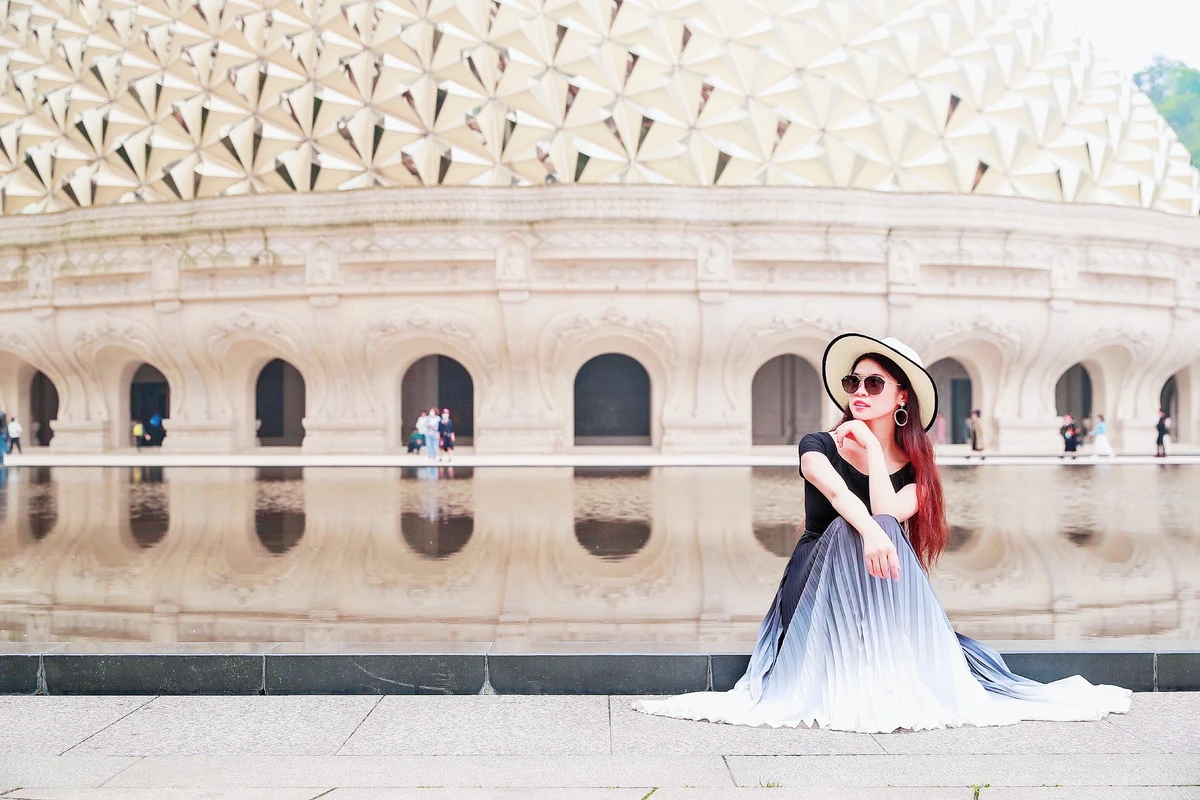
Taking the escalator, we quickly reached the platform of the Buddha's Crown Palace on the west peak. When the scene unfolded before my eyes, my first reaction was, "Oh my goodness, how can there be such an exquisite and beautiful place? What kind of celestial architecture is this?"… I admit, at that moment, my eyes were filled with surprise and disbelief. Only when a breeze blew, wrinkling the mirror-like water surface into ripples, did I believe the sight before me was real.
Looking closely, the exterior of the Buddha's Crown Palace comprises a large and a small dome. The undulating, beautifully curved one is the large dome, draped over the small dome like a kasaya robe. The small dome is even more exquisite, topped with a Cintamani jewel and resting on a lotus throne, presenting the sacred image of "a lotus supporting a precious gem."
Don’t think the Buddha's Crown Palace is only beautiful on the outside; the interior will also impress you. The palace consists of the Grand Meditation View and the underground palace. To reach both places, you need to take a downward escalator.
We first visited the Grand Meditation View. Looking around in the vast space, the sala dome had a stunning blue hue, like a sea of stars. A little secret: this dome is magical—because of the light-transmitting membrane and lighting design, it can simulate morning dawn, midday sunlight, evening glow, and silver moonlight… Sounds amazing, right?
From top to bottom, your gaze finally lands on a pure white Buddha statue. If you look closely, you’ll notice this statue is slowly rotating. Yes, it rotates 360 degrees slowly, allowing you to appreciate its serene face and state of mind from every angle without any blind spot. Strolling slowly in this tranquil and poetic place instantly calms your restless heart.
After saying goodbye to the Grand Meditation View, we continued on the downward escalator and soon reached the Relic Hall and Relic Vault, sacred places that house the Buddha’s parietal bone relic. Upon entering, my mouth hung wide open the whole time—it was simply awe-inspiring.
Unlike the Grand Meditation View, here everything was resplendent and visually stunning. With the high ceiling and intricate beauty on all sides, you had to tilt your head back and keep moving to take in the 360-degree grandeur.
Gazing at the magnificent sight, I fell into deep thought: Who could have imagined that this was once an abandoned mine, and now it is a Buddhist sacred site that amazes everyone? After coming out, I remained in a state of profound wonder…
A friendly tip: this place is extremely photogenic. If you love taking pictures, you can come dressed beautifully and snap away. I’ll share a few nice photo spots: one is the reflection in the water right in front of the Buddha's Crown Palace; another is the European-style corridor beneath the small dome…
Attraction: Niushou Mountain Cultural Tourism Zone
Opening hours: 8:30–17:00
Ticket price: 88 yuan
Address: No. 18, Ningdan Avenue, Jiangning District, Nanjing, Jiangsu Province
Note: Remember to bring your ID card
2. 【Confucius Temple】: China’s first national highest academy
When you first visit Nanjing, Confucius Temple is a must-go. It is a sacred place for worshipping Confucius and was China’s first national highest academy, a hub of ancient Chinese culture… As Confucius Temple is to Nanjing, the Forbidden City is to Beijing and the Bund is to Shanghai—it is the city’s most representative tourism signature.
Confucius Temple is located in the core area of the Confucius Temple Qinhuai Scenic Belt, mainly composed of three architectural groups: the Confucian Temple, the Imperial Academy, and the Examination Hall. When you follow the crowds to the bustling bank of the Qinhuai River, you have arrived at the temple. On the riverside stands a tall memorial archway inscribed with the four characters "Tian Xia Wen Shu" (Epicenter of Culture and Learning). Just four characters, but they exude tremendous confidence and authority, don’t they?
Behind the "Tian Xia Wen Shu" archway is the Lingxing Gate, inlaid with peony brick relief carvings, and the ornamental columns carved with auspicious clouds… Do you know, this gate was once a passage for emperors to make pilgrimages and worship Confucius. Now, ordinary people can freely stroll through it laughing and chatting!
Passing through Lingxing Gate, you come to the Dacheng Gate of Confucius Temple. Though it’s just a gate, there’s much to it. The central gate, also called the Ji Gate, was not open to everyone. On the first and fifteenth of each lunar month for worship, and during spring and autumn ceremonies, only county officials, magistrates, and instructors could pass through it. Scholars had to use the side doors. Today, Dacheng Gate is wide open, welcoming visitors from all over the world.
After stepping through Dacheng Gate, you’ll notice the characters "Li" (Rites) and "Ren" (Benevolence) on the left and right walls, representing the two core ideas of Confucian thought.
Continuing forward, you face a group of stone statues. At the end of the line of sight is the Dacheng Hall, where the sage Confucius stands in the center, with piercing eyes, looking eagerly at his disciples.
Dacheng Hall is the main hall of Confucius Temple.
Entering Dacheng Hall, you see a portrait of Confucius with his hands folded in salute. This is the largest Confucius portrait in China. Around it are displayed many replica ancient ritual musical instruments; with luck, you might hear the sound of bells and drums. Many parents gather here, either making wishes or kowtowing, murmuring, "May my child pass the exam with high honors"… Seeing their devout eyes and movements, I was deeply moved.
Confucius Temple follows a front-temple-back-academy layout. Past Dacheng Hall is the Imperial Academy, where the gate of "Southeast No. 1 Academy" sees a constant stream of visitors.
Looking around inside, the overall architecture is symmetrical and rigorous, truly outstanding among classical buildings.
I thought that was the end, but there’s still a Zunjing Pavilion at the back, which also houses the Chinese Academy History Exhibition Hall and the Confucius Temple Folk Art Grand View Garden. If you’re interested in the history of academies, don’t miss it. Though small, it has everything. Stroll through it, and you’ll gain a wealth of knowledge about academy history.
Beyond being a place of nostalgia, Confucius Temple is also a food street. There’s a dizzying variety of snacks here. You could try duck blood vermicelli soup. I recommend Lao Shengqing’s, on Wuyi Lane. It’s a bit more secluded, but offers great value—a 26.8 yuan set meal includes a bowl of duck blood vermicelli soup, four pieces of stinky tofu, and a duck oil pastry.
Attraction: Confucius Temple
Opening hours: 09:00–22:00
Ticket price: 30 yuan (Dacheng Hall)
Address: No. 80-1, Gongyuan Street, Qinhuai District, Nanjing, Jiangsu Province
3. 【Qinhuai River】: An ordinary river with an extraordinary destiny
"A district of misty moon from the Six Dynasties, a place where powder and beauty gather"—this is the ten-li Qinhuai River!
The Qinhuai River is Nanjing’s mother river and China’s most famous historical waterway… Amidst the oar sounds and lantern shadows, it carries not only romance and elegance but also a pure heart.
The Qinhuai River originates from two tributaries in Jurong and Lishui, which converge in Jiangning District, flow through urban Nanjing, and finally merge into the Yangtze River. It has two branches: one passes under the Nine Dragon Bridge and enters Nanjing city through Dongshui Pass, becoming the inner Qinhuai River, i.e., the ten-li Qinhuai; the other bypasses the city wall from Tongji Gate via Zhonghua Gate, known as the outer Qinhuai River, which also serves as the moat.
My impression of Qinhuai River comes entirely from Confucius Temple and the Eight Beauties of Qinhuai, especially the latter. They are Liu Rushi, Chen Yuanyuan, Gu Hengbo, Dong Xiaowan, Bian Yujing, Li Xiangjun, Kou Baimen, and Ma Xianglan. Because of these talented, beautiful, and fiercely individual courtesans, I have an even greater longing for the prosperous ten-li Qinhuai.
On the riverbank beneath the "Tian Xia Wen Shu" archway, there is an entire stone wall carving dedicated to the Eight Beauties of Qinhuai. If you want to get to know them quickly, spend some time here.
It has to be said, as China’s premier historical river, the crowds here are endless, shoulder to shoulder… I hadn’t seen such dense human activity in over a year. After waiting in the crowd for a long time, I finally spotted an open spot and rushed over. Now what lay before my eyes was no longer a sea of heads but painted pleasure boats gliding on the water.
Watching this stretch of water, I seemed to glimpse the peak prosperity of the ten-li Qinhuai since the Eastern Wu period, and the beautiful scenes of the Eight Beauties and scholars composing poems and painting… As the boat broke the water’s calm, my fanciful reverie came to an abrupt end.
Ah, Qinhuai River, you are an ordinary river, yet you gathered countless merchants, talents, and beauties, who together created a center of Jiangnan culture and left behind stirring tales of love, hate, infatuation, and obsession… Because of that, you, an ordinary river, became extraordinary—a waterway imprinted with deep human emotion.
You gave, and you received in return. In turn, this river adorned the dreams of scholars and the windows of beauties… Barren human activity, nourished by you, became more poetic and picturesque.
Attraction: Confucius Temple Qinhuai Scenic Belt
Opening hours: 24 hours
Ticket price: free
Address: Confucius Temple Qinhuai Scenic Belt, Qinhuai District, Nanjing, Jiangsu Province
Note: It’s extremely crowded here. When taking photos, be careful with your valuables and remember to wear a mask.
1. 【Presidential Palace】: A model of Nanjing’s Republican-era architecture
When mentioning Nanjing, you can’t escape the term "Republican elegance." As is well known, Nanjing is a city steeped in this atmosphere, and the key to unlocking it lies in its many Republican-era buildings. Among them, the Presidential Palace is the prime representative. It has a history of over 600 years. In the early Ming Dynasty, it housed the mansions of the Marquis of Guide and the Prince of Han; in the Qing Dynasty, it became the Jiangning Weaving Office and the Governor-General of Liangjiang’s office. Emperors Kangxi and Qianlong both used it as a temporary palace on their southern tours…
The Presidential Palace embodies both the traditional Jiangnan garden style and remnants of modern Western architecture. How could I not yearn for such a beautiful and historically rich Republican building?
On my second day in Nanjing, I rushed straight to the Presidential Palace. Upon arrival, I embarrassingly realized I had forgotten my ID card. Note: to enter, you must swipe your ID card, not scan a QR code, whether you bought tickets online in advance or at the door. If you forget your ID, don’t worry—go to the counter and apply for a temporary electronic ID, then show it to the ticket seller. This method works, but it’s somewhat troublesome, especially when there’s a long queue.
After getting the electronic ID, I headed to the entrance, where a long line had already formed. A popular attraction indeed, with countless visitors daily—and this is the norm.
Once inside, I first walked into a courtyard with dense shade.
Further in is the famous "Tian Xia Wei Gong" archway. I couldn’t help but sigh—it was so crowded that taking a tourist photo was a struggle.
The Presidential Palace is divided into three zones: the central area mainly contains the presidential office and its affiliated institutions; the west zone has the temporary president’s office, secretariat, and West Garden; the east zone mainly holds the Executive Yuan and Tao-Lin Memorial Hall.
Though the area isn’t huge, there’s plenty to see. Because there have been so many visitors recently, it’s unrealistic to see every exhibition hall and every corner. The presidential office on the second floor, in particular, was packed—a sea of people inching forward at a snail’s pace…
To avoid the crowds as much as possible, I suggest just looking around the periphery, like strolling along the west central axis, where you’ll find Xu Garden, Fangsheng Pavilion, Yilan Pavilion, and the Stone Boat. Xu Garden is a Jiangnan garden named after Prince of Han, Zhu Gaoxu, because of the character "Xu" in his name. In January 1912, the temporary president’s office and living quarters were located here.
Yilan Pavilion sits in the middle of the water, connected to the shore by a stone bridge. In the past, this was the confidential room of the Taiping Heavenly Kingdom.
The Stone Boat, also called the Unmoored Boat, is built from ten layers of giant bluestone—commonly seen in Jiangnan cities. Even though it’s made of stone, it doesn’t lack any of the graceful curves.
Apart from these buildings, there is a tall hydrangea in a waterside courtyard. This season, its blossoms are exceptionally lush and beautiful, with white walls and blue tiles on one side and a lake reflection on the other, attracting everyone to take photos—it’s the Presidential Palace’s new online celebrity.
Attraction: Presidential Palace
Opening hours: 8:30–18:00
Ticket price: 35 yuan
Address: No. 292, Changjiang Road, Xuanwu District, Nanjing, Jiangsu Province
Note: It’s extremely crowded here. When taking photos, be careful with your valuables and remember to wear a mask.
2. 【1912 Block】: Reliving Republican elegance here
For Chinese people, 1912 is not an unfamiliar number. It was a special year when many historic events took place. For example, it was the year Nanjing became the capital of the Republic of China, shaping the city’s innate Republican charm.
"What was once the presidential residence is now the city’s living room." After leaving the Presidential Palace, walk west along Changjiang Road for about 200 meters, and you’ll reach the 1912 Block. For Nanjing, the 1912 Block is like Tianzifang for Shanghai, Nanluoguxiang for Beijing, and Kuanzhai Alley for Chengdu—a culturally significant commercial and cultural block.
The 1912 Block consists of nine Republican-style buildings. It may seem small, but it can be quite a walk. Strolling through, you’ll find yourself surrounded by gray-blue and brick-red Republican architecture. Around a corner, a cute little train might appear, along with stained glass on doors, ivy on walls, English signs on windows—all brimming with artistic vintage flair.
The 1912 Block mainly hosts various restaurants and bars, such as KFC, Red Mansion, and Nanjing Da Paishou. Don’t be fooled by the quiet, artistic vibe during the day; it takes on a different charm at night. Unfortunately, I didn’t visit in the evening this time, so I’ll have to make up for it next trip.
Besides eateries, there’s a East-West Creative Market selling adorable trinkets—perfume, small accessories, little dolls, and so on. When ladies come here, they tend to browse every shop; by the time they leave, they’ll likely be holding a cute item or two.
The 1912 Historical and Cultural Block is right at the entrance of Changjiang Road, opposite Daxinggong Station on Metro Line 2, so it’s very accessible. I recommend visiting it on the same day as the Presidential Palace.
Attraction: 1912 Block
Opening hours: 24 hours
Ticket price: free
Address: No. 8, Changjiang Backstreet, Xuanwu District, Nanjing, Jiangsu Province
3. 【National Art Gallery】: Watch an exhibition of classic animation with a sense of history
Still craving more Republican architecture and culture? Then don’t miss the National Art Gallery site on Changjiang Road. Located at No. 266 Changjiang Road, it was completed in 1936 and was China’s first national art museum. In 1960, it was renamed the Jiangsu Province Art Museum.
Did you know this gallery didn’t come easily? In the early Republic, there were no art museums in the country. Thanks to the tireless efforts of cultural giants like Lu Xun and Cai Yuanpei, and famous painters like Xu Beihong and Liu Haisu, this National Art Gallery was finally established.
When you spot a stone tablet reading "National Art Gallery Site" beneath lush plane trees, you’ve arrived. Note: admission is free but requires a ticket, so you’ll need to register at the entrance to get one.
Facing the main building, this streamlined “mountain-shaped” structure is simple yet grand, inspiring quiet admiration. It turned out to be perfect timing: there was an exhibition titled “Oriental Charm: Classic Chinese Animation Works and Documents Exhibition,” offering many animation films to enjoy.
Calabash Brothers—classic and beloved enough, right? A collective memory of the post-80s generation. Did that touch a tender spot in your heart?
Nine-Colored Deer, adapted from the Dunhuang mural “The Deer King Jataka,” tells the story of Sakyamuni’s previous life as a nine-colored deer king who saved a drowning man, only to be betrayed later…
There are also familiar works like Magic Brush Ma Liang and Legend of Sealed Book. I suggest viewing them carefully, and even reading the accompanying text for deeper understanding.
Inside the National Art Gallery, besides enjoying classic animation, you can also take beautiful photos in the style of Ni Ni at the long bench upstairs. The spacious floor-to-ceiling windows, vintage chandeliers, and warm sunshine… If you love posing, don’t miss it. Be aware, though, quite a few people come to take photos here, so you might need to queue for a bit. If time allows, a weekday visit is recommended.
Attraction: National Art Gallery
Opening hours: 24 hours
Ticket price: free
Address: No. 8, Changjiang Backstreet, Xuanwu District, Nanjing, Jiangsu Province
1. 【Xuanwu Lake】: Nothing beats daydreaming here
I personally like cities with water. I always feel water brings spirit and poetry. In Nanjing, besides Qinhuai River, Xuanwu Lake is also worth a visit. It’s free to enter, which is very citizen-friendly.
Xuanwu Lake, a Jiangnan imperial garden, is known as the "Pearl of Jinling." It is bordered by Purple Mountain in the east and the Ming City Wall in the west, with Fuzhou Mountain to the south and Nanjing Railway Station to the north—a truly blessed location. As a renowned imperial lake, Xuanwu Lake has a long history.
This body of water has existed since the pre-Qin period. During the Six Dynasties, emperors reviewed their navies here. In the Northern Song Dynasty, due to Wang Anshi’s policy of “abolishing the lake and reclaiming farmland,” Xuanwu Lake disappeared. In the Yuan Dynasty, it reappeared. In the Ming Dynasty, it was designated a royal forbidden area, exclusively for storing the Yellow Registers—national household and tax records and land registries… Through all these changes, it has finally become a backyard garden for ordinary people to enjoy.
At dusk, our group arrived at Xuanwu Lake. Standing on the bridge and looking around, the water shimmered, and boats drifted freely—so relaxing and pleasant.
The cutest were the boats shaped like rubber ducks. Those on board were inside a painting, unaware they had become a scenic view for people on the bridge.
Cross the bridge and head to the willow-lined shore. A gentle breeze ruffled the calm water and swayed the graceful willows… Sitting under a willow tree, feeling the breeze, watching the boats, with nothing on your mind—it just felt wonderful.
Attraction: Xuanwu Lake Park
Opening hours: 24 hours (park attractions: 6:00–21:00)
Ticket price: free
Address: No. 1, Xuanwu Lane, Xuanwu District, Nanjing, Jiangsu Province
2. 【Green Expo Garden】: Into the green kingdom of birdsong and flowers
Nanjing is a historic tourist city. Famous sites like the Presidential Palace and Confucius Temple Qinhuai are always packed… If you want to experience a lesser-known, different side of Nanjing’s beauty, take a stroll in the Green Expo Garden.
The Green Expo Garden was the venue for the first China Green Expo. It borders Yangzijiang Avenue in the east and the Jiajiang section of the Yangtze River in the west, making it the largest urban park along the river, with top-notch environment. Stretching 3 kilometers along the Yangtze embankment, it contains 45 scenic spots, including 35 domestic gardens, 5 international gardens, 2 industry gardens, and 3 natural scenic areas beyond the embankment… The whole garden is quite large; if you want to cover it all on foot, it might take a full day.
If time or energy is limited, follow me to check out the following spots. One is the Dutch windmill, built on a large lawn. The red-brick chimney tower has two pairs of blue blades turning. It’s fun to take photos here—you can strike a pose or run freely and be captured, resulting in pictures full of childlike joy. A reminder: this spot is very sunny and exposed, so take sun protection measures beforehand.
The second is the rose flowers outside the Dutch windmill. They are blooming so brilliantly, that as far as the eye can see, the road is lined with pink blossoms, and the air carries a delightful fragrance. Pose quickly and take portrait after portrait—so beautiful!
Attraction: Nanjing China Green Expo Garden
Opening hours: 08:00–17:30
Ticket price: free
Address: No. 228, Yangzijiang Avenue, Jianye District, Nanjing, Jiangsu Province
In Nanjing, besides journeys through culture and history, through Republican architecture and art, and through fresh, lung-cleansing nature, there are many other themed journeys. Over three days, although we visited quite a few spots, it was only a cursory glance, and many regrets remain. For example, I didn’t take a night boat ride on the Qinhuai River. For example, due to weather, I missed a few art museums and museums with special designs that I had been longing to see. For example, because of time, I couldn’t leisurely sip coffee at the Librairie Avant-Garde on Yihe Road...
On second thought, regrets are also good, because with regrets, there’s a reason and motivation to set off again, isn’t there?
Goodbye, Nanjing! I look forward to our reunion someday…
Hi, I’m Manyou, a travel- and photography-loving pixie. Follow me and I’ll take you to more poetry and the distance!
Travelogue Index
1. Opening words
2. Brief itinerary
3. Photo preview
4. 【I】’: Culture and history journey
5. 【II】: Republican architecture and art journey
6. 【III】: Fresh-air and green journey
7. Closing words
Travel information
Hotel index
Travel guide index
Flight ticket index
Website navigation
Tourism index
Cruise index
Corporate travel index
Cooperation
Affiliate alliance
Friendship links
Corporate gift cards
Insurance agent cooperation
Hotel partner recruitment
Destination and scenic area cooperation
More cooperation
About Ctrip
About Ctrip
Ctrip hotspot
Contact us
We’re hiring
User agreement
Privacy policy
Business license
Security center
Ctrip Content Center
Intellectual property
Trip.com Group
Algorithm disclosure


