Down to Yangzhou in March: The West Lake, So Slender, So Slender…
Taking advantage of a flight discount, in the fine spring month of March, and coinciding with the May Day holiday, I traveled with my husband and child down to Jiangnan.
“There are thirty-six West Lakes under heaven,” but the West Lake in Yangzhou stands out with its delicate and graceful beauty. Compared to Hangzhou’s West Lake, it possesses a certain slender charm. Qing-dynasty poet Wang Hang from Qiantang wrote: “Weeping willows stretch unbroken into faded grass, the rainbow bridge like wild geese in formation resembles a painting. It is also a melting pot of gold, hence it should be called Slender West Lake.” Thus Slender West Lake got its name and became famous far and wide. So, we headed straight for it.
Jiankang, Jinling, and the Eight Beauties of Qinhuai—these were my impressions of Nanjing from history class. So we made a stop there!
Day 1: Ge Garden
Yangzhou’s Ge Garden is renowned for its bamboo and rockeries; even the “个” in the garden’s name is taken from half of the Chinese character for bamboo. Throughout the garden, lush bamboo was planted, echoing Su Dongpo’s line: “I would rather eat without meat than live without bamboo; without meat one grows thin, without bamboo one becomes vulgar.”—to show the owner’s refined taste. Ge Garden is famous for its exquisite rockery piles representing the Four Seasons. The rockery art employs the technique of using different types of stones on different peaks, creating four scenes—spring, summer, autumn, and winter—with varied stone materials. Each seasonal rockery has its own character, expressing the poetic imagery of “spring scenery is gorgeous and seems to smile, summer mountains are verdant as if dripping green, autumn mountains are clear and bright like makeup, winter scenes are desolate as if sleeping” and “spring hills are best for strolling, summer hills for viewing, autumn hills for climbing, winter hills for dwelling.” The garden also contains the owner’s ancient mansion, making one feel the deep, deep layers of courtyards.
Dongguan Street, its main thoroughfare paved with stone slabs, is lined with the gray-brick, gray-tile mansions of salt merchants. The concentration of delicious snacks and local souvenirs adds to the joy of strolling, truly deserving its reputation as “a representative historic old street in Yangzhou.”
The Ancient Grand Canal: The Yangzhou section is the oldest part of the entire canal, perfectly coinciding with the route excavated under Emperor Yang of the Sui dynasty, forming the famous “Three Bends of Yangzhou.” This stretch is the most ancient, dotted with historical sites and rich in cultural landscapes. The scenery is exceptionally beautiful and enchanting. It was right behind our hotel, so we would take a walk there after meals.
Day 2: Nanjing
Sun Yat-sen Mausoleum, a must-visit. I had been there over a decade ago, but since my husband hadn’t, we went again. The entire complex is built along the mountain slope, arranged on a central axis from south to north, and the layout resembles an “alarm bell” shape.
Laomendong was right in front of our guesthouse, very convenient for evening strolls and food. That day there was even traffic control.
Day 3: Nanjing and Yangzhou
In the morning, Confucius Temple was pleasantly uncrowded. First built in the Song dynasty, it sits near Gongyuan Street on the north bank of the Qinhuai River; originally a shrine to Confucius, it was destroyed and rebuilt many times. Along with the Confucian temples in Beijing, Qufu, and Jilin, it is one of China’s four great Confucian temples, and it’s the main attraction in the Confucius Temple–Qinhuai River scenic belt. Walking along the Qinhuai River and taking photos was lovely. Due to time, we’ll try the Eight Beauties of Qinhuai next visit. Boating we also plan for another evening.
He Garden, also called Jixiao Mountain Villa. The covered corridors are a major feature; I almost got lost in them that day. The collision of Qing-dynasty and Western culture is vividly visible, perfectly blending East and West. Personally, I prefer He Garden over Ge Garden.
Day 4: Yangzhou
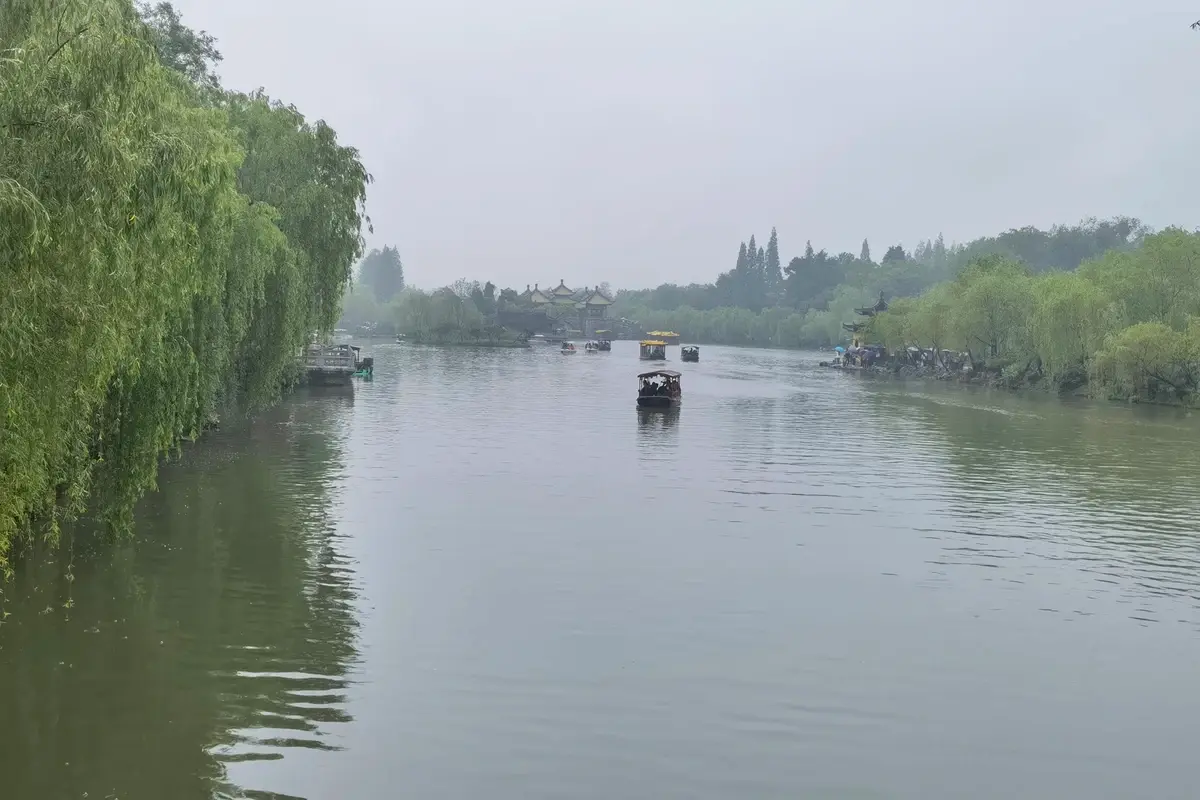
Slender West Lake, the grand finale of our trip. As luck would have it, it was drizzling that day, which perfectly suited the mood. Slender West Lake is a narrow, elongated waterway. We entered at the South Gate, passing Xu Garden, Fishing Terrace, Five-Pavilion Bridge, White Pagoda, and Twenty-Four Bridge all the way to the West Gate, then took a boat to the North Gate. We savored the poetic and artistic heritage left by generations of literati, and felt the carefree spirit of Emperor Qianlong when he toured the lake.
At the Eight Eccentrics Museum, I finally understood that the ‘Eight Eccentrics’ are not eight individuals but a group, representing a spirit of innovation.
At the Han Guangling King Tomb Museum, you can see a replica of the unearthed jade burial suit sewn with gold threads, and the spectacular authentic wooden burial chamber in the ‘huangchang ticou’ style—the highest-grade funeral system reserved for ancient emperors.
When in Yangzhou, you mustn’t miss the intangible cultural heritage of back scrubbing. As a Cantonese person, I shyly and awkwardly gave it a try—very interesting. The essence of Yangzhou back scrubbing is ‘eight light, eight heavy, eight thorough,’ a tradition passed down over centuries, emphasizing techniques that are light yet perceptible, heavy but not painful—gentle to care for the skin, firm to invigorate the body.
As for food, I still think Cantonese cuisine is the best. I won’t go on about it!
In March, down to Yangzhou—pacing through poetic verses, drifting in a boat through the ancient city. Ge Garden’s little scenes, fragrant narrow lanes, relics of the Sui and Tang, Jianzhen’s Daming Temple. And the West Lake, so slender, so slender. Yangzhou is worth visiting again and again!
Recorded on May 4, 2021, at Taizhou Airport.


