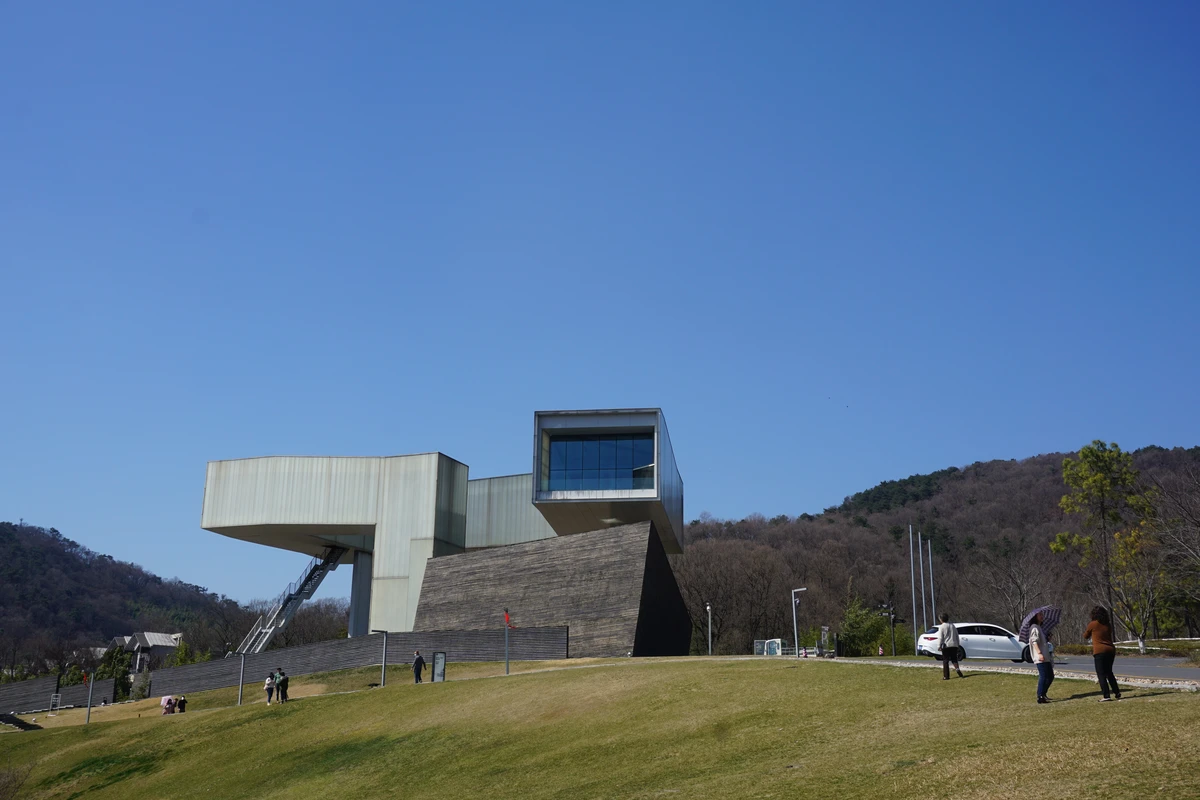
The Most Beautiful Mountain Art Museum: Sifang Contemporary Art Museum
Travel date: February 2021
Travel mode: self-driving
Address: Sifang Contemporary Art Lake District, Nanjing
Itinerary: Sifang Contemporary Art Lake District (24 buildings, including Sifang Contemporary Art Museum) — Doushuai Temple in Laoshan Forest Park
The Sifang Art Lake District covers a vast area, sometimes on a hillside, sometimes in a valley. We drove around the district, stopping now and then. Drive, pause, drive again, pause—there was so much to see in this expansive district. We saved the Sifang Contemporary Art Museum, the place we had come for, for the end. The museum is one of the most remarkable and important art buildings in the district. Perched on a hillside, its distinctive silhouette can be seen from many angles within the district.
Looking up at the building from the foot of the hillside, it's a palette of black, white, and gray. The dark exterior walls and the solid lower volume support a translucent structure floating above, like a box suspended in the air.
Walking up the gentle slope toward the museum, we looked back at the Conference Center nestled in the valley.
We stepped into a semi-enclosed space defined by black bamboo-formwork concrete walls. The plain black walls bore the unpretentious bilingual name 'Sifang Contemporary Art Museum,' while an L-shaped glass window and door exuded a strong contemporary art vibe. The Chinese characters '灵与景' (Spirit and Landscape) on the glass announced the theme of the current major exhibition.
Looking up from this semi-enclosed space, the sky was exceptionally blue. The blue, paired with the white and black bases suspended in mid-air, created pure, ultimate colors.
The crisscrossed bamboo-formwork concrete walls echoed with the swaying green bamboo. Old tools on the lawn gave a strong industrial vibe.
A pool of emerald water in the courtyard softened the industrial atmosphere with a touch of tenderness.
The irregular architecture, the ultra-cool staircase, and the parallel overlapping translucent volumes instantly transported us into an artistic realm, immersing us in the beauty of unconventional forms.
The black courtyard walls on the lower level and the white exhibition hall floating high above—the contrast of black and white with the elevated volume made the main structure even more striking.
In the courtyard, gazing up at the white aerial structure, a long steel staircase stretched upward, piercing through the floating volume above.
The entire building gradually rises, its pathway evolving from straight at the bottom to winding, lifting the upper gallery into the air. Unfolding clockwise, a grand staircase connects the suspended space to the ground, possessing a strong sculptural quality.
The large staircase that diagonally links the elevated volume serves both as a circulation route and enriches the overall architectural form.
Viewed from different angles, the sinuous steel staircase exudes a dynamic elegance.
The aerial structure spread lightly among the clouds, brimming with modernity.
Behind this half-wall was the museum entrance.
Inside, a service desk stood in the center.
The structure here is unlike the typical boxy feel of most museums. The topography itself is distinctive: the ground floor undulates like a wave. The interior color scheme is predominantly white. White walls and white trusses make the space feel spacious and bright. Parallel rows of trusses with lights provide illumination. The marble-textured floor exudes an antique elegance, lending a special ambiance.
The museum's interior layout is like an immersive artwork—every step reveals a new view, each turn and intersection offering a fresh visual experience. To the left is an art shop focusing on creative products and books, with a counter serving tea, coffee, and desserts.
In the center, low cabinets displayed an array of books.
On the white walls, colorful posters; a few small tables and chairs, each one uniquely shaped.
A transparent glass side table, a languid painting, and a potted plant—every detail was so artistically tasteful.
Shelves on the wall, a long table by the wall, and low cabinets in the center filled with a dazzling array of creative products that overwhelmed my eyes.
Each item was full of creativity.
At the far end, there was also a café.
After browsing the shop, we returned to the exhibition area. The museum was hosting the 'Spirit and Landscape' art exhibition, showcasing works by Swiss artist Miriam Cahn and Peruvian artist Claudia Martínez Garay.
The exhibited works spanned oil paintings, sketches, watercolors, installations, sculptures, videos, collages, and murals created for the museum's specific spaces. They explored how the artists rethink the relationship between 'spirit' and 'landscape' and express it through art.
Large-scale murals on the entire wall, together with tufted tapestries, created a powerful visual impact.
A portrait-like close-up of an alpaca.
The tufted tapestry patterns drew from various motifs in Andean culture.
The exhibition presented contrasting and ambiguous imagery of animals and humans, bodies and plants, terror and allure.
Descending the granite staircase, we entered an underground exhibition space. The staircase seamlessly connected the ground-floor and underground exhibition areas. The design integrated the stairs and landing into a perfect blend, providing a cozy nook to rest.
On the landing, a sand painting installation featured Claudia Martínez Garay's ceramic sculptures placed upon it.
The expansive sand painting and the wall mural together created an artistic space.
After exploring the ground floor and basement, we took the elevator up. The elevator doors opened to a straight corridor, at the end of which was a large panoramic window. The white-dominated setting combined with translucent solar panels made the entire upper exhibition space bright and serene.
The wall resembled a broken palette of paint colors.
The aerial gallery displayed a group of paintings by Miriam Cahn. Portraits and figure paintings lined a wall, vividly depicting violence, refugees, women, children, and those who have been insulted and hurt.
Miriam Cahn is known for her oil paintings on canvas. While contemplating the contemporary human condition, she always places her figures within an inner world where they coexist with animals and plants.
The images are intense and poignant, a tense response to trauma, war, violence, and social conflict.
Love remains the eternal theme of the world.
The museum's design, with its interlocking spatial layers, creates varied viewing angles while integrating with the surrounding gardens and waters. At the end of the corridor, a large window; below, the entrance to the district where we had arrived. The museum is actually located right at the district's entrance, but we chose to drive deep into the lake area first, saving the museum—our grand feast—for the last.
The setting here expresses the relationship between humans and the environment. Beyond the full-wall window, a large platform juts out into the air.
Stepping onto this aerial walkway felt like merging with the sky. Looking around, we faced the skyline of Nanjing, establishing a connection with the place. Gazing down upon the lakeside, buildings of various sizes and distinct styles dotted the rolling green hills.
From the elevated gallery, we could see architecture in the foreground, the lake and forest in the middle ground, and the cityscape in the distance, all parallel layers creating a rich spatial depth.
Built in the mountains, on a hillside, away from the bustle of the city and tourist crowds, the museum enjoys a superb vantage point. Its location creates a world that feels almost unreal—pure, natural, and serene, harmoniously coexisting with the landscape and trees. Walking through the museum, whether in the indoor exhibition area, the sky gallery, or the outdoor spaces, feels like strolling inside a painting.
After the visit, we returned to the forested space. From here, Sifang Contemporary Art Museum looked as if a giant lens was aimed at you—the very sky platform from which we had just admired the Nanjing skyline. The museum is more than its internal exhibitions: its structure, beautifully irregular due to the natural topography; its irregular geometric form; and the long staircase linking the aerial gallery to the outer space—all make the architecture itself a sculptural landscape. Sifang Museum truly deserves the title of the most beautiful mountain art museum.


