【Autumn in Nanjing】Free Fall Foliage, Gingko and Red Walls, Tangshan Hot Springs, Qixia Mountain; Plus Duck Blood Vermicelli Soup and Salted Duck
Nanjing is a city where history meets modernity, where tradition blends with innovation, and where the ancient coexists with the young. Shaped by the trials of the 'Ancient Capital of Ten Dynasties' and illuminated by the brilliance of a modern metropolis, Nanjing, a historic city nestled by mountains and water, exudes unique charm. The majestic Zhongshan Mountain, the shimmering Qinhuai River, the soul of Xuanwu Lake, the spirit of Yuhua, the Youth Olympic Games conversing with the Six Dynasties, and the Zifeng Tower gazing upon the Republic of China era. Yibai Hotel looks forward to exploring the city's ancient simplicity and modern beauty with you.
The Ming Palace, consisting of the Imperial City and the Palace City, was grand and magnificent, serving as the blueprint for Beijing's Forbidden City. It served as the imperial palace for three early Ming Dynasty reigns—Hongwu, Jianwen, and Yongle—lasting 54 years. After Emperor Yongle (Zhu Di) moved the capital to Beijing, the Ming Palace gradually fell into decline, and now only the foundation stone components buried underground remain.
The existing Nanjing City Wall was built in the early Ming Dynasty under the order of Emperor Hongwu (Zhu Yuanzhang). Unlike other city walls in China, Nanjing's wall is irregular in shape. The Ming Dynasty city originally had 13 gates, but only a few remain today.
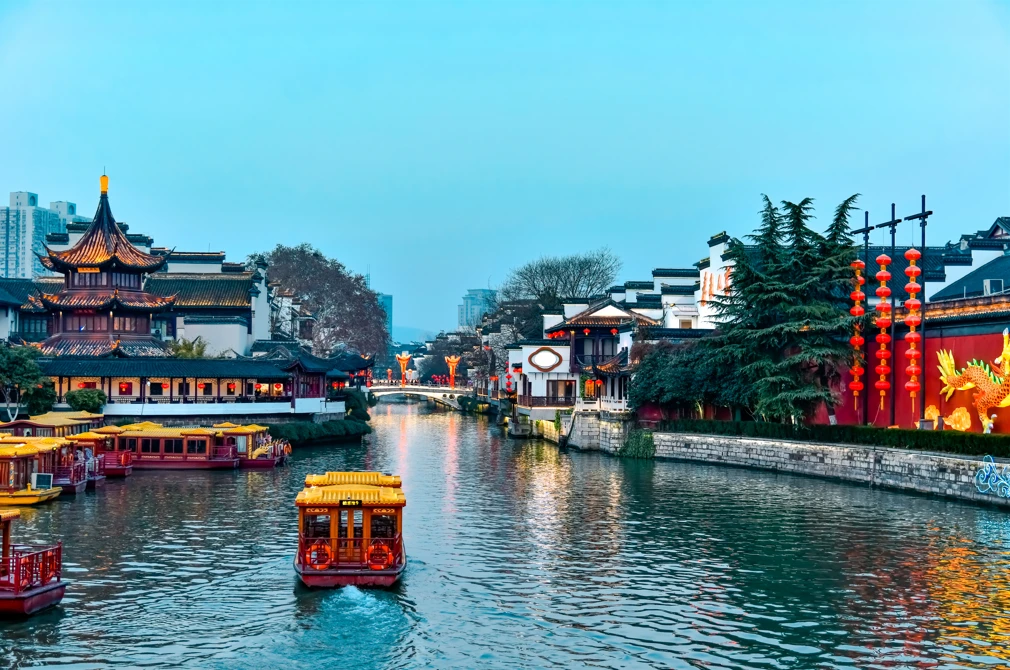
Confucius Temple, first built in the Song Dynasty, is located on the north bank of the Qinhuai River near Gongyuan Street. Originally a place for worshipping Confucius, it has been destroyed and rebuilt multiple times. Along with Beijing's Confucius Temple, Qufu's Confucius Temple, and Jilin's Confucian Temple, it is one of China's four great Confucian temples, and a major attraction in the Confucius Temple-Qinhuai River Scenic Area.
Nanjing Tangshan Hot Spring Tourist Resort is located in Tangshan Subdistrict, Jiangning District, Nanjing. A national-level tourist resort integrating steles, springs, caves, lakes, and temples, it blends cultural landscapes with natural scenery. It is also a world-renowned hot spring therapy area, ranking first among China's four major hot spring resorts, and is praised as 'a thousand-year sacred hot spring, a paradise for health and wellness'.
Tangshan, anciently named 'Hot Spring', has a history of over 1500 years. Since the Southern Dynasties, it has been a destination for officials and literati to bathe and relax. During the Xiao Liang period of the Southern and Northern Dynasties, the emperor designated it as 'Sacred Spring'. The daily water output reaches 5,000 tons, with a constant temperature of 60-65°C, containing over 30 minerals and trace elements. It is ideal for hot spring therapy, fitness, entertainment, and hot spring resort activities.
Jiming Temple, also known as Ancient Jiming Temple, is located on the eastern foothill of Jilong Mountain in Xuanwu District, Nanjing. Built in the first year of the Yongkang reign of the Western Jin Dynasty (300 AD), it has a history of over 1700 years, making it one of Nanjing's oldest Buddhist temples and royal monasteries. Its incense has never waned, and it has been hailed since ancient times as 'the First Temple of the Southern Dynasties' and the foremost of the '480 Temples of the Southern Dynasties'. During the Southern Dynasties, it was on par with Qixia Temple and Dingshan Temple, serving as the Buddhist center of China at the time.
Qixia Mountain is hailed as 'Jinling's First Bright and Beautiful Mountain'. During the Southern Dynasties, the 'Qixia Abode' was built here, giving the mountain its name. It is a national 4A-level tourist attraction and one of China's four best places to view maple leaves. Known as a 'renowned site of the Six Dynasties', it was listed in the Ming Dynasty as one of the 'Forty-Eight Scenic Spots of Jinling', and there is a saying that 'One Qixia Mountain preserves half of Jinling's history'. It boasts over 80 historical relics and sites, embodying religious, imperial, and tea cultures. The ancient Qixia Temple, a millennium-old monastery, the ancestral temple of the Sanlun (Three Treatise) School of Buddhism, and one of the 'Four Great Buddhist Monasteries', sits on the western foot of Qixia Mountain.
Since the Ming Dynasty, there has been a saying: 'In spring, visit Niushou; in autumn, visit Qixia.' 'Qixia's Red Maples' is one of the 'New Forty Scenes of Jinling'. The maple-covered ridge on the western side of the mountain, with its dense maple forests, is the main attraction of Qixia Mountain and one of China's four best maple-viewing sites. Qixia has many types of red-leaved trees, predominantly sweetgums, but also red maples, Japanese maples, trident maples, feather maples, zelkova trees, and Chinese pistache. Every late autumn, the mountain turns completely red, as if sunset clouds have descended, creating a spectacular sight.
Nanjing's snacks are famous nationwide, ranked first among China's four great snack cultures. Main gathering places include Confucius Temple, Lion Bridge, and Gan's Grand Courtyard. There are many specialty snacks, such as Huiwei Duck Blood Vermicelli, Shiwangfu Lion's Head Meatballs. Additionally, Nanjing offers Qinhuai Eight Unique Delicacies, Soup Dumplings, Boiled Shredded Dry Tofu, Duck Blood Vermicelli Soup, Ruyi Hui Lu Gan, Mixed Vegetable Tofu Pudding, Zhuangyuan Beans, Salted Duck, Steamed Dumplings, Wang Eggs, Stinky Tofu, Huozhuzi (live-bead eggs), Nannong Roast Chicken, and Sweet Taro Seedlings, among other flavorful snacks.
First and foremost is the most famous Duck Blood Vermicelli Soup. It is quite simple to make: duck carcasses are boiled to create a rich broth, then duck livers, hearts, and other duck offal are blanched with ginger slices to remove blood. A braising liquid is prepared, and the duck offal is simmered in it. In another pot, boiling water is prepared, and duck blood is added and boiled briefly, then removed and set aside. The soaked vermicelli noodles, duck blood, and braised duck offal are then simmered together in the broth. Finally, season to taste and sprinkle with some cilantro and green onions. Duck blood vermicelli is ready—a simple yet renowned delicacy.
Mixed Vegetable Tofu Pudding is a famous Nanjing snack, belonging to Jinling cuisine and Jinling snacks. Tofu lao, also called 'doubulao' in Nanjing dialect, means soft tofu curd or douhua. Nanjing's tofu pudding emphasizes a variety of condiments, complemented by over ten ingredients such as dried shrimp, pickled mustard tuber, wood ear mushrooms, chopped green onions, chili oil, and sesame oil. Not only is it visually appealing, but the taste is mellow, rich, fragrant, fresh, with a perfect balance of saltiness and spiciness. A special feature is the addition of mixed vegetables, symbolizing a bright and prosperous future.
Salted Duck is a famous Nanjing specialty, a representative of Jinling cuisine, also known as Osmanthus Duck. With a history of over 2,500 years, it is highly celebrated. The duck features white skin and tender meat, rich but not greasy, fragrant and delicious, boasting characteristics of being aromatic, crispy, and tender. The best Salted Duck is made around the Mid-Autumn Festival when the osmanthus is in full bloom, hence the name Osmanthus Duck. Salted Duck best captures the duck's natural flavor through a simple, back-to-basics preparation that removes excess fat, eliminates gamey taste, preserves freshness, and maintains tenderness. Regular consumption of Salted Duck can also help reduce inflammation, reduce swelling, and delay aging, making it particularly suitable for those with cardiovascular diseases.
Squirrel Fish is one of Nanjing's famous dishes and also one of the four signature dishes of Maxiangxing Restaurant. Squirrel Fish is often served as the last course at banquets, especially common in Zhejiang restaurants. It emphasizes visual appeal, which this dish certainly possesses. In preparation, the fish is fried twice: first to cook it through, and second to crisp up the outer skin. When sweet and sour sauce is poured over it, the fish remains crispy for a long time, making it especially delicious.
Yibai Hotel Nanjing Confucius Temple is located at No. 409 Jiankang Road, Qinhuai District, just 300 meters from Confucius Temple. Water City, Confucius Temple Pedestrian Street, and Bailuzhou Park are all very close. The hotel enjoys convenient transportation: Metro Line 1 Sanshanjie Station is 500 meters away, Metro Line 3 Station is 300 meters, and Jiankang Road Dazhongqiao bus stop is only 100 meters. Nanjing Lukou International Airport, Hurong Expressway, Nanjing Railway Station, Nanjing South Railway Station, and Nanjing East Bus Station are all easily accessible. Yibai Hotel adheres to the philosophy of 'convenience, safety, comfort, affordability, and innovation,' making it an ideal choice for your travel, leisure, and business needs.
Yibai Hotel is located on Maqun Street, close to the Fan Hongxian Martyrs Memorial Pavilion and Zijin City Plaza. The hotel's overall décor is simple yet stylish, with clean, cozy rooms in bright tones, equipped with air conditioning, LCD TVs, 24-hour hot water, and private bathrooms. The hotel also offers parking and other facilities. Attentive and warm service ensures guests can relax and enjoy a restful night's sleep.
Travelogue Contents: 1. Nanjing Ming Palace Ruins Park 2. Nanjing City Wall 3. Confucius Temple 4. Nanjing Tangshan Hot Spring 5. Jiming Temple 6. Qixia Mountain 7. Food Chapter 8. Duck Blood Vermicelli Soup 9. Mixed Vegetable Tofu Pudding 10. Salted Duck 11. Squirrel Fish 12. Accommodation Chapter 13. Yibai Chain Hotel Nanjing Confucius Temple Metro Station 14. Yibai Hotel Nanjing Dr. Sun Yat-sen Mausoleum Maqun Metro Station Store Travel Information, Hotel Index, Strategy Index, Airfare Index, Site Navigation, Travel Index, Cruise Index, Corporate Travel Index, Join Us, Distribution Alliance, Friendship Links, Corporate Gift Card Procurement, Insurance Agency, Agent Cooperation, Hotel Franchise, Destination and Scenic Area Cooperation, More Franchise Cooperation, About Ctrip, About Ctrip, Ctrip Hot Topics, Contact Us, Careers, User Agreement, Privacy Policy, Business License, Security Center, Ctrip Content Center, Intellectual Property, Trip.com Group Algorithm Announcement


