Travelogue II – 'The Mountains Aglow with Crimson Leaves Like Rosy Clouds'
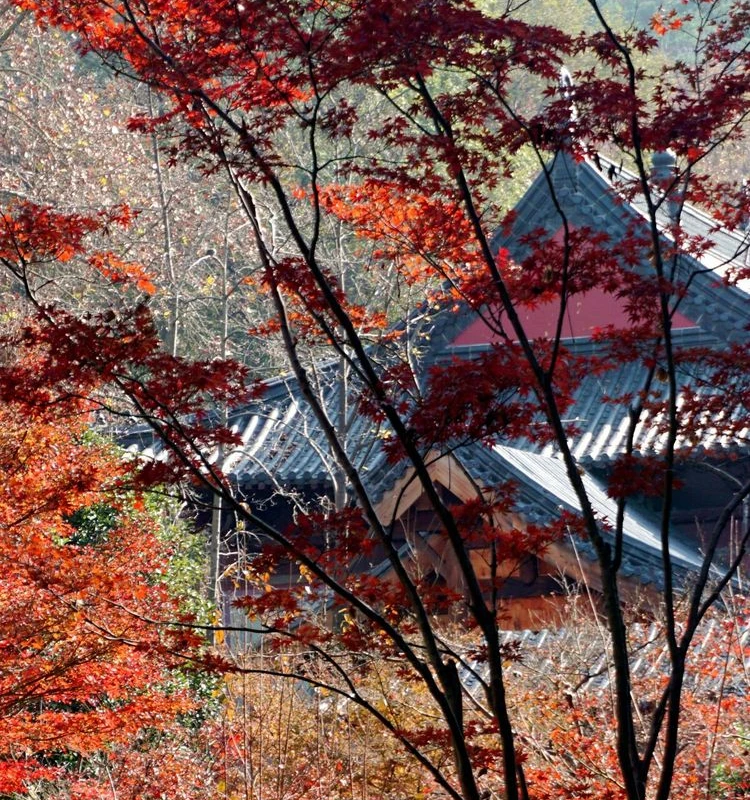
Since the Ming Dynasty, the saying 'Spring at Niushou, Autumn at Qixia' has been passed down. 'Qixia Red Maples' ranks among the New Forty Scenic Spots of Jinling. On Qixia Mountain’s western slope, Maple Ridge is blanketed with dense maple forests, the main attraction for visitors and one of China’s four great maple-viewing destinations. In late autumn, the entire mountain blazes red, like a sunset descending upon the hills—a spectacular sight. We came to Qixia primarily to admire the maple leaves and soak in the beauty of the multi-layered, fiery forests...
Qixia Mountain has long been known as a 'scenic remnant of the Six Dynasties' and was listed among the 'Forty-Eight Scenic Spots of Jinling' in the Qing Dynasty. As the saying goes, 'One Qixia Mountain, half the history of Jinling.' Throughout history, five kings and fourteen emperors have set foot here. With over 80 historical sites and relics, the mountain is a treasure trove of religious, imperial, ecological, folk, geological, stone carving, and tea cultures. The thousand-year-old Qixia Temple—ancestral home of the Sanlun (Three Treatise) school and one of Buddhism’s four great monasteries—lies nestled at the western foot of Qixia Mountain.
Mingjing Lake
Mingjing Lake lies to the west of the Qixia Temple gate. Built during the Qianlong reign of the Qing Dynasty, it covers about 3,000 square meters. In the middle stands a central pavilion connected to the shore by a zigzag bridge, creating an exquisite scene named 'Rainbow Mirror.' A stone tablet inscribed with 'Rainbow Mirror' stands by the water. To the east is Crescent Moon Pond, followed by the entrance to Qixia Temple.
Qixia Mountain, anciently named Sheshan (Photographic Mountain) and also known as Umbrella Mountain, got its current name from the 'Qixia Abode' built here during the Southern Dynasties. The temple complex covers over 2.7 hectares (40-plus mu) and consists of several courtyards, including the Vairocana Hall and the Sutra Library, rising step by step with the terrain in a harmonious layout. In front of Qixia Temple spreads a broad green lawn, with the mirror-smooth Mingjing Lake and the crescent-shaped White Lotus Pond. Surrounded by lush trees and flowers and framed by undulating peaks in the distance, the air is fresh and the scenery serene and beautiful. Main structures within the temple include the Shanmen (Mountain Gate), Maitreya Hall, Vairocana Treasure Hall, Dharma Hall, Buddha Recitation Hall, Sutra Library, Jianzhen Memorial Hall, and the Sarira Stone Pagoda. In front of the temple stands the Ming Huijun Stele; behind the temple is the Thousand Buddha Cliff and numerous other sites. To the left of the entrance, the Ming Huijun Stele was erected in the early Tang Dynasty to honor Ming Sengshao. Its inscription was composed by Emperor Gaozong (Li Zhi) and written by the Tang calligrapher Gao Zhengchen. On the reverse side, the two characters 'Qixia' are said to be Emperor Gaozong’s own handwriting. This stele is one of the most treasured ancient stelae in the Jiangnan region.
Passing through the Mountain Gate, you enter the Maitreya Hall, where a laughing, bare-chested Maitreya Buddha is enshrined, with Skanda, the guardian deity, standing erect behind. Ascending the steps, you reach the temple’s main hall, the Great Buddha Hall, which houses a ten-meter-tall statue of Sakyamuni. Behind it lies the majestic Vairocana Treasure Hall, where a five-meter-high gilded Vairocana Buddha sits in the center, flanked by the disciples Brahma and Indra, with twenty celestial beings arrayed on both sides. At the back stands the Island Guanyin statue: Guanyin rides a sea turtle, attended by Sudhana and the Dragon Maiden, while thirty-two manifestations of Guanyin adorn the island. The sculpting is exquisite and breathtakingly lifelike.
Beyond the Vairocana Hall, the Dharma Hall, Buddha Recitation Hall, and Sutra Library climb the hillside. The Sutra Library houses a precious collection of the Chinese Tripitaka in 7,168 volumes, along with over 14,000 other scriptures. A jade statue of Sakyamuni is enshrined in a niche. To the left of the library is the 'Master Who Crossed the Seas Memorial Hall,' which enshrines a lacquer statue of Master Jianzhen and displays paintings of his sixth eastward voyage and other memorabilia—gifts from Japanese Buddhist communities that bear witness to centuries of friendship between Chinese and Japanese Buddhists. The temple has also built a Jade Buddha Hall, where a 1.5-meter-tall, 390-kilogram jade Buddha donated by the Taiwanese monk Master Hsing Yun is enshrined. The statue is finely carved and richly gilded and painted. The walls are adorned with colorful murals depicting Sakyamuni's enlightenment.
The Sarira Pagoda stands east of Qixia Temple at the foot of Qixia Mountain in Qixia District, Nanjing. Built during the Five Dynasties period, it is China’s largest sarira pagoda and a key national cultural relic. Compact in structure and lavishly decorated, the octagonal pagoda has five tiers of eaves and a height of 15 meters. It is a masterpiece of Chinese pagoda art and a rare example of the multi-eaved style in the south, also an important artifact for studying architecture of the Southern Tang. Qixia Temple was founded in the first year of the Yongming era (483 AD) of the Southern Qi Dynasty; the original sarira pagoda, a five-story square wooden structure, was restored in the first year of the Renshou era (601 AD) under Emperor Wen of Sui. The existing stone pagoda was rebuilt by the Southern Tang (937–975).
According to legend, the temple’s founder, Ming Sengshao, dreamed of a Buddhist halo on the western cliff and vowed to carve Buddha images there. After his death, his son, together with Master Zhidu, began chiseling niches into the cliff in 484 AD. By 489 AD, the Three Saints—Amitabha, Avalokiteshvara, and Mahasthamaprapta, collectively known as the 'Three Saints of the West'—were completed, giving the hall its name, the 'Three Saints Hall.' In 540 AD, a miraculous light supposedly appeared above the Three Saints’ niche, drawing aristocrats of the Liang Dynasty to sponsor more carvings. From 484 to 511 AD, 515 Buddha statues in 294 niches were carved, with five or six, sometimes seven or eight figures per niche. Successive dynasties—Tang, Song, Yuan, and Ming—added more carvings on Shamao Peak, bringing the total to 700. The largest statues are several zhang tall, while the smallest are merely a foot high. Hence the site is called 'Thousand Buddha Cliff.'
Three Saints Hall and the Mysterious Light
Since 2009, a 'miraculous light' phenomenon has been observed in the Three Saints Hall. On November 22, 2009, the legendary light reappeared from 15:17 to 15:43, lasting 27 minutes. It began as a thin line of light on the right cheek of the Amitayus Buddha statue, then slowly moved and changed shape until it centered precisely between the Buddha’s eyebrows in a fan shape. There, a crystal bead on the forehead refracted the light into a splendid five-colored glow that shone onto the hall’s ceiling and then mysteriously vanished. Over the following four or five days, the phenomenon recurred almost at the same time, but the light’s path varied daily, and its duration grew shorter. On the final day, the beam disappeared before reaching the Buddha’s forehead and never returned. This strange occurrence has attracted growing attention from visitors and drawn many devout Buddhists to come and pay homage.
Scholars have offered various explanations—some attribute it to coincidence, others to an artificial masterpiece. According to the 'Tongzhi Shang Jiang Two County Gazetteer,' the Amitayus Buddha in the Three Saints Hall at Thousand Buddha Cliff once had a jewel on its head that emitted dazzling light; regretfully, it fell off and was taken by a powerful official during the Song Dynasty, after which it was lost. This shows that a 'mysterious light' at Qixia Mountain has a historical record. It suggests that ancient Chinese artisans might have skillfully used the interplay of sunlight and architecture to create such effects. Whether coincidence or human ingenuity, the most compelling explanation links the phenomenon to the solar elevation angle over Nanjing on those specific days—a natural occurrence. Yet, happening at this particular sacred site, it feels all the more uncanny and stirs the imagination.
The Thousand Buddha Cliff lies on the southwestern slope of Fengxiang Peak. In 489 AD, Ming Sengshao’s son and Master Zhidu carved the Three Saints to honor Ming Sengshao. Later additions from Tang to Ming, together with those from the Southern Dynasties, total 700 figures. The largest are several zhang high; the smallest, barely a foot. The 'Great Buddha Pavillion' is the earliest and largest grotto, carved in 489 AD, containing a 12-meter-high seated Amitayus Buddha. The eastern apsaras (celestial beings) appear in niche No. 102—a tiny cave with five Buddha statues. On the ceiling, two sets of orange apsaras are clearly discernible, and a flame pattern can be faintly seen above the central Buddha. Despite only these two pairs, they represent the easternmost 'Dunhuang vestige' discovered in China.
Leaving through the back gate of Qixia Temple, we followed the mountain path toward the main peak. Qixia Mountain is embraced by hills on three sides and faces the Yangtze River to the north. It has three peaks, the main one being Sanmao Palace, also called Fengxiang Peak, at 286 meters above sea level.
Emperor Qin’s River-viewing Spot
This spot sits halfway up the northern slope of the middle peak. According to Sima Qian’s 'Records of the Grand Historian,' in 210 BC, Emperor Qin Shihuang, during his eastern inspection tour, climbed Sheshan (Qixia Mountain) on his return north, symbolizing his dominion over all under heaven. Built in spring 2006, the spot features a classical-style complex with double-eaved pavilions, corridors, a veranda, and an observation platform—an excellent vantage point for enjoying panoramic river views.
Peach Blossom Ravine
Since the Ming Dynasty, this ravine has been famed for its peach blossoms in spring. Ming literary figure Sheng Shitai wrote in his 'Qixia Mountain Gazetteer': 'In late spring and early summer, red blossoms and green shade scatter left and right; strollers beneath them find their sleeves tinged with the season’s hues.' In the transitional late Ming and early Qing period, the celebrated courtesan Li Xiangjun lived here in seclusion and was buried after her death in a grove by the ravine. Peach Blossom Lake and Li Xiangjun’s tomb face each other across a path, surrounded by boardwalks, ancient maples, peach groves, pavilions, the lake, Layered Wave Rock, Sky-Opening Rock, and the Imperial Garden.
Qixia Mountain has three peaks: the main Fengxiang Peak (286 m), Dragon Mountain to the northeast, and Tiger Mountain to the northwest. Geologically rich and abundant in fossils, it has served as the type locality for many geological terms and is dubbed a 'natural geological museum' and 'earth science textbook' by experts.
Maple Ridge lies on the western side of Qixia Mountain, covered with dense maple forests. In late autumn, fiery red leaves blanket the mountain, earning it the reputation as 'Jinling’s Most Radiant and Beautiful Mountain.'
Qixia Mountain boasts many intriguing natural wonders. To the northeast of Qixia Temple, on the southern slope of Ping Shantou, lies a bluish-grey rock with a wavy surface known as ‘Layered Wave Rock’—a rare sight. Other curiosities include 'Green Edge Sword,' 'Sky-Opening Rock,' 'Thread of Sky,' and Li Xiangjun’s tomb.
Red Leaf Valley
Located at the junction of the Imperial Garden and the southwestern slope of Fengxiang Peak, this area was long untouched, carved by water into a landscape of exposed rock formations, dense woods, and wetlands. Its unique microclimate nurtures a scene of jagged rocks, ancient maples, and tangled old vines. The valley’s development carefully integrates landform, water features, plants, and facilities, aiming to restore Qixia Mountain’s ecological function while beautifying and enriching the environment. Ponds have been created by diverting water, improving the local ecology. Covering about 50,000 square meters, Red Leaf Valley enchants with its natural beauty, combining mountains, rocks, water, forests, and pavilions into a new red-leaf appreciation zone.
Spring touring at Niushou, autumn at Qixia,
The hills are mantled in red leaves like rosy clouds.
Each crimson leaf intoxicates the heart,
The layered forests dyed in splendor, an endless feast for the eyes.


