A Nanjing Native's View of Nanjing: T80, a Distinctive Creative Park
Nanjing T80 Park
Address: Xiaowei Street, Xuanwu District, Nanjing.
How to get there: Take Metro Line 2 to Xiamafang Station, Exit 2, and walk along the Zijin Mountain Greenway for a few minutes to reach the south gate.
Time of visit: May 2021
This park is right on my doorstep, and it's truly distinctive. Tucked at the foot of Zijin Mountain, the complex rises and falls with the hillside, arranged in a charming jumble. The main structures are grey-brick courtyard houses, with Republican-era buildings popping up here and there. Set within the naturally historic Zhongshan Scenic Area, this unique, slightly mysterious T80 always draws me back. Sometimes I meet friends here on purpose; other times, with good weather and an hour or two to spare, I just come to snap photos. The grey-brick courtyards and buildings, paired with the lush flowers and greenery, are incredibly photogenic. Even someone like me, who isn't naturally photogenic, ends up with pictures I'm proud of.
I've been here many times and even wrote a travelogue about it a few years ago. May is a gorgeous season in Nanjing! This May I came three times in a row. Once was a lunch with colleagues in the middle of the day; the beautiful setting prompted a few photo-loving girlfriends to come together a second time to a bookstore-café here for pictures. Still not satisfied, on a late afternoon with especially good light, I returned to keep the setting sun company, feeling that the grey-brick courtyards glowed with a leaping, lively spirit under the sun. So I thought I'd pair these May images with another introduction to these grey-brick courtyards!
Here is the north gate of the compound—cars coming from the direction of Sun Yat-sen Mausoleum enter the park here. There are several parking lots inside; since this is a niche spot, there are few visitors, mostly neighbors, so you never need to worry about parking.
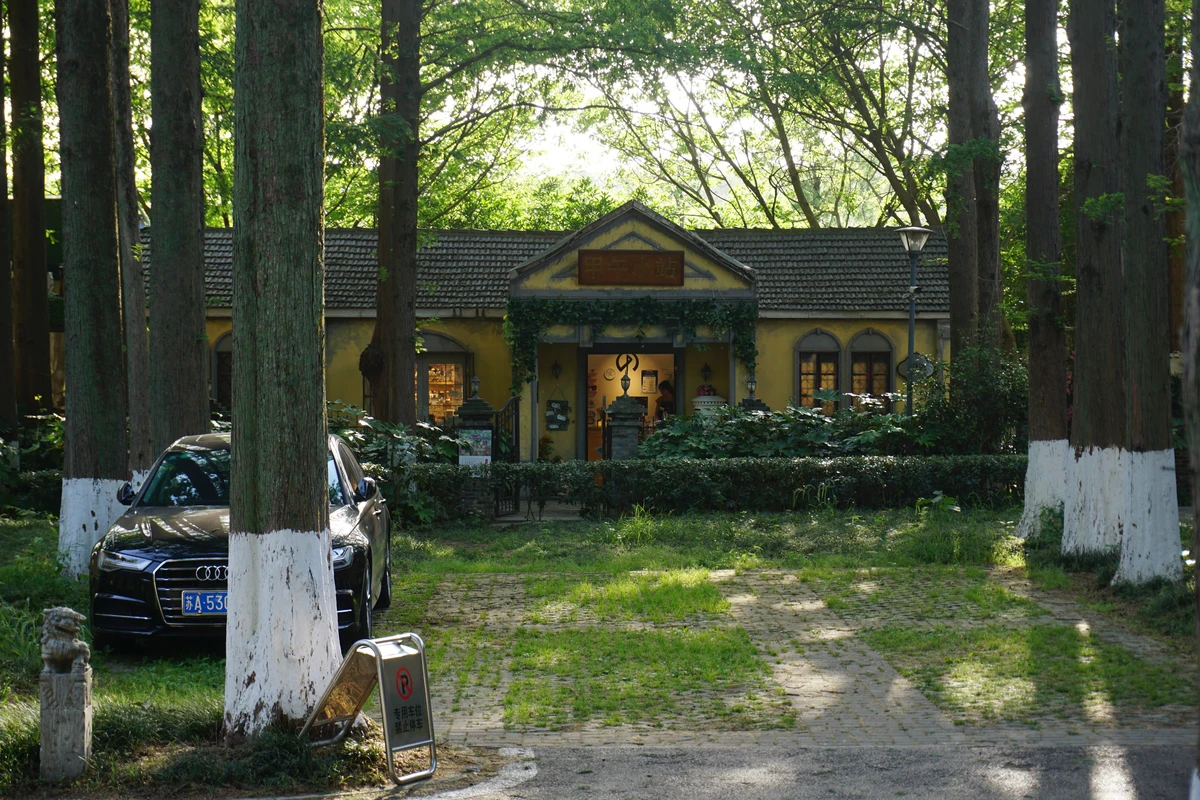
The moment you enter, you're on the main road, flanked by towering, perfectly straight parasol trees that block the sky. Hidden behind them are a few rare old Republican-era villas.
On one side there's an introduction and a simple map of the park. The park's original site housed a branch of the Central Political Institute built by the Republic of China in 1934. After 1949 it successively served military academy units and the No. 701 Research Institute; from 1970 it was the No. 724 Research Institute. In 2014 it was transformed into an international sci-tech and cultural community.
These buildings now host a complete mix of cultural exhibition centers, art education venues, advertising and media companies, theater and photography studios, creative design firms, tea art and calligraphy studios, distinctive eateries, and coffee shops.
A restaurant called Tian Mi Mi, its yellow building wrapped in varying shades of green.
Here, a white building—Yunjia Academy. An open courtyard with grey brick walls and an arrangement of dry branches—I really love this atmosphere.
The westering sun casts tree shadows on the wall, forming a lovely picture.
Standing here, letting sunlight bathe my face, I feel my heart filling with hope.
On the right, a great sweep of green stretches to a massive grey-brick building with a gable roof at the far end.
The entire park follows the mountain's contours, with the terrain rising from west to east and from south to north. These level changes make the architectural grouping even more varied and intriguing. We walk downhill from the road; this slope is creatively paved with all sorts of grey bricks and tiles, which serves both as decoration and as a place for visitors to rest. Sitting here, watching the sunset, brings a wonderfully peaceful feeling.
Down the slope, nearing it, is Zhengren International Art Education. I'm not too concerned about what it now houses; I just study the grey-brick courtyard carefully.
In front of the building is a large courtyard. Slightly raised wooden platforms and lower gravel patches divide it into different zones. Several large umbrellas and chairs create a relaxed atmosphere.
Both the building and the courtyard are built from grey bricks. But these are not ordinary bricks—they are works of art. Every patterned wall panel has been crafted with special care, each brick a different shape, never repetitive.
The new-green lawn in front and the emerald forest behind sparkle brilliantly under the setting sun. Here, the various patterned brick walls serve as a design language, interpreting a strong sense of place rooted in spatial experience. They connect inside and outside through the latticework.
Grey-tiled single-story houses, patterned bricks paired with large glass windows,
and those few red-leaved shrubs in front give the place a dignified yet lively character.
A tiny plant shows off different shades of green, thanks to the sunlight.
There aren't many visitors, so active kids can play to their hearts' content, and remote-controlled cars can zoom around as if on real roads.
The park contains 56 detached buildings, each with its own courtyard. The predominant style is grey brick and grey tile, but a few yellow two-story Republican-era buildings are scattered among them.
These noble, elegant yellows with vermilion beams and pale grey roofs.
Ivy covering entire walls adds vibrant life to the yellow-and-red buildings.
Yellow and grey-blue collide throughout the park—two distinct yet both striking architectural styles merging here.
Sometimes a single building combines yellow and grey together.
The courtyards are richly varied—quadrangles, round courtyards, double-round ones—each a pleasant surprise. Wandering quietly through these lanes and alleys between the courtyards is deeply satisfying.
In addition to the enclosed courtyards, two buildings are separated by a natural forest courtyard formed by towering metasequoia trees.
This building now houses a combined bookstore, café, and cat lounge.
Under the metasequoias in front, there are seats for relaxing; it stays cool even in high summer.
Big glass windows let you take in all the coziness inside.
Inside, floor-to-ceiling display cabinets showcase models of various vehicles—the owner clearly loves car models.
Several large bookcases hold different kinds of books. The long tables and window bar counters are perfect reading spots: read a book, gaze at the scenery outside, daydream, enjoy some me-time. Bookcases lined with playful decorations cover the walls. Sip a coffee, pull a book from the shelf, and you have a quiet afternoon tea moment.
At the end of the tall metasequoias, warm lamplight beckons like a summons. This north-south yellow building on the west side now houses a creative shop—Jiawu Station.
The landscaping around it is very creative. Next to the window leans a 28-inch rod-brake Phoenix bicycle. I had one just like it at home when I was little; I'd sit on the top tube in front, while Mom held my little brother on the rear carrier. That bike was our daily transport.
I definitely had to take a photo with this Phoenix.
Jiawu Station also has a big courtyard, with tables, chairs, and a swing.
Yet another style of courtyard wall. Various figure paintings and green plants hanging on it soften even the hardest wall into something full of tenderness.
Oil paintings are casually scattered around the courtyard, looking effortlessly deliberate.
Through the large windows, I peer inside. The warm lamplight is cozy and reassuring.
The station has a real sense of depth. Different areas are created by various wooden shelves and cabinets. It’s a warm little stationery shop.
There are exquisite, interesting, creative products here. Browsing gives a warm feeling.
Stationery, reading, gifts, warm drinks...
A man-made tunnel over ten meters long leads to the east side of the park. This part, leaning against the mountain, gains charm from the ups and downs of the terrain and the organic arrangement of buildings. The tunnel's shadow, coupled with the setting sun casting light on one side, made for an interesting photo—I love this special quality.
On the east side, stretches of grey-brick buildings and courtyards run north to south. There are straight lanes lined with neat grey-tiled, grey-brick single-story houses. Though the lanes are straight, they might suddenly turn at the end, revealing yet another exquisite lane. Straight, continuous, but turning courtyard walls form the streets and lanes—arranged like musical notes, both harmonious and unified.
Even though it's grey, the wall surfaces are never monotonous. The undulating brickwork leaps like notes on a score. Fresh greenery sets off the grey-themed buildings, arched double-doorways, and narrow windows cut into grey-brick walls...
The staggered single-story houses are built from countless shapes of patterned bricks. Each building uses a different brick shape, and even the brick pattern and laying structure vary from one to the next. With few people around, the straight lanes are often ours alone. Whether walking or just sitting, no one disturbs us.
In May, all kinds of little flowers adorn these solid, rugged bones, bringing a calm yet distinctive charm.
The intensely light-filled pink is especially alluring.
And all sorts of green plants decorate further.
The park has not only large courtyards but also small ones, and no matter the size, each holds unexpected discoveries.
You often spot adorable cats in the park.
On the hilltop at the easternmost end sits Shanyouli Lawn Wedding Company. This modern, bright venue is built against the mountain, open north to south, embracing both sky and earth. I came here once for a small colleague gathering. The white main building pairs perfectly with the dense mountain forest behind. With views rarely seen in the city, it artfully conveys the feeling of being hidden in plain sight. Wild vegetables, greenery, and the surrounding Republican-era buildings envelop the entire space.
This evening, a lawn wedding was underway. Walking through the eastern half of the park, I could hear the emcee's excited, impassioned voice. The couple, it seems, had gone through seven years of on-and-off relationship struggles before finally coming together. The groom's words and confession made his voice choke with emotion, deeply moving. Even at my age, this story touched me a bit. I have my own habitual way of thinking about love—I was moved by his love but also worried for it. Actually, such worry is unnecessary. In love, when it comes, just enjoy it; when it goes, just cherish the memory!
Except for the area where the wedding sounds reached, most of the park remained quiet. Finally, in the stillness, I heard cheerful sounds—a small event area was lively within it.
In this predominantly grey-brick park, the breath of spring makes everything charming and vibrant.
From the east side, I returned to the main road guarded by parasol trees. Here you can clearly see how the terrain rises in the east and falls in the west.
A perfectly straight avenue of parasol trees runs north to south through the park, ending at the north gate. We had entered from the north end of the main road, wandered around its two sides, and finally came back to it. Near the south gate, embraced by tall parasol trees, stands a building with yellow walls and grey tiles.
No. 9 Coffee House, a café. The creative new owners have brought all kinds of fresh ideas into these time-worn buildings, giving them enduring vitality.
Looking closely, the yellow walls have grey bricks protruding from the surface. The brickwork, from color to pattern, looks casual but is actually carefully considered.
The café's warm colors invite you to sit and linger. Besides wooden tables and chairs, there are soft sofas to curl up in. Simple vintage pendant lamps sway above, with gentle slow music playing. Once you sit, it feels as if time stands still—you can daydream, you can whisper.
On a May evening, the sunlight is just perfectly intense. The main road is elegantly beautiful, with clean, flowing lines. Beneath the tall parasol trees—yellow houses, neat courtyards, grey bricks and tiles... The dappled light filtering through the ancient parasols falls on the asphalt and walls.
T80 Park, right on my doorstep, nestles quietly within the mountain-encircled, water-blessed Zhongshan Scenic Area—a secluded, tranquil, and intimate Republican-era enclave. The grey-brick patterned walls are absolutely a highlight. Patterned brick walls aren't rare, but it's uncommon to see so many different styles in one place. Whether on the villas or within the courtyards, they all feature patterned brickwork, and even on a single wall, the bricks vary in size and arrangement. Built from grey bricks, they echo the motifs of Republican-era buildings, as if preserving and extending the memory of that era. The architecture here lingers in your heart like a melody of nostalgic, restrained elegance.


