A September Visit to She Village: Nanjing Countryside Escape
Travel date: September 2021
Address: She Village, Dongshan Street, Jiangning District, Nanjing
My travel style is simple: I often go somewhere on a whim. If it leaves a good impression, I’ll look it up online later. I first visited She Village in December 2019. This village, encircled by hills and water, made a wonderful impression. Stone-paved paths naturally divided the fields, with houses dotted in between. Strolling along those stone paths through fertile farmland, far from the city’s noise, She Village felt like a little paradise tucked away from the world. Neatly lined houses, villagers going about their peaceful lives—it was a perfect picture of rural tranquility. It immediately reminded me of the beautiful lines from *The Peach Blossom Spring*: “The land was open and level, with cottages in good order, fine fields, lovely pools, and mulberry and bamboo groves.” Back home, I searched for She Village online and found there is a popular Instagram-worthy spot—a Danxia landform. I was puzzled why I hadn’t seen it during my visit; clearly I had only seen a small part of the village. But I remembered it and thought I must come back someday to see this Jiangnan Danxia. This time, I wanted to bring my parents to see this beautiful village cradled by mountains and water, and so we set off.
At the entrance to the village lies a large reservoir—She Village Reservoir. Under the clear, boundless sky, the broad water surface was calm, its gentle ripples breaking the light into silver specks, as if sprinkled on a silver plate.
The surrounding mountains stretched out, creating a breathtaking sight of lake and hills. She Village nestled right in this landscape, with the reservoir, hills, and village forming a perfect pastoral scene.
Amid the green mountains, a patch of red rock appeared, its crimson cliffs like a towering wall—surely the Danxia landform I was looking for.
It turned out to be Longdu Quarry on the map. On the reservoir side, a small lane west of Shangyu Road led upward. We drove up that unnamed path, with no signs or decent road, just guessing the general direction. In an open mountain spot, we found another reservoir.
On the other side of the reservoir was the famous Danxia landform.
Climbing was now forbidden, so we could only view it from a distance. But what I saw didn’t match the feeling in the photos online. Back then, people could climb up; perhaps seeing the gully-filled terrain up close with a person in the picture made it more striking. From afar, it was a different feeling.
Returning to Shangyu Road and driving on, we came to a fork and left the main road, heading up a slope.
She Village, nestled in the hills, had undulating terrain. Two years later, it had added many modern recreational attractions, making good use of the natural landscape.
Following the village road, we reached the park in the center.
My last visit in December had left a deep impression: the vast autumn reeds in the park exuded a desolate, poignant beauty.
The park’s stone paths and the reeds, lush green in September, were a completely different picture and mood compared with the brilliant golden reeds in late autumn.
Standing in the center of the park and looking around, every angle painted a different picture.
The September reeds were oceans of green. Dark green leaves and light green reeds surrounded white-walled, black-tiled houses, the whole scene fresh and fragrant.
The reeds weren’t just a village backdrop; they swayed with emotion, each ripple truly the surge of the heart.
The park’s landscape features were both attractive and practical. A zigzag shaped pergola high above the reed beds poked out its face.
Walking from the parking lot through the reed park, we reached the village heart—a large square and a landmark village tree, a gathering spot where locals chat.
On one side of the square, Shangyu Road runs north–south and serves as the village’s main thoroughfare.
At a T-junction stood She Village’s iconic building.
There, an open area called Jiulong Square opened up.
At the crossroads stood a scenic viewing tower.
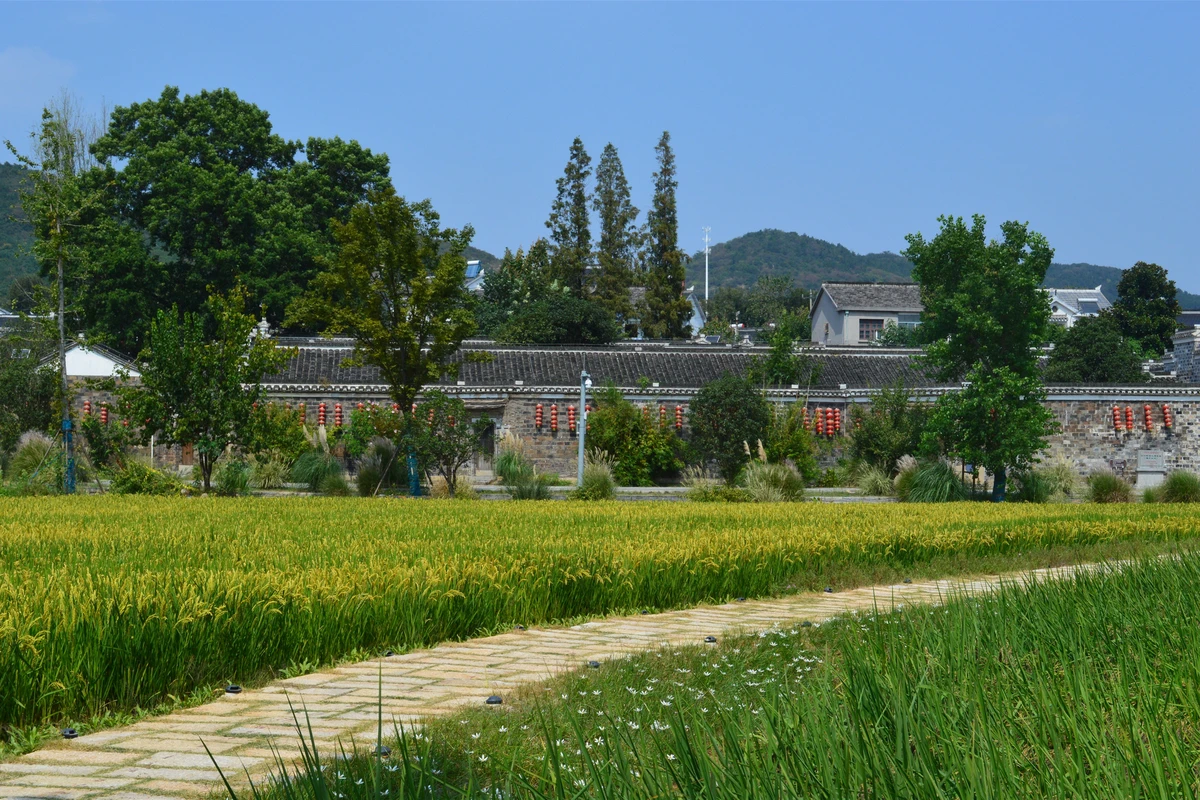
At the end of a stone path beside green rice paddies was Pan’s Ancestral Hall. Built in the early years of Emperor Shunzhi’s reign in the Qing dynasty, this antique Huizhou-style building with blue bricks, black tiles, and horse-head gables is over three hundred years old.
The ancient structure looked even more solemn and serene amid the yellow-green rice fields.
Looking up, I saw layers of blue hills; looking down, expansive flat fields stretched out. Beyond the fields, village houses rose and fell, and the continuous rolling hills naturally layered, just like a charming rural oil painting!
I framed the picture with verbena at the edge as the foreground.
At the far end of the field, behind rows of red lanterns, stood a high-walled compound—the ancient Pan’s Residence complex, dating from the late Ming and early Qing dynasties.
Pan’s Residence amid the green ocean of September and its winter appearance were two different moods.
She Village is famous mainly for its extensive ancient buildings from the Ming and Qing dynasties. The key ones are Pan’s Residence and Pan’s Ancestral Hall, which carry much of the village’s old charm. But on both my visits, the gates were locked. It’s said they’re still being renovated and not open to the public; I could only admire the exterior.
From outside, Pan’s Residence looked large-scale; its mottled blue bricks and simple, elegant horse-head gables made me deeply curious about what lay behind those walls.
New village houses, separated from the historic buildings by vast fields, showed their own character.
A courtyard overflowing with flowers.
A house entirely built of massive stones now serves as a community home for people with disabilities.
The well-arranged buildings and terraced stone vegetable gardens created a space both pleasant and practical.
The main hall had many functional areas—a tea room, coffee bar, reading room, and even a small cinema.
Having a cinema was quite special.
On the rooftop, a large terrace with leisure tables, chairs, and large parasols offered a wonderful, quiet moment—sipping a pot of tea in the early morning or evening.
From the terrace height, the view of the village was excellent.
A red flower peeped over the wall.
Field paths traced beautiful curves.
I followed a stone path through the fields toward Pan’s Residence.
Walking beneath the high walls of this late Ming–early Qing complex, amid the blue bricks and black tiles, I unconsciously slowed down, imagining myself in Hanfu with a painted umbrella.
Rows of red lanterns lining the tall courtyard walls had a strong emotional pull.
The horse-head gables of the ancestral hall—only the side view showed its scale, leaving me to imagine its layout.
High and low horse-head gables rose in an artful rhythm.
A tree with wildly spreading branches soared toward the sky in front of the gate.
She Village Bookstore enriches the villagers’ cultural life.
When I first visited She Village in autumn, I fell in love with this place—no urban noise, no traffic, just green hills, clear water, ancient houses, and farmland. I had always wanted to bring my parents, and today we finally made it. They strolled through the park with us, wandered around the village square a bit, then rested under the big tree, waiting.
Knowing someone is waiting always makes me restless. We quickly circled around, didn’t even stop for a coffee, then hurried to sort out lunch. My parents are in their seventies, still not very old by today’s standards. But their lives are simple, and they rarely go out unless we children take them. I’m someone who loves to roam; being in nature, changing surroundings, shifts my mood and makes life more interesting. I try my best to bring them along, and these trips have become a way of accompanying them. I thought they would enjoy this kind of lifestyle. But today, when I walked toward them under that tree, a new thought struck me. I was taking them out in a way I thought was meaningful and nice, but was that what they liked or needed? Was I being presumptuous? Maybe I should talk to them and ask what they really want. I can’t treat my own idea of “good” as their need.
We found a farmhouse restaurant. The food suited our tastes perfectly and was very good value, but since I’m not that focused on food, I took no photos—a shame I can’t show it in this travelogue. After lunch, we prepared to head back.
The September weather was still hot, so we needed to get my parents home for their afternoon nap. Reluctant to leave, I drove a circle around the village roads.
At the village entrance stood a red-brick kiln. This was once a quarry site; the kiln is probably an industrial relic now, under reconstruction for new uses. I wondered what it would become—very curious.
In the fields, a cluster of white-walled, blue-tiled guesthouses brought new life to the countryside.
She Village, embraced by hills on three sides and water on the fourth, showed me layered green mountains when I looked up, and expansive flat fields and lotus ponds below. The whole village exuded a simple, quiet charm.
A black butterfly danced over the fields.
The village sign at the entrance: the left road leads directly in, while the right one skirts the edge.
We followed the Jiangning Little Sichuan-Tibet Road to Longshang Reservoir.
This road is also a favorite among motorcyclists.
Guesthouses had sprung up by the reservoir. I couldn’t help but sigh at how quickly things change—leave for a while and new things appear. I’m curious what new changes I’ll find next time I visit She Village.


