A Local's View of Nanjing – Linggu Temple Amidst Autumn Splendor
Address: Xiaolingwei Street, Xuanwu District, Nanjing
Visit date: November 2021
Nanjing is beautiful in all four seasons, yet autumn stands out as the most stunning. The city's autumn beauty is everywhere, seeping into every corner. Living and working in the eastern districts, I am surrounded by full autumn hues. In deep autumn, on my lunch break, I ride Plum Blossom Valley Road to admire the fiery bald cypress forest; stroll along the colorful Crescent Causeway in the Botanical Garden's South Garden; watch dusk on the autumn-toned Elephant Path... and the autumn of Linggu Temple, so close by, is something not to be missed. At the scenic area entrance, visitors queue orderly to enter.
Autumn brings fiery red maples.
Cross Yingjia Bridge, you reach Wangong Pond, which in autumn is a palette of colors.
Facing the pond is the Hongshan Gate of "Linggu Sacred Land". The gate is a triple-arched entrance hall, with "Linggu Sacred Land" inscribed on the central archway, topped with green glazed tiles and flanked by red walls.
On either side of the main gate, there are smaller red-wall doors inscribed with "Song of Pines" and "Spring of Tides".
Enter through the Hongshan Gate and you're on the scenic area's central axis, heading north. Towering pines on both sides remain deep green.
Ascend 42 steps to the reinforced concrete memorial archway for the fallen soldiers' cemetery.
Under blue sky and white clouds, the archway roofed with green glazed tiles is a spectacular sight.
Two stone guardian beasts stand left and right of the archway.
The temple grounds are richly planted; in late autumn, the vegetation turns colors abundantly.
Sunlight filtering through dense woods casts dappled shadows on the ancient buildings, adding a layer of mystery.
Pick up a ginkgo leaf to create a small foreground for the archway.
Looking north from beneath the archway, the central axis leads to Wuliang Hall.
The lush vegetation makes the historic structures seem solemn and majestic, full of grandeur and the weight of time.
Deep in the forest, a stone turtle guards the spot.
Look closely – its expression is lifelike; a century of guardianship hides countless stories.
In autumn light and shadow, the building colors and rich plant hues paint a picture of autumn charm.
Wuliang Hall, built entirely of bricks from base to top without a single piece of wood, is awe-inspiring, a masterpiece of ancient Chinese stone architecture.
The square in front of the hall is richly and artistically planted.
Six towering ginkgo trees stand before the hall.
On the east and west sides of the square, rows of maple trees spread out.
These low, red maples attract visitors to pose for photos.
A close-up of these lovely leaves.
View from Wuliang Hall back towards the archway.
In the dense woods, tall trees display leaves of every hue, while multicolored fallen leaves carpet the ground.
Even on a single tree, leaves show five different colors.
Exiting Wuliang Hall, you arrive at the open semi-circular flowerbed lawn – Cemetery No. 1. When the cemetery was built, a hundreds-meter-long semi-circular wall was constructed, its arc gently undulating like Nanjing's city flower, the plum blossom, in a blend of Chinese and Western styles. Now the cemetery has become a garden with diverse vegetation.
In deep autumn, that diversity reveals itself in rich colors. Branches and foliage of varying tints are like paintbrushes filling a canvas with vibrant strokes.
To one side is the popular Linggu Temple with its yellow walls and black tiles, deep green pines, and tranquil atmosphere. Through this round gate is the temple's vegetarian restaurant.
Walking around the wall of Cemetery No.1, I catch sight of Songfeng Pavilion. It's a palace-style building with a glazed-tile roof, the double-eaved signboard reading "Songfeng Pavilion". Ornately carved and brightly colored, the pavilion sits loftily above.
Climb the steps, walk around the pavilion, and snap a silhouette shot.
A tripod and the pagoda come into view.
The pagoda is still the same pagoda, but the same scene takes on different effects with each season's shift in plant colors.
Under sunlight, Linggu Pagoda gleams.
Constructed of reinforced concrete and granite, the pagoda resembles a traditional tower.
Elegantly shaped, solid and secure, it is encircled by carved stone railings with cloud motifs. Green and white intermingle as golden light blazes, piercing the blue sky.
On the front lintel of the first floor, the three characters "Linggu Ta" (Linggu Pagoda) are incised in regular script and gilded.
Enter through the main door. Inside, a spiral staircase of 252 steps leads straight to the ninth floor.
From the second to ninth floors, each level has a ring of doorways opening onto the encircling balconies.
From these balconies, you can pause and gaze at the scenery; the same landscape looks different from each height.
On the second floor, autumn's beauty lies in the rich, intense colors. Under the sun, the forested hills roll like golden waves.
Forests fill your view; from every angle you see the clash of deep red and brilliant gold.
Continue spiraling upward – the sight of these autumn woods is truly breathtaking.
Immersed within, the intoxicating autumn enriches the hills. The Linggu Temple area, dyed by autumn light, seems coated in a soft, warm glow.
Doorways at each level let sunlight stream from one opening to another, creating magical effects.
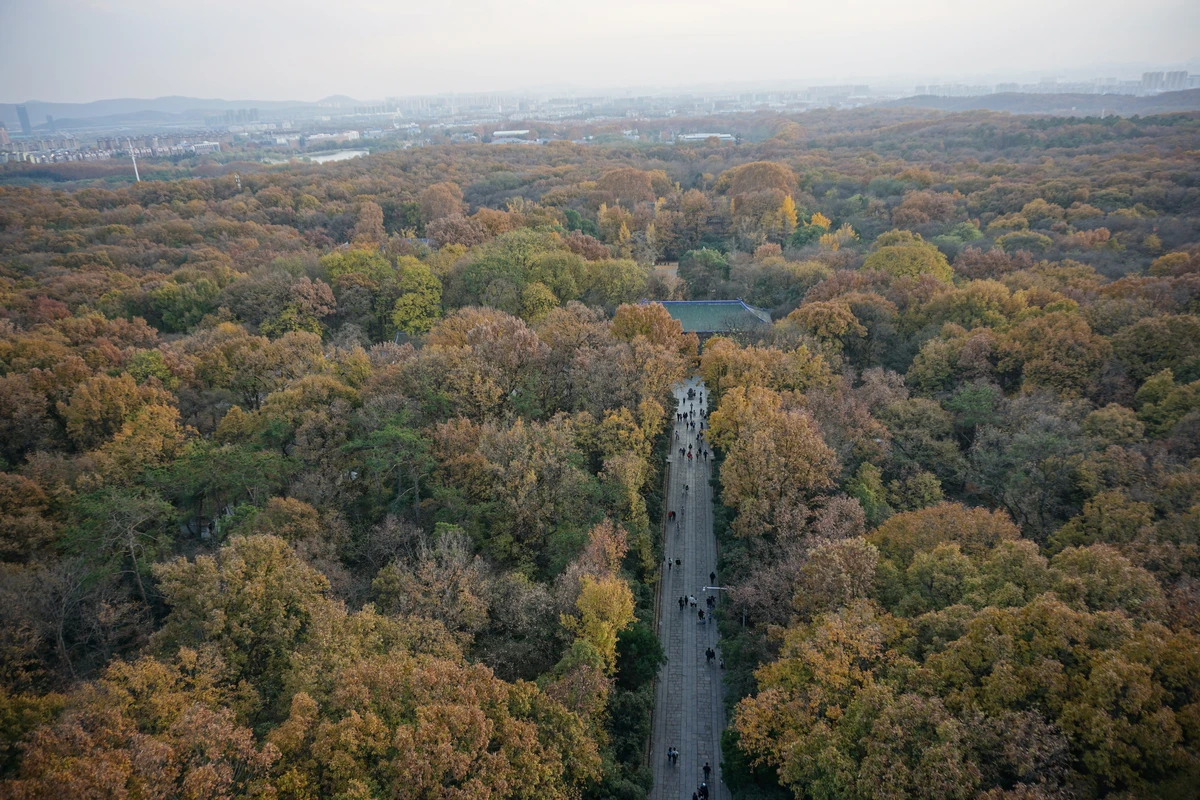
Look down upon the rippling layered woods; beyond them stretches the Nanjing skyline.
On the gentle mountain slopes, various plants interweave, each displaying its own charm while clustering together, blurring background and foreground into an enchanting scene.
To the southeast, the Maqun area is already packed with high-rises.
The setting sun is like a magician: as clouds shift, light and shadow flow, and the forest's colors keep changing – now yellow and green, then red and yellow reflecting each other.
Multihued, autumn dyes the woods beautiful.
Each level's balcony lets you face the vast, richly tinted landscape directly. Even the most colorful oil painting imaginable could hardly surpass this.
The upturned eaves and mythical beasts on every level have silently guarded this land, watching the woods cycle from spring green to deep green, then to gold and russet red.
On this clear autumn day, many visitors linger on each floor to admire the beauty.
Many enthusiasts with long lenses are here to capture the sunset.
And some women quietly contemplating the scene.
To the west of the pagoda, amidst the ridges of Zijin Mountain, the closest building with blue-and-yellow glazed tiles is the Scripture Library; on the middle ridge lies the grey-blue Sun Yat-sen Mausoleum; and the observatory on the farthest, highest peak is all in clear view. Among the city scenery alongside the ridge, Zifeng Tower is highly recognizable.
The city silhouette to the west of the mountains looks hazy and romantic under the setting sun.
Sun and clouds make the picture ever-changing, but always beautiful.
Leaning on the railing and looking straight down, the central axis of the Linggu Temple scenic area aligns with the pagoda's front.
From the entrance, I accompanied the rich, intense autumn colors all along the central axis straight to the tower top: Wangong Pond – Hongshan Gate – Martyrs’ Archway – Wuliang Hall – Martyrs’ Cemetery – Songfeng Pavilion – Linggu Pagoda, the whole path steeped in an intoxicating autumn.
Forests and city under the setting sun form a twilight autumn rhyme.
I watched the sunset from the pagoda top, then, while the sun still lingered on the horizon, descended to seek more colors.
Walking around Songfeng Pavilion, I came to the tomb path of Tan Yankai's tomb on the east side of the temple. Tan Yankai's tomb consists of four sections, but I did not continue north to the square, memorial hall, and tomb chamber; instead, I followed the tomb path south.
Though Linggu Temple may not have the vast fields of red like Qixia Mountain, everywhere within the scenic area you unexpectedly come upon fiery scenes of red maples blazing.
The temple's east wall is covered with ivy. Ivy and ancient trees intertwine, gently embracing the temple. Now that the leaves have fallen, the ivy looks strong and vigorous, contrasting with the red maple in front, making the red even more vivid – a born foil for color.
Yellow walls, blue sky, lonely bare branches.
Delicate yet stubborn ivy, a symbol of late autumn's life force – bleak yet powerful.
In deep autumn, leaves return to the soil, only the tough stems remain clinging, awaiting next year's growth.
Under towering ancient trees stands a Nanhu stone archway.
Here, a strong sense of seclusion and winding paths pervades.
Twenty meters south of the archway is a stele ringed by a stone protective railing, inscribed with "Linggu Shen Song" (Deep Pines of Linggu). In fact, this stele was originally the tombstone of Tan Yankai, who once served as Chairman of the National Government and President of the Executive Yuan. It originally bore the words "Tomb of Mr. Tan Yankai, Central Executive Committee Member of the Kuomintang and former Chairman of the National Government and President of the Executive Yuan" written by Chiang Kai-shek, but was altered after 1949. However, the four characters "Linggu Shen Song" truly reflect the environment and atmosphere around the stele – surrounded by verdant pines and cypresses – and behind the stele pond lies the pathway leading to Tan Yankai's tomb.
To the east of the path, a small stream flows from north to south; a pool of fallen leaves here is stunningly beautiful, a beauty of solitude.
The serene Linggu Temple, wrapped in autumn charm, feels even more ancient.
A right turn off the path leads to the main gate of Linggu Temple. Yellow walls, black tiles, red pillars, amidst ancient pines and lush woods, the environment is quiet and peaceful.
Today I suddenly discovered a huge ginkgo tree here.
I have no memory of this grand ancient ginkgo. I visit Linggu Temple every year – why did I only notice it this time? If it wasn't here before and was transplanted later, that's one thing. But if it was always here and I kept overlooking it until it suddenly revealed itself to me today... could there be some meaning in that?
The Caishen (God of Wealth) Hall under the ancient ginkgo.
Linggu Temple, cradled in autumn's charm, exudes even more elegance.
In recent years the pandemic has kept us from traveling far, but luckily Nanjing is beautiful enough – no need to leave town; if you open your eyes, Nanjing is full of beautiful scenes.


