Bucket-list Trip: Lushan, Wuyuan, Nanjing
Date: September 2021
I retired in August, and in September I finally made that long-awaited trip to Lushan. After I got back, life got busy again, and it wasn't until October that I found time to jot down this travelogue. If I hadn't started now, I'd probably have forgotten everything.
I'd never been to Jiangxi before, but I'd always wanted to visit Lushan. Most travel buddies recommended staying on the mountain, which meant a longer trip—something I could never manage while working. Now that I'm retired, I have all the time in the world, so a Lushan trip was a must. Over the years, I'd got used to squeezing in a weekend plus one day off, zipping off to a place and then racing back to work. Even with all this free time now, my speedy travel style hasn't changed; the only difference is I can finally relax, no longer worrying about a mountain of work waiting for me back at the office.
Lushan Airport was under expansion, so all flights had to land at a nearby city, where you'd switch to a train or bus. That meant two train stations were available for Lushan: Lushan Station and Jiujiang Station. There are three ways to get up and down the mountain: 1. Cable car: large cabins holding up to 30 people, taking only eight minutes from the foot of the mountain straight to the Lushan scenic area (Guling Town). The round-trip ticket costs 120 yuan per person. The cable car station is about 20 yuan by taxi from Lushan Station and about 50 yuan from Jiujiang Station, but Jiujiang Station has bus No. 57 that goes directly there for just 2 yuan, taking over an hour. 2. Bus: from Jiujiang Station to Jiujiang Bus Terminal to Lushan North Gate, then transfer to a scenic shuttle to Lushan scenic area (Guling Town) for 15 yuan. The whole route takes over an hour along winding mountain roads — even people who don't normally get carsick can be completely wiped out. 3. Self-driving: outside major holidays you can drive your own car. During big holidays, private cars are banned, and you must take the shuttle from the North Gate.
D1: High-speed train from Tianjin to Beijing to Lushan Station. Stayed in Chaisang District, Jiujiang City, where Lushan Station is located.
D2: Took the cable car up to Guling Town first thing in the morning. The cable car seems to double as a commuter service for people who work on the mountain — many in the cabin looked like office workers. The eight-minute ride whisked us from the foot to the summit. As soon as we boarded, I called the hotel we'd booked on the mountain (our reservation included one free pickup, so why waste it?), and when we stepped out of the cable car station, the hotel car was already waiting. We chose the Lushan Building, close to the Lushan Conference Memorial Hall, right in the middle of the scenic area and with a sightseeing bus stop at the door. One small detail: when I bought the cable car ticket at the self-service machine at the foot of the mountain, it prompted me to also buy a sightseeing bus ticket for the mountain, 70 yuan per person for unlimited rides over seven days. Thinking we'd only be on the mountain for two days, I couldn't bring myself to buy a seven-day pass. It turned out that every sightseeing bus stop sells tickets, including a one-day option for 30 yuan per person with unlimited rides that day.
Here's the hotel exterior; the Lushan Conference Memorial Hall is just next door.
A photo of the room interior.
And the corridor, full of early Republican-era charm.
Because we took the cable car, after settling in at the hotel we reached the bus stop just after 9 a.m. We immediately bought a day pass and set off on Day 1. I'd done plenty of research beforehand, but once I was actually at the scenic spot and on the bus, I still felt a bit lost. I'd planned to start at Sandie Spring, the farthest point, and work my way back, but on the bus other passengers were all giving different suggestions, and I hesitated, eventually hopping off at Dakou Waterfall. To see any waterfall here you have to look up from the valley floor. Reaching Dakou Waterfall's valley was easy, but the scenery along the way was just okay.
Standing in the valley looking up at Dakou Waterfall, it wasn't as grand as I'd imagined. Maybe because it was so easy to get to, it felt quite ordinary.
Back at the sightseeing bus stop, we boarded again and, following the old Lushan saying 'You haven't really been to Lushan if you haven't seen Sandie Spring,' headed straight for the Sandie Spring area.
Getting to Sandie Spring wasn't easy. We skipped the one-hour mountain trail and instead took the little train, which got us to the entrance in minutes. From there, a long staircase led down to the valley floor. After seeing the waterfall, you retrace your steps back up. The whole trek took about 1.5 hours and was pretty exhausting if you weren't fit.
The water cascades down three levels, the bottom one massive and thunderous.
From Sandie Spring we went straight to Wulao Peak. Wulao Peak is actually five connected peaks that from a distance look like five old men sitting in a row. We'd only intended to find a nice angle to view the peaks from afar, not to climb them. But following a side trail's sign, after hacking through overgrown paths and tough going, we ended up standing right on top of Wulao Peak.
Looking out from the summit, you could see Jiujiang City and Poyang Lake at the foot of the mountain.
A marker on Wulao Peak: 1314.
After Wulao Peak, we took the bus to Hanpokou. This was quite a rip-off spot — all that effort to reach it just for a photo like this. The views were barely worth it.
By now we'd covered most of the natural scenery on the eastern route. For cultural sights, Meilu Villa was a must. Meilu Villa was built by Chiang Kai-shek for his wife, the only residence ever lived in by both Kuomintang and Communist leaders. The villa was equipped with a fridge, western toilet, bathtub and all sorts of modern conveniences — quite avant-garde for its time.
The words 'Meilu' were handwritten by Chiang himself. Later, when a Chinese leader stayed there, staff wanted to chip the characters off the wall. The leader said, 'Leave them. This is history. Even if you remove them, history remains.' So you can still see chisel marks around the characters.
The only cinema on Lushan is famous for screening just one film: 'Romance on Lushan Mountain.' Rumor has it the two young projectionists who first showed it met, fell in love through the film, and ended up spending their lives together. Who knows if it's true, but the story reflects a love of beautiful love stories.
Guling Town sits atop Lushan and is the centre of the mountain, known as 'the mountain city in the clouds.' A bull sculpture is its symbol. In the evening, at the town's street-corner park, locals dance to square-dancing, that quintessentially Chinese sight.
Day one had been all about energy-draining sights; today was a more relaxing route, the classic tour-group circuit.
Jinxiu Valley, as the name suggests, is a beautiful valley with babbling streams and lush trees. At one bend in the trail, you can look out over Jiujiang City far below.
The arched gateway at the entrance to Xianren Cave. Inside stands an old pine tree, roots exposed but still standing proud.
Coming out of Jinxiu Valley, you face Ruqin Lake. From above, the lake is shaped like a violin, hence the name.
Beside Ruqin Lake is the entrance to Flower Path. Legend has it that Tang-dynasty poet Bai Juyi admired peach blossoms here and wrote: 'In April the world's blooms fade, but mountain temple peach flowers just begin.'
Inside the red Huajing Pavilion, the characters for 'Flower Path' are said to be in Bai Juyi's own hand.
When Bai Juyi was demoted to serve as a local official in Jiangzhou, he built a thatched cottage here to live in seclusion.
In front of the cottage stands a statue of the poet.
In a day and a half we'd covered Lushan's main highlights. In the afternoon we took the cable car back down to Jiujiang city. Early next morning, we'd head straight for Wuyuan.
D4: Wuyuan — Huangling — Likeng — Moon Bay — Sixi Yancun
Although Wuyuan is part of Jiangxi Province, historically it was under Anhui's administration, so the architecture has always kept Hui-style features. Wuyuan is often called 'China's most beautiful countryside.' Since the various Wuyuan scenic spots are far apart and public buses have limited schedules, hiring a car is the way to go; most hotels can arrange a car and driver.
First, a map of Wuyuan's tourism spots downloaded from the internet to give some idea of where everything is.
Because we only had one day in Wuyuan, we chose spots not far from Wuyuan town.
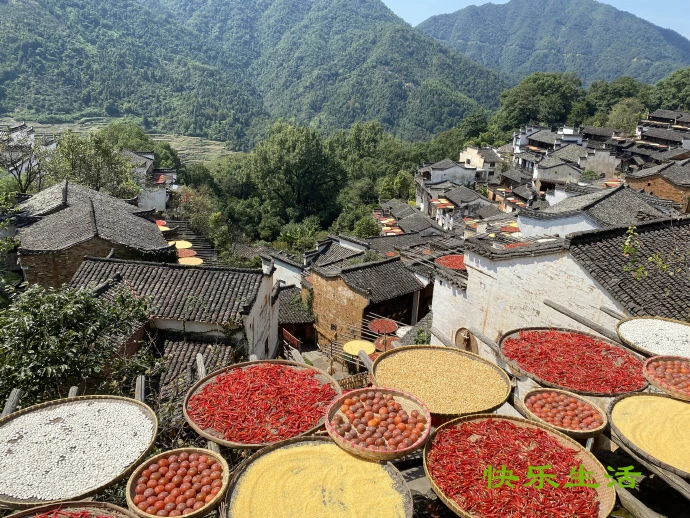
After leaving the train station, we hopped into the hired car arranged by the hotel and went straight to Huangling — the must-see and farthest spot of this trip. Huangling is famous for its rapeseed flower terraces in spring and 'autumn sun-drying' in autumn. 'Sun-drying' means after the harvest, every household puts out fruits and crops to dry on windowsills, under the eaves and in courtyards, creating a gorgeous patchwork of colours.
A cable car takes you up to Huangling. In the past, transportation here was so poor that villagers' lives were extremely hard. The government built new houses at the foot of the mountain, and all the villagers moved down; now roads reach every doorstep. The old mountain houses have been preserved, linked to the new town by cable car. In harvest season the old village is set up as a sun-drying scene, drawing crowds of tourists, generating income, and also drying the villagers' crops — a real win-win.
At the village entrance, a decorative wall blazes with red and warm colours.
As a tourist spot, the village is filled with small bridges over flowing streams, making it truly enchanting, though it would have been pretty inconvenient as a place to really live.
Chilli peppers drying on a windowsill.
The best spot for photos is the Sun-Drying Workshop at the very top of the village.
From its windows you can overlook the whole village: white walls, dark grey tiles, and vivid dried crops — a perfect autumn harvest scene.
All that bountiful fruit brings the joy of harvest.
On one house, peeling plaster on a side wall has accidentally formed the shape of China's map.
Exploring Huangling takes about 3–4 hours. Coming down, we followed our driver's recommendation and ate lunch at a village-run restaurant at the foot of the mountain. When we paid the bill, we saw it was actually ranked number one on **Dianping — the food was really good and the price was reasonable.
On the way to the next spot, we made a quick stop at Wangkou. I just took a photo from a distance. Wangkou village is surrounded by water, almost like it sits on an island.
Likeng also charges an entrance fee, but unlike Huangling, its residents are original inhabitants. Tourists and villagers each go about their own business, unhurried.
A small river cuts through the village.
Likeng feels both authentic and nicely kept as a tourist attraction.
After Likeng, we dropped by Moon Bay. It's named after the crescent-moon shape of the lake.
Our last stop for the day was Sixi Yancun, made up of two adjoining villages, Sixi and Yancun. They were mainly built by merchants who made their fortunes and returned home, and they continue the Hui-style tradition: white walls, dark tiles, simple yet elegant.
I've increasingly felt that cities are becoming more and more alike. Whether it's the architecture, the culture, or even the local snacks, the differences are getting harder to spot. It's probably the result of migration and the internet — a kind of resource sharing. But at the same time, it makes each city lose its own character. Travelling all the way from a place you've grown tired of to an almost identical city somehow lessens the joy of travelling.
It had been years since I last visited Nanjing, so I took the chance to see it again. Nanjing, an ancient capital of six dynasties, naturally called for a visit to Nanjing Museum. It's one of China's three great museums (along with Beijing's Palace Museum and Taipei's National Palace Museum) and the country's earliest museum.
Time flies in a museum, and before I knew it, closing time arrived. I wrapped up in a rush and headed straight for Confucius Temple (Fuzimiao), which is best explored by night. Jiangnan Examination Hall was once the largest exam venue for students from southern China.
Nanjing Impressions, a chain found in many cities, no longer tempted my appetite. Just seeing its original branch was enough.
Qinhuai River, the mother river of Nanjing.
Time always passes too quickly when travelling. Before I realised it, it was time to head home. When work and life get tiring, changing your surroundings for a while helps you relax and recharge, so you can throw yourself back into the next round of busy days with full energy.


