Winter at Shijiu Lake (3) — Lakeside Zhujia Village
Travel date: 2021.2
Travel mode: Self-driving + metro
Route: Nanjing S9 Line Mingjue Station – Zhaocun Village, Lishui, Nanjing – Wugui Hill – Zhujia Village, Hefeng Town, Lishui, Nanjing – Zhangxu Village, Hefeng Town, Lishui, Nanjing
After admiring the curve of Shijiu Lake Bridge from the southwest, we drove east to the southeast side of the bridge. A row of neatly lined cedar trees along the dam formed a natural barrier.
Here, Wugui Hill is an island in Shijiu Lake during summer, visible only from afar and inaccessible. In February, during the dry season, you can drive down from the dam right to the foot of Wugui Hill. We drove directly into the heart of Shijiu Lake.
Where there was once a vast expanse of water, now there is lake water, mudflats, and gullies.
As the water level dropped, the lakebed mudflats were exposed, creating a scene of half mudflats and half water.
The crisp air and deep blue sky lifted our spirits. We walked and took photos on the grass-covered lakebed,
or simply plopped down on the thick grass to act as models for each other's cameras.
A train came by, and I captured the moment when the train and bridge merged into one frame.
After a short rest here, we returned to the circular road on the dam and continued toward Zhujia Village.
On the circular dam at Zhujia Village, a warehouse with white walls and red tiles added a nice touch to the open vista.
Looking down from the dam, the lake that floods into a vast sea during the rainy season now resembled a richly textured map. With the water receded, diligent villagers had swiftly planted assorted vegetables on the exposed flats.
The lake water, gullies, and reed beds created a distinctive winter landscape.
The village nestles at the foot of Fengqi Mountain southeast of Shijiu Lake, leaning against the hill and close to the water—a classic water-town fishing village.
The heart-shaped tree by the lake has become one of Zhujia Village's social-media-famous landmarks.
Zhujia Village is an ancient fishing village with a history of 700 years.
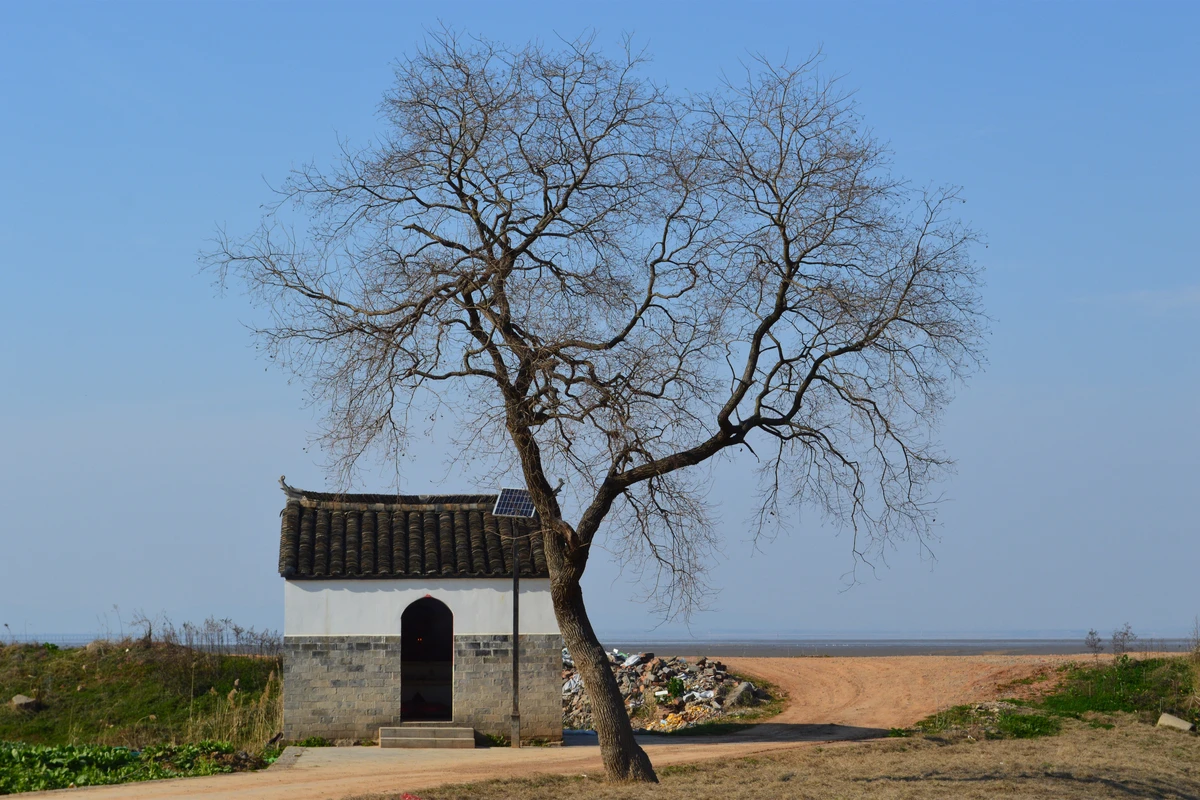
The village still preserves some centuries-old houses. The Zhu Clan Ancestral Hall is a landmark of Zhujia Village, its white granite and grey brick walls exuding an antique charm.
In the village square, there is also a newly built opera stage.
The simple, unadorned village houses.
Renovated old houses have been turned into community practice centers.
Zhujia Village has a now well-known guesthouse. A hundred-meter walk from the guesthouse brings you to the shore of Shijiu Lake.
The guesthouse is designed in a Japanese style.
A round courtyard gate and a low wooden fence door create a sense of semi-concealment.
Sunlight lazily bathed the predominantly white guesthouse, its golden glow warming up the minimalist style.
Strolling through the courtyards, our hearts calmed, following the village's rhythm—leisurely and beautiful.
The quiet village, the quiet courtyards—we didn't dare speak loudly. Even when taking photos with friends, we communicated just with our eyes.
In February, the air was already faintly scented with wintersweet. Walking here gave us a feeling of peaceful days; every casual snapshot turned out incredibly beautiful.
Each guesthouse building, each room, not only had a unique layout
but also a uniquely charming name.
From your room, through the glass windows or from the large terrace, you can gaze out at the pond, the village, distant hills, and fields. Scene after scene of tranquil beauty unfolds before your eyes and lingers in your heart.
I added the manager on WeChat. I thought of picking a day to come for a short stay, to slow down and immerse myself in nature. To stroll through the fields, watch white geese playing in the river, count stars on the hillside, wait for a sunrise and a sunset by the lake... letting time slip gently through my fingers.


