Ancient Charm of Jinling, Life Along the Qinhuai
Part One: Sun Yat-sen Mausoleum
Centered on Mount Song in Henan, Mount Tai, Mount Hua, Mount Heng, and Mount Heng (the Five Great Mountains) stand in four directions, embodying the ancient Chinese unifying vision that the empire commands awe from all corners and overlooks the world under heaven. This idea is reflected in the naming of capital cities, hence Nanjing, Beijing, and Xijing (Western Capital).
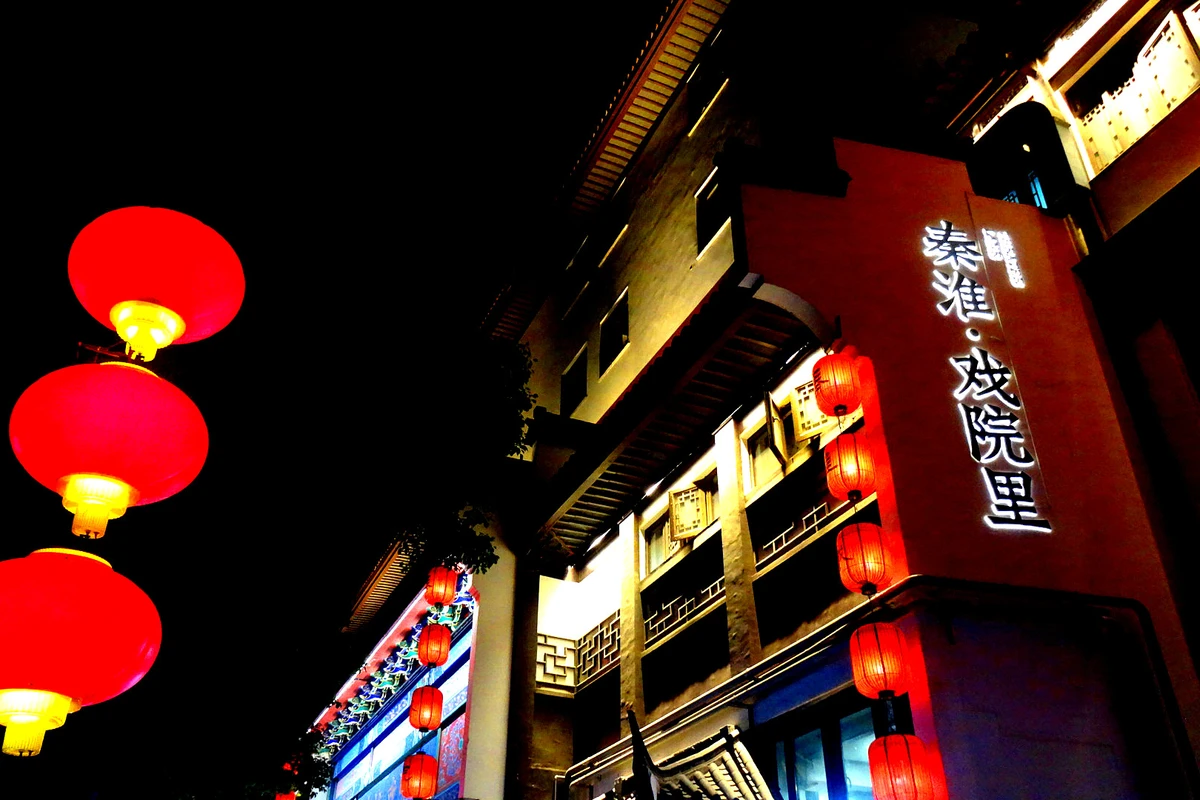
In early May, I visited Nanjing – Jinling – the ancient capital of six dynasties. The weather was kind, the temperature moderate, not much different from the north. There was none of the imagined oppressive heat, nor was I caught in the rain. With reverence, I paid homage to the Sun Yat-sen Mausoleum; recalling bygone history, I explored the Presidential Palace; and traveling through time, I experienced the night view of the Qinhuai River. I felt the indescribable charm of this ancient city, Nanjing.
Sun Yat-sen – the father of the Republic of China and the Kuomintang – but for any Chinese person, he is a great figure, because of his pursuit of truth, and because under his relentless drive for that truth, the feudal monarchy that had lasted over two thousand years was reduced to ashes. Now, let us follow the camera up to the Purple Mountain and pay our respects at the Sun Yat-sen Mausoleum.
The Sun Yat-sen Mausoleum is located at the southern foot of the Purple Mountain, in the Xuanwu District, Nanjing, Jiangsu Province, within the Zhongshan Scenic Area. It faces a plain to the front and is backed by green ridges, with Linggu Temple to the east and the Ming Xiaoling Mausoleum to the west. The entire complex is built along the mountain slope, gradually rising from south to north along a central axis. Following the stream of visitors from south to north, the path is gentle. On both sides of the road, a long gallery of photographic exhibitions titled "Jinling Delights" depicts Nanjing's local customs, economic development and scenic beauty. Walking under the shade of trees while getting a preliminary taste of Nanjing’s many facets is indeed a wonderful experience.
In the distance I saw the Purple Mountain. It is said that the design of the Sun Yat-sen Mausoleum was inspired by the bell shape of Zhongshan (Bell Mountain). The main structures – the Fraternity Arch, Spirit Way, Mausoleum Gate, stone steps, Stele Pavilion, Sacrificial Hall, and the tomb chamber – are arranged along a single central axis, embodying traditional Chinese architectural style. Viewed from above, it resembles a "Liberty Bell" lying flat on a green velvet carpet, symbolizing the "wooden-tongued bell warning the world." At the foot of the mountain, the Filial Piety Tripod serves as the tip of the bell, the semi-circular plaza forms the arc of the bell’s top, and the domed ceiling of the tomb chamber at the apex is like a perfectly round bell clapper. This conveys the idea of "awakening the people to establish the Republic." The stone gateway at the southern entrance and the long, gentle Spirit Way represent the suspension cables below the bell. The Spirit Way faces south and is built into the mountainside, gradually ascending along the central axis from south to north. Along this axis are arrayed the square, memorial archway, Spirit Way, Mausoleum Gate, Stele Pavilion, stone steps, Grand Platform, Sacrificial Hall, and tomb chamber. Together with the surrounding walls, they form the body of the great bell. The Sacrificial Hall at the highest point is the core building of the mausoleum. It lies 700 meters from the archway and rises 73 meters in vertical elevation, and the tomb chamber behind it represents the bell’s suspension loop.
A friendly tip: The Sun Yat-sen Mausoleum is open to the public free of charge, but online reservation is required. Just present your reservation information at the entrance gate – a modern interpretation of Dr. Sun’s "Three Principles of the People." The opening hours are 8:30 AM to 5:00 PM, but the doors of the Sacrificial Hall and the tomb chamber are normally closed, opening only on special occasions such as the anniversaries of Dr. Sun’s birth and death, or major commemorative events.
The Fraternity Arch. The memorial archway of the Sun Yat-sen Mausoleum, also called the Fraternity Arch, stands at the southern entrance of the Spirit Way, and all those who come to pay their respects must pass through it. The entire archway is steeped in traditional Chinese style. It is 11 meters high and 17.3 meters wide, a three-bay, four-column soaring type. The top of the Fraternity Arch is covered with blue glazed tiles. At the foot of the four stone columns, both front and back, drum-shaped bearing stones are embraced, and the columns rest on large rectangular stone bases. The archway is carved with lotus petals, cloud patterns and motifs imitating ancient architectural paintings.
On the horizontal lintel of the central gate is set a stone plaque engraved with Dr. Sun Yat-sen’s own calligraphy – the two characters "Bo Ai" (Universal Fraternity). Hence, this archway is known as the Fraternity Arch. The two gilded characters on the lintel, broad and magnanimous, open a wide spatial vista and inspire boundless imagination. Dr. Sun Yat-sen was particularly fond of writing these two characters as gifts. Because of this, Nanjing is acclaimed as the City of Universal Love.
The Spirit Way of the Sun Yat-sen Mausoleum stretches 440 meters from the Fraternity Arch to the Mausoleum Gate and is 36 meters wide, divided into three lanes. The central lane, 12 meters wide, is paved with reinforced concrete. The left and right paths, each 4.6 meters wide, are lined with two rows of cypress trees. Walking along the Spirit Way flanked by towering pines and cypresses, one cannot help but feel a surge of remembrance and reverence for Dr. Sun Yat-sen.
The Mausoleum Gate. The Mausoleum Gate is positioned at the very center of the mausoleum’s central axis. In front of it lies a broad concrete platform that can accommodate over 10,000 people. On both sides of the platform are velvet-like lawns. On these lawns, ten symmetrically arranged, evergreen boxwood balls and six precious multi-branched pines, each shaped like an umbrella, stand exceptionally elegant.
On either side of the Mausoleum Gate, a pair of white marble lions face forward with mouths agape, vividly lifelike. The placement of these lions accentuates the building, lending the Mausoleum Gate great imposing grandeur. To reach the gate, you climb 20 granite steps. The gate is rectangular in plan, 24 meters wide and 8.8 meters deep, with a height of 16.5 meters. It uses the form of traditional ancient Chinese wooden architecture but is entirely built of granite. The patterns and carvings on the dougong brackets, beams and lintels are exquisitely detailed.
The roof of the Mausoleum Gate is single-eaved with a hip-and-gable style, covered with blue glazed tiles. The gate has three arched entrances, the middle one larger and the two side ones smaller. The central gate is closed; visitors go up using the right and come down using the left. Above the main entrance is set a stone plaque engraved with four gilded characters, "Tian Xia Wei Gong" (All Under Heaven Belongs to the Public). This is Dr. Sun Yat-sen’s handwriting – dignified, unadorned, bold and graceful – embodying the ideal he pursued in his revolutionary life.
The Stele Pavilion. The Stele Pavilion of the Sun Yat-sen Mausoleum is built on the second-level terrace behind the Mausoleum Gate bearing the "All Under Heaven Belongs to the Public" inscription. Constructed of granite with double eaves resting on a hip-and-gable roof covered with blue glazed tiles, it imitates traditional Chinese wooden architecture. It stands 17 meters high and 12.2 meters wide, with a nearly square plan.
The tombstone is 9 meters high and weighs dozens of tons, carved from a single immense block of granite. Three lines of gilded inscription are carved from right to left in vertical arrangement:
"The Premier of the Kuomintang of China, Mr. Sun, is buried here. June 1st, the 18th year of the Republic of China." The characters are in Yan style, with flowing strokes, structured yet vigorous and powerful. When the tombstone was being made, material was sourced from across the provinces. Fujian Province selected a huge granite slab, but when it was being transported, due to its enormous size and weight, the boat sank soon after loading. So a second granite slab had to be prepared in Fujian and shipped to Nanjing. From the Xiaguan Wharf in Nanjing, it was moved inch by inch, entirely by human labor using rolling logs, to the foot of the Purple Mountain, and then from the mountain base to the construction site at the Stele Pavilion on the hillside – a process that took over forty days. This attests to the immense scale and difficulty of the project, as well as the indomitable perseverance of the workers. The large stele we see in the Stele Pavilion today was made from that second slab of Fujian granite.
The Stone Steps. From the Fraternity Arch to the Sacrificial Hall, there are altogether 392 stone steps, eight terraces, and a vertical drop of 73 meters. The 392 steps symbolized the 392 million people of China at that time. From the Stele Pavilion to the Sacrificial Hall, there are 339 steps, representing the 339 members of the two chambers of the Kuomintang legislature, signifying each person serving as a step to carry forward Dr. Sun’s spirit – the number nine also implies "the Nine Provinces united in harmony." The flight of steps directly ahead has 290 steps divided into eight sections, symbolizing the Three Principles of the People and the Five-Power Constitution. The steps are all built with granite from Jinshan in Suzhou.
The stone steps are a vital component of the Sun Yat-sen Mausoleum, organically linking the archway, Mausoleum Gate, Stele Pavilion and Sacrificial Hall into a majestic whole shaped like an alarm bell. The designers and builders ingeniously divided the 392 steps into ten segments. This layout is truly original and distinctive. Looking up from below, you see only steps, not terraces; looking down from above, you see only terraces, not steps. From the seventh terrace, you climb 30, 42, and then 54 steps to reach the eighth, ninth, and tenth terraces respectively. Here, near the final stage of the mausoleum, the slope is steeper, further accentuating the imposing grandeur of the Sacrificial Hall and the tomb chamber. Stone balustrades line the sides of these 126 steps, and two longitudinal rows of balustrades divide the flight into three lanes.
The Sacrificial Hall is the main structure of the Sun Yat-sen Mausoleum, situated on the tenth grand terrace at an elevation of 158 meters. The terrace is 137 meters wide from east to west and 38 meters deep from north to south. Perched on the highest peak, it blends Chinese and Western architectural styles. The Sacrificial Hall adopts the symmetrical, axial layout characteristic of traditional Chinese imperial tombs, but rather than the yellow glazed tiles and red walls of traditional imperial mausoleums, it features a blue roof and gray-white walls, reflecting Dr. Sun Yat-sen’s lifelong pursuit of democracy.
The Sacrificial Hall is 28 meters long, 22.5 meters wide and 26 meters high. Its exterior is entirely built with granite from Hong Kong. The three arched entrances have double-leaf doors of openwork copper, and above each is carved a word in seal script – ethnicity (民族), people’s livelihood (民生), and civil rights (民权) – calligraphed by Zhang Jingjiang and gilded. On the lintel of the central door is carved in gilded characters another piece of Dr. Sun’s handwriting, "Heaven and Earth's Righteous Spirit."
Friendly reminder: Photography is not permitted inside the Sacrificial Hall. At its center sits a seated statue of Sun Yat-sen, 4.6 meters tall, carved from white Italian marble in Paris by the world-famous sculptor Paul Landowski. Six reliefs on the pedestal depict scenes from Dr. Sun’s revolutionary activities. Wearing a traditional long gown and mandarin jacket, with a high forehead and broad cheeks, and holding a long scroll, the profound gaze directed forward leaves an unforgettable impact on those who stand before him in reverence.
On the east and west inner walls of the Sacrificial Hall, excerpts of Sun Yat-sen’s handwritten "Outline for National Reconstruction" and the "Premier’s Testament" penned by Hu Hanmin and others are carved into marble. A colossal emblem of the Kuomintang adorns the dome. The door to the tomb chamber was closed, so I did not have the chance to see the white marble recumbent statue of Dr. Sun.
Flanking the Sacrificial Hall on both front sides stands a pair of tall ornamental pillars (huabiao), carved from Fujian granite. The pillars are 12.6 meters high, with a lower diameter of 2 meters and an upper diameter of 1 meter. Their cross-section is hexagonal, each face adorned with relief carvings of swirling clouds. Seen from afar, they seem to pierce the blue sky, presenting a strong three-dimensional presence. On the stone pedestals beside the grand stone staircase rest two covered bronze tripods. The huabiao and bronze tripods further enhance the magnificence and solemnity of the Sacrificial Hall, adding to the atmosphere of mourning.
Stepping out of the Sacrificial Hall, under the blue sky and white clouds, surrounded by emerald cypresses and pine trees, with the green ridge behind and the city before me, I was overcome with a flood of emotions. Recalling how the great man once commanded the winds and clouds, raised his arm in the nation’s peril, rallied the world to follow, toppled the feudal dynasty like dry twigs, built alliances with the Soviet Union and the Communists to save the nation from danger – alas, Heaven envied talent, and his revolutionary cause was left unfinished. Today, I take heart that we live in a flourishing era, thinking with gratitude of our predecessors who devoted their hearts and blood to the people’s livelihood.
The Filial Piety Tripod stands directly south of the Sun Yat-sen Mausoleum. Cast by the Jinling Arsenal, the tripod is 4.25 meters high, weighs about five tons, with a maximum belly diameter of 1.21 meters. It sits on a stone platform about three meters high, which has three tiers: the lowest is about 16 meters in diameter, the middle 12.7 meters, and the upper 4 meters. At the center of the platform is a round stone pedestal (tripod base) carved from white marble, on which the bronze tripod is placed.
The Filial Piety Tripod is cast in bronze with a unique design. Structurally, it can be divided into three parts: a drum-shaped bronze base; the main body of the tripod with two upright handles and a round belly; and above the rim, a six-pillar pavilion with a three-tiered hexagonal spire roof, covered with small roof tiles. Inside the pavilion stands a hexagonal rectangular bronze tablet inscribed with the full text of the "Classic of Filial Piety" in the handwriting of Dai Jitao’s mother, Madame Huang.
Coming down from the Sun Yat-sen Mausoleum and seeing the map of the Zhongshan Scenic Area, I was suddenly reminded of a poem by Chairman Mao: "Over Purple Mountain a storm rises, turning pale yellow; a million gallant troops cross the great river. With our unspent valor pursue the tottering foe, not imitating the Conqueror seeking hollow fame. If Heaven had feeling, Heaven too would grow old; the proper path on earth is full of hardship and change."
Part Two: The Presidential Palace
My earliest knowledge of the Presidential Palace goes back to the illustrations in primary school history textbooks. One image left a particularly deep impression: after the People’s Liberation Army occupied Nanjing, soldiers stood atop the Presidential Palace changing the national flag. That photo framed the palace with great strength, giving it an imposing and lofty appearance. On the way from the Sun Yat-sen Mausoleum to the Presidential Palace, I reminisced about that textbook illustration. When I arrived, I realized it was not so tall – it is actually just the gatehouse, only because the flag was raised there.
The Presidential Palace is located at No. 292 Changjiang Road, Xuanwu District, Nanjing. It is the largest and most intact surviving complex of modern Chinese architecture, covering over 50,000 square meters. It encompasses both classical Chinese Jiangnan gardens and buildings from the period when Western influences began entering China. Its history can be traced back to the Marquis Guide’s Residence and the Han Prince’s Mansion in the early Ming Dynasty. In the Qing Dynasty, it became the Jiangning Weaving Bureau, the Office of the Governor-General of Jiangnan, and so on. Emperors Kangxi and Qianlong both used it as a temporary palace during their southern tours. After the Taiping Heavenly Kingdom made Tianjing (present-day Nanjing) its capital, it was expanded into the Heavenly King’s Palace. On January 1, 1912, Dr. Sun Yat-sen was sworn in there as the Provisional President of the Republic of China, and it became the Presidential Palace, later serving as the Presidential Palace of the National Government of the Republic of China.
On March 29, 1853, the Taiping Army occupied Nanjing, established Tianjing as its capital, and founded the Taiping Heavenly Kingdom regime. They initially stayed at a provincial government office, soon began renovating the Office of the Governor-General of Jiangnan, and in May started building the Heavenly King’s Palace on its foundation, expanding it into the Celestial Palace centered on the former governor-general’s office. By November, an accidental fire reduced it to ashes.
In February 1854 (the fourth year of the Xianfeng reign), construction of the Heavenly King’s Palace in Tianjing began anew. On June 1, 1864 (the third year of the Tongzhi reign), the young heir Hong Tianguifu succeeded to the throne. On July 19, Tianjing fell. The Qing army then carried out a massacre. The Taiping forces set fire to the city as the Hunan Army broke in, and after widespread looting, the Qing soldiers also set fires everywhere, burning down the palace buildings.
After the Qing armies entered China proper, the site of the Ming Han Prince’s Mansion was used for the Jiangning Weaving Bureau, the Governor-General of Jiangnan’s Office, and the Office of the Governor-General of Jiangnan. During their southern tours, both Emperors Kangxi and Qianlong used it as a temporary palace. Kangxi visited Jiangnan six times and stayed four times at the Jiangning Weaving Bureau, which is why the area has been called "Daxinggong" (Grand Palace) ever since.
The Taiping Heavenly Kingdom movement led by Hong Xiuquan swept across the nation and established its capital at Tianjing (now Nanjing). Though it ultimately failed due to the combined suppression of domestic and foreign reactionary forces, its ideals of giving land to the tillers and pursuing universal brotherhood were far ahead of their time. It delivered a heavy blow to the Qing Dynasty, accelerating the downfall of the last feudal dynasty, and also struck against foreign invaders, showing them the boundless potential of the Chinese peasantry.
The Heavenly King’s Throne recreates the past splendor of the Celestial Palace. The room also displays cultural relics and photographs reflecting historical events of the Taiping Heavenly Kingdom in Tianjing, highlighting the theme of the "Three Heavens" – the Heavenly King, the Heavenly Capital, and the Celestial Palace.
The Museum of Modern Chinese History covers 90,000 square meters and is divided into three visiting areas. The central axis mainly comprises the National Government, the Presidential Palace and their affiliated institutions. The western area features Dr. Sun Yat-sen’s Provisional Presidential Office, the Secretariat, the Western Garden, and the General Staff Headquarters. The eastern area mainly includes the former Executive Yuan, stables and the Eastern Garden. A series of exhibition halls and historical displays are distributed across these three areas.
The architecture is distinctive: the main buildings are European-style, very exquisite, while the corridors display unmistakable Chinese characteristics – red lanterns, red pillars and latticework in the corridor, perfectly blending Chinese and Western elements to create a sense that is both retro and modernly festive.
The meeting room in the Zichao Building (Presidential Office Building) has a simple layout.
The reception room of the Zichao Building. Before formal ceremonies, Chiang Kai-shek, Lin Sen, or Li Zongren would rest here briefly, and it also served as a reception room for domestic guests. There is a suite that served as Chiang Kai-shek’s temporary office; sometimes he worked here instead of the main Presidential Office. The 1946 KMT-CCP negotiations were also held here. On February 27, 1949, Acting President Li Zongren met here with the "Shanghai Peace Mission" – Yan Huiqing, Shao Lizi, Zhang Shizhao, and others who had returned from Beiping.
The fusion of Chinese and Western architecture creates an extremely strong visual impact.
The Zichao Building stands at the northern end of the Presidential Palace’s central axis. This office building was constructed during the tenure of Lin Sen as Chairman of the National Government. Lin Sen’s courtesy name was Zichao, and he served the longest as Chairman, hence the building is commonly called the "Zichao Building." Construction started in 1934 and finished in December 1935. The building has five main floors, with a partial sixth floor. The ground floor first housed the Civil Affairs Office of the National Government, later becoming the office of the Presidential Palace’s Secretariat. The second floor contained the offices of the President and Vice President; the south-facing room was Chiang Kai-shek’s office, the north-facing one was Vice President Li Zongren’s office. The third floor housed the National Government’s meeting room. The entrance hall was under renovation.
Vice President Li Zongren’s office
President Chiang Kai-shek’s office
The Fu Garden (Eastern Garden) was the garden of the Governor-General of Jiangnan during the Qing Dynasty. During the Taiping Heavenly Kingdom, an Eastern Garden was built here, with stone boats, lakes, rockeries, pavilions and towers. It was destroyed when the Qing army took Tianjing in 1864. During the National Government period, it was part of the Executive Yuan. In 2002, part of the original Eastern Garden was reconstructed based on historical records. The organic combination of Jiangnan garden style and Western landscape layout features rockeries, greenery and ever-changing views – one scene shifting as you step. In the garden, a small round pond has a European-style fountain at its center.
Sun Yat-sen’s Residence. Built in 1909, it is a two-story Chinese-style building with small green glazed roof tiles, wooden structure and flush gable ends. It was originally the lodging for senior advisors of the Governor-General of Jiangnan in the Qing Dynasty. From January to April 1912, when Sun Yat-sen served as the Provisional President of the Republic of China, he lived here. The upper floor was his bedroom and office; the lower floor comprised a reception room, dining room, as well as the guardroom and kitchen. When his eldest son Sun Ke and his wife Lu Muzhen arrived from Nanjing with their daughters Sun Yan and Sun Wan, they also lived here with him. On March 25, Madame Lu left Nanjing, entrusting the two girls to the care of Sun Yat-sen’s English secretary, Soong Ching-ling. Sun continued residing here until he stepped down on April 3.
How simple and unassuming! When I think that the office of the President of a country was so cramped and modest, a deep respect spontaneously arises.
The Western Flower Hall. In the early 20th century, some buildings in Nanjing were influenced by Western eclectic architectural trends, and people vied to imitate Western architectural forms, taking pride in them. This yellow Western-style single-story building is a typical imitation of the Italian Renaissance style, begun under Duanfang, the Governor-General of Jiangnan in the Qing Dynasty, and completed under Zhang Renjun, the last governor. Because it was on the west side of the governor-general’s office, it was called the Western Flower Hall. The building faces south and has seven bays. After January 1912, it became the office of the Provisional President of the Republic of China.
The Xu Garden (Western Garden) originally was the garden of the Han Prince’s Mansion in the early Ming Dynasty, named after the "Xu" in Prince Han’s personal name, Zhu Gaoxu. During the Qing Dynasty, it was the garden of the Governor-General of Jiangnan, and during the Taiping Heavenly Kingdom, it was expanded during the construction of the Celestial Palace. Because it lay on the west side of the palace, it was also called the Western Garden, complementing the Eastern Garden. Destroyed when the Qing army took the city, it was rebuilt by Zeng Guofan. The Xu Garden is a typical Jiangnan garden, seamlessly integrated with the Presidential Palace. It still preserves many famous historical sites, such as the Stone Boat, the Sunset Pavilion, the Forget-to-Fly Pavilion, the Ripple Pavilion, and the Mind-in-Heart Stone Hut.
The Stone Boat, also called the Unmoored Boat, sits in the southern part of the Xu Garden, floating on the rippling Taiping Lake – "a boat unmoored, drifting wherever it pleases in the void." It was built in 1746 by Yin Jishan, then Governor-General of Jiangnan, to welcome Emperor Qianlong on his second southern tour.
The Forget-to-Fly Pavilion, built during the Kangxi reign, rebuilt in the ninth year of Tongzhi
The Tongyin Hall, rebuilt in 1870 (the ninth year of Tongzhi)
Zeng Guofan playing Go in the Tongyin Hall
A poetic stele of "Mooring by Maple Bridge at Night" by Yu Yue, recopied from the original by the Reformed Government in 1939
Stepping out of the Presidential Palace felt like completing a tour through a long river of history. Gazing at the national flag fluttering from the palace’s gate tower and the towering buildings across the street, my thoughts returned to the present – a nation at peace, forging ahead through the waves…
Part Three: Confucius Temple – Qinhuai River
The Confucius Temple-Qinhuai Scenic Area is located in the Qinhuai District of Nanjing, Jiangsu Province. Centered on the Confucius Temple, with the Ten-Li Qinhuai as its axis and the Ming city wall as its link, it strings together numerous sites under national, provincial and municipal cultural protection. Enriched with Confucian thought, imperial examination culture and folk customs, it integrates sightseeing, food and shopping, science education, and festive culture. As a treasure house of Nanjing’s history and culture, it is also a renowned open National 5A Tourist Attraction.
At the entrance to the Qinhuai River scenic area, it was truly bustling with traffic. The tall horse-head walls gave a striking visual impact of the archetypal Huizhou-style architecture of Jiangnan.
As dusk fell, the crowds grew even denser. Antique shops of all kinds were bustling. Nowhere did one see hurried feet; instead, the rhythm was leisurely. Despite the lively bustle, the atmosphere exuded a serene and peaceful beauty.
The Confucius Temple is one of China’s four great Confucian temples, a hub of ancient Jiangnan culture and a concentrate of Jinling’s history and humanity. It was not only the cultural and educational center of Nanjing during the Ming and Qing dynasties but also the foremost group of cultural and educational buildings among the southeastern provinces, making it the largest traditional ancient market street in China.
The Confucius Temple-Qinhuai scenic area is rich in historical and cultural significance. Confucius Temple snacks are ranked first among China’s four great snack traditions. The Confucius Temple Lantern Festival, held annually from the Spring Festival to the Lantern Festival, is among the first batch of national-level intangible cultural heritage items and one of China’s most famous lantern festivals, attracting countless visitors to enjoy the lanterns and celebrate the holiday together, brimming with strong local flavor and cultural atmosphere.
Walking along the embankment, I got a first impression of the Qinhuai River, evoking a sense of "the Qin dynasty moon over the Han dynasty pass." Strolling along the riverbank, watching boats cutting through the waves, with throngs of tourists on both sides and bright lights everywhere, it truly felt like stepping into a living painting. That wondrous sensation can only be understood through personal experience, not through words.
Modern lighting art added much brilliance to the lantern festival.
A world of light that a camera can never fully capture or reproduce. The boats glide almost soundlessly, yet the sound of waves lapping the banks, combined with the myriad colorful lights, creates one stunning picture after another.
People waiting to board a boat to tour the Ten-Li Qinhuai could only be described as "waiting with eager expectation." I thought I had missed the chance, but when I inquired, tickets were still available – only combo tickets, though; there were no more single boat tickets. That is to say, boat tickets, especially for the evening, must be booked in advance; by the time you arrive, they are certainly sold out. Without a moment’s hesitation, I bought a combo ticket (which included a VR experience on the second-floor rooftop of the ticket office to see the Qinhuai River through the ages, plus entry to the China Imperial Examination Museum). After all, what would a trip to Nanjing be without experiencing the Qinhuai River up close?
Having bought the ticket, I did not want to waste any opportunity, so I visited the China Imperial Examination Museum. After climbing to the second floor, I sat down, put on the VR glasses, and quietly enjoyed the historical changes of the Qinhuai River across the ages. Though not the main attraction, this side trip was still worthwhile. To be honest, the VR visuals were quite mediocre and in need of improvement.
Look, standing on the rooftop of the ticket center and looking down at the throngs of visitors is quite a nice feeling. From a higher vantage point, the core scenic spots lie unobstructed before you – another kind of gain.
The Jiangnan Examination Hall, also called the Nanjing Examination Hall, is located in the southeast corner of Nanjing, east of the Confucius Temple academy. It is part of the Confucius Temple-Qinhuai scenic area and one of the three major ancient architectural complexes in the Confucius Temple area. It had over 20,644 examination cells alone, plus hundreds of auxiliary buildings, covering more than 300,000 square meters. From its completion until the abolition of the imperial examination in the late Qing, the Jiangnan Examination Hall produced for the nation over 800 principal graduates (zhuangyuan), 100,000 advanced scholars (jinshi), and over a million provincial graduates (juren). During the Ming and Qing dynasties, more than half of the country’s officials came from this hall.
The China Imperial Examination Museum at the Jiangnan Examination Hall is the only specialized museum in China that reflects the imperial examination system. It is the center of China’s imperial examination system research, culture and artifact collection.
When people mention the imperial examinations, some might condemn it without any reservation, regarding it as a toxic vestige of feudal society. This is not entirely fair. We cannot judge the past from the perspective of the present. The imperial examination was probably the only way for common people in feudal society to have a say. You can list a hundred faults, but didn’t the elite of society all emerge from this system?
There is a saying: "The south produces scholars, the north produces generals." Here I gained a deeper appreciation of this. Indeed, the south – more precisely, Jiangnan – places great emphasis on talent cultivation, evident from the preserved inscriptions, ancient courtyards, and ancestral halls.
Principal graduate, second-place, third-place… "Excellence in learning leads to officialdom" was the highest aspiration of feudal-era literati through the ages. Even a romantic poet like Li Bai cherished a passion for a political career, let alone ordinary mortals. Moreover, the examinations required real, solid skills, especially for the military champion. Even today, we still mainly select talent through examinations. There are many similarities between past and present worth exploring.
Many young students, hoping to see their names on the golden list of success, come here in a constant stream to take commemorative photos.
The results are posted: after ten years of hard study in obscurity, some feel the joy of "galloping in the spring breeze, seeing all of Chang’an’s flowers in a day," while others weep with joy or become delirious like Fan Jin. Thus, the Ten-Li Qinhuai has witnessed countless romances, and even more of the cold and fickle ways of the world.
The Kuixing Pavilion. Accompanying it is a poem to Kuixing, the star god of examinations: "Among the 28 constellations, I am the chief; I control the rise and fall of essays. The principal graduate is chosen by my nod; to attain the top depends on Kuixing. Even if your essays soar a hundred measures high, it is futile if the red brush does not nod. Since ancient times, no fixed standard rules in writing; I only hope Kuixing will give a nod."
Descending from the Kuixing Pavilion, I entered the main event of the evening – boarding a boat to tour the Ten-Li Qinhuai. Describing the crowds as a sea of people is no exaggeration. Perhaps with the pandemic over, people need to release themselves, or perhaps the Qinhuai River’s fame is simply too great – the phoenix tree planted naturally attracts visitors. The order was excellent; people queued up conscientiously, moving when it was their turn, with no jostling or noise. Hats off to everyone.
No sound of oars, only the slapping of water against both banks. I had a good opportunity: the boat filled up and departed, and there were fewer than ten people before me in line. That meant I could choose my seat first – a small stroke of luck. I sat near the middle on the left, giving me a complete view of the Ten-Li Qinhuai both going and returning.
Sitting on the boat felt completely different from walking on the shore or standing atop the examination hall. The fantastic, kaleidoscopic scenes slowly shifted as the boat moved forward – near, far, far, near… everything was in flux, everything an anticipated unknown. The early May temperature was just perfect; a slight cool breeze brushed past my ears, mingling with the sound of water, and I was immersed in the gentle embrace of Qinhuai riverside life.
Happy hours always pass quickly. Unknowingly, over an hour drifted away amid this reflection, coziness and splendor. Back at the departure point, I caught sight of the Moon-Watching Pavilion once again, returning once more to the Qinhuai’s loving arms. Nearly eleven at night, the people boarding boats had gradually thinned. Back on shore, I looked back at the boats, the water, the railings – was it nostalgia, admiration, or a lingering reluctance in my heart?
Once more back on the streets, the bustle of visitors continued, injecting boundless vitality into the night of Jinling, blossoming with passionate, exuberant energy like spring…
The Confucius Temple, after a day of hustle and bustle, reached its closing time. Would the Master ever have imagined that two thousand years later he would be so revered? Qinhuai River, do you also feel how intimately people now embrace you? Reflecting on the past and the present, from Emperor Qin Shi Huang’s burning of books and burying of scholars to Emperor Wu of Han’s honoring Confucius alone and dismissing the other hundred schools, which laid the foundation of "Han" culture, the Master is no longer just a symbol, but a thought and a faith intimately intertwined with dynasties through the ages, radiating an inspiring brilliance amidst the clear breeze, bright moon, and flowing water!


