A Summer Trip to the Jiangnan Region
We opted for a round trip by sleeper train, which was also young Wu's first time on a sleeper. It later proved what a wise decision I had made. On August 2nd, we took train K668 from Jinzhou, departing at 4:59 p.m. and arriving in Nanjing at 12:12 noon the next day. A hard sleeper lower berth was 331.5 yuan, a middle berth 321.5. Personally, I found it much more comfortable than the high-speed train. The high-speed journey takes over seven hours of just sitting there—tiring. A sleeper offers more space to move around and roughly ten hours of sleeping time, so it's quite cozy. The whole trip cost a total of 9,573.81 yuan, and the savings were definitely on transportation.
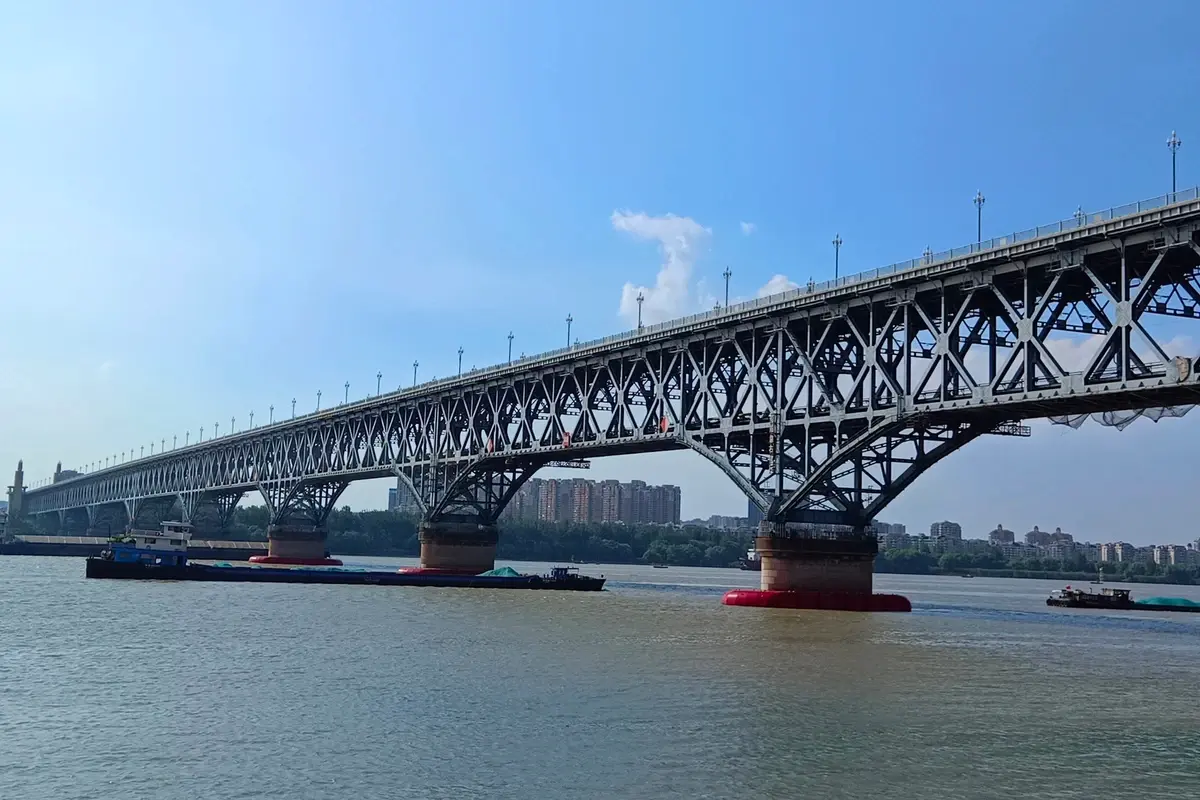
After dropping off our luggage, the first stop had to be the world-famous Nanjing Yangtze River Bridge. Unlike the Wuhan Yangtze River Bridge, this one isn’t in the city center. We booked a hotel near Fuzimiao Pedestrian Street, and a taxi ride of over 50 yuan brought us to the foot of the bridge for a proper look.
Actually, this photo was taken while strolling through Fuzimiao Pedestrian Street before heading to the bridge—look at the crowds. Summer holiday travel is really not ideal, but we had no other choice.
Next to us was the China Imperial Examination Museum, which charges an entrance fee, so we didn't go in.
The night view of the Qinhuai River—at the time, the queue for boat tickets was at least 100 meters long. We resolutely gave up.
I wonder when there are fewer visitors.
Nanjing Dapaidang at Fuzimiao—the line was almost as long as the one for the boats.
Early the next morning, we took a bus to the Presidential Palace. Tickets were 35 yuan for adults, free for children.
The visit wasn’t that enjoyable.
After the Presidential Palace, we hopped on the metro and then took a ride-hailing car to the Sun Yat-sen Mausoleum scenic area.
The scenic area is supposed to be free, but we hadn’t managed to book tickets in advance. We spent 263 yuan on Taobao for the three of us to get in, which included a guide to give us some explanations and a few small souvenirs.
From the highest point of the Sun Yat-sen Mausoleum, we overlooked Nanjing. Jiangsu Province is probably the lowest-altitude province in China; looking out, it’s truly a vast flatland with hardly any mountains.
On the way back, we took the metro and got off at Xinjiekou Station. Come and count if there really are 24 exits!
The third day was mostly spent at the Nanjing Museum. As we exited the metro station, we happened upon the Nanjing University of Aeronautics and Astronautics (NUAA). Maybe in the future, my kid could manage to get in there!
China has many museums, but only a handful are grandly called “Museums” in the sense of “博物院.” This Nanjing Museum is incredibly hard to get into. The guide said that on peak days, up to ten million people try to book online simultaneously—no idea if that’s true. We tried days in advance, roped in several people to help, and still couldn’t secure a slot. In the end, we relied on the mighty Taobao, paying 241 yuan for the three of us to enter with a guided tour. That was fine; otherwise, we’d have had to pay someone to get us in anyway.
A treasure of the Nanjing Museum.
Looks small in the photo, and it’s not that big in real life either.
The jade burial suit sewn with gold thread—another museum treasure.
Brick relief of the Seven Sages of the Bamboo Grove.
A sancai (three-color) pottery twin-fish vase.
Most museums have their top ten treasures, but these were all that were on display at the Nanjing Museum at the time—the rest were either under maintenance or away on loan.
We entered the Nanjing Museum a little after 9 a.m. and didn’t leave until after 4 p.m. when it was about to close. The visit was really rewarding.
The fourth day: Nanjing University, the Nanjing City Wall Museum, and then off to Suzhou in the afternoon.
Nanjing University wouldn’t let us in either, so we took a souvenir photo at the gate.
After NJU, bus 202 took us straight to the Nanjing City Wall Museum, literally right beneath the city wall.
This museum charges admission: 30 yuan for adults, free for kids.
The earliest embryo of Nanjing city.
I recall that ancient Nanjing had thirteen city gates.
This is just outside the gate.
The city wall seems open to the public too, though it’s not as famous as the one in Xi’an.
In the afternoon, we caught a train to Suzhou. High-speed trains run roughly every ten minutes, almost like a bus service, so we didn’t bother buying tickets in advance. When I checked around noon, all high-speed tickets were sold out—how many people can there be? In the end, we bought a regular intercity ticket and it took over two hours to reach Suzhou.
During this time, something happened that I will never, ever forget for the rest of my life—also known as an unforgettable moment (sounds like a line from a primary school essay, doesn’t it?).
On the way back to the hotel to pick up our luggage—right at the doorstep, actually—I twisted my foot while walking. The pain was excruciating, and it became difficult to walk; my right foot could only shuffle along the ground...
Bearing severe pain, I somehow made it to Suzhou. By the time we checked into the hotel, my foot had already swollen up like this.
I compared my left and right feet and sent a photo straightaway to a classmate who is an orthopedic surgeon. He said, based on the photo, he suspected a fracture of the fifth metatarsal bone in my right foot (gotta say, his judgement was spot-on—I give him a thumbs up). I said I’d go to the hospital the next day, but he insisted I go immediately. So, around 8 p.m., we went to the Affiliated Hospital of Soochow University. I got an X-ray, and sure enough, it was a fracture. The first fracture of my entire life, in my favorite city in all of China! So, my second visit to Suzhou turned out to be this kind of experience. For the next three days, the mother and kid went sightseeing while I just lay flat in the hotel room!
Day five: Suzhou Museum and the Humble Administrator’s Garden.
A corner of the Suzhou Museum—all the museums here embody the style of Jiangnan gardens.
I can’t even name all these objects, but they’re all treasures. I think they didn’t photograph the pearl sarira container.
One of the museum’s treasures.
The Humble Administrator’s Garden—one of China’s four great gardens. Ticket: 80 yuan for adults, 40 for children.
Of the four great gardens, the Mountain Resort in Chengde and the Summer Palace are imperial gardens, while the Humble Administrator’s Garden and the Lingering Garden are private gardens.
Pavilions, terraces, and towers are arranged in graceful disorder.
For a description, I’d refer you to Mr. Ye Shengtao’s essay, “Suzhou Gardens.”
Day six: Tiger Hill and the Lingering Garden.
Touted as the No. 1 Hill in Wu, though its altitude is actually just 34 meters.
The Lingering Garden’s character lies in its exquisite refinement.
Pingjiang Road at night. They say, “One Pingjiang Road, half the city of Gusu.”
And there’s also “One Chang’an City, half of Chinese history” — such phrases are meant to highlight the greatness or importance of a place.
I especially love this atmosphere of little bridges over flowing streams alongside people’s homes.
This time, you two go and experience it; I’ll piece it all together in my mind through the photos.
Indeed, a nationally famous tourist city—traffic was still jammed on the main road past 9 p.m., a sight you never see in our little nowhere town.
Day seven: Lion Grove Garden and Hanshan Temple.
Tickets 40 yuan, children 20.
The Lion Grove Garden in the imperial Mountain Resort corners was modelled after this very one.
I genuinely can’t read what those characters say.
In the afternoon, we headed to Hanshan Temple, which is a bit out of the way. Entry: 20 yuan for adults, 10 for kids.
Various calligraphic styles and scripts transcribing the poem “Night Mooring by Maple Bridge.”
I had originally planned to detour to Shanghai on the last day, see the Bund, and then head home. But given my condition, Shanghai was off the table. So we boarded train Z516 directly from Suzhou at 4:25 p.m. and arrived at Jinzhou South Station the following morning at 8:31. Lucky thing we’d bought those sleeper tickets earlier—otherwise I would have really suffered on a plane or high-speed train.
And finally, a bonus. The circled area shows where the fracture is.
Here’s a clearer, color X-ray taken at my local hospital. I gathered several doctors I know for a makeshift “consultation.” Most recommended surgery.
In the end, I went under the knife. Five stitches, four days in the hospital—I endured quite a bit, then went home to recuperate.
I had to lie flat at home for two months. The doctor said staying like that was the best way to heal...


