【Super Japan】Nara and Osaka, a Seven-Day Family Trip
From Monday to Sunday, Osaka and Nara, seven days in two cities. No guide, no detailed itinerary, not even any expectations beyond feeding deer and shopping. Just two families with kids, walking and looking around. The six-year-old child, revisiting a familiar place, eagerly shared her experiences and tips; the two-year-old simply relaxed and enjoyed the journey.
With parents by their side, experiencing unfamiliar cities and strangers, I believe the little ones will recall this trip with smiles: "The world is small and friendly."
This trip covered Osaka and Nara in the Kansai region of Japan. We ensured we woke up late and took afternoon naps every day, so the activity level was very relaxed.
Day 1: Flight from Tianjin to Osaka.
Since our companions had a very young child, the planned itinerary was to depart at noon, arrive in the afternoon, and check in by evening. Although it slightly wasted a day, it was necessary to adjust for travel fatigue.
After arriving at the airport, we took the subway directly to the area around the Universal Studios hotel. Note that searching for "Studio" in navigation apps won't find the destination. See the image below for details.
Around evening, we arrived at Osaka Universal Studios and checked into the hotel. It was convenient for getting to the studio the next day.
Day 2: Full day at Osaka Universal Studios.
Day 3: Train from Osaka to Nara, staying at Mount Wakakusa, feeding deer.
Overall, the major Kansai cities—Osaka, Nara, and Kyoto—form a triangle, with convenient and fast transportation between them. It's more like a commuter trip between Beijing and Tianjin than crossing prefectures.
In Nara, we chose the same hotel as before, the Deer Garden Hotel at the foot of Mount Wakakusa, and even the same room.
Day 4: Strolling in Nara.
Nara Park, Todaiji Temple, Kasuga Taisha Shrine, Nigatsu-do Hall, feeding deer.
Day 5: Train from Nara back to Osaka, staying in Namba. Eating and shopping.
Our hotel in Osaka was near Namba, inside a building connected to Takashimaya, with the hotel entrance inside Takashimaya itself. It was convenient for shopping.
Day 6: Separate activities. Happy Children's Day.
Some went to play (Children's Paradise, hot springs), others went shopping (Shinsaibashi, Takashimaya).
Day 7: Last-minute shopping at Takashimaya, then flight from Osaka back to Tianjin.
It felt like getting to the airport was farther than going to Nara! Along the way, we saw the suburban towns of Japan, not particularly advanced but somehow felt livable.
Kansai International Airport is huge but not crowded.
Summary of the Nara-Osaka trip:
The subway station map at Kansai International Airport is quite clear, making it easy to find major destinations and cross-reference with apps.
We bought ICOCA cards for transportation in Kansai. Awkwardly, I casually inserted the ICOCA card into the slot meant for paper tickets... and it got stuck!
Until a staff member came, disassembled the gate, and retrieved the card.
Thanks to the staff, who showed no blame or complaint, smiling at us throughout, as if their equipment failure caused our inconvenience.
From Kansai International Airport, it was easy to take the subway to the studio. The train had station signs for several stops ahead, so referencing with the phone app, we had no worries about taking the wrong train.
WeChat Pay and Alipay were effective payment methods in Osaka. Of course, cash was still necessary.
Internet companies' electronic payments are essentially playing a word game with "cashless cities" versus "cardless cities." The latter is more meaningful and beneficial to the public.
Cash, as legal tender, is the best and most convenient payment method in many situations. In Japan, coins are not just currency but keys to many aspects of daily life, such as gacha machines, lockers, and shopping carts.
Taking the subway from the airport, we got off at Universal City Station. Exiting the station, we could feel the atmosphere of the studio. It was around 7 PM Japan time, already dark, with perfect lighting.
The hotel had an excellent location, very close to the station and the studio entrance, with a Universal Studios theme throughout.
While the adults checked in, the kids played small games happily. The lobby had a time-travel clock where you could choose a time and place to "travel."
For dinner, we ate at a simple place called Egg Things near the hotel. It wasn't great or special, just convenient. After a long day of travel, the priority was to eat quickly and rest.
Interestingly, we had encountered Egg Things before in Osaka and Hawaii, both times by chance.
After dinner, we wandered around the studio area. The lighting setup wasn't too dense or brilliant, but not bleak either. It was nice to stroll with the kids.
The shops on both sides were still open, so we browsed without feeling tired or bored.
We visited the studio's souvenir shop but didn't buy anything, saving it for the next day. Based on past experience, kids spend far more time in souvenir shops than on rides.
The streets had a strong studio vibe. We walked leisurely, chatting and joking, enjoying the relaxed atmosphere in a foreign land.
We checked out the studio entrance around 8 PM, when visitors were starting to leave.
Back at the hotel, the lobby had a guide to the studio's attractions, which was helpful for planning which rides to prioritize the next day.
Today was all about enjoying the studio.
As luck would have it, it rained in the morning. Third time's a charm? Our previous two visits to Tokyo Disneyland also had rain, and this time at Osaka Universal Studios was no different. A tradition we can't break.
The back door of the hotel led directly to the studio entrance—literally zero distance.
The wide, empty streets with strong studio-themed shop buildings felt like Los Angeles.
Even though it wasn't a holiday or weekend and it was raining, there was already a queue at the studio entrance in the morning. We used the waiting time to grab a guide map and plan our route.
Entering the studio, the iconic globe was at the entrance—just like how every Disney park has Walt Disney holding hands with Mickey Mouse. This globe is the same at Universal Studios Hollywood and Singapore.
Theme parks generally follow a similar layout: the entrance typically has a town-like atmosphere with canopied walkways and shops on both sides. This design isn't for entry but to boost last-minute purchases upon exit.
Universal Studios does this, Disney does this, and even Chimelong does this.
Following the guide, we hurried to the Hogwarts reservation machine, only to find it "CLOSED."
Reportedly unique among Universal Studios worldwide, Hogwarts Castle is the biggest draw at Japan's Universal Studios.
The realistic Hogwarts Castle perfectly replicates its appearance.
Hogwarts School of Witchcraft and Wizardry is one of Europe's magical schools. Children with magical abilities are registered at birth and receive owl-delivered acceptance letters at age 11. The school follows a seven-year program, and all students board. Hogwarts has four houses: Gryffindor, Hufflepuff, Ravenclaw, and Slytherin. The Sorting Hat determines your house based on your character and qualities.
Inside the castle were classic scenes from the movies. The lighting was dim, so no flash photos were allowed, limiting our pictures. The famous Harry Potter flying broom ride required securing phones to prevent them from falling, so no photos were possible.
We bought Hermione's wand.
Mr. Ollivander told Hermione that her wand was made of vine wood with a dragon heartstring core.
Dragon heartstring is made from a dragon's heart. Few female witches use such a rigid wand, symbolizing Hermione's daring and courage. With her vast knowledge, brave heart, and outstanding magical abilities, she serves more as the group's magician, while Harry is more the warrior.
I wanted to say to my child:
Academic excellence isn't everything, but it is the most reliable way to overcome innate or acquired shortcomings through personal effort, and the best way to keep your destiny in your own hands. Just like Hermione—so what if she was Muggle-born? So what if she was ordinary-looking?
Whether in novels, on screen, or in reality—Granger-Hermione or Emma Watson—both have shone as heroines after being nourished and refined by knowledge. I think Watson today looks back with gratitude for her persistence in academics.
Study hard. Excellence is a habit, success is an aura. Always be that vibrant, sunny youth.
Just like the song "The Youth" that my child loves to sing—though for now she only finds it melodious and catchy, in the future she will understand that persistence is power:
I am still that youth from before, not a single change. Time is but a test, the belief in my heart has never diminished.
This youth before me still has that original face, no matter how many hardships lie ahead, I won't retreat.
Say never never give up, like a fighter.
----------------------------------------------
Strolling around the studio in light rain was quite relaxing and fun.
Playing games without expecting prizes—just the joy of participation.
For children, happiness is simple. Sprinkling breadcrumbs and watching sparrows peck at them is already great fun.
Like Disney, we occasionally encountered movie characters. In line with Japanese service standards, they were more enthusiastic and friendly with kids compared to their American counterparts.
Of course, as a local anime star, Hello Kitty received treatment unmatched by Western characters, including her own castle, similar to Disney's Mickey Mouse House. Hello Kitty's castle was a favorite spot for the kids. From the queue at the entrance, they were immersed in Kitty's pink atmosphere.
The overall layout and route design felt very much like Mickey's house at Disney.
We meandered through and gave Hello Kitty a warm hug. A photo was a must.
At the exit, there was a place to buy photos, but we were also allowed to take our own.
The magical monkey with light and sound effects was probably an immersive viewing experience.
The interplay of sound, light, and film, along with the host's engaging manner, easily drew everyone into the scene, and language wasn't a barrier to understanding.
I never understood why kids love indoor play areas like these—whether at Universal, Disney, Chimelong, or even Songcheng, and every shopping mall or amusement park has them.
The carousel was a must-do activity, always commemorated with a photo.
Watching the kids go round and round, they grow up.
Actually, the main attraction at the studio was shopping.
We scored big time...
Dinner consisted of various snacks.
Today's itinerary was to take the train from the studio to Nara.
Gacha machines were the best way to fill any spare time.
Nara Station was small but spacious and bright. Across the street from the subway exit was a bus stop. While waiting, we bought breakfast and fruit snacks at a supermarket.
We took a bus directly to the Deer Garden Hotel. It wasn't far—about 3 kilometers—but with luggage, walking wasn't practical.
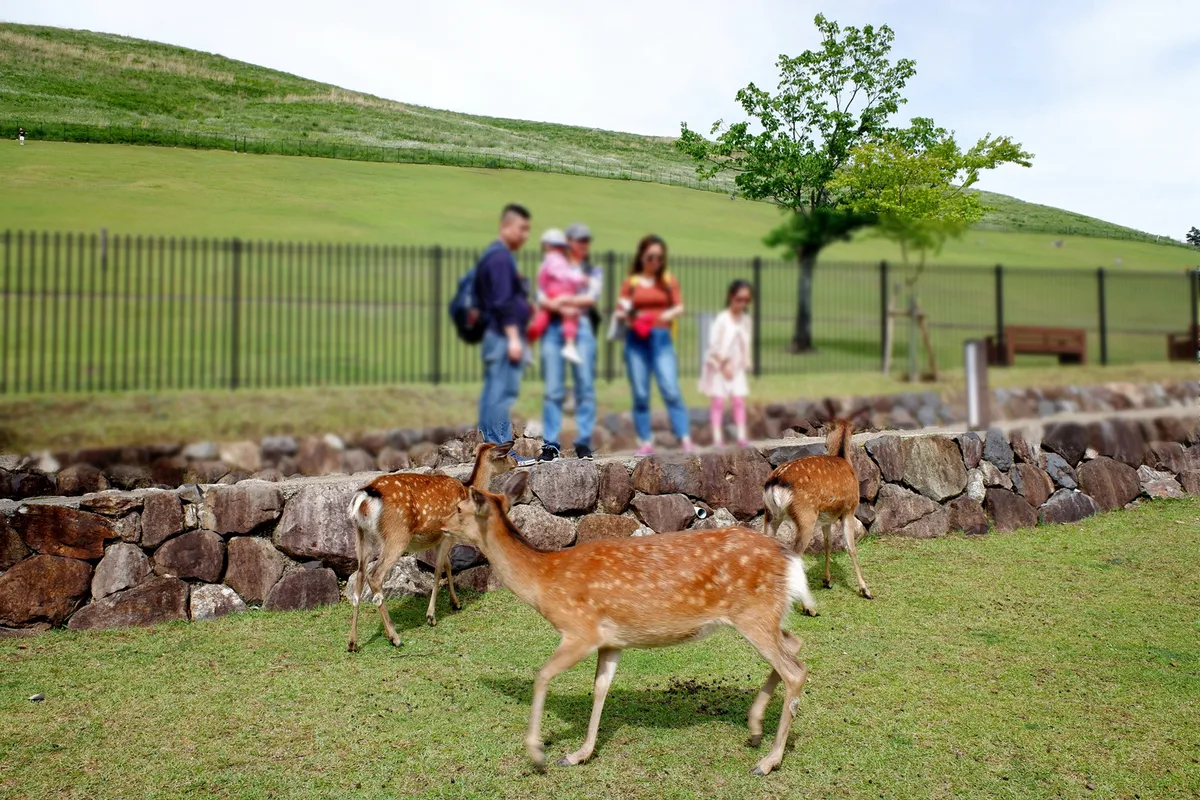
Before even reaching the hotel, we encountered deer in small groups on the path.
The kids were a bit shy at first, watching the adults interact closely with the deer.
The hotel was the same guesthouse we stayed at last year, at the foot of Mount Wakasuga. Deer often loitered at the entrance, peeking in curiously.
After quickly unpacking, we went out for a stroll.
"Deer cry out, eating the wormwood in the fields. I have honored guests, I play the zither and blow the sheng."
The deer before us strolled on the lawn, while we chatted with friends. Cao Cao's "Short Song Style" felt perfectly fitting.
On one side was the vast green Mount Wakakusa, likely due to the annual grass burn, with no large trees, only fresh green grass.
On the other side were groups of deer chasing tourists for food.
Deer crackers were sold everywhere.
The deer weren't afraid of humans at all, getting very close—within breathing distance for the kids.
Even adults avoided the adult male deer, which were used to bumping and shoving, but we were not.
Legend has it that the deity of Kasuga Taisha rode a deer from Kashima Shrine to Nara, so deer have been protected as divine messengers since ancient times.
Thus, we strolled until evening.
After a short rest at the hotel, we went out again at night.
The forest paths were quiet, with no deer in sight—they had retreated somewhere to rest. Only occasional small movements could be heard in the woods.
On early summer nights, few tourists were about. We walked in high spirits, feeling no fatigue from the day's journey.
Near Todaiji Temple, Starbucks was already closed. We bought semi-prepared food at a 7-Eleven, planning to cook dinner at the hotel.
Nara settled into nighttime early, with no nightlife bustle—only the tranquil, peaceful atmosphere of a countryside town.
Yes, peaceful. The streetlights weren't bright, but we felt completely safe.
The 7-Eleven had few customers, and the hot food was mostly sold out, but there were plenty of semi-prepared options.
We devoured the food, only remembering to take a photo afterward.
The adults ate and chatted, while the kids had online English lessons—just like a casual gathering at a friend's house.
The wooden cabin, warm yellow lighting—it was very comfortable.
The night was quiet and peaceful.
Morning came, and we set off along the forest paths we had become familiar with the previous evening. Today's route roughly was: Nara Park – Todaiji Temple – Kasuga Taisha Shrine – Nigatsu-do Hall.
The kids gradually got used to being around the deer. Though they still dodged and chased, there was more laughter than fear.
Nara Park is actually very large, reportedly 4 kilometers long. The lawn in front of Mount Wakakusa where we stayed is part of it. However, what most tourists call Nara Park specifically refers to the open woodland area near Todaiji Temple.
Here, both tourists and deer are concentrated. Many photos of close deer encounters online are taken here. Objectively speaking, for a more mystical atmosphere, the forest paths near Kasuga Taisha are better.
It had a feeling of "deep in the clouds, nowhere to be found"—like a deer spirit girl.
Gacha machines weren't really an activity but a natural way to pass the time.
Casually, anytime, anywhere...
The deer at Todaiji seemed to act like half-owners of the Buddhist sacred ground, behaving even more brazenly with tourists, occasionally blocking the way.
Todaiji's main gate path was both wide and long, lacking the cramped feeling of other Japanese temples. On one side was a large pond with many fish and turtles.
Todaiji, a UNESCO World Heritage site, was where the Tang Dynasty monk Jianzhen (Ganjin) gave precepts. It is the head temple of the Kegon school of Buddhism, also known as Daikōden or Konkōmyō Shitennō Gokokuji. Located east of Heijōkyō (present-day Nara), it is called Tōdaiji (Eastern Great Temple). The Great Buddha Hall is 57 meters wide and 50 meters deep, the world's largest wooden building. Inside is a 15-meter-tall statue of Vairocana Buddha. The temple also includes the Nandaimon Gate, Nigatsu-do Hall, Sangatsu-do Hall, and Shōsō-in. The Nandaimon has famous twin Kongō Rikishi statues. Nigatsu-do offers a panoramic view of the Great Buddha Hall and Nara city.
Washing hands and rinsing mouth are rituals to purify the mind, fostering reverence, tranquility, and equanimity.
These rituals are common at Japanese temples, with special basins at Sensō-ji, Kiyomizu-dera, and Tenryū-ji.
The kids didn't have much insight into the temples.
The Buddha statues were solemn, the guardian deities fierce. As per my habit, I didn't take photos—unlike Zhang Wang's "Footprints of the Buddha" at Lingyin Temple, which required deep familiarity.
Our main focus was still on the deer, and we gradually became more comfortable with them.
A pool of clear water, a few pine branches—a scene of ethereal beauty, no wonder Li Bai wrote about "letting the white deer roam among the green cliffs."
On the way back to the hotel, we always encountered deer, and a deer cracker as a greeting gift was unavoidable.
The afternoon sun slanted through sparse trees. We leisurely used the twisting banyan aerial roots as a swing, enjoying a lazy time.
In the afternoon, we went to Kasuga Taisha, a place with an excellent ambiance. Along the ancient stone steps, flanked by equally ancient moss-covered stone lanterns, the path led onward, passing various shrines of different sizes.
Shrines: Japanese buildings dedicated to nature spirits, clan ancestors, and heroic figures. Shrines are traditionally rebuilt every certain period. Their plans and appearances are relatively simple, with two basic styles: one is "Taisha-zukuri" (square plan, gabled roof, entrance on the gable side, a central pillar inside); the other is "Shinmei-zukuri" (three-bay width, entrance in the central bay, also gabled roof). After the Heian period, more styles emerged, such as "Kasuga-zukuri" (single square bay, gabled roof with an additional pent roof on the gable side), "Nagare-zukuri" (a pent roof added to the front of Shinmei-zukuri to form a porch), "Hachiman-zukuri" (two buildings connected front-to-back with a joined roof), and "Hiyoshi-zukuri" (a pent roof added on the left, right, and front of a three-bay shrine).
Buddhist temples: Another major type of Japanese architecture. Key structures include pagodas, Buddha halls, middle gates, and cloisters. The halls typically house Buddha statues, with lecture halls in the rear.
Kasuga Taisha was built to protect Heijōkyō and pray for national prosperity. It is a UNESCO World Heritage site and the head shrine of all Kasuga shrines in Japan. Along with Ise Grand Shrine and Iwashimizu Hachiman-gū, it is called one of the three major shrines in Japan. Mount Kasuga, as the shrine's sacred mountain, has been protected from logging for over a thousand years, preserving its virgin forest.
Kasuga Taisha stood deep in the woods at the end of the path. On both visits, there were few tourists, enhancing the shrine's tranquility and making it more approachable. "Deep in the trees, deer are seen; by the stream at noon, no bells are heard. Wild bamboos break through the blue mist; a flying spring hangs from a green peak."
The deer roaming among the vermilion wooden pillars and corridors seemed even more spiritual, no wonder both Buddhism and Taoism revere the deer and crane as immortals.
Whenever I think of these things, I feel the cultural connection between our neighbor Japan and us.
This was one of my favorite photo spots—a tranquil shrine, vivid corridors, quiet yet full of life.
The architectural feature is the main sanctuary consisting of four parallel shrines. The vermilion corridors surrounding the main sanctuary contrast beautifully with the green forest of Mount Kasuga. Together with lanterns hanging from the eaves and the shrines themselves, it forms a picturesque landscape. The vermilion main sanctuary has been famous for wisteria since ancient times. The 3,000 stone lanterns and hanging lanterns on the grounds are also noteworthy.
We passed through Kasuga Taisha and continued deeper into the forest paths.
There were many smaller shrines nearby, including Wakamiya Shrine, Meoto Daikoku Shrine, and Kinkō Shrine... I couldn't remember or match them, so we just walked, took pictures, and moved on.
Even deep in the forest, there were gacha machines.
Since the Nara period, Japan has built stone lanterns in temples to protect the lamps offered to Buddha. The approach to Kasuga Taisha is long, lined with an impressive number of stone lanterns, densely packed on both sides. The lantern tops were covered with moss, showing the passage of time.
We took a wide arc and exited back to the main road from the other end of Kasuga Taisha, passing through a torii gate.
The sun was setting. We wandered around the nearby shrines, occasionally encountering a deer or two without surprise, just naturalness.
Before it got completely dark, we returned to the hotel for dinner, then met up with friends to go to Nigatsu-do Hall.
The sun had set, and Mount Wakakusa loomed dark green before us. We walked along the path at the base of the mountain.
Nigatsu-do was not far from our guesthouse—about a 20-minute walk along the path.
Sparse streetlights and shrine lamps lit the way, preventing it from feeling too dark or lonely.
Nigatsu-do sits atop a small hill, offering an excellent panoramic view of Nara city.
The main hall was locked, but lights were left on around the area so visitors wouldn't lose their way.
Due to its remote location and darkness, we saw no other tourists, allowing us to laugh and chat without disturbing anyone.
On the way back from Nigatsu-do, a few late-night deer greeted us, perhaps wanting to say goodnight.
The journey from Nara back to Osaka was smooth and convenient.
The hotel we stayed in had an excellent location, right above Takashimaya. Even checking in required finding the front desk inside Takashimaya.
The hotel had a great view, and the room was unusually spacious and bright for a Japanese hotel, without the typical cramped feeling. From the window, we could see Namba Station below.
From the hotel, we went out for shopping.
Rows of gacha machines amazed the kids, making them linger so long they couldn't move.
For dinner, we had Osaka-style okonomiyaki. Meat, vegetables, rice, and sauce were cooked on a hot iron plate—pretty tasty.
It started raining at night. We ate and wandered around Nankai-dori, which was very close to the hotel, just across the intersection.
By the roadside, we saw young girls performing—more like entertaining themselves than street busking.
Today's plan was for the two families to split up.
Moms went shopping, while dads took the kids to the Children's Paradise for Children's Day.
Familiar with the route, we got off the subway at Ogimachi Park and ran straight to the outdoor play area.
The park was ordinary, with no special decorations or ground maintenance—just a simple playground with large equipment on dirt. Many local families were relaxing and playing there.
After playing until tired, we bought tickets to the Children's Paradise for a rest.
The science experiments and nature observation area hadn't changed much from last time, but the kids had a great time. It was similar to a science museum in China.
New since last year were exhibits on world cultures and customs. The kids loved experiencing life in various traditional houses from around the world—playing drums, instruments, shadow puppets, and dressing up.
Japanese attention to detail was also evident in the design of experiential games, such as allowing kids to experience how a person in a wheelchair gets on and off a train. I think this gives children a more intuitive and profound understanding of priority seating for the disabled, from an individual to a societal level.
Japan is the best country I've encountered at integrating consciousness, personal behavior, social rules, and legal systems—even surpassing the much-praised Nordic countries and Switzerland in naturalness and maturity.
I suddenly felt that "engaging in the world is cultivation" probably describes this kind of social atmosphere.
Again, the kids ran for a long time in the maze-like play area.
The career experience zone was the most crowded and popular area.
For some reason, the child became obsessed with being a mail carrier—picking up letters and delivering them to different mailboxes scattered around the children's center, then collecting outgoing letters and returning them to the post office.
It was a simple game, but she repeated it over and over, tirelessly. I followed her, dragging my legs with fatigue, while she still hopped and skipped. Children's joy is simple.
She delivered nearly 200 letters without getting tired... There's no need to understand a child's world completely; just being there is enough.
There were other games—not complicated but with strong hands-on appeal, which the kids liked.
After leaving the Children's Paradise, we continued playing in the outdoor area. I tried to video the child, but I slipped and fell... As long as the kid was happy.
Around dinner time, we took the subway from Ogimachi Park to Shinsekai for a hot spring.
It was a large building, advertised as Asia's largest hot spring, quite similar to a bathhouse in China. The only difference was that it was very uncrowded, almost like a private session.
We also had dinner at the hot spring center.
Shinsekai is a well-known commercial district, home to Tsutenkaku Tower.
Back at the hotel, we looked out at the dazzling night lights of the bustling city.
Happy Children's Day, my precious one.
In the morning, the dads stayed at the hotel with the kids while the moms seized the last chance to shop at Takashimaya...
Eventually, one dad had to go to the store to help carry things.
Thankfully, the hotel's location was excellent, right above the connecting mall building.
Around noon, we checked out of the hotel. From the subway, we took the Nankai Line directly to Kansai International Airport.
It was an easy trip. I hope when the kids grow up, they will remember it just as easily.
Travel Diary Content:
1. Itinerary Overview
2. Japan 01 - Check-in at Osaka Universal Studios
3. Japan 02 - Full Day at Universal Studios Osaka
4. Japan 03 - Osaka to Nara
5. Japan 04 - Nara: The Deer's Cry
6. Japan 05 - Nara Back to Osaka
7. Japan 06 - Osaka: Children's Day
8. Japan 07 - Osaka: Shopping Finish
Travel Information:
Hotel Index, Attraction Guide Index, Ticket Index, Website Navigation, Travel Index, Cruise Index, Corporate Travel Index, Joining Cooperation, Distribution Alliance, Friendly Links, Corporate Gift Card Purchase, Insurance Agency, Agency Cooperation, Hotel Franchise, Destination and Attraction Cooperation, More Joining Cooperation, About Ctrip, Ctrip Hot Topics, Contact Us, Careers, User Agreement, Privacy Policy, Business License, Security Center, Ctrip Content Center, Intellectual Property, Trip.com Group Algorithm Announcement