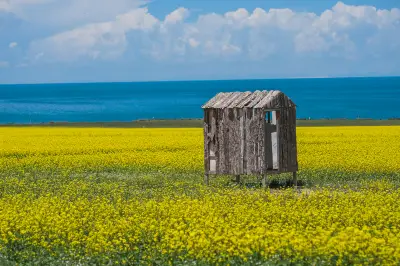
Qinghai Travel: A Charming Trip to Qarhan Salt Lake (Photos)
The Qarhan Salt Lake in Golmud, Qinghai, was a major highlight of the journalist's trip on the 'Charming Qinghai-Tibet Tour' special train organized by China Railway Tourism in July 2007. On the evening of July 28, the tour train departed from Xining for Golmud, the second largest city in Qinghai Province. After an overnight journey, the train arrived at Golmud Station at around 8 a.m. on July 29, and the group then took a bus directly to the famous Qarhan Salt Lake.
Street view of Golmud (Photo: Feng Ganyong)
Earlier, the journalist learned that with the growing popularity of salt lake tourism in Golmud, many tourists visit between June and July each year. The number of visitors sometimes reaches several hundred, including business travelers, group tours, and mostly self-driving tourists. Today, several hundred tourists from Beijing on the special train visited the lake, demonstrating the extraordinary appeal of the salt lake scenic area.
Citizens doing morning exercises (Photo: Feng Ganyong)
The tourist bus drove through Golmud city center, revealing a very quiet city in the northwest, with few vehicles and pedestrians. According to relevant sources, Golmud is a Mongolian word meaning 'a place with many rivers.' It is located in the south-central part of the Qaidam Basin and was built in the 1950s. Geographically, Golmud borders the Kunlun Mountains to the south and Qarhan Salt Lake to the north, at an altitude of 2,800 meters. The climate is cold, with large temperature differences, long sunshine hours, and little rainfall.
Morning market in Golmud (Photo: Feng Ganyong)
The Golmud administrative area covers 124,000 square kilometers and consists of two separate geographic units. The urban area covers over 20 square kilometers and is home to more than 200,000 people from Han, Mongolian, Hui, and other ethnic groups, making it a multi-ethnic settlement. Golmud is a transportation hub with convenient transport and communication facilities. It leads north to Dunhuang, Gansu; south to Lhasa, Tibet; west to Ruoqiang, Xinjiang; and east to Xining, the capital of Qinghai. The first phase of the Qinghai-Tibet Railway reaches here, and flights connect to Beijing, Xining, Xi'an, and Lhasa.
A tranquil park (Photo: Feng Ganyong)
The population mainly consists of Han immigrants. A few years ago, these immigrants came to Golmud to start growing potassium carbonate plants, which have now become the city's main economic支柱. Otherwise, it would be hard to imagine anyone willing to live in this dry and cold place. Golmud is rich in mineral resources.
China Salt Lake City (Photo: Feng Ganyong)
In addition, there are abundant water resources, land, wildlife, and tourism resources. For tourists, Golmud is located east of Xining, north of Dunhuang, and south of Lhasa. Perhaps it is this transit location that makes Golmud interesting. Many tourists stop here briefly before heading to Xinjiang, Tibet, and other places.
Journalist at Salt Lake City (Photo: Sun Minghe)
The Qarhan Salt Lake visited by the tour group is the largest salt lake in China and one of the most famous inland salt lakes in the world. It is located in the Qaidam Basin in western Qinghai. The lake stretches over 160 kilometers from east to west, 20 to 40 kilometers from north to south, with a salt layer thickness of about 2 to 20 meters, covering an area of 5,800 square kilometers at an altitude of 2,670 meters. It contains over 50 billion tons of sodium chloride, enough to feed the world's population for 1,000 years. The lake also produces world-famous carnallite, which is crystal clear and very lovely. It is associated with minerals such as magnesium, lithium, boron, iodine, and is extremely rich in potassium and salt resources.
The Ten-Thousand-Zhang Salt Bridge (Photo: Feng Ganyong)
The convoy of tourist buses took about an hour from downtown Golmud to reach the salt lake. Along the way, the guide explained that the road they were on was the famous Ten-Thousand-Zhang Salt Bridge. This salt bridge is a highway running from Golmud to Dunhuang, passing over Dabusun Lake. The salt crust, 15 to 18 meters thick, forms a natural salt bridge 32 kilometers long, equivalent to ten thousand zhang in Chinese measurement, hence the name.
Salt harvesting boat (Photo: Feng Ganyong)
The road surface is smooth and flat, with beautiful scenery of mountains and lakes, truly 'unparalleled in the world.' The jade-belt-like salt bridge road has no guardrails, no piers, and no flowing water beneath. The entire road surface is smooth, flat, and straight. The salt bridge (road) splits the salt lake in half, evoking amazement and admiration for human ingenuity and wisdom.
Endless salt lake (Photo: Feng Ganyong)
The maintenance method of the salt bridge is very unique. Usually, when potholes appear on the road, workers break salt chunks from nearby salt crust, then scoop a ladle of concentrated brine from roadside saltwater pits, pour it over the salt pieces, which quickly dissolve and solidify on the road surface, restoring the pothole to its original state.
Office building (Photo: Feng Ganyong)
Upon arriving at the salt lake, the journalist discovered that this is the site of Qinghai Salt Lake Development Co., Ltd., the company behind the listed stock 'Salt Lake Potash' on the Shenzhen Stock Exchange, known for its relatively good performance.
Production area of Salt Lake Company (Photo: Feng Ganyong)
The bus passed through the factory area and soon reached the vast salt lake scenic area. Scattered salt lakes, like unique natural landscapes, were distributed across the vast Qaidam Basin, presenting a magnificent view.
Salt lake scenery (Photo: Feng Ganyong)
Some salt lakes neighbor snowy mountains, reflecting the continuous mountain ranges and white snow; some lie quietly in the desert, surrounded by white salt belts like jade necklaces; others have dried up and hardened into salt rock, with railways and highways passing over them. The salt rocks come in various shapes, reminiscent of the Yunnan Stone Forest. The salt lake water contains multiple chemical elements, harboring huge inorganic salt mineral resources.
Salt flowers by the lake (Photo: Feng Ganyong)
Tourists arrived at the central dock of the salt lake, which offered the best view but was very windy, making everyone shiver. On the lake, a few colorful boats were working.
Salt lake sightseeing (Photo: Feng Ganyong)
On the shore of the dark green salt lake, white jade-like salt crystal formations stood in various shapes, full of vitality and extremely beautiful.
Working boat on the lake (Photo: Feng Ganyong)
The formation of the salt lake is due to disasters or crustal movements. The Qinghai-Tibet Plateau was once part of the ocean. After long-term crustal movements, the land rose to form the world's largest plateau, leaving seawater in some low-lying areas, creating many salt lakes and ponds. Qarhan Salt Lake is one of them. The salt in the lake is nearly inexhaustible because rainwater brings more salt from the surrounding mountains.
Commemorative stone at the salt lake (Photo: Feng Ganyong)
Qarhan Salt Lake has a mining history of over 3,000 years. Visitors can enjoy the salt lake scenery and observe mechanized salt mining operations. It is a world of salt: on the vehicles, on the ground, even in the air, there is a taste of salt. In the distance, dredgers dig salt; up close, the salt appears as crystal-like crystals. Tasting it, the flavor is slightly different from table salt.
Vast salt lake (Photo: Feng Ganyong)
It is said that if visitors are lucky, they can see the natural phenomenon of 'mirage' during the day. These natural scenes formed by sunlight refracted through water vapor can be disorienting. The mirages may include houses, cattle, or even sheep swimming on the lake surface, all truly breathtaking.
Mushroom-shaped salt flower (Photo: Feng Ganyong)
The terrain around the salt lake is flat, with a boundless desert, but the scenery is unique. The entire lake surface looks like freshly plowed fertile soil or fish scales, layer upon layer, wave upon wave. Unfortunately, there is no grass on the land, no fish in the water, no birds in the sky, creating a silent scene.
Salt lake scenery (Photo: Feng Ganyong)
On calm and sunny days, the vast lake resembles a giant mirror, radiating silver light, steaming, and shimmering like a vast ocean. The salt flowers in the lake are crystal clear and varied in shape, some like coral, pagodas, flowers, others like constellations, ivory, gems, so lovely that one cannot bear to put them down, earning the name 'blue flowers.' Being among these flowers evokes boundless imagination, as if wandering in a fairyland.
Lakeside scenery (Photo: Feng Ganyong)
After returning from the salt lake scenic area, the group also visited the exhibition hall of Qinghai Salt Lake Development Company. Through a wealth of graphic materials, sand table models, and exhibits, visitors not only learned the origin and development of the salt lake but also deeply felt that the salt lake workers, who work in the field year-round, have made remarkable achievements on China's industrial front, deserving great respect and praise... (Text and photos: Feng Ganyong)