Poetry and Distance Amid the Pandemic: A 2020 Self-Drive Tour of Beautiful Qinghai
This year has been special. Due to the pandemic, all work schedules have been disrupted. In previous years at this time, I would have been leading tour groups in Europe, either in Prague or Amsterdam... And because of the pandemic, I have had the time to see the great rivers and mountains of our motherland. Last year, I went on a ten-day self-drive trip in Tibet with a friend, and it felt absolutely wonderful. After returning, I couldn't forget it for a long time. What Tibet left me with is not just the scenery, but more the shock to the soul from the faith of the Tibetan people and the religious temples. Qinghai had always been a place I wanted to visit. After Tibet, I wanted to go to Qinghai even more. It borders Tibet, and the mysterious Hoh Xil uninhabited area is mostly within Qinghai Province. Driving from Golmud through Hoh Xil, passing Nagqu to reach Lhasa takes about 2-3 days by car. Last year, I took the Qinghai-Tibet Railway from Lanzhou into Tibet, crossing Hoh Xil and climbing over the Tanggula Mountains. This time, I thought about driving the Qinghai-Tibet Highway, so the Qinghai trip was decided on the spur of the moment...
(The popular Qinghai-Gansu Grand Loop online is also good, but I wanted a more relaxed self-drive, so I didn't go to Gansu. Besides, Zhangye and Jiuquan are too sunny and hot this season; Qinghai is better for escaping the heat. Even in summer, the weather in Qinghai requires at least a fleece jacket. The temperature difference between day and night can reach 20 degrees Celsius, especially near the Kunlun Mountains and Qinghai Lake.)
July 18: Beijing – Xining
At this time, Beijing had been clear of the second wave of the pandemic for ten days. The Beijing airport no longer required nucleic acid testing, but to be safe, I still got one done at Chaoyang Hospital before departure. Sure enough, as soon as the plane landed at Xining Caojiabao Airport, passengers from Beijing were told to disembark holding negative nucleic acid test results.
I left the airport smoothly. The weather was great, with a crisp autumn feel. I picked up the car at the rental location—a JEEP. The road conditions along the entire route were quite good, with no need to climb mountains or cross rivers. A two-wheel-drive car was sufficient, but I recommend an SUV with higher ground clearance, as some national roads are not very smooth.
Driving back from the airport to downtown Xining, it was already around 6 PM. In this month, sunset in Qinghai is between 8:30 and 9 PM... The hotel was not far from the famous Mo Jia Street, so I strolled over for dinner. For the first meal, I ordered Qinghai clay pot hotpot and highland barley cakes. The taste was excellent. The highland barley cake had a hint of cinnamon flavor that I love. Maybe because I was very hungry, every ingredient in the hotpot was delicious. It's completely different from our usual hotpot—all ingredients are already cooked and placed in the pot to eat directly, or dipped in minced garlic. I should also mention that I bought some homemade Qinghai yogurt on the way. It was incredibly tasty, with a thick layer of milk skin, eaten with a spoon. And it only cost 3 or 5 yuan—very affordable.
July 19: Xining – Kumbum Monastery – Sun & Moon Mountain – Qinghai Lake (Lashize Binhai Hotel)
The advantage of independent travel is not having to rush or get up early. I had a leisurely breakfast, bought some snacks, and set off at 9:30 AM. First stop: Kumbum Monastery. It's 30 kilometers from the city center, about a 40-minute drive. Kumbum Monastery is extremely famous. Ever since I studied for my tour guide license in college, I had memorized introductions to Kumbum Monastery countless times—the Three Wonders of Kumbum! Today, the content from the textbooks finally appeared before my eyes. This is the birthplace of Tsongkhapa, one of the six major monasteries of the Gelug school of Tibetan Buddhism, with a prestigious and powerful status. The monastery is very large, much bigger than Tashilhunpo Monastery in Shigatse and Sera Monastery in Lhasa, which I visited last year. I loved this place so much that I came back again on the morning of the last day before my flight.
At the entrance, I had a bowl of "firecracker noodles" (noodles cut into small segments like firecrackers) at a small restaurant, along with a serving of dumplings filled with pure mutton. Of course, I couldn't miss ordering yogurt wherever I went. Since I couldn't bring it back, I had it at every meal, every day.
At noon, I continued toward Qinghai Lake! Along National Highway 227, I passed the Laji Mountain Pass at 3,800 meters. After 80 kilometers and an hour and a half, I first arrived at the Sun & Moon Mountain Scenic Area. Cars can drive up the mountain to overlook the entire grassland. There is also a "Boundary Stone Tablet" clearly inscribed: "The dividing line between the Loess Plateau and the Qinghai-Tibet Plateau." To the east of here, the climate is humid, resembling the Inner Mongolian grassland; to the west is the Qinghai-Tibet Plateau, where green pastures become sparse and the yellow of deserts and gobi takes over.
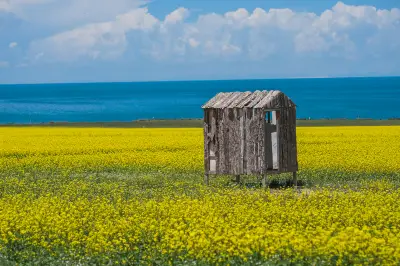
Currently, only the Erlang Sword Scenic Area of Qinghai Lake is open. From Sun & Moon Mountain, take National Highway 109 for 60 kilometers, about an hour's drive. After about half an hour, Qinghai Lake came into view. Heading west along the southern shore, the road is still some distance from the lake. Rapeseed flowers are everywhere by the lake, and in the distance, Qinghai Lake looks like the sea. The car passed through neat fields of rapeseed flowers. Listening to music, with the window open—such happiness...
When I reached the entrance of the scenic area, I gave up and didn't go in. There were too many tour buses and people, all noisy and chaotic—I don't like such spots. I preferred to keep driving while gazing at Qinghai Lake from the car.
I found a less crowded spot near the lake, got out to enjoy the breeze, and saw the Ring Lake Road (the venue for the annual Qinghai Lake International Road Cycling Race; I'm not sure if it was held this year due to the pandemic).
Tonight, I booked a hotel by Qinghai Lake—the Lashize Binhai Hotel in Heimahe Town, 80 kilometers from Erlang Sword. Run by Tibetan locals, the conditions were very basic, but the location was superb—on the southwest corner of Qinghai Lake, only 300 meters in a straight line to the lakeshore.
The average altitude of Qinghai Lake is 3,500 meters. That night, I experienced slight altitude sickness—headache, sore legs, and nausea. Having experienced altitude sickness in Tibet last year, I wasn't worried. Qinghai has more vegetation than Tibet and higher oxygen levels, so a mild reaction in the first couple of days is normal. Last year in Tibet, including the train ride, I had headaches for three days and endured them. For me, this was nothing!
July 20: Chaka Salt Lake – Delingha – Dachaidan Town
I still had a slight headache in the morning, but once I got in the car and set off, it completely disappeared. Today, I checked in at the popular spot: Chaka Salt Lake. Continue on National Highway 109 for 100 kilometers, about an hour and a half drive.
[Aside: Every morning was overcast with thick clouds. Like Tibet, Qinghai's longitude means it actually has a time difference of about two to three hours from Beijing. 10 AM here is equivalent to 7 or 8 AM in Beijing. Group tours usually depart at 7 or 8 in the morning, so wherever they go in the morning, it's cloudy and gray. The sun doesn't come out until noon or later. Self-driving is better because you can manage the time. Even at 8 PM when driving to the hotel, it's still light out, and having dinner at 9 PM is normal.]
Chaka Salt Lake has become incredibly popular online in recent years. My expectations were high, so the disappointment was greater. It's just a salt lake. Qinghai has many salt lakes, large and small, visible along the road. I don't know why only Chaka is so famous. It seemed everyone was there just to pose for photos... Too many tourists, with colorful silk scarves and red dresses everywhere. I didn't want to linger. I walked in, took a few pictures, then took a speedboat back to the entrance.
Since I planned to visit Emerald Lake tomorrow, everyone on the grand loop had to get to Dachaidan Town tonight (440 kilometers from Chaka, over 5 hours). I was no exception. On the Chade Expressway and Dexiao Expressway, I passed through Delingha. This place should be familiar—the legendary Alien Ruins are here. CCTV even aired a special documentary about it, so I really wanted to see it. But... when I got to the entrance, it was closed. Apparently, the road was washed away by water and hasn't been repaired. My alien dream was shattered.
Continuing onward, I headed straight for Dachaidan Town. This small town doesn't have many hotels, but it's a must-pass point. You must book a day or two in advance, otherwise, there really are no rooms available. I chose a slightly better one, the Xihai Mingzhu Grand Hotel, at over 700 yuan per night, the most expensive hotel of the entire trip. It's in the town center with a good location, a large parking lot, and various restaurants right outside. People were sitting outside eating even at 10 or 11 PM, very lively. It seems that everyone traveling the Qinghai-Gansu route or the Qinghai-Tibet route passes through here.
July 21: Emerald Lake – Dongtai Jiner Lake – Golmud City
Last night, the hotel parking lot was full. When we left at 9:30 AM, only one car was left, looking lonely. 10 kilometers to Emerald Lake—the water was truly emerald green, but the area is very small. However, I preferred the Dachaidan Lake opposite it, which is very similar to Chaka Salt Lake, perhaps even more beautiful, and with fewer people. Around noon, the sun came out, and the reflection effect of the salt lake appeared...
The next route is very important! The newly popular scenic spot in Qinghai: Dongtai Jiner Lake. Before leaving, I saw pictures, and friends recommended that I go there, but I didn't have high hopes. Moreover, it required a 200-kilometer detour, so I was a bit hesitant. However... after driving through endless desert and gobi, when the car arrived and I saw that "sea" in the distance, I felt that all the distance was worth it.
Special note: From Emerald Lake to Dongtai is 200 kilometers, a 3-hour drive, on the northern route of National Highway 215. Passing through a place called "Nanbaxian," which resembles the Devil City in Xinjiang—it's actually a yardang wind-eroded landscape, very beautiful. There are designated spots to stop and take photos.
Leaving Dongtai, take National Highway 315, passing the famous internet-famous highway, the legendary "Sky Road"...
Onto the Liuge Expressway, 290 kilometers in total, a 4-hour drive to reach Golmud City.
A bit of background: Golmud City in Qinghai Province can be considered the largest city in China, with an area six times that of Beijing. All vehicles and people crossing Hoh Xil must resupply and assemble in Golmud. It is a necessary stop on the Qinghai-Tibet route into Tibet and the last major city before entering Hoh Xil. It is a very important city in the northwest. Last year, when I took the Qinghai-Tibet Railway, Golmud was also a major stop.
July 22: Golmud – Kunlun Sacred Spring – Yuzhu Peak – Kunlun Mountain Pass – Hoh Xil Observation Deck – Golmud
Today's altitude is close to 5,000 meters. I prepared two oxygen canisters in advance. This was also the day I looked forward to most on the entire trip—driving the Qinghai-Tibet Highway, heading west along the Qinghai-Tibet Railway line, entering the Yushu Tibetan Autonomous Prefecture in Qinghai, and traversing a section of Hoh Xil. Along the way, I passed several scenic spots, stopping and playing. The one-way distance is about 180 kilometers, then driving back to Golmud for the night. The total distance today is about 360 kilometers (equivalent to the distance around Qinghai Lake). The problem with National Highway 109 is that there are too many large trucks—almost all fully loaded trucks heading to Lhasa. So the average speed is only 50 km/h. In addition, due to the high altitude of the Kunlun Mountains and the complex and harsh weather of Hoh Xil, it's rare not to encounter a couple of rainstorms or hailstorms. On this road, you must have an experienced driver constantly alert to safety.
First stop: Kunlun Sacred Spring
After reading the introduction, it truly is sacred water. I filled several bottles to take away. Nearby, I could see the Kunlun Mountain Mineral Water Plant; no wonder that water is so expensive in the market.
Second stop: Wuji Dragon & Phoenix Palace
This is the highest-altitude Kunlun Mountain Taoist temple in China, at 3,800 meters. There were few people and no admission fee. I stopped by to take a quick look.
Third stop: Yuzhu Peak
On the national highway, I passed the Yuzhu Peak viewing platform. The snowy mountain in the distance is Yuzhu Peak, at an altitude of 6,100 meters, the highest peak in the eastern Kunlun Mountains. This is a training base for the national mountaineering team and also a training camp for climbing Mount Everest.
Fourth stop: Kunlun Mountain Pass – 4,800 meters
Upon reaching here, everything must be done slowly—walk slowly, don't exert yourself, don't move too quickly, or you'll really get dizzy with altitude sickness symptoms. From here, you officially enter the hometown of the Tibetan antelope—the Hoh Xil Nature Reserve.
Continuing west, I reached today's endpoint: the Snow Mountain Observation Deck. The snow-capped mountains in the distance were not very clear. At that moment, dark clouds pressed down, and heavy rain and lightning arrived. I put on my down-filled fleece jacket, hid in the car, and brewed a bowl of instant noodles with a chicken sausage. The distant snow mountains had disappeared. What a feeling...
After the heavy rain, I started heading back around 5 PM and returned to Golmud at 8 PM.
July 23: Golmud – Gangcha County
If time permitted, I could have driven from Golmud to Dunhuang in Gansu, over 500 kilometers, and continued the Gansu loop: Dunhuang-Jiayuguan-Zhangye-Menyuan-Xining. That would take about 11 days. But I only had 9 days, so it was a bit tight. Instead, I drove all the way back to the northern shore of Qinghai Lake. Also, during the pandemic, Gansu had stricter checks, and I was worried that my Beijing ID would cause trouble entering.
Today was a travel day, covering 630 kilometers in total, back to the north shore of Qinghai Lake, in preparation for tomorrow's Qilian Mountains and Zhuor Mountain. I stayed at the Gangcha Yongjimeiduo Tibetan-style Hotel, where the kang (heated brick bed) was very characteristic. Each room had a projector, like a movie-themed hotel. The front desk and restaurant staff were all very nice.
July 24: Gangcha – Zhuor Mountain
Very few tourists take this route today, so the National Highway 213 was really disheartening—bumpy and in poor condition. The 170-kilometer drive took 4 hours. Fortunately, the Qilian Mountains truly lived up to their reputation; the scenery was so beautiful that it dispelled some of the displeasure along the way.
Tonight, I stayed at Bawa Town in Qilian County, near the scenic area. I highly recommend the Qilian Water World Wooden Cabin Hotel, located at the foot of Zhuor Mountain, with a very good location and convenient dining. On the walk back to the hotel after dinner, there was a pleasant surprise: the entire Zhuor Mountain was lit up...
July 25: Zhuor Mountain – Menyuan Rapeseed Flowers – Xining
Today, I still set out slowly at 10 AM. From Zhuor Mountain to the Menyuan scenic area is 150 kilometers, still on provincial and national roads, taking nearly three hours. The navigation showed the destination as "Menyuan Hundred-Li Rapeseed Flower Sea Scenic Area." When I arrived at the entrance, I found that even entering the parking lot required queuing, so I decisively gave up. I dislike such man-made attractions the most—building a viewing platform just to charge a fee, and the key issue is the crowds of people and cars. I didn't join the excitement. Watching the hundred-li rapeseed flower sea from afar as I drove was also nice. Besides, in the previous days at Qinghai Lake, I had already seen plenty of rapeseed flowers—the flower seas by the lake were truly beautiful.
From Menyuan, continue driving back to Xining. It seems only 140 kilometers, but in reality, it requires crossing mountains and driving on mountain roads, taking nearly three hours. Upon arriving in Xining, I had no specific scenic spots I wanted to visit. I really liked Kumbum Monastery, so I decided to go again the next morning. Thus, it started and ended at Kumbum Monastery, concluding the 9-day Qinghai trip!