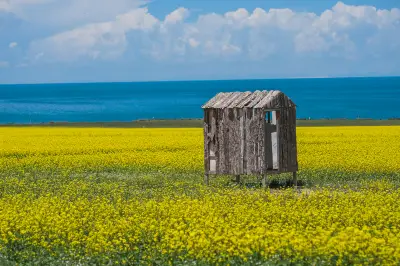
Crossing the Qaidam Basin (Part 3)
On the morning of the sixth day, we set off from the Yardang Geological Park and drove to Dongtai Jin'er Lake. As soon as we entered the scenic area, we were truly amazed—a vast, snow-like salt flat rushed toward us, with the distant lake like a pale blue gauze ribbon, the salt flat and lake water as if inlaid between heaven and earth. We entered with excitement, unable to resist posing freely on the salt flat.
What made us even more excited was that a local villager had placed a transparent boat by the lake for tourists to take photos. One end of the boat was tied to a rope. The villager pushed the boat toward the center of the lake, giving each person 3 minutes to take photos, then pulled the boat back to the shore with the rope. Thus, a long queue formed on the shore waiting to board the boat for photos, mostly made up of women.
Each person paid 30 yuan for 3 minutes. The villager had a good business sense, receiving about 200 people a day, with a decent daily income. But the villager said they only do business for the three summer months each year.
Because there was only 3 minutes, every woman boarding the boat prepared fully on the shore: first, clothing and props; second, their companions helped take photos from the shore, some from high angles, some from low angles. Everyone had their cameras and phones ready, aiming at the transparent boat. The women on the boat just posed freely. The sound of shutters clicking was nonstop, and the boat was pushed to the center of the lake, then slowly pulled back to the shore. Even if reluctant, the boat had to be given to the next beauty.
Leaving Dongtai Jin'er Lake, we drove along National Highway 315 toward Dachaidan Emerald Lake. On this section of Highway 315, there is a U-shaped road where all tourists stop to take photos. No matter which direction you came from, you drive your car to the other end of the U-shaped road, look back, and the extremely steep road seems to pour down from the clouds. Tourists gather at the low point of the U-shaped road; when no cars are passing, they run to the middle of the road and pose freely. After returning home from Qinghai, we saw in the news that the Qinghai traffic police had issued a notice banning tourists from taking photos in the middle of the road to ensure their safety and smooth traffic flow.
Leaving the U-shaped road, we continued our journey to Dachaidan Emerald Lake.
Arriving at Dachaidan Emerald Lake, we were breathless. The beauty there cannot be described by my clumsy pen. Despite the blazing sun, we didn't care, only regretting that our lenses weren't good enough, our photography skills too poor, and our poses not beautiful enough.
The blue of the lake water was refreshing and soothing; the cleanliness of the water made us want to jump in.
Tonight we stay in Dachaidan.
After packing our luggage, we went to the Dachaidan town center to find a place for dinner. Arriving at a lively area, we saw a small shop with a bustling crowd. Approaching, it was a halal restaurant, its liveliness in stark contrast to the neighboring shops, especially striking during the pandemic. We quickly found a seat and then seriously asked what this food was and how to eat it. After understanding, we decided to try it.
It turned out to be a local specialty: lamb, vegetables, and flatbread cooked together in an iron pot. The taste was good, but as people from Sichuan, we weren't used to eating so much meat at night. We ordered a small amount but still had to make an effort to finish.
We were already so full. After dinner, we took a walk back to the hotel, partly to aid digestion and partly to see the night scenery of Dachaidan. There were few pedestrians on the streets, completely unlike Chengdu, where nightlife is just beginning at this hour.
Today is the seventh day.
Early in the morning, we went to Xiaochaidan Lake. This lake is completely wild, with no proper road leading to it. We parked far away and walked there under the scorching sun. Up close, we could see it is a freshwater lake, as there were many water plants and reeds. Perhaps because we had seen too many lakes along the way, or due to aesthetic fatigue, this lake didn't excite us much. We took a few photos at the shore and left.
The second stop was Qarhan Salt Lake.
Here there is a huge Qarhan Salt Chemical Plant. Outside the plant, there is a dedicated tourist center. All vehicles must park in the designated parking lot and transfer to the plant's special tourist buses. The guide on the bus gave a brief introduction to Qarhan Salt Lake.
This salt lake is the largest in China, the second largest in the world, and has the highest salt content globally. It is China's largest soluble potassium-magnesium salt deposit, with reserves of sodium, magnesium, potassium, and lithium ranking first in the country. Salt chemical industry plus tourism has become the most distinctive and potential industry in the Qaidam economic cycle pilot zone.
The tourist bus stopped at a designated spot in the plant. We got off to explore freely. After enjoying ourselves, we returned to the drop-off point and boarded the special bus back to the parking lot. Here, we strongly recommend the milk popsicles from the plant—rich and creamy.
The entrance sign to Qarhan Scenic Area: a huge crystalline salt rock.
In the distance, the salt chemical workshop.
Arriving at the salt lake, the weather wasn't cooperating. Although the temperature was very high, the sun didn't come out; it was gray and hazy, no blue sky or white clouds.
Salt harvesting boats were busy on the lake.
The salt flat was pure white and fine.
Qarhan Salt Lake covers 5,856 square kilometers. To facilitate salt harvesting and solar evaporation, workers have built crisscrossing salt ridges, also called the Ten-Thousand-Li Salt Bridge. If the bridge surface becomes uneven, they simply pour a few ladles of salt water onto the uneven area; under the sun, the water evaporates, leaving crystalline salt, and the road becomes smooth again.
The endless salt bridge divides the salt lake into many salt fields.
Leaving Qarhan Salt Lake, we arrived in Golmud City and stayed there tonight.
After freshening up, we went out again to find food. The locals said there was a pedestrian street with everything to eat, drink, and play. So we took a taxi straight there. It looked like an inland night market, with mostly ordinary clothes and cheap accessories, nothing special. However, an open-air food court attracted us. There was food from all over the north and south. Management was orderly; every stall and table had a number. You ordered at the stall and told the vendor your table number, and they delivered the prepared food to your table. We focused on northern food, and overall it tasted good and was quite acceptable.
After dinner, we walked back to the hotel, preparing for tomorrow's trip to Hoh Xil.
Day 8. We set off at 9 a.m. along National Highway 109 toward Hoh Xil.
Highway 109 is what we commonly call the Qinghai-Tibet Highway. There were many large trucks along the way, mostly transporting goods to Tibet. The mountains on both sides were sharp and bare, without a trace of green. The wind was harsh and wild. We had already put on down jackets.
This is the gateway to the Qinghai-Tibet Highway; we stopped for a photo.
Traveling through the barren mountains, we finally saw a sign ahead: Kunlun Mountain Pass, elevation 4,768 meters.
We were so excited. We showed no signs of altitude sickness, proving that after seven days of long-distance travel, our bodies were in good condition. We got out of the car, took photos.
Kunlun Mountain Pass is the starting point of Hoh Xil. From here, we entered Hoh Xil—the homeland of the Tibetan antelope.
This is also the source of the Yangtze River, Yellow River, and Lancang River—the Three Rivers Source. On the plateau, three clear streams flow happily eastward, eventually converging into three mighty rivers. The wonder and mystery of nature bestow endless resources for human survival.
Hoh Xil Snow Mountain Viewing Platform.
Along the Qinghai-Tibet Highway, apart from designated scenic spots where you can stop for photos, because it is an ecological reserve for Tibetan antelopes, vehicles are not allowed to stop casually. While driving, we carefully scanned the vast grasslands for signs of Tibetan antelopes. When we finally spotted them, we slowed down, opened the windows, zoomed in our lenses, and got close to these plateau spirits from a distance.
After driving on the plateau for nearly 4 hours, we arrived at Sonam Dargye Nature Protection Station.
Sonam Dargye was a hero. He was once the deputy secretary of the Zhiduo County Party Committee in Yushu Tibetan Autonomous Prefecture, Qinghai. He died heroically in January 1994 while fighting poachers. In May 1996, the China National Environmental Protection Agency and the Ministry of Forestry awarded him the title "Environmental Protection Guardian." In December 2018, the Party Central Committee and the State Council conferred on him the title "Reform Pioneer" and awarded him the "Reform Pioneer Medal."
Sonam Dargye Protection Station was the first non-governmental nature protection station in China. Now it has become a large station with accommodation, convenient for travelers on the Qinghai-Tibet Highway to rest. An ecological exhibition hall has also been built, displaying some animal specimens and pictures. After a serious visit, we set off back to Golmud. Because going further would take us into Tibet, which was not part of our plan.
On the Qinghai-Tibet Highway, we saw this plateau spirit from a distance—the Tibetan antelope.
The only Tibetan wild ass we saw.
We returned to Golmud at 9 p.m. Hungry all day, we only found a lamb restaurant still open. We ordered lamb chops and hand-grabbed lamb. When the food arrived, we were shocked—how could we eat so much meat at night?
We have completed our entire itinerary.
Today is the ninth day. We will fly from Golmud back to Chengdu.
On this trip, we flew 3,493 kilometers and drove 2,523 kilometers. Over 9 days, we traveled in a rough S-shaped route across Qinghai Province and Gansu Province.
The Qaidam Basin was once just a geographical term in middle school textbooks—a remote, unknown barren land on the map of China. I never thought I would venture deep into its heart, get so close to it, appreciate it, and love it. It was also on this trip that I truly understood the relationship between Qaidam, Dachaidan, and Xiaochaidan—things that were previously vague in my knowledge. I never imagined I would come to Hoh Xil and see Tibetan antelopes. Every little bit of understanding about nature makes me strongly aware of my own ignorance. I think I will come back to Qinghai, entering the Qaidam Basin from another direction. I think I will also plan to truly enter Tibet—entering via the Sichuan-Tibet Highway and exiting via the Qinghai-Tibet Highway.
Indeed, reading ten thousand books, you must also travel ten thousand miles. Farewell, Qaidam. Farewell, Qinghai!
On this trip, I rarely talked about food and drink. Traveling is often described as "eating and wandering." Along this route, pay attention to the following:
1. After entering the Qaidam Basin, you will be in the Gobi almost all day, so be sure to bring enough dry rations and water.
2. Book the first-night hotel in advance; only when you reach a city in the evening can you dine at a restaurant.
3. The temperature difference between day and night is large, so bring clothes for all seasons.
4. There are almost no gas stations in the Gobi. Fill up the car every evening when you reach a city. Running out of gas in the Gobi is no joke.
5. Portions in Northwest China are large. Order less and add more if needed to avoid waste.
6. If you plan to go to the Mars Camp, be sure to book the space capsule room. Tents are not suitable for older people.
The above suggestions are for reference.