My Third 'Date' with the Northwest: A 19-Day, 5,000-Kilometer In-Depth Journey Through Gansu, Qinghai, and Inner Mongolia
Only by going to unfamiliar and different places can you leave the noisy world behind! This trip covers approximately 5,000 kilometers, starting from Xining, making a big loop, and ending back in Xining without retracing any steps. We traversed grasslands, lakes, rivers, gobi deserts, yardangs, deserts, grottoes, temples, danxia landforms, and flower seas... This is a super-extended, enlarged, and upgraded version of the Qinghai-Gansu Grand Loop. Only under unusual circumstances, with an unusual private driver and unusual guests, can one dare to take this unusual route! For me, tourism is both addictive and intoxicating; I've gone further down this path and there's no cure. I love the beautiful scenery along the way; I love the feeling of walking on the road; I love making friends from all over the world during the journey; I love listening to all kinds of people tell their stories; I love taking photos and flying drones; I love recording every bit of the journey with words... Everyone I meet is a book, a painting, worth savoring.
1. The video clips in the travelogue are all shot with a drone, and the rest of the photos are taken with a mobile phone, original without post-processing. 2. Since the itinerary is quite long, this travelogue cannot describe every attraction in detail like a running account (it would take at least tens of thousands of words), so I have to make choices. 3. In terms of content, my travelogue only talks about the attractions, rarely covering itinerary arrangements, accommodation, meals, tips, etc. If you're interested in these aspects, you can follow me and send a private message for further understanding.
Pick-up at Xining Airport one day in advance; D1 Xining - Menyuan Rapeseed Flowers - Qilian Zhuoxian Mountain; D2 Qilian - Arou Temple - Qilian Mountain Grassland - Biandukou - Shandan Military Horse Farm; D3 Shandan Horse Farm - Badain Jaran Desert, stay in the desert; D4 Out of the desert - Pingshan Lake Grand Canyon - stay in Zhangye; D5 Zhangye Mati Temple - Giant Buddha Temple - Rainbow Danxia Sunset - stay in Zhangye; D6 Zhangye - Jiayuguan Pass - Hanging Great Wall - First Pier of the Great Wall - stay in Jiayuguan; D7 Jiayuguan - Guazhou 'Son of the Earth' - Yulin Grottoes - stay in Dunhuang; D8 Mogao Caves - Singing Sand Mountain - stay in Dunhuang; D9 Dunhuang - Yangguan - Aksay Oil Town - stay in Lenghu Town; D10 Lenghu - Eboliang Yardang - Mangya Emerald Lake - stay in Mangya; D11 Aiken Spring - Double-colored Lake - stay in Dongtai Village; D12 Water Yardang - U-shaped Highway - stay in Golmud; D13 Qarhan Salt Lake - stay in Golmud; D14 Golmud - Kunlun Mountains - Hoh Xil - stay in Qumalai County; D15 Qumalai County - Zhongqing Temple - stay in Yushu; D16 Yushu - Princess Wencheng Temple - Jiegu Temple - Mani Stone City - Star Sea - stay in Maduo County; D17 Maduo - Distant view of Animaqing Snow Mountain - Jiuzhi County - Ningma Temple - Awancang Wetland - First Bend of the Yellow River - stay in Maqu County; D18 Maqu - Langmusi stay; D19 Langmusi - Xining Airport ends.
Xining Airport pick-up: Must have a sense of ritual
The three experienced beauties I brought this time are from Taiyuan, Shanxi. They are repeat customers and loyal fans of mine, especially fond of the Northwest (especially the one in the middle who has come three times). So I bought three bouquets of flowers at a flower shop the day before to surprise them at the airport. This sense of ritual is a first for me in greeting guests since I started my career (thinking about it, I'm a bit moved).
A small incident: Because the weather in Xining in mid-July was still quite hot, the flowers in the trunk seemed a bit wilted, and their flight was delayed by more than two hours, so I was a bit upset.
While waiting for the pick-up, first there was a violent windstorm, then a downpour, and finally a double rainbow appeared. This rhythm came too suddenly. As the saying goes: Guests come from Jinxiang by air, startling the dark clouds to roll away!
Two bottles of old Baijiu, a precious friendship. To be treasured and saved, choose an auspicious day to drink.
The first day of the trip was sunny and the weather was great.
The flowers had withered, but she couldn't bear to throw them away and still wanted to show them off here.
Color and Romance: Wandering in the Menyuan Rapeseed Flower Sea
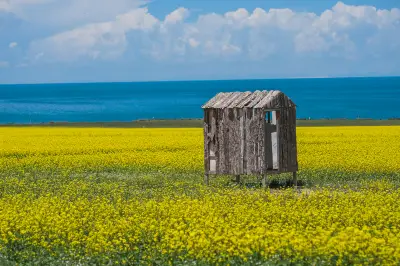
Menyuan Hundred-mile Rapeseed Flower Sea
July in Qinghai is the most beautiful season, with cool weather and fragrant flowers. The Menyuan rapeseed flower sea is a must-see in the itinerary.
Let me have some fun in the flower sea! Menyuan Hundred-mile Rapeseed Flower Sea
In this season, rapeseed flowers elsewhere in the country have already turned into seeds, but here they are just beginning, becoming the most beautiful color of summer.
Menyuan Hundred-mile Rapeseed Flower Sea
The colorful hues, together with the blue sky, white clouds, mountains, and rivers, form an intoxicating painting.
Menyuan Hundred-mile Rapeseed Flower Sea
Standing on the viewing platform overlooking the foot of the mountain, the beauty is breathtaking.
Menyuan Hundred-mile Rapeseed Flower Sea
Phones, cameras, and drones were all used, clicking away endlessly, but it never felt like enough.
Menyuan Hundred-mile Rapeseed Flower Sea
According to the normal schedule, two to three hours would be enough, but we were so captivated, not feeling tired and not asking about the way back, that we played for over four hours before reluctantly leaving.
According to the itinerary, we were to stay at the foot of Qilian Zhuoxian Mountain tonight, so we had to pass through the Qilian Mountain Grassland. Whenever we encountered beautiful scenery, my co-driver, Teacher Xiaorong, would just give a look or a small move, and I knew she wanted to stop for photos. That had to be arranged, and the effect of long legs!
Qilian Mountain Grassland drone footage also had to be arranged!
'The sun sets in the west, a suffering wanderer at the edge of the world' (my self-mockery). The folk inn at the foot of Zhuoxian Mountain has a great location, affordable price, and satisfied guests. Although my stomach was growling, as soon as I saw the beautiful scenery and heard about taking photos, all practical difficulties were forgotten.
Our own vegetable patch, our own mountain, do you think it's satisfying or not?
A Colorful Paradise on Earth: Qilian Zhuoxian Mountain
After a night's rest, we got up early the next morning, packed our gear, and started entering the scenic area. I don't know how many times I've been to Zhuoxian Mountain, but it feels different each time. This time, I naturally had to accompany the guests in (even though there were many steps, the altitude was high, and my knees hurt a bit).
Zhuoxian Mountain is an iconic attraction in Qilian County, Qinghai, a place that could drive photographers crazy (I said that because I'm not a photographer, but seeing this scene made me a bit crazy).
'Mountains are famous not for their height but for their immortals; waters are spiritual not for their depth but for their dragons.' Because of a beautiful legend from the past, Zhuoxian Mountain has gained a touch of fairy spirit and a layer of pure romantic atmosphere.
The viewing platform we are at now has a very good location, offering a wide view of the distant mountains.
The winding lines at the foot of Zhuoxian Mountain are very beautiful.
Looking out, the highland barley, rapeseed flowers, villages, and rivers below blend together, different colors complementing each other, like a heavy-ink watercolor painting.
Immersed in such beautiful scenery, wouldn't it be a waste of the visual feast nature has given us if we didn't show off a bit?
However, it's worth reminding everyone that the altitude at the top is already around 4,000 meters, so it's best to walk slowly and avoid strenuous exercise to prevent altitude sickness. But the experienced beauties traveling with me were fine and didn't feel a thing.
Magnificent like heavenly brocade, any shot is a masterpiece!
Standing on the beacon tower, the view is extremely wide. Opposite is Niuxin Mountain, on the left and right are Lajiao Gorge and Baiyanggou, behind are the rolling Qilian Mountains, and at the foot is the surging Babao River.
Here I'd like to remind you that the ticket for Zhuoxian Mountain is 80 yuan per person. The scenic area has sightseeing buses, line A and line B, which are east and west entrances. If you take the bus from the east entrance, you must return the same way. Don't get it wrong.
In recent years, Zhuoxian Mountain has become a must-visit holy land for many tourists coming to Qinghai, as well as a sketching and inspiration base for writers, poets, and artists. If time permits, it's best to enter around 8 a.m. or after 4 p.m. The light at noon is too strong, and photos won't turn out well.
If you are a deep traveler, I suggest spending a whole day there, from sunrise to sunset, taking it all in at a glance.
Drones are allowed in this scenic area, but you need to operate them very carefully. Because the mountain terrain is uneven, there are many utility poles on the top, and the altitude exceeds 4,000 meters, the drone may have signal problems. I risked crashing my drone and flew through two batteries, and the results were excellent.
We entered around 8 a.m. and played until 3 p.m. It wasn't me rushing them; the guests didn't want to leave, as if they could never get enough fun.
Seeking and Dreaming: Shandan Horse Farm
Shandan Military Horse General Farm
Shandan Horse Farm is located in the Damaying Grassland at the northern foot of the Lenglongling Range in the Qilian Mountains, central Hexi Corridor. The terrain is flat, the water and grass are abundant, making it an ideal place for horse breeding and growth. It was founded in 121 BC by the Han Dynasty's Piaoqi General Huo Qubing, with a history of over 2,130 years. Since the dissolution of the Soviet Union's Don River Horse Farm, it is now the largest horse farm in the world. Because of this highlight, I specially arranged this itinerary.
Shandan Military Horse General Farm
Perhaps you have an image in your mind: 'Herds of fine horses grazing on the vast grassland, with rolling mountains, boundless grassland, and galloping horses, imposing and magnificent. Riding at full speed in the endless expanse, intoxicated by the picturesque green field... However, I smirk inside.
Shandan Military Horse General Farm
Let's first learn about the history of the horse farm: In 121 BC, the Han Dynasty's Piaoqi General Huo Qubing heavily defeated the Xiongnu at the foot of Yanzhi Mountain. The defeated Xiongnu people sang a sad song and withdrew from the Qilian Mountain pasture. From then on, the Han Empire began to station troops and raise horses in the precious land of Damaying Grassland, which became the imperial horse farm for successive dynasties. It mainly bred Qinghai-Tibet horses, Mongolian horses, Yi-type horses, Ferghana horses, Don River horses, Hequ horses, and Bai Zhang Biezheng horses (blood-sweating horses), etc. Since September 1949, Shandan Horse Farm has been under military management and is the largest military horse breeding base in China and Asia, with a maximum stock of 20,000 finished horses, supplying the military and civilian needs across the country. At the same time, it painstakingly cultivated the 'Shandan Horse' with excellent pack, riding, and draft capabilities, making great contributions to the cultivation and breeding of new horse breeds for the motherland.
Shandan Military Horse General Farm
With the changes of the times, the role of horse raising has gradually faded from the historical stage. The horse farm now focuses mainly on farming, but its reputation remains, attracting many tourists every year to visit.
Shandan Military Horse General Farm
To fulfill the guests' dream of 'ten thousand horses galloping,' I specially arranged accommodation at the horse farm, just to get a glimpse of them in the morning when the horses drink water.
Shandan Military Horse General Farm
The night before, I fully charged the camera and drone batteries to be ready for this moment.
Shandan Military Horse General Farm
Here they come, they really come.
Shandan Military Horse General Farm
This is the 'ten thousand horses galloping' from an aerial perspective. You can imagine: 'Under the blue sky and white clouds, sturdy horses rush like a storm across the boundless pasture, with long manes flying and thundering sounds...'
Shandan Military Horse General Farm
The grassland wetlands under the morning light.
Shandan Military Horse General Farm
The Piaoqi General's Camp
Shandan Military Horse General Farm
These wooden cabins are my favorite.
Shandan Military Horse General Farm
Another voice-over in my mind rings out: I have a house, facing the sea, with spring blossoms...
Shandan Military Horse General Farm
Time will pass, but images will last forever. Every step we take is traceable: From tomorrow on, be a happy person. Feed horses, chop firewood, travel around the world. Give every river and every mountain a warm name...
Shandan Military Horse General Farm
Learn to keep company with solitude. The ancients said: 'Rather than clinging to each other in a dried-up pond, it is better to forget each other in the rivers and lakes.' So the best relationship between people is not to depend on each other in a dry pond, but to swim freely in their own rivers and lakes.
Shandan Military Horse General Farm
Suddenly having such a feeling comes from the horse farm; from its first director, Huo Qubing; from his youthful success but premature death; from his brilliant moment like a meteor streaking across the night sky.
Shandan Military Horse General Farm
Temporary Farewell to the World: Badain Jaran Desert
There is a desert that spreads from the ground to the sky, and then from the sky to the boundless infinite; there is a desert that once caused a sensation throughout Europe due to a book by German explorer Bormann; there is a desert that is unique in the world because of its scattered lakes of various sizes. This is the Badain Jaran Desert.
From now on, the phone has no signal. We will temporarily say goodbye to this noisy world.
The Bauhinia flowers on the edge of Badain Jaran Town are nice, must check in.
Having written so much in the travelogue, it's time for the author to show his true face! Look! He appears so different at first sight. Holding an oil-paper umbrella, standing in the endless flower sea, with a natural expression, body posture and eyes showing confidence and ease, he can be described as 'a handsome man topples the city, the landscape pales.' Key point: It's the person who took the photo for me, not my own doing.
The Badain Jaran Desert borders the Ejina Populus Euphratica Forest Scenic Area, very worth a special trip. The conventional entrance to the Badain Jaran Desert is located at Badain Jaran Town in Alxa Right Banner.
The Badain Jaran Desert is famous for its 'peculiar peaks, singing sands, lakes, divine springs, and ancient temples.' Highlights include: Nuortu, Bilutu (Desert Everest), Yindertu (viewing the divine spring), Badain Jaran Temple (worshipping the desert imperial palace), and Baoritaolegai (experiencing singing sands).
No matter what means of transportation you use to reach Badain Jaran, you’ll eventually have to rent a special desert off-road vehicle to go into the hinterland. It is uniformly managed by the Badain Jaran Desert Tourism Development Company with unified prices and routes. Each vehicle costs 3,000 yuan for one entry and exit, with tickets and accommodation charged separately.
Our first stop was Badan Lake, where we made a brief stay.
If the Badain Jaran Desert is the most beautiful desert, then this pink lake in its hinterland is the pink gem embedded in the most beautiful desert. This is the focus of this trip, and also the place I've been longing to visit.
What causes such a unique color? It is because the lake water contains minerals such as potassium and sodium, and a halophilic green microalga called Dunaliella salina. Under specific conditions, it produces heme, turning the salt lake into a rare 'rose lake.' This phenomenon is only seen in high-temperature areas.
Another theory is that it is due to a local specialty—'brine shrimp.' Brine shrimp tolerate high salt and live in salt lakes. When they reproduce, the carotene they contain turns the lake water red. The higher the salinity, the more algae, and the redder the water.
Regardless of the reason, the pink lake is fascinating.
Normally, June to August is the best season to see the red lake, but what we saw this time was far less beautiful than the pictures on the internet. Perhaps due to special climate conditions this year.
The most magical aspect of Badain Jaran is its many lakes (commonly called 'haizi'), 74 of which have water year-round. Most are salty and undrinkable, but there are also 12 freshwater lakes, generally 1 to 1.5 square kilometers in area, with a maximum depth of 6.2 meters, all located in the southeastern part of the desert.
When the car zigzagged up the sand dunes, the feeling was very special. Compared to the large sand mountain, the vehicle was so tiny, making me marvel at the wonders of nature.
Far from the hustle and bustle of the city, in the depths of the desert, you can feel the peace between heaven and earth.
Walking alone in Badain Jaran in this northwest corner, I think she has long seen through the vicissitudes of the world in her thousands of years of ups and downs.
An important experience in the desert is sand surfing. Driving along the wave-like curves of the dunes, shuttling between endless tall sand dunes, you will feel the vastness of the Badain Jaran Desert and experience thrills and excitement. For safety, I asked Driver Xiao Liu to drive steadily and slowly as much as possible.
Show off our vehicle for this trip!
The vegetation around the lake is lush, mostly wet and salt-tolerant plants, including dense reeds, willows, and sea buckthorn, forming a unique little ecosystem rarely disturbed by humans.
At sunset, standing on the sand mountain, you can take in the endless sand sea and gem-like lakes. At this time, using a camera to capture your precious travel memories will make the trip worthwhile!
This is the largest Nuortu lake in the desert, not to be missed. 'Nuortu' means 'lake' in Mongolian, named because Nuortu is the largest lake in the Badain Jaran Desert.
If you have never been to the desert, you cannot truly understand life; if you have not penetrated deep into the desert, you cannot truly grasp the grandeur and magnificence of the vast desert. So, this place is definitely worth a visit.
My Turf, My Rules: Checking in Zhangye
Zhangye is my hometown. This magical land records thousands of years of brilliance and writes legends generation after generation. As a pearl on the Silk Road, it is a key recommendation in my itinerary.
Here, there are not only vast yellow sands but also clear rivers, as well as the Qilian Mountains with snow-capped peaks visible all year round. The Mati Temple we visited in the morning is located in the Linsong Valley at the foot of the Qilian Mountains.
Mati Temple is not a simple temple; it is a group of grottoes carved with caves. It got its name because of a legend that a thousand-li horse left a horseshoe print here. Thus, the horseshoe print is a treasured treasure, enshrined in the Horseshoe Hall.
The earliest record is that a literati named Guo Yu came to Zhangye, carved a cave here, lived in seclusion, cultivated Taoism, and lectured, playing a very important role in spreading Han Chinese culture.
The Mati Temple grottoes can also be called the Hanging Temple, built on steep cliffs. The project was massive, and the steps and passages are very dangerous and difficult, leaving people in awe.
The grottoes were first carved in the Sixteen Kingdoms period (Northern Liang) and have a history of over 1,600 years. They are a famous Buddhist holy site on the Hexi Corridor and the only grotto group in China located in the snow mountains with the highest altitude.
Unfortunately, after countless changes and wars, they have been severely damaged. Generations of history have left layer upon layer of marks here. The only thing that remains unchanged is the low-browed Buddha statues with compassionate smiles and eyes. I sincerely hope that everyone holds reverence and cherishes these historical and cultural relics.
According to the normal Zhangye one-day tour schedule, it is usually Mati Temple in the morning and Rainbow Danxia in the afternoon, just to watch a perfect sunset.
Zhangye Rainbow Danxia Scenic Area - Viewing Platform
The Rainbow Danxia Scenic Area has become an increasingly popular 5A-level scenic spot in recent years. Most first-time visitors are shocked by the landscape before their eyes.
Zhangye Rainbow Danxia Scenic Area - Viewing Platform
If these landscapes were man-made, it would be one thing, but they are naturally formed, making us sincerely marvel at the wonders of nature. Some describe it as the Jade Emperor's palette falling to the mortal world, but I think it's even more fitting to say that the rainbow of heaven has fallen to earth.
Zhangye Rainbow Danxia Scenic Area - Viewing Platform
Currently, four viewing platforms are open: No.1 Colorful Immortal Fate Platform, No.2 Colorful Sea of Clouds Platform, No.3 Colorful Splendid Platform, and No.4 Colorful Rosy Cloud Platform. These four platforms actually account for only a small part of the Danxia scenic area; a large other area is yet to be developed.
Zhangye Rainbow Danxia Scenic Area - Viewing Platform
Because it's the peak tourist season, the viewing platforms are packed with people, making it really difficult to find a good spot for shooting.
Zhangye Rainbow Danxia Scenic Area - Viewing Platform
This is a very good shooting angle, where you can capture the perfect curves of the scenic area road.
Zhangye Rainbow Danxia Scenic Area - Viewing Platform
The moment when hot air balloons fill the sky, which you can only see in Turkey, is realized here. When the altitude rises to about 50 meters, you can better enjoy the panoramic view of Zhangye Rainbow Danxia, stepping into a colorful fairy tale world and experiencing a new visual feast.
Zhangye Rainbow Danxia Scenic Area - Viewing Platform
In the evening, returning to the city, since it's my turf, I naturally took charge. As usual, I invited the guests to taste local specialties, and 'stir-fried firecracker' noodles had to be arranged. Due to space constraints, the pictures are not shown one by one.
Zhangye Rainbow Danxia Scenic Area - Viewing Platform
Zhangye, as a pearl on the Hexi Corridor, has profound historical and cultural heritage. It is also unique in culinary culture, and the key is that it's affordable. Those who eat know!
Zhangye Rainbow Danxia Scenic Area - Viewing Platform
In recent years, with the gradual development of tourism, its fame has grown. Today, we only visited two representative attractions: Mati Temple and Rainbow Danxia. There are other niche attractions, such as Binggou Danxia, Alien Valley, Ghost Face Danxia, Yanzhi Mountain, Kangle Grassland, Giant Buddha Temple, etc. Due to time constraints, we had to leave them for next time, giving the guests a reason to come back to Zhangye.
Seeking Solitude and Desolation: Guazhou
Tao Yuanming wrote in his poem: 'Step by step I search for traces of the past, there are places that linger especially.' Here, I want to focus on Guazhou in Gansu. Guazhou was a popular city in ancient times. Over the dynasties, various ethnic groups lived on the vast land of Guazhou. Many ancient city ruins are preserved, and Guazhou County has become one of the counties in western China with the most preserved ancient castle ruins. For example, Suoyang City preserves the most complete military defense system and agricultural irrigation system of ancient China. It is the largest Tang Dynasty prefecture in China and was listed in the World Heritage List in 2014. Of course, due to time constraints, we skipped these places this time and focused on visiting the 'Son of the Earth' and 'Boundless.'
The 'Son of the Earth' is a large sculpture located on the Gobi slope of Hongshanpo in Guazhou County. It is different from the sculptures we often see; it is not a Buddha, Bodhisattva, or historical figure, but a large infant. The infant is neither sitting nor lying but kneeling and crawling on the ground, looking peaceful and serene.
This desert seems like a mother's embrace, allowing him to sleep peacefully. This scene with strong visual impact makes many people feel affection.
Enjoy a short drone video.
You might have encountered mirages in movies or dreams. But here, a real scene appears before our eyes.
When the seemingly unreachable and ever-changing mirage-like landscape, with pavilions and towers, appears in the Gobi, sometimes far, sometimes near, both real and illusory, it is a rare sight. It was created by Professor Dong Shubing from the Academy of Arts & Design, Tsinghua University.
Isn't this scene beautiful?
This sculpture is made of over 6,000 specially customized scaffolding pipes for construction engineering, connected with more than 30,000 fasteners. Due to changing light and wind, it produces many charming sights in the desert, especially at sunset, creating an even more ethereal effect.
In addition, in this Gobi sculpture art corridor, there are other sculptures like 'Emperor Han Wu,' 'Wind Whisperer,' and 'Gobi Ark' worth stopping to appreciate and feel.
A Foodie's Aspiration: Dunhuang
Dunhuang, 'Dun' means grand, 'Huang' means prosperous. Because it broadly opened up the Western Regions, it was named Dunhuang, meaning grand and prosperous. From the moment this city was born, it was destined to be extraordinary.
The thousand-year-old Library Cave, the two-thousand-year-old Mogao Caves, and the seven-thousand-year-old Silk Road. During the Han Dynasty, Dunhuang was the throat of the Silk Road. Zhang Qian's mission to the Western Regions and Huo Qubing's resistance against the Xiongnu are all related to Dunhuang. In the Tang Dynasty, Xuanzang departed from the capital Chang'an, passed through Liangzhou, and left from Guazhou and Dunhuang through the Yumen Pass westward, enduring hardships to reach Tianzhu (India). Dunhuang has been very popular in recent years (actually, the entire Great Northwest has been hot).
This itinerary naturally arranged for the guests to visit the Mogao Caves and Singing Sand Mountain and Crescent Moon Spring. There is already a flood of information about these two attractions online, so I won't go into detail.
Let's talk about other things, such as the azure blue sky, the wispy clouds, and the cheerful mood!
And the local specialty: sandstorms. We encountered all of them this time, considered as a 'welcome gift' from Dunhuang to my guests.
As a native of the Northwest, I've been used to such scenes since childhood. Normally, sandstorms end by April or May, but this year the weather has been particularly unreliable. Even in July, such bad weather still occurs frequently. In one word: To develop the economy, humans have been taking endlessly, and now we have to pay the price.
If you go to Dunhuang and don't experience the lively night market, it's like going in vain.
The Dunhuang Night Market is known as Dunhuang's 'night scene' and 'genre painting.' At night, it's brightly lit and crowded, with a dazzling array of local products, and long lines in the food area, full of worldly vitality.
After years of careful development, this place is quite distinctive, with clearly divided functional areas. The local specialty crafts area is worth a visit; you can pick a few Dunhuang-style souvenirs to keep as mementos.
The food area goes without saying; it's bustling, and it's hard to find a seat.
Various unique delicacies from the Northwest gather here. Although expensive, since we're already here, we should treat our taste buds right.
There are handsome guys and beautiful girls everywhere, all foodies, it seems.
In Dunhuang, you must check in at the city's landmark: the 'Flying Apsaras Playing Pipa' sculpture. The flying apsaras playing the pipa is the most famous artistic image in Chinese Tang Dynasty dance culture, long renowned at home and abroad. It is generally believed to originate from Dunhuang murals, but I've also read related articles where some scholars have different opinions.
When mentioning Yumen Pass, the first thing that comes to mind is Wang Zhihuan's poem 'Liangzhou Ci': 'Why should the Qiang flute complain about the willows? The spring breeze never reaches Yumen Pass.' This poem, which every Chinese person learned in primary school, has been deeply rooted in our minds, but not many people actually come here to trace its roots. So I specially arranged this place in the itinerary for the sake of two words: nostalgia.
Coming here, you can feel the desolation described in the poem. Think about the people who guarded this place in the past; facing such desolation, how great they were. Only then can you deeply feel the word 'complaint' in the poem, how poignant it is.
Yumen Pass has always been a heavy stroke in the works of writers and poets. Only by being there in person can you truly feel why.
Over more than a thousand years, most of it has been buried by wind and sand. From the remaining city wall ruins and beacon towers, a sense of awe suddenly arises. What a massive project, how much manpower and material resources must have been consumed to complete it?
The small mound we see now is also called Xiaofangpan City. It was probably first built when Emperor Wu of Han opened up the Western Regions and established the four prefectures of Hexi. Although far less majestic and vast than imagined, it was an important military pass and transportation hub on the Silk Road during the Han Dynasty.
Despite thousands of years of wind and rain erosion, it still stands in the Gobi desert, as if telling people about the former glory and prosperity of this desert pass.
The weather is hot, so we must eat melon. Cutting melon violently with skillful technique, we had a full meal and continued west.
Searching for the 'Black Mountain Demon': They Are Persistent
In the Great Northwest, exquisite niche attractions can be found everywhere. One place that looks like outer space is called the Black Mountain Gobi. This year, through online hype, it has become extremely popular. The guests I brought had heard of it in advance and insisted on going there. Although I said on the way that legend has it there is a 'Black Mountain Demon' living in the Black Mountain Gobi, specializing in tormenting beauties, especially mature ones, they dismissed it and said in unison, 'Let the legend be true!' I was speechless!
This place is about 20 kilometers from Lenghu Town, and most tourists generally overlook it because it's not really a scenic spot, just a pass-by.
However, for us four, it was a must-check-in.
From a distance, peaks connect, with gray gravel and small stones covering the mounds of various sizes, covered with black sand, giving an unreal feeling.
Some say this is the place most like the moon. Besides black mountains, there are only black mountains, fulfilling people's fantasies about the moon. There may be no traces of humans or animals here; the only thing you can experience is desolation.
The wind and sand are strong on the Gobi, and vehicles can easily get stuck in the sand. You must drive along the tracks and avoid driving onto the steep slopes of the Gobi. Due to time constraints, we didn't go further into the depths of the Gobi, and naturally didn't take ideal photos. I flew the drone about 2 kilometers above, but the signal was weak. To avoid crashing, I returned safely.
Currently, it's not a scenic area, no tickets are needed, and there are no supermarkets or parking lots along the way. Tourists who want to visit need to prepare food and water in advance. Also, do not damage the Black Mountain Gobi scenery, and consciously take away your trash.
If you like the moon but can't reach the real one, why not come to the Black Mountain Gobi, the place most like the moon, and experience it? Especially for photography enthusiasts, it's indeed a place where you can produce great photos. However, the prerequisite is that you have ample time and can endure hardships; you need to go deep to get good results.
The Most Beautiful Scenery on the Road: The Old Driver
On the road, everything within sight is scenery; joy, anger, sorrow, and happiness are all moods. Looking at the distant horizon heals the wounds in the heart. In an instant, the heart calms down, merging into the world.
Throughout the Great Northwest trip, because the distances between attractions are relatively large, we spend a lot of time on the road, but precisely the most beautiful scenery is on the road.
Wusute Yardang Geological Park
Accompany each season with a smile, walk through every waning and waxing moon with a calm sentiment. Not seeking the ultimate prosperity, but a quiet and peaceful life.
Wusute Yardang Geological Park
As long as we are on the road, it won't be time wasted. The traces we leave are marks of maturity.
Wusute Yardang Geological Park
I like driving for one reason: I like the feeling of being in the car, chatting, thinking, and being silent while moving, then stopping and starting, dodging, changing directions, until we reach the destination.
Wusute Yardang Geological Park
Thank you to our vehicle, 'Little White,' for being with us every day without complaint, accompanying us through wind and rain, crossing mountains and seas.
Wusute Yardang Geological Park
With it accompanying us on the road, there was joy when crossing muddy sections, frustration when we had to turn back due to impassable roads, gratitude for the enthusiastic help from kind-hearted people, anxiety while rushing through the journey, and finally the eagerness to return home on the last day...
Wusute Yardang Geological Park
Look at our old driver Teacher Xiaorong's driving skills. From now on, I have a new interpretation of female drivers (I'll omit ten thousand words here).
Passing by Huanggua Liang, there must be a sense of ritual.
Searching for the Last Pure Land: Water Yardang
Some say it is a jade in the Gobi, a forgotten world; some say it is a paradise for explorers; some say it is a death zone where angels and demons coexist.
Wusute Yardang Geological Park
But no matter what, this place is very popular.
Wusute Yardang Geological Park
Most of the yardang landforms discovered worldwide exist in extremely arid regions. But in this uninhabited area in northwestern Qinghai, a unique water yardang landform is hidden, unparalleled in the world.
Wusute Yardang Geological Park
It is an expanse of water that emerged out of nowhere in the endless desert, like a quiet mirage. The strange shapes, unique geomorphology, and ever-changing desert climate attract many tourists from across the country, making accommodation prices ridiculously high during the peak season.
Wusute Yardang Geological Park
Most friends who have traveled the Qinghai-Gansu Grand Loop have probably visited Water Yardang, but 90% of them have not seen the 'Eye of Yardang.' This is a newly developed area this year. Even during the peak season, few people go there, and you can produce great photos without a drone.
Wusute Yardang Geological Park
The specific location: Take the sightseeing bus from the scenic area to the end, then walk a short way further to find a desert sand bike riding point. After about 15 minutes, you reach the end, and after walking another 5 minutes, you can see it.
Wusute Yardang Geological Park
The following photos were taken with my drone.
Wusute Yardang Geological Park
No filters or post-processing added, all original. The round one is called the 'Eye of Yardang,' and the crescent-shaped one can be called the 'Moon of Yardang.'
Wusute Yardang Geological Park
Wusute Yardang Geological Park
Wusute Yardang Geological Park
This is me, the master. Isn't it imposing?
The Long-Awaited Hint of Green: Qarhan Salt Lake
This is the largest salt lake in China. Seeing this landscape, even an old driver like me is amazed. Because this place is a bit off the beaten path, it is not included in the regular Qinghai-Gansu Grand Loop.
This year, the scenic area just started trial operation, and currently, only two points are open: the Ten Thousand Zhang Salt Bridge and the Thousand Islands Salt Flowers.
There are scenes such as a piano on the sea, swings, glass boats, and beach chairs where you can take photos to your heart's content.
The sightseeing car here departs every hour, so you need to manage your time well.
With such a landscape, a drone is a must. From God's perspective, shoot the scenes below. Don't you think it's fairy-like?
Shoot videos like this, isn't it fairy-like?
Also, regarding photography, there are a few things to note. Along the way, there are places with glass boats for aerial photography, but they require a fee. The best time for photos is morning or noon. For clothing, obviously, you should choose brightly colored dresses, no doubt.
Additionally, the salt here is industrial salt and not edible. The sightseeing car in the scenic area departs every hour, so be careful with time. When entering the water, be extremely cautious. Do not wade barefoot, do not rub your eyes, and avoid injuring your eyes.
The ultraviolet rays in the scenic area are very strong, so wear sunglasses to avoid glare. Also, this is the world's second-largest salt lake, so be sure to protect the environment and follow the relevant regulations.
The colors of the salt lake surface are mainly yellow, white, green, and blue. Any shot is a masterpiece. My personal suggestion is not to overdo post-processing color adjustment. The photos I'm posting now are all original from my mobile phone, and I think they are already very impressive and beautiful.
There is also a type known as the 'King of Salt Lakes' called pearl salt, which is as white as snow, as crystalline as jade, in square blocks, transparent like glass. But I'm not sure which one it is exactly, because it's everywhere.
The newly built wooden plank road extends into the lake. With red clothes and a red umbrella, doesn't this photo have a strong sense of immersion?
The above are the famous salt flowers in the salt lake. What they look like exactly depends on your imagination.
This is also a classic photo spot. But I don't understand what these letters mean.
Searching for Tibetan Antelopes: Hoh Xil
Hoh Xil National Nature Reserve
Hoh Xil National Nature Reserve
Hoh Xil National Nature Reserve
Hoh Xil National Nature Reserve
Hoh Xil National Nature Reserve
Hoh Xil National Nature Reserve
Hoh Xil National Nature Reserve
Holy Land in the Heart: Yushu
Hoh Xil National Nature Reserve
Hoh Xil National Nature Reserve