Asia's largest salt lake, 56 times the size of Chaka Salt Lake, with salt reserves sufficient for 7 billion people for 1,000 years
When it comes to salt lakes, what comes to mind? Bolivia's Uyuni Salt Flats? Or China's Chaka Salt Lake? Or the recently popular Dachaidan Emerald Lake that has taken the internet by storm? Yes, these are all extremely famous salt lakes. Some are known for their mirror-like surfaces, others for their emerald-like colors. They are all great places for tourism and photography.
But if asked where China's largest salt lake is, how many friends know? I believe very few people know, not because it is not beautiful enough, but because it has been overlooked by many. It is the Qarhan Salt Lake located in Golmud City, Haixi Prefecture, Qinghai Province.
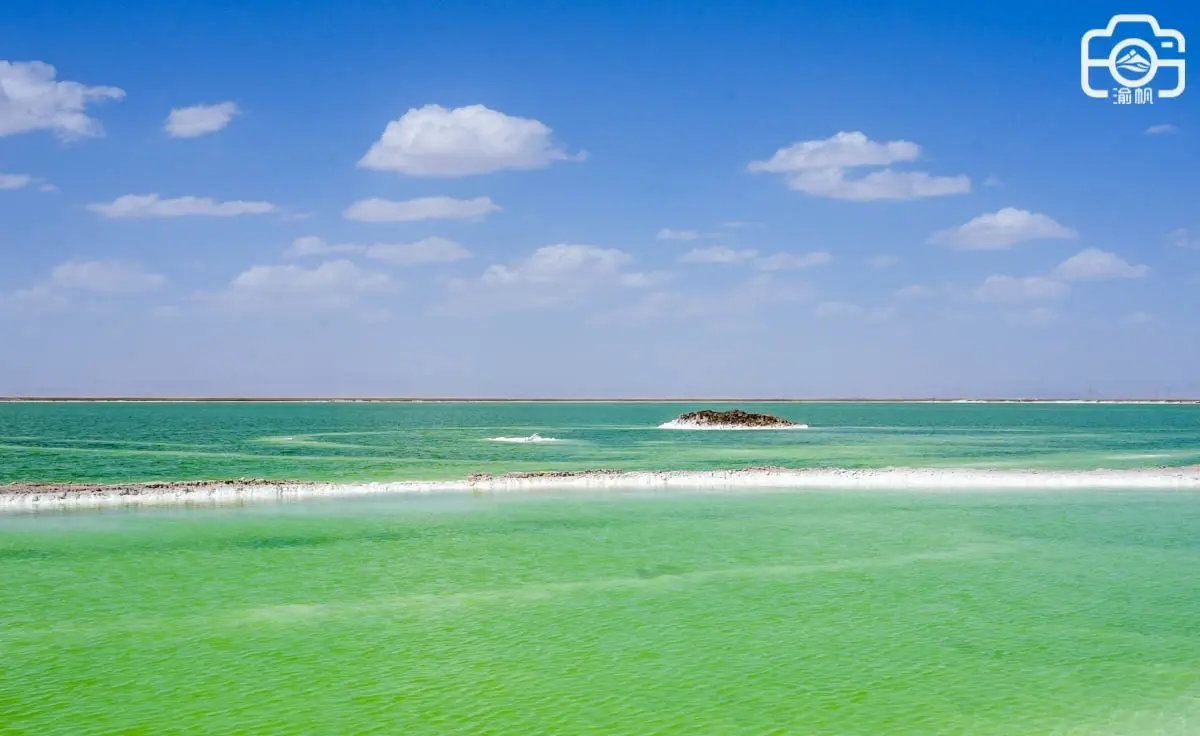
Qarhan Salt Lake is situated in the southern part of the Qaidam Basin, spanning the two counties and cities of Golmud and Dulan. The salt lake stretches over 160 kilometers from east to west, 20 to 40 kilometers from north to south, with a salt layer thickness of about 2 to 20 meters. Covering an area of over 5,800 square kilometers, it is nearly 56 times the size of Chaka Salt Lake. It is China's largest natural salt lake and the largest soluble potassium-magnesium salt deposit.
According to local friends traveling with us, Qarhan Salt Lake contains nearly 500 million tons of potassium chloride, 1.65 billion tons of magnesium chloride, 8.246 million tons of lithium chloride, and 46.22 billion tons of sodium chloride, all ranking first in the country. Especially the sodium chloride reserves are enough to feed the entire world's population for over 1,000 years. If calculated at market prices, its salt reserves are worth up to 12 trillion yuan, making it truly China's number one salt lake.
Qarhan Salt Lake is actually not a single lake but consists of multiple adjacent and connected salt ponds, including Dabuxun Lake, South Hobsun, North Hobsun, and Sene. The altitude here is 2,670 meters, the lowest point in the Qaidam Basin. Therefore, several inland rivers such as the Golmud River and the Qaidam River also flow into the lake.
It is understood that 'Qarhan' is a transliteration of Mongolian, meaning 'salt marsh.' Legend has it that hundreds of millions of years ago, the Qaidam Basin where Qarhan Salt Lake is located was once a vast ocean. Later, due to the uplift of the Qinghai-Tibet Plateau causing changes in sea and land, Qaidam became a basin. Initially, although the ocean turned into land, countless lakes of various sizes were formed, and Qarhan was just the largest among them.
Due to geological changes, this area later became a vast Gobi desert, with a dry and hot climate, long sunshine hours, and evaporation far exceeding precipitation. Over time, the lakes in this region, exposed to prolonged wind and sun, formed high-concentration brine that gradually crystallized into salt particles. The surface of the lake consolidated into a thick salt crust, extremely hard. As early as Li Shizhen's 'Compendium of Materia Medica,' there was a record of Qarhan, and the 'blue salt' mentioned at that time originated from here.
After the liberation, the local government established the largest potassium fertilizer production base in the country here, but it was little known to ordinary people. Later, with the rise of salt lake tourism, this largest salt lake in China, deep in the Qaidam Basin, gradually became known to the world. However, in terms of fame, it still lags far behind Chaka Salt Lake, which is also in Haixi Prefecture, Qinghai Province.
Although it is not very famous and cannot be considered a real scenic area, its beauty has always been underestimated. Particularly, the Ten-Thousand-Zhang Salt Bridge that traverses the salt lake is truly magical. This is a natural salt bridge made of a salt crust 15 to 18 meters thick, with a total length of 32 kilometers. Converted to the Chinese unit of zhang, it exceeds ten thousand zhang, hence the name Ten-Thousand-Zhang Salt Bridge. The bridge is smooth and flat, and large vehicles can pass over it without any problem, making it unparalleled and astonishing to visitors.
1. Qarhan Salt Lake is about 50 kilometers from Golmud city center, connected by an expressway, and takes about 40 minutes by car. If you are self-driving and unfamiliar with the road conditions, you can navigate directly there.
2. Qarhan Salt Lake is beautiful but also very sunny. There is no vegetation in the lake, and apart from a few viewing pavilions, there is almost no shade. Therefore, visitors should take sun protection measures when coming here.