Hoh Xil, the Forbidden Zone of Life: China's Largest and Highest Nature Reserve, Mysterious, Beautiful, and Full of Danger
Hoh Xil, a place that sounds extremely mysterious, naturally conjures up images in the mind: desolate, vast, boundless, rolling snow-capped mountains, picturesque landscapes. The desolation and vastness are real, while the mystery stems from the fact that for most people, it is far away. The vast majority only have a slight understanding of it through media images and text.
Hoh Xil is mysterious even for travel self-media professionals like Yufan, who travels around all year round. Although I have been to Qinghai, Tibet, and Xinjiang many times before, I had never set foot in Hoh Xil. But this time we were very lucky. During the 'Source of Three Rivers, Mysterious Kunlun' cultural tour, a trip to Hoh Xil was added on the spur of the moment, making us extremely excited.
There are actually two concepts of Hoh Xil. One refers to the Hoh Xil Nature Reserve, covering an area of 84,000 square kilometers, roughly the size of Chongqing Municipality, located almost entirely within Qinghai Province. The other is the Hoh Xil region, which is much larger, with a total area exceeding 230,000 square kilometers, spanning the three provinces of Qinghai, Tibet, and Xinjiang, and including the well-known Changtang, Altun Mountains, and Sanjiangyuan areas. The Hoh Xil Nature Reserve is only a small part of the Hoh Xil region.
Hoh Xil is a transliteration of the Mongolian language, meaning 'blue mountain ridge,' and some say it means 'beautiful maiden.' Tibetan compatriots call it 'Achingongjia.' It is one of the best-preserved pristine environments in the world and one of the largest, highest (average elevation above 5,000 meters), and richest in wildlife resources nature reserves established in China. The climate is extremely cold, natural conditions are harsh, and humans cannot live there for long periods, earning it the title 'Forbidden Zone of Life.'
We set out from Golmud City that day, passed through Yuzhu Peak Viewing Platform, Wuji Longfeng Palace, and Kunlun Mountain Pass, and after about 3.5 hours, we finally entered Hoh Xil. The area we were in no longer belonged to Golmud but to Yushu Prefecture in Qinghai. This is also the source of the Yangtze River in Sanjiangyuan. It is said that the Sanjiangyuan and Hoh Xil nature reserves are separated by the Qinghai-Tibet Highway, with one focusing on natural ecological protection and the other on plateau animal protection, complementing each other and coexisting side by side.
It is understood that the Hoh Xil National Nature Reserve is home to more than 30 known species of mammals, almost all of which are endemic to the plateau, and only one species of reptile, the Qinghai toad-headed agama. It boasts wild yaks, Tibetan antelopes, wild donkeys, white-lipped deer, brown bears, and other unique wildlife of the Qinghai-Tibet Plateau. It is one of the regions in China with relatively abundant animal resources, hosting over 230 species of wildlife.
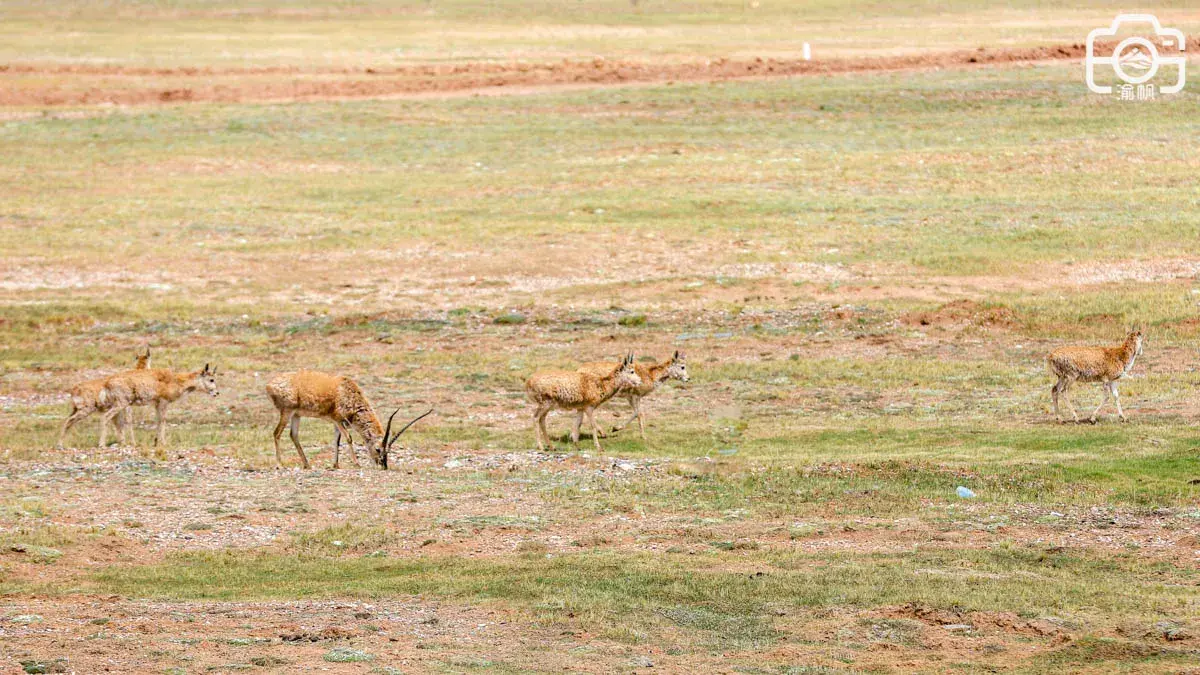
Due to time constraints and national protection policies, we did not enter the core area of the Hoh Xil National Nature Reserve. We only toured the periphery for an hour or two, during which we saw quite a few wild animals, including Tibetan wild donkeys and Tibetan antelopes. The wild donkeys were bolder and lived closer to the highway, so we could capture them from the car. The Tibetan antelopes, however, were seen running far away on the grassland, and our lens simply could not reach them; we could only crop some images with poor results.
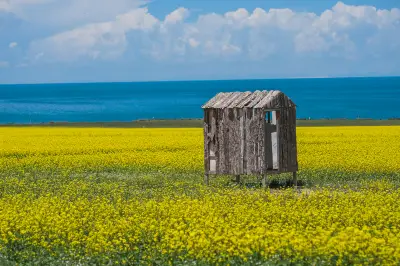
Hoh Xil is very beautiful because it is far from the masses, just as Wang Anshi said: 'Places that are flat and near are visited by many; places that are dangerous and remote are reached by few. And the world's magnificent, grotesque, and extraordinary sights are often in dangerous and distant places, rarely visited by people.' So because it is far away and human activity has caused little damage, it is considered very beautiful and mysterious in people's minds. It is a pure land far from the hustle and bustle of the city, with azure skies,连绵的 snow-capped mountains, patches of white clouds, and many rare plants and animals living on the endless grasslands. However, beauty is often accompanied by danger, and Hoh Xil is no exception. Beneath its clean and sacred appearance lurk unknown dangers. It is even more a 'no-man's land,' making people hesitate to approach. Only by seeing those bones can we better understand the reverence humans should have for nature.