A Miraculous Lake Discovered in Qinghai: Fresh on One Side, Saltwater on the Other, with Distinctly Different Colors and a Clear Boundary
China has many lakes, the largest being Qinghai Lake covering 4,583 square kilometers, the deepest being Changbai Mountain Tianchi at 373 meters deep, the highest being Huo'erbo Lake at an altitude of 6,166 meters, the largest salt lake being Chaerhan Salt Lake, the largest hot water lake being Yangbajing, and the lake with the most islands being Qiandao Lake. However, few friends know that there is also a very miraculous lake in China—freshwater on one side and saltwater on the other. Does anyone know where it is?
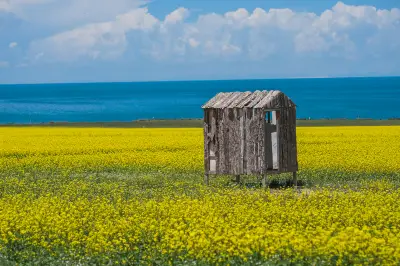
This lake is West Taijinar Lake, located in Haixi Prefecture, Qinghai. National Highway 315, known as China's Route 66, cuts through the lake, dividing it into two parts. Amazingly, the water on either side of Highway 315 is strikingly different: one side is light green, while the other is deep blue, with a clear boundary that surprises every visitor.
This lake could once be described as obscure, but in recent years, together with the neighboring East Taijinar Lake, it has suddenly become popular, emerging as an online attraction that countless tourists yearn to visit. Although these two lakes are not far apart, their styles are completely different.
The water of East Taijinar Lake resembles the sea, with a noble color like Tiffany gemstones, symbolizing happiness and romance. Combined with the soft and white salt crystals on the lakeshore, which are as delicate as melted cheese, it has been called China's Maldives in the northwest by many. In comparison, West Taijinar Lake is not as stunning as East Taijinar, but the wonder of one lake having two types of water and two colors is truly breathtaking.
Why does the same lake have two colors and two types of water? This is a topic of great interest to many. Since this is not a commercial scenic area and there are no professionals nearby to give authoritative explanations, according to Yu Fan, West Taijinar Lake was originally a single lake. Located in the Qaidam Desert, surrounded by uninhabited areas, it has an arid and extremely arid climate with annual precipitation less than 25 mm. The lake water mainly relies on meltwater from the Kunlun Mountains.
After Highway 315 split West Taijinar Lake down the middle, the water supply became differentiated. One side receives the same saltwater as East Taijinar Lake, while the other side receives meltwater from the Kunlun Mountains. Due to the different water sources, the water quality on both sides gradually changed, resulting in the unique natural wonder seen today.
According to a local friend traveling with us, West Taijinar Lake formed 2.6 million years ago. It is a magnesium sulfate subtype salt lake and is considered one of the best resource conditions among China's many salt lakes. Together with China's largest salt lake, Chaerhan Salt Lake, it is recognized as one of the two most valuable salt lakes for development.
We noticed that the surrounding water yards around West Taijinar Lake and East Taijinar Lake both have various yardang dunes, but West Taijinar Lake does not, making it appear relatively plain. However, as we drove through the lake, with the lake and sky meeting outside the window and flocks of wild ducks, the scenery was still very beautiful, prompting us to stop the car and slowly appreciate and take aerial photos.
East Taijinar Lake, adjacent to West Taijinar, has quietly disappeared, while West Taijinar Lake remains open to the public for free—no ticket required to enjoy this unique natural wonder. So if you like it, make sure to come and see it while it still exists, because it might disappear quietly like East Taijinar at any time. To give a simple example, if the two lakes connect, the clear boundary of the "mandarin duck pot" wonder will vanish. What do you think?