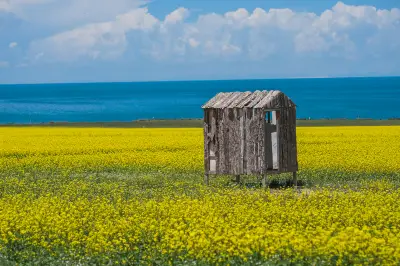
August: Around Qinghai (4, Chaerhan Salt Lake)
After leaving Chaka Salt Lake, I had that feeling of spending a lot of money but still not being satisfied. The next stop was Dachaidan, which was said to have a lake as pure as a huge emerald. According to the car rental company, the RV campground in Dachaidan was the most well-equipped place, with water and electricity hookups, and bustling with people. At first, I was quite looking forward to it. But after two days of travel, my thoughts had changed a bit.
First, my view on RV campgrounds. The RV campgrounds we passed along the way were almost no different from ordinary wilderness. This area of Qinghai is a vast barren land. Typical RV campgrounds are just leveled areas by the roadside with a large engraved stone. There were hardly any people around, and at night it was dark and windy. Some local herders were not very friendly, and people would come over and ask for parking fees without hesitation. So I parked my car on open ground very close to the road. When resting at night, I had to stay alert—if I noticed any collision or clearly unfriendly sounds outside, I could drive away immediately. The most comfortable "campground" we stayed at over these two days was in a town. Food and drink in Qinghai are expensive, but accommodation is not. Yesterday we found a small inn, arranged with the owner to take showers and change clothes, but we didn't sleep there. Instead, we parked the car at the entrance to charge and refill water. It cost us only about 100 yuan, cheaper than a fully equipped campground. Moreover, washing with plenty of water in the bathroom was much more refreshing than showering in the car. The parking area had lights, bright and reassuring, and there was a steady flow of people nearby, not so "quiet." When small issues arose, the owner was happy to help—comfortable and safe. So for the rest of the trip, we didn't specifically look for RV campgrounds; whenever we came across a small town or station, we just stopped and rested. In fact, for self-driving tours in the northwest, an SUV is more practical—better value, simple, and quick. The advantage of renting an RV is only during the current pandemic, as the interior is hygienic, easy to disinfect, and it reduces contact with crowds, leaving fewer traces of travel.
Second, the scenery. After leaving Chaka Salt Lake, as we were driving, we caught sight of an emerald-green lake. We were just talking about how beautiful Dachaidan would be when we looked outside. Huh? Had we arrived so soon? A long stretch of "jade" lay across the horizon not far away. Between the lake and the road was about one kilometer of ground—half of it was wilderness, and further ahead, reeds lined the lake. Above the reeds was the green water, and beyond that, yellow wilderness and distant mountains. This scene reminded me of a cartoon I watched as a child called "The Nine-Colored Deer." Caravans from the Western Regions traveled through such landscapes, surrounded by strong winds, tough grass, and swirling sand. Fortunately, the deer god protected the people. The weather now was much better than back then. OK! Everyone get off, gear up and set out!
The reed marsh was only about a meter high, looking flat from a distance. But when we walked in, the ground was uneven—some places could completely hide a person. The reed heads were sharp. All five of us were in long sleeves and pants, so the reeds didn't hurt when they brushed against us. The unexpected problem was the many hard roots on the ground. I was in front, and before long, a root pierced the sole of my shoe. Fortunately, it wasn't deep, and I didn't see any blood. For the rest of the way, I had to be very careful: I first trampled down the reeds in front, then tested the ground before stepping, with the others following my path. A few hundred meters felt especially long. After more than ten minutes, we suddenly saw an open view—but the water was blocked by countless black tree roots beneath the surface, preventing us from entering. The water was exceptionally clear; no fish were visible, and there were few insects around. Flocks of birds were flying over the lake. Leaning by the water, feeling both the blazing sun and the crisp wind, was extremely pleasant. This was a perfect spot for photos and a short rest. Unknowingly, over an hour passed—this was the real travel feeling!
Checking the navigation on my phone, I found that this place was actually called Xiaochaidan Lake. After finishing here, I lost the desire to go to Dachaidan Lake. Since we still felt unsatisfied with the salt lake at Chaka, Xiao Li said there should be another salt lake nearby, larger and more beautiful than Chaka. When the sun shines on its surface, it shows seven colors—a magnificent rainbow across the vast land. That imagery was breathtaking. But there was little information online about this place; it probably isn't a tourist attraction. It's unclear whether there is even a road leading there. If it involves a military area, things would be even more complicated.
The following is a rough summary of our discussion: We went out to have experiences. Although we couldn't take children up mountains or into the sea, as long as the danger was controllable, we could try more things. The RV's basic off-road capability was decent; if the road was bad, we'd drive slowly—we weren't in a hurry. If there was a military checkpoint, we could just turn back. The conclusion was: We must go to Chaerhan Salt Lake!
On the navigation, we only found a place called "Ten-Thousand-Zhang Salt Bridge" near Chaerhan. We were ready—let's explore and move forward. The road was in good condition. When the navigation showed we were approaching the destination, a giant industrial complex seemed to rise out of the endless wilderness. The machinery and equipment we could see were enormous, giving a kind of industrial cyberpunk feel, especially the characters "Kunlun" standing out prominently.
By the time we entered the factory area, it was nearly dusk. This was a large industrial complex containing many factories. Everyone we saw wore work uniforms. There seemed to be no residential areas nearby. Following the navigation, we soon encountered a checkpoint—it was the entrance to a factory. We said we wanted to see the salt lake. The gatekeeper said that this was all factories, and the entire salt lake was surrounded by factories; there was no road to enter. After much pleading, perhaps because they saw we were from the northeast, they couldn't bear to let us come all this way for nothing. They reluctantly let us in, but we had to leave before dark. We registered and left our phone number. In any case, thank you, gatekeeper brother, for allowing us to see the night scenery here!
We drove along the salt embankment. Although it wasn't as refined as Chaka and lacked recreational facilities, it was all about the "vastness." We drove for several kilometers and still couldn't see the end. On both sides of the road, there was nothing but green water and white salt.
It was already past 7 p.m. when we reached the salt bridge. Fortunately, this area is two time zones behind the northeast, so it doesn't get dark until around 9:10 p.m. We still had plenty of time to walk and take photos. There were few tourists nearby—mostly people from Golmud driving here to relax.
Walking in such vast spaces opens up one's mind. The children, seeing this scene for the first time, ran around excitedly in the salt field, tireless, leaving youthful impressions.
The salt bridge is the center of the landscape. According to locals, there was once an attempt to build a scenic area like Chaka here, contracted to a private operator. But after a few years, the visitor numbers were insufficient, and the operating rights were taken back. The summer months are the best season for the salt lake. The relevant authorities plan to hold large events here in the future to increase its fame, and then reopen it at an appropriate time.
What we saw was actually salt fields—all artificially dug, serving as raw material bases for the nearby factories. The extracted table salt, potassium salt, magnesium, and lithium are all important industrial products, always in demand. So the surrounding area is full of large state-owned enterprises, with stable profits and generous benefits. As for the Chaerhan Salt Lake on the map, you have to go all the way to the end of the salt embankment to see a bit of it.
After taking plenty of photos, we drove along the embankment to the end. At the end of the salt fields, there were several parallel channels, clearly man-made. The basic process of salt field production is to first dig salt field ponds near the lake, each about 3 square kilometers. Now there are over a dozen such ponds, looking quite orderly from satellite images. Water is channeled into the salt fields through the channels we saw. After the factories extract what they need, the wastewater is sent back to the salt lake through the same channels. When we finally approached the real Chaerhan Salt Lake, the sky and earth had turned pale white. The glow of the sunset beyond the distant mountains was especially beautiful and precious. Having witnessed this most beautiful moment, it would be impossible to enter during the daytime tomorrow—the colorful sunset glow would only be a beautiful legend!
There was a dredging boat working in the middle of the channel. My wife and Xiao Li had nothing to do, so they went to chat with the dredging boss. Unexpectedly, they got some extra gains. Although the factory wouldn't allow an RV inside during the day, the factory was still expanding. There were construction teams from all over the country. Outside the factory area, a few access roads for construction vehicles had been left. The boss could give us directions tomorrow. The roads were dirt and rough, with some detours, but only a few extra kilometers. We could drive to the salt bridge without any problem. Moreover, along the way, there would be rare and beautiful scenery. Listening to the boss's vivid description, we were tempted again! Thank you, kind stranger. We are ready to set off toward a better tomorrow!!!