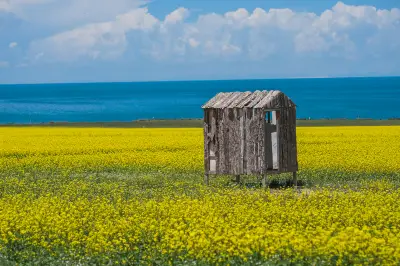
A Qinghai-Gansu Road Trip Perfect for Self-Driving: Deserts, Yardangs, Danxia, Grottoes, Snow Mountains, Lakes, Grasslands, Flower Seas, Temples, Salt Lakes
As the three years of the pandemic drew to a close in 2023, I really wanted to go out and breathe fresh air. After confirming that there were no more recurring cases, taking all protective measures, and the media no longer reported on the pandemic daily, on August 10, 2023, the Qinghai-Gansu Grand Loop trip officially began.
D1 (8/10) Shanghai Pudong Airport — Xining Caojiapubao Airport
D2 (8/11) Xining — (28km) Kumbum Monastery (Tar Temple) — Laji Mountain — (145km) Qinghai Lake
D3 (8/12) Qinghai Lake — (152km) Caka Salt Lake — (200km) Delingha
D4 (8/13) Delingha — (218km) Emerald Lake (翡翠湖) — Dachaidan
D5 (8/14) Dachaidan — (136km) Qarhan Salt Lake — (210km) Water-based Yardang (Uxinte Yardang)
D6 (8/15) Water-based Yardang — West Taijinar Lake — (119km) Nanbaxian — (106km) Dachaidan
D7 (8/16) Dachaidan — (245km) Oil Town (Petroleum Town) — (99km) Yangguan Pass — (60km) Dunhuang
D8 (8/17) Dunhuang Museum — Leiyin Temple — Mingsha Mountain and Crescent Spring
D9 (8/18) Dunhuang — (186km) Yulin Caves — (67km) Son of the Earth (大地之子) — Han Wu Emperor Statue — (274km) Jiayuguan
D10 (8/19) Jiayuguan — (19km) Hanging Great Wall (悬壁长城) — (13km) First Beacon Tower of the Great Wall (长城第一燉) — (216km) Zhangye Colorful Danxia
D11 (8/20) Zhangye City — (57km) Pingshan Lake Grand Canyon
D12 (8/21) Zhangye City — (57km) Mati Temple (马蹄寺) — (178km) Zhuor Mountain (Zhuo'er Mountain)
D13 (8/22) Zhuor Mountain — (286km) Xining
D14 (8/23) Xining Caojiapubao Airport — Shanghai Pudong Airport
The Qinghai-Gansu Grand Loop is located in the provinces of Gansu and Qinghai, with the Qilian Mountains serving as the boundary between the two. The self-driving loop is about 3,200 kilometers in total length and covers more than 20 of the most scenic spots in the two provinces, including deserts, yardangs, danxia, gobi, grottoes, snow mountains, lakes, grasslands, flower seas, temples, uninhabited areas, salt lakes, and high mountains. It is a complete route with no backtracking, a grand collection of Northwest China's natural scenery and the historical culture of the Silk Road, and a paradise for photography enthusiasts.
1. Qinghai section: Xining — Qinghai Lake — Caka Salt Lake — Dachaidan (Emerald Lake) — Qarhan Salt Lake — Water-based Yardang — Nanbaxian — Dachaidan — Oil Town
2. Gansu section: Yangguan Pass — Dunhuang Museum — Leiyin Temple — Mingsha Mountain and Crescent Spring — Yulin Caves — Son of the Earth — Han Wu Emperor Statue — Jiayuguan Pass — Hanging Great Wall — First Beacon Tower — Zhangye — Pingshan Lake Grand Canyon — Mati Temple
3. Qinghai section: Zhuor Mountain — Xining
D1 (8/10) Shanghai Airlines flew from Shanghai Pudong Airport to Xining Caojiapubao Airport, taking 3 hours. After exiting the airport, we took a taxi to the Atour Hotel and checked in.
D2 (8/11) We drove the rented Audi SUV and started the Qinghai-Gansu Loop trip... In the morning, we visited Kumbum Monastery (Tar Temple), and in the afternoon, we went to Qinghai Lake, passing by Laji Mountain.
Kumbum Monastery is one of the six major monasteries of the Gelug school (Yellow Hat sect) of Tibetan Buddhism. It is located in Huangzhong District, the capital city of Qinghai Province, and was founded in the 12th year of the Ming Hongwu era (1379). The temple is mainly used for prayers and rituals, carrying a sense of ceremony and solemnity that naturally inspires reverence for the divine. In such an atmosphere, people become calm, imagining they can enter a state of meditation. However, as Kumbum Monastery has become a tourist attraction, there are huge crowds of people, bustling and noisy, completely lacking the quiet atmosphere a monastery should have.
Around the buildings, there are prayer wheels, which are turned clockwise to pray for blessings and well-being for oneself and family, wishing for all to go smoothly.
After leaving Kumbum Monastery, we continued on, passing Laji Mountain at an altitude of 3,820 meters.
There is a viewing platform by the lake. Only by climbing high can one overlook Qinghai Lake. At this point, the altitude is already 3,200 meters, and climbing several hundred steps is quite tiring, so we walked slowly...
Qinghai Lake is one of the highest lakes in the world, with an altitude of 3,196 meters. The lake surface is up to 106 kilometers long from east to west, up to 63 kilometers wide from north to south, with a circumference of about 360 kilometers. The overall outline of the basin is oval, tilting from northwest to southeast. It is a closed inland basin with a plateau continental climate. Qinghai Lake is a saltwater lake with high salinity. The water supply comes from rivers, followed by underwater springs and precipitation.
The afternoon sun was beautiful.
Delicious meals for cattle and sheep.
The sunset glow by Qinghai Lake lit up the sky.
The clouds were edged with gold, shining brightly.
D3 (8/12) Early in the morning, we left Qinghai Lake for Caka Town, located in the eastern part of Ulan County, Haixi Mongolian and Tibetan Autonomous Prefecture, Qinghai Province. Caka Salt Lake is a famous natural crystalline salt lake in the Qaidam Basin. "Caka" means "salt pond" in Tibetan. Surrounded by snow-capped mountains and grasslands, Caka Salt Lake is a lagoon with coexisting solid and liquid phases. It has layers of blue waves and patches of white salt, with snow mountains reflecting and grasslands embracing, forming a unique natural landscape and various salt flowers. The salt sculpture art group, carved from the lake's raw salt and brine, is a major feature, combining salt and sculpture art.
The existing salt in Caka Salt Lake is enough for the whole country to eat for 70 years, and the salt is renewable. It is also one of the birthplaces of China's salt culture.
From June to October every year, due to the large amount of salt deposits crystallizing out, the lake bed forms a salt layer dozens of meters thick. The water above the salt layer is only a few millimeters deep. From a distance, people standing on the salt bed seem to float on the water, with clear reflections. Hence the name "Sky Mirror."
We took a sightseeing train in and out. Everything was a vast white expanse. We rented high plastic boots to enter and walked or ran on the crystalline salt for the first time in our lives. There are salt pits of different sizes, so we had to be careful.
August is the peak season, crowded with people everywhere. Capturing a photo without others in the scene was rare and fleeting, so timing was crucial.
D4 (8/13) The distance between Qinghai Lake and Emerald Lake was long, so after leaving Caka Salt Lake last night, we chose Delingha as a transit stop to rest. Early this morning, we headed to Dachaidan, and after noon, we entered the Emerald Lake scenic area. The weather was not cooperative, cloudy and rainy and very cold. Again, we took the sightseeing train in and out, able to get on and off at any stop.
Emerald Lake is composed of salt ponds of various sizes, shapes, and depths. The lake is rich in different concentrations of potassium, magnesium, lithium, and other elements, thus presenting different colors. The color of each water area is not only related to the concentration of minerals but also to the weather and time of day.
The sky gradually brightened, making us feel comfortable, and the lake shimmered, like a fairy lake. We imagined it would be even more beautiful on a sunny day, truly deserving the name "Emerald Lake."
D5 (8/14) Today was a sunny day. Early in the morning, we entered Qarhan Salt Lake. It was incredibly beautiful. We had never seen such a green lake. We cheered, jumped, and marveled! Qarhan Salt Lake is a salt lake in western Qinghai Province, China. It is the largest salt lake in China, the largest in Asia, and the second largest in the world. It is as famous as Caka Salt Lake, located in the southern part of the Qaidam Basin, spanning Golmud City and Dulan County.
The salt ponds were neatly arranged, and in the clear sky, the water and sky merged into one, magnificent! Personally, from a scenic perspective, Qarhan Salt Lake is more beautiful than Caka Salt Lake and Emerald Lake, surpassing them.
In Qarhan Salt Lake, no green plants can grow, but it nurtures magical salt flowers as clear as jade and ever-changing. During the crystallization process of brine, due to different concentrations, durations, and compositions, salt flowers of various forms, exquisitely crafted by nature, are formed.
The salt lake is located in a vast gobi desert. The climate here is hot and dry, with long sunshine hours, and evaporation far exceeds precipitation. Due to long-term wind and sun exposure, high-concentration brine forms in the lake, gradually crystallizing into salt particles. The lake surface hardens into a thick salt crust, extremely hard.
The lake surface is vast, connected to the horizon. Walking on the salt sand gave a special feeling. We were amazed that the total reserves of the salt lake could reach more than 60 billion tons!
Around the lake, a ring of silver-white salt crystals appeared, like a beautiful necklace on the pond. The salt lake was huge; we left reluctantly around noon. Spending a whole day in the scenic area would yield more rewards.
Leaving Qarhan Salt Lake, we continued and entered the Yardang region at 3 p.m.
The Yardang formations illuminated by sunlight before sunset.
From a high vantage point, we could see the real water-based yardangs scattered in the lake...
The boat's entry brought a sense of movement and new life.
Uxinte Yardang Geological Park is located in the northwestern part of the Qaidam Basin in Qinghai. After millions of years of geological movements and changes, it has formed the world's largest and most spectacular Yardang cluster, covering an area of about 21,000 square kilometers, mainly distributed in the Nanbaxian and Eboliang areas. Uxinte Yardang is located within the Nanbaxian Yardang cluster. The yardang mounds in the area are estimated to be dozens of meters high, scattered in the lake, making it the earliest water-based yardang landscape discovered in the world.
The sunset glow gently fell on the mounds, extremely peaceful...
Where there are prayer flags, a sense of reverence arises...
D6 (8/15) The road to West Taijinar Lake was bumpy, with the car bouncing violently. Returning tourists said the road ahead was even worse, and the scenery was similar to the next two photos, so we turned back halfway and did not see the two-colored lake. We then headed to Nanbaxian.
On the way to Nanbaxian, the yardang landform was very beautiful. We truly felt the vastness and desolation of Northwest China.
Everything in sight was yellow earth, with small mounds one after another, like being on another planet.
Camping is possible here. Doesn't it look like another planet?
This is Taijinar Town, with obvious yardang landforms. Standing on a high point, the view was even more stunning.
This is the Nanbaxian Devil City, located in the Haixi Mongolian and Tibetan Autonomous Prefecture, Qinghai. Apart from tourists, there were really no people. It is unmanaged and free of charge. The yardang landform was more distinct and widespread.
Yardang landform means "wind-eroded soil mounds," a combination of intermittently elongated ridges and depressions. It is a type of wind-eroded landform, also called sand-eroded mounds or wind-eroded mounds. The landform causes strong winds, blowing sand and making strange, eerie howling sounds. The locals initially thought it was the wailing of ghosts, hence the name "Devil City."
In 1955, eight female geologists from the south came here to explore and survey for oil resources, stepping onto this barren land. On their return, a sandstorm engulfed the desert, causing them to lose their way. The only landmarks were buried, and they could not find the way back. Fear, hunger, and thirst followed. When they were found, they had already been buried forever in this ancient wilderness. Five of them were found huddled in a circle, protecting valuable survey data from being buried by sand. To commemorate the eight glorious female geologists, the place where they sacrificed was named "Nanbaxian" (Eight Immortals).
Small cars should generally not drive in; SUVs can enter, but should not go deep into the yardang hinterland. Safety is important. We could climb the mounds to overlook the endless yardang clusters and feel their charm...
D7 (8/16) At 9:40, we set off from Dachaidan to Oil Town, 240 kilometers, passing two service areas, arriving at 13:16. There were huge crowds; the restroom queue took 40 minutes. It was just some old sites, feeling a bit like a rip-off, so we ignored it and continued to Yangguan Pass. We entered the Yangguan Pass scenic area at 16:00 and visited the Yangguan Museum.
During the reign of Emperor Wu of Han, he wanted to ally with the Yuezhi to attack the Xiongnu and sent Zhang Qian as an envoy to the Western Regions. More of this historical event can be learned from the Yangguan Museum collection.
We took an electric car to the Yangguan Pass ruins. The Yangguan Road was very impressive.
The desert was boundless. In that era, the only means of transportation were horses. How much courage, boldness, and perseverance Zhang Qian needed to travel to the Western Regions!
The sun was setting, making us marvel at the charm of the boundless desert in Northwest China.
Outside the city gate, various weapons of war were displayed.
At sunset, we climbed the city wall, and the ruins of Yangguan were lit up by the sunset glow.
D8 (8/17) In the morning, we visited the Dunhuang Museum, which was packed with people. In the afternoon, Leiyin Temple was very quiet. We happened to encounter monks holding a class. Although we didn't understand, we quietly listened to the end. It was not commercialized. In the evening, we went to Mingsha Mountain and Crescent Spring. The ticket value was poor, management was chaotic, and the scenery was average.
You can bring your own rubber boots or rent them for 20 yuan. It took more than an hour to climb the sand mountain using the ladder, and we didn't even reach the top. The last third had no ladder and was very difficult, taking one step forward and sliding two steps back.
As it got dark, we had climbed two-thirds of the desert path. We sat down to rest and watch the evening performances. Descending required technique: walking in an S-shape to avoid rolling and to make it easier. With such a large crowd, if everyone came down at once, it could be dangerous, risking stampedes. So before it was completely dark and before the performance ended, we went down.
D9 (8/18) Dunhuang Caves require a month's advance booking. We booked too late, so we went to the Yulin Caves instead. Four regular caves cost 40 yuan, and we paid an additional 200 yuan for Special Cave No. 25. The murals and Buddha statues in the caves were damaged and faded due to natural disasters and historical reasons. The Buddha statues had obvious traces of restoration. The murals in the special cave had richer stories. They were more enjoyable for those who like painting, but the price was indeed high and not good value.
Water resources here are scarce and the climate is very dry. No photography is allowed inside the caves. We kept an impression of the external environment.
After leaving Yulin Caves, we headed straight to Jiayuguan, passing three photo spots: Wu Jie (Boundless), Son of the Earth, and Han Wu Emperor. Personally, I found Son of the Earth more interesting~
Han Wu Emperor, majestic.
Son of the Earth, prostrate in the embrace of Mother Earth, a very heartwarming scene.
Son of the Earth slept soundly in the open desert... The design concept and inspiration are left for people to interpret.
D10 (8/19) At 9:30 a.m., we set off for Jiayuguan Pass, then went to the Hanging Great Wall and the First Beacon Tower.
Jiayuguan, known as "the First and Greatest Pass under Heaven," is located in the narrowest part of the valley, 5 kilometers west of Jiayuguan City, Gansu Province. The city walls on both sides cross the desert and gobi, connecting to the Hanging Great Wall on the Black Mountain to the north and the First Beacon Tower to the south. It is the westernmost pass of the Ming Great Wall, historically called the throat of the Hexi Corridor, magnificent and grand.
The Hanging Great Wall is about 7 kilometers from the pass. It is the northern extension of Jiayuguan Pass and an important part of the ancient military defense system. It was first built in the 18th year of Jiajing of the Ming Dynasty (1539) and is considered the final section of the Great Wall as it enters Jiayuguan, often called the end of the Great Wall. It takes less than 2 hours to climb the Hanging Great Wall to the top.
The First Beacon Tower refers to the starting point of the Ming Great Wall. It connects to the Great Wall, extending to the pass and then to the Hanging Great Wall, forming the entire border defense function.
Now the area is desolate, with no water in the riverbeds.
At 2:30 p.m., we set off for Zhangye City. Driving on the Lianhuo Expressway took 2.5 hours to reach Zhangye Colorful Danxia Scenic Area.
Colorful Danxia Scenic Area is located in Linze County and Sunan County, Zhangye City, Gansu Province. The total area of the scenic area is 50 square kilometers. It is the most typical Danxia landform in the arid regions of northern China, formed by thick layers of conglomerate and sandstone through tectonic movements, water and wind erosion. It is the only highly composite area of Danxia landform and colorful hilly landscape in China, with brilliant colors, high ornamental value and geological research value.
There are seven viewing platforms in the Colorful Danxia Scenic Area: Colorful Sea of Clouds, Colorful Fairyland, Colorful Splendor, Seven-Color Rosy Cloud, Best Photography Spot, Colorful Aohe Terrace, and Ten Thousand Elephant Soil Forest Valley. Each spot has different scenery. The most beautiful is Platform No. 4, where both the shapes of the hills and the colors are the most vivid, with purple-red, gray-green, yellow-green, gray-black, and other colors interweaving in an orderly manner, full of rhythm and layering.
Driving through the valleys.
Colorful Danxia embodies the unique roughness and magnificence of the West.
Color layers, gorgeous and orderly, like music sheet rhythms.
Climbing up to take in the view, we marveled at the exquisite craftsmanship of nature.
From the Qinghai-Gansu journey, we saw vast expanses, wind and sand, drought, monochrome colors, mainly yellow. It wasn't until we entered Zhangye City that green vegetation began to increase. Where there is water, there are green plants, and the environment improved. This area also had richer colors.
Thin layers of mudstone, sandy mudstone, and shale interbedded.
We took a hot air balloon to overlook the Danxia landform.
We could also see the sunset glow.
D11 (8/20) Today we went to see Pingshan Lake Grand Canyon. We chose the Grand Loop deep tour. The scenic shuttle bus covered 17 kilometers. First, we went to the viewing platform on the top of the mountain to overlook the Danxia landform. Then we took an off-road vehicle that bounced along the mountainside, very steep, traveling along cliffs and precipices down to the bottom of the canyon. After that, we walked 300 meters, rode a camel for 200 meters, walked, took a camel cart, then walked another 1.4 kilometers to a spiral staircase, climbed 380 steps to Platform 4, and then took the scenic shuttle bus back to the starting point.
Pingshan Lake Grand Canyon is about 60 kilometers from Zhangye City. After hundreds of millions of years of wind and rain, the canyon is deep and the peaks strange, mostly conical or columnar, with unique shapes. The colors are mainly red. Nature has carved the red sandstone mountain into incomparably beautiful, breathtaking masterpieces.
At the mountaintop viewing platform, everything was reddish-brown sandstone, with layers of various shapes forming magnificent mountains.
Going up and down, from the bottom of the canyon to the top.
At the top of Platform 4.
In the deep part of the canyon, a ray of sunlight slanted in, making the colors redder and brighter.
Hundreds of millions of years of wind and water erosion formed the mountains, with loose sand and gravel easily peeling off.
Valleys of varying widths.
Riding a camel gave a great Western atmosphere.
The section we traveled by camel cart was the deepest and most beautiful. The bells on the camels made crisp sounds, and the scene gave a sense of time travel. The mountains illuminated by sunlight were beautiful, with different colors on the sunny and shady sides, giving the canyon a three-dimensional feel.
D12 (8/21) We left Zhangye City in the morning and drove to Mati Temple. At 2 p.m., we left, passed through Biandukou, and arrived at Zhuor Mountain to check into a hotel.
Mati Temple is a large-scale grotto complex, including seven smaller grotto groups. It is a tourist area combining grotto art, Qilian Mountain scenery, and Tibetan culture.
There are the Thirty-Three Heaven Caves, Horse Hoof Print Cave, Tibetan Buddha Hall Cave, Shengguo Temple, and Thousand Buddha Cave. The main buildings in the temple, such as the Mahavira Hall, Standing Buddha Hall, Guanyin Hall, Medicine Buddha Hall, and Ksitigarbha Hall, are mostly from the Wanli period of the Ming Dynasty. These halls, despite centuries of wind and rain, still stand on hundred-meter-high cliffs, astonishing visitors with the excellent architectural skills of the ancients and providing a visual and spiritual impact.
Prayer flags are everywhere, a major feature of Northwest China.
The environment of Mati Temple is wonderfully beautiful, with more greenery, green mountains, clear waters, strange peaks, and unique caves, known as the "Four Perfections."
The Thirty-Three Heaven Caves have seven levels with a total of 21 caves, neatly arranged on a cliff over a hundred meters high. Each level is connected by tunnels. The tunnels are carved inside the rock in a zigzag pattern. Stone steps and winding corridors are narrow, with the narrowest point allowing only one person to pass.
D13 (8/22) Zhuor Mountain is located in Babao Town, Qilian County, Qinghai Province. It is a Danxia landform, composed of red sandstone and conglomerate. Early in the morning, we followed the boardwalk to the top of Zhuor Mountain. The view from the top was extremely open, with no obstructions in any direction. The rolling Qilian Mountains, beautiful scenery everywhere, like a fairyland, made us feel relaxed and happy.
The back mountain had a rural farming landscape.
The front mountain had the red sandstone Danxia landform.
The red sandstone was covered with varying shades of green, like velvet...
Scenery changed with every step. Personally, I thought the pastoral scenery of the back mountain was even more beautiful.
Babao Town in the valley.
At the foot of the mountain, the Babao River surrounded the county like a white hada (scarf).
White stupas are sacred in the hearts of Tibetan people... At 2:30 p.m., we left Zhuor Mountain and drove to Xining.
D14 (8/23) After breakfast, we went to the airport. At 1:30 p.m., we safely arrived at Shanghai Pudong Airport, successfully concluding the Qinghai-Gansu Grand Loop trip, a total distance of 3,200 kilometers. The deepest impression from the trip was the vastness of Northwest China, the broad horizons, and the beauty of diverse landforms: thousands of ravines and rocks, enchanting the eyes and refreshing the mind. The thousand-year-old grottoes and deep cultural heritage. However, the population is sparse, the climate dry, with mainly yellow earth and desert. Apart from Zhangye and Zhuor Mountain, green vegetation was sparse, and cash crops were relatively scarce due to poor soil. Therefore, developing tourism is a good way to boost the economy. Seeing different natural environments and understanding different cultures and customs was truly worthwhile.