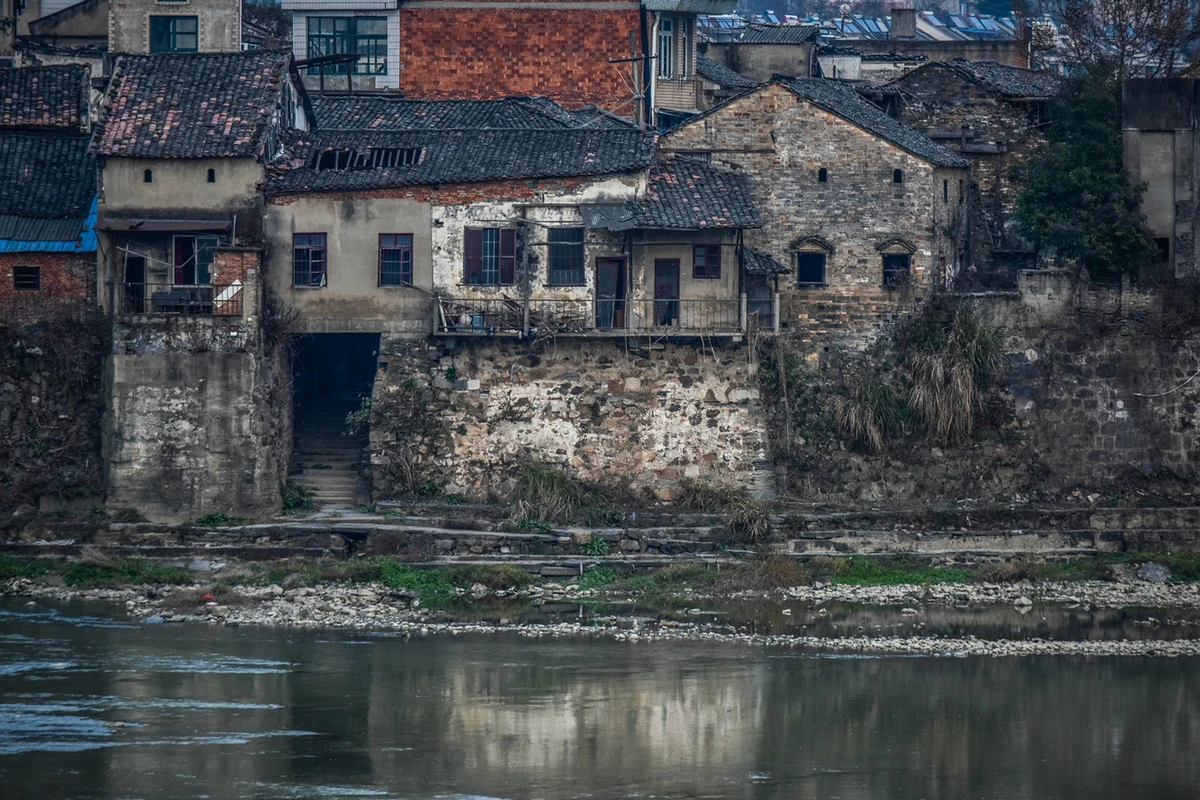
Once a Bustling Trading Port, Now a Desolate Ruin—Is Its Future Plagued by Misfortune or Full of Promise?
As time flows, it inevitably eliminates and preserves certain things in the long river of history. The scene remains but people change—this is the mechanism of time's elimination; what endures most is human culture and history. Across the country, many historical sites stand as symbols of prosperity from centuries or even decades ago. For instance, in a small city in southern Anhui, there lies a forgotten urban ruin exuding an intensely desolate atmosphere. Yet a hundred years ago, this was a very prosperous, lively, and affluent trading port—the famed Helixi Old Street in Ningguo, renowned throughout Jiangsu, Zhejiang, Shanghai, and Anhui.
Such dilapidated old houses are common nationwide, but for the small southern Anhui city of Ningguo, they represent an indelible memory. The old saying "Small is Ningguo County, grand is Helixi" once spread from Ningguo County across all of Anhui and even the entire Jiangsu-Zhejiang-Shanghai-Anhui region. Especially during the early years of the People's Republic of China, the working class was very familiar with Ningguo County, and their knowledge of Helixi Old Street in Ningguo was as intimate as the back of their hand.
If told that this place was the economic center of Ningguo County, many might think how poor and backward Ningguo County was back then! But that's not the case! This place was prosperous decades ago; it was only after the relocation of the old Ningguo county seat in the 1980s, the shift of the old industrial system, and the withdrawal of the Third Front construction workers that it gradually declined. With young people leaving and only the elderly remaining, it slowly became a no-man's land. Over time, without management, this town center turned into a ruin.
Due to historical reasons, Ningguo County became a place of diverse populations, including people from Hubei, Qingtian and Pujiang in Zhejiang, Shanghai, Anqing in Anhui, and some indigenous residents. It is also the county-level city in Anhui with the largest population of migrants. As early as the Song Dynasty, the Helixi trading port was a thriving port town center in southeastern Anhui. The bluestone paths, repeatedly patched old houses, and messy electrical wires all testify to a place rich in the sedimentation of time.
Today's Helixi Old Street evolved from the former Helixi trading port. Most of the population has moved to the city center or built new houses nearby; only the elderly who are attached to this place remain, reluctant to leave. Walking along the entire street, aside from a few elderly people, young faces are rarely seen.
Locals call Helixi Old Street Xiaoxikou (Little Creek Mouth). Its residents are mainly descendants of Hubei migrants, later joined by merchants from Huizhou and Shanghai's "Third Front" construction workers. The Huizhou merchant mindset, the working-class ethos of Shanghai, and Hubei's business acumen were perfectly integrated here, giving rise to a unique "Ningguo merchant" identity. This concept is a vague one—a collective term that fuses different business philosophies. Perhaps it was the idea of the "Ningguo merchant" that enabled this remote mountain county town to become a standout among county-level cities in southeastern Anhui.
According to the enthusiastic and proud introductions of the local elderly left behind, Helixi Old Street was once extremely lively—a world apart from its current state. An elderly man nearly 80 years old told me that in those days, the main street, less than a kilometer long, was lined with every kind of shop imaginable: butchers, seafood sellers, steamed bun shops, breakfast stalls, barbershops, bathhouses, tofu shops, small grocery stores, vegetable stalls, tailors, and more—everything one could need. It was even more bustling than the Ningguo county seat at the time. Now, it is chillingly quiet.
The main street at Xiaoxikou in Helixi is the shortest route from downtown Ningguo to the new Helixi district. Many commuters pass through the alleys off the main street—first, because it is less crowded and free of traffic jams, and second, because it is the nearest path. Every day at 8 a.m. and 6 p.m., Helixi Old Street sees its peak foot traffic, giving this utterly desolate ruin two bursts of activity a day.
Walking along this street evokes many thoughts—either a poet's sighs or a historian's regret. The traces left on the ancient stone slabs make it easy to see how lively it once was, how prosperous. The stone slabs themselves have cracked, and the roadbed has sunk in places. At this moment, I truly don't know what to say or think.
Helixi developed into a trading port due to its location at the confluence of the Zhongjin River and Dongjin River upstream of the Shuiyang River. Before the Northern Song Dynasty, boats from the Helixi trading port in Ningguo could reach Wuhu, Nanjing, Wuxi, Yangzhou, Shanghai, and areas along the Zhejiang-Anhui border. Although the river has dried up today, its water source is still well protected. Though it lacks the bustle and prosperity of old, the water quality remains quite good. A wolfdog from the old street drinking from the river testifies to the water quality; the reflection of the dog and the blue sky and white clouds in the water reveal its clarity.
Helixi enjoys an excellent geographical location—it is the most convenient passage from southeastern Anhui to central and southern Zhejiang, and from Jiangsu and Shanghai to Mount Huangshan and Jiangxi. In recent years, the new Helixi district has built Ningguo's largest highway hub, making it a thoroughfare connecting north and south, east and west. Due to historical issues with the old Anhui-Jiangxi Railway, the integration of Helixi with Ningguo's main urban area has yet to be realized. I believe that once the realignment project of the Anhui-Jiangxi Railway through Ningguo's urban section is completed, Helixi will surely achieve integrated development with Ningguo's main city, and its future may be very promising.
In the past year of 2019, Helixi Old Street in Ningguo was designated as a provincial-level cultural relic protection unit by Anhui Province—a great piece of news. With the construction of Ningguo's external transportation network, Helixi will see growth in service industries and related sectors. For example, the Nanjing-Nanchang-Nanning high-speed rail, the Nanjing-Xuancheng-Ningguo-Lin'an-Hangzhou intercity railway, and the Hefei-Wuhu-Ningguo-Jinhua-Wenzhou high-speed railway will surely bring enormous development opportunities. Additionally, the abandoned railway line of the old Anhui-Jiangxi Railway, less than two kilometers from Helixi Old Street, could be repurposed as a city sightseeing rail transit line connecting Ningguo's main urban area with the Helixi district. If the tourism angle is fully leveraged, the prospects are boundless. Therefore, I believe the future of Helixi Old Street holds great potential. However, if the local authorities fail to act, this once-thriving and lively old street may remain plagued by misfortune. Finally, what do you think—will Helixi Old Street's future be troubled or bright? Share your views!


