A Village Split by an Old Railway, with Scenery More Beautiful Than Imagination, Like a Paradise
This is a village split by an old railway. I thought it would be a very backward and impoverished rural area, but unexpectedly, it turned out to be a place of poetry and painting. The scenery inside the village is more beautiful than we could imagine, and during the stroll, I felt like I had entered a paradise. Do you know which village this is?
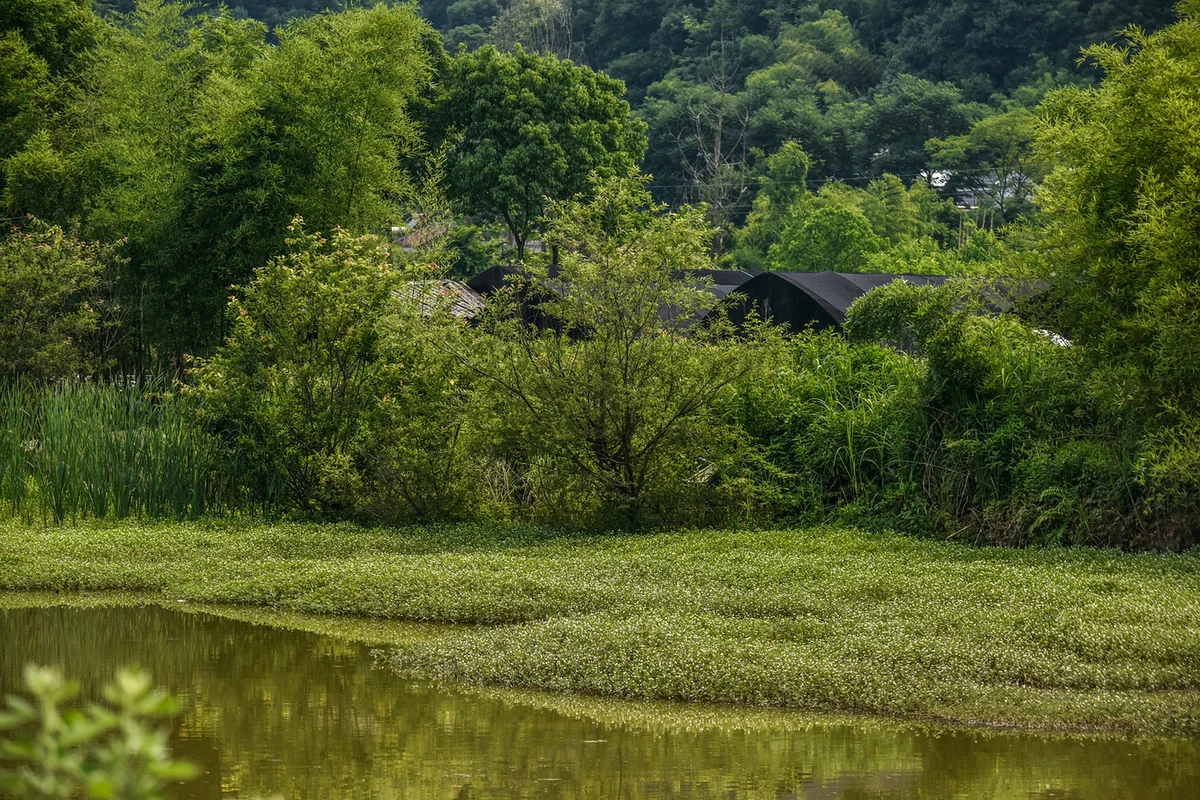
This place, like a paradise, could easily be mistaken for a scenic area, but in fact, it is just a corner of a small rural village. The beautiful landscape of green mountains and clear waters left me stunned at first sight. I never thought rural scenery could be so beautiful. I saw this rural landscape a few days ago, and I still can't forget it, constantly asking myself: when did China's countryside become so picturesque?
If I used image editing software to remove the small rural houses and clutter in the photo, it would definitely be considered a hidden paradise. To preserve the real scene, I made no changes. But no matter what, you can't imagine this is in a rural area! Do you know which countryside this is?
From this angle, the vegetable garden full of rural atmosphere is clearly visible, which fully proves that this is indeed in the countryside, not in some wetland scenic area. So where exactly is this countryside? First of all, it is not the economically developed Jiangsu-Zhejiang-Shanghai region, nor is it the picturesque Yunnan-Guizhou-Sichuan region.
This rural area, like a paradise, is located in Ningguo City, in the south of Anhui Province, and belongs to Wu Village of Heli Subdistrict, Ningguo City. Wu Village is a rural area relatively close to the main urban area of Ningguo City. In a true sense, it is a village on the urban-rural fringe. I had heard long ago that the construction of a new countryside in Ningguo was at the forefront of the country, and I also knew that Ningguo has beautiful mountains and clear waters, so the rural environment must be good, but I never imagined the scenery could exceed our expectations.
Wu Village, Heli Subdistrict, Ningguo City, is located in the lower reaches of the Zhongjin River and a tributary of the Dongjin River. There are many rivers within the village, with various small wetland environments and diverse vegetation, creating a unique southern Anhui wetland landscape in the lower reaches of the Yangtze River. In addition, there is no large-scale industrial pollution here, and the forest coverage rate is high, so the environment is very good. This provides an important prerequisite for Wu Village to have a paradise-like environment.
As a village on the urban-rural fringe, Wu Village should have a combination of urban street scenery and rural landscape of mountains and waters. So why is it still so pristine? Ningguo, with its developed economy and complete industries, has sufficient financial resources to build these villages on the urban-rural fringe. Why has Wu Village remained in a primitive state? The main reason is that Wu Village is split by an old railway nearly a hundred years old, making urban construction difficult.
The Anhui-Jiangxi Railway, which starts from Anhui and heads toward Jiangxi, existed before the founding of the People's Republic of China. At that time, it served as a major freight corridor from Beijing to Nanjing to Anhui to Jiangxi, with some passenger transport functions, and was one of the busiest freight corridors in East China. Due to historical and natural reasons, the relocation of this old railway has been搁浅 (delayed), not only becoming a stumbling block for the development of Wu Village but also one of the biggest obstacles to the urban development of Ningguo City.
With the development of the regional economy, the pattern of strategic cooperation in the Yangtze River Delta has basically taken shape, and breakthroughs have finally been made in the long-standing problem of the old railway. After years of being considered a non-economic route by the railway department, it has transformed into a national railway trunk line. The relocation project of the Anhui-Jiangxi Railway and the approval of the Anhui-Jiangxi Railway Passenger Dedicated Line project have finally been settled, becoming the biggest historical event in Ningguo City since the founding of the People's Republic of China, and it will surely be written into the annals of Ningguo. The old railway line passing through the urban area of Ningguo and the urban-rural fringe will be abandoned, and some villages, including Wu Village, will develop integrally with the urban area.
In theory, Wu Village belongs to a rural area, but the urban framework of Ningguo City has expanded, so it is only a few kilometers away from the city center. After the relocation of the nearly century-old Anhui-Jiangxi Railway, the municipal road heading east from Ningguo City will be extended here. The railway and rural road intersection seen here is less than 1 kilometer from the railway crossing between Ningguo urban area and Wu Village.
From the Wu Village railway crossing to Nanshan East Road in the urban area of Ningguo City, it is only 980 meters. Wu Village is a pristine rural landscape like a paradise, while here it is a view of city streets. The gap between the countryside and the city is only 980 meters, and all because of a nearly century-old Anhui-Jiangxi Railway!
Outside this Wu Village railway crossing, less than 1 kilometer away, lies the entrance to the paradise-like environment of Wu Village. With the relocation of the old railway, this place will surely become more beautiful and livable. And with integrated urban development, its future prospects are certainly immeasurable. After all, it is very convenient to reach the economically developed Zhejiang, Shanghai, and southern Jiangsu regions from here, and vehicles from Wu Village can directly access the expressway to reach major cities in Jiangsu, Zhejiang, and Shanghai. After the future planned Ningxuan-Hangzhou intercity railway and the He-Ning-Hang-Wen intercity railway build a high-speed rail station 3 kilometers east of Wu Village, Wu Village will become the eastern gateway for the southeast development of Ningguo.
Construction in Wu Village is also very rapid, with some Ningguo municipal projects in the distance proceeding vigorously. Finally, we hope that in the future, while Wu Village pursues integrated urban-rural development, it will not only develop the social economy but also continue to maintain its beautiful environment of green mountains and clear waters. When we come to Wu Village again in a few years, we hope to still see such a paradise-like environment.


