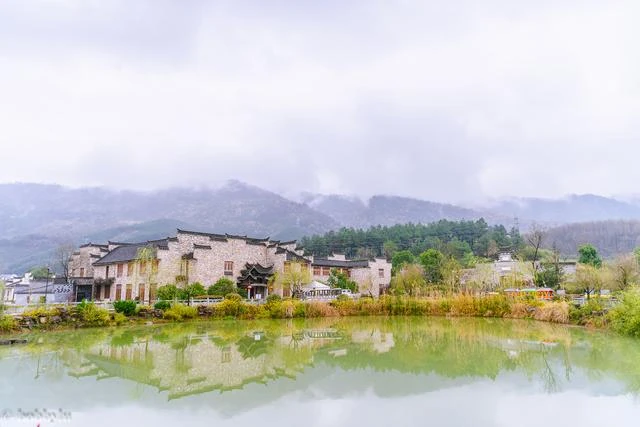
A memory of Ai Ci Baba, letting you reminisce about the landscape painting of Huizhou, the magnificent Jing County
I personally feel that sightseeing is like savoring food. No matter how delicious something is, eating it every day will make you tired of it. Just like northerners love pasta, but who can stand having zhajiang noodles every day! So occasionally switching up the “flavor” is like suddenly visiting the scenery that others see and “eat” every day—a sense of novelty and curiosity bursts forth! Besides delight, there is the unexpected harvest that was already anticipated...
Such unexpected harvests and novelty are commonplace in Huizhou. I say this not only because this land is a unique representative of Jiangnan scenery. If the garden landscapes of Suzhou and Hangzhou represent condensed, exquisite bonsai, then Huizhou is the grand, freehand landscape painting of Jiangnan. And such a painting is often visible the moment you push open a door while staying here.
Jing County is not as famous as Yi County, after all, Yi County is one of the birthplaces of “Huizhou merchants” and “Huizhou culture,” with many surviving Ming and Qing ancient folk houses, ancestral halls, and memorial archways. It even boasts ancient villages like Xidi and Hongcun, which are World Cultural Heritage sites. But purely in terms of landscape scenery and artistic conception, Jing County is no different from these well-known ancient towns in Huizhou. If I must define a difference, I can only say that there are relatively fewer tourists here, but the scenery is truly not inferior...
As mentioned earlier, in Jing County, whether at dawn or dusk, or even in the awkward hours of late morning or early afternoon, the scenery is visible as soon as you open the window or step outside. Just like a rare delicacy placed before you, if you want to add some charm to such beautiful scenery, just wait here for a rainy interlude or listen to a song you love to match the view. These elements act like embellishments that allow you to “chew” with more interest and “reminisce” with deeper meaning...
Coincidentally, in Huizhou and especially in Jing County, there is never a shortage of drizzle. Especially in early spring, the abundant rainfall and warm, humid climate here are beyond your imagination! Combined with over 40 cultural attractions in Jing County and its reputation as “a beauty amidst clouds and misty mountains,” strolling through any part of Jing County, you can equally feel the long history and brilliant culture of the “old county of the Han dynasty,” as well as its profound cultural heritage.
Take the Taohuatan Ancient Town in Jing County, or the Zhaji Ancient Village; of course, there is also the world-famous Xuan paper and Xuan brush from Jing County, and Li Bai’s timeless verse: “The Peach Blossom Pond is a thousand feet deep, but not as deep as Wang Lun’s love for me when he sees me off” from “To Wang Lun.” Of course, when traveling, you see scenery and cultivate your temperament; you can occasionally reflect on the past, but you cannot always lament the present. And when you walk into some ancient town in Jing County, along any old street or alley, a feeling of longing or nostalgia wells up spontaneously.
In Taohuatan Ancient Town, especially in the old village lanes, the sight before you makes this emotion run through the entire journey. The wet, bluestone-paved roads become even smoother under the rain’s infiltration. Moss grows along the junction of wall foundations and the ground, extending all the way to the end of the old street. You often see domestic cats or dogs lazily and aimlessly lying or leaning by the gate of a courtyard...
And the house gates or courtyard doors are mostly wide open, yet you cannot see the owners. Occasionally stepping into a courtyard and looking at the furnishings inside from a distance or up close, you can’t help but recall moments or chapters from childhood. It’s very much like visiting your grandparents’ home only once in a long while. Although the materials of the furniture and utensils differ from those in the north, the luster and wear marks from frequent use all reveal traces of time...
The alleys, whether wide or narrow, give a similar sense of cramped space. Tall gable walls form the outline of long, narrow lanes in a continuous, tight manner. The difference is that wide alleys allow three or four people to walk side by side, while narrow ones only allow two people to pass each other sideways. But what remains the same is that the road surfaces are paved with cobblestones and bluestones that are worn smooth and shiny, full of the marks of time.
The width of the alleys does not limit the size or refinement of the courtyards. Typical Huizhou architecture, mainly made of brick, wood, and stone, is not uncommon in this ancient town. The subtle stone carvings, stone engravings, wood carvings, brick carvings, and other intricate decorations in the buildings all reflect the superb skill and level of Huizhou decorative arts.
From large, luxurious and exquisite garden mansions to small, elegant ordinary homes, they all reveal the care, standards, and etiquette of Huizhou architecture, and embody the spiritual essence of Huizhou’s landscape. Perhaps from the door of a household you cannot appreciate the temperament of the courtyard mentioned above. But the unique human environment here inevitably creates these seemingly ordinary but inwardly extraordinary small households...
Occasionally, elderly people met in the narrow lanes either stroll slowly or stand and gaze. In casual conversation, their slow speech, courteous attitude, and occasional gestures show that no matter what you say, and regardless of whether they fully understand, they are happy to chat with you. And when you raise your camera, they slowly turn away a bit shyly but do not refuse...
When you show them the photo you took, they will look at it and point to a nearby spot, telling you, “There’s some baba up ahead that you can eat, it’s very tasty...” So I followed the direction they pointed and indeed found a small food stall. An old lady had a simple small stove in front of her, with a griddle on top, sizzling as it fried several greenish thin pancake-like foods. “Ai Ci Baba” is its name, a food that almost every household here makes, and it counts as a local specialty.
At that time, in Taohuatan Ancient Town in Jing County, there were not many street vendors selling snacks. So I spent ten yuan to buy three Ai Ci Baba from the griddle and sat by the riverbank. While savoring the Ai Ci Baba, which had no particularly special taste, I gazed at the scenery before me...
The Qingyi River flowed slowly before my eyes, enduring for a thousand years without fading. As recorded in the Ming Jiajing edition of the “Jing County Gazetteer”: “Jing County was established during the Qin dynasty. The mountains and rivers are beautiful, the land is fertile, and there are many scenic spots—a fine place by the river.”...


