The Soon-to-Be-Abandoned Old Railway: From Freight Corridor to Green Wonderland, Documenting This Ecologically Livable City
Railways are an indispensable means of transportation for social development and economic trade needs. The railway coverage rate in Chinese cities exceeds 60%. With the rapid economic development, many single-track railways have undergone or are about to undergo electrification and capacity expansion. The Wannan–Jiangxi Railway, a major rail corridor connecting Shandong, Jiangsu, Anhui, Jiangxi, Fujian, Hunan, Yunnan, and Guangdong, has drawn national attention due to the contradiction between economic growth and transportation capacity. Plans include converting this line into a freight corridor and constructing a new double-track passenger line. Did you know that on the soon-to-be-abandoned section of the Wannan–Jiangxi Railway passing through Ningguo City's urban area, there is a scene reminiscent of a green wonderland?
Ningguo, a small city in the mountainous region of southern Anhui Province, is one of the key station cities along the Wannan–Jiangxi Railway. The line runs about 580 kilometers from Wuhu, Anhui, to Guixi, Jiangxi. Although Ningguo Station is a small stop on the Wannan–Jiangxi Railway, its economic strength is second only to Wuhu City. Of course, the economic statistics here are calculated at the city level, excluding data from county-level cities.
Originally one of the busiest freight corridors in East China, the line passes through many mountainous areas severely affected by natural disasters. Nevertheless, its freight volume is substantial, ranking just behind the Shanghai–Nanjing and Zhejiang–Jiangxi lines within the Shanghai Railway Bureau, on par with the Xuanzhou–Hangzhou line. It truly deserves its reputation as a major freight corridor.
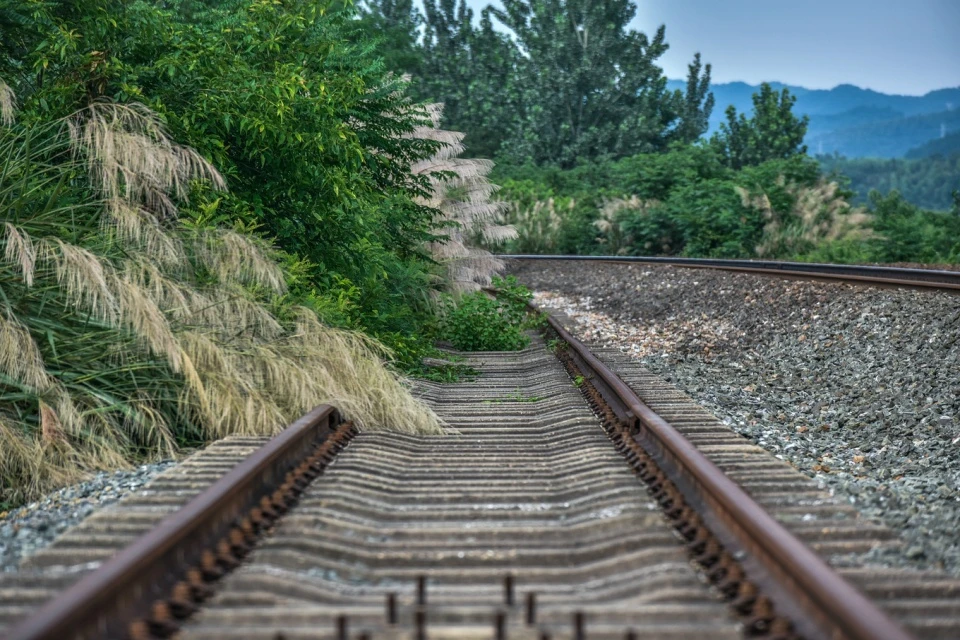
Due to outdated railway facilities, this route is about to be upgraded by China Railway Corporation. As a result, many original freight trains have been rerouted, leaving only a few freight trains and a handful of passenger trains. Over time, the signs of age on the Wannan–Jiangxi Railway have become evident, with rusty tracks bearing traces of train passage.
This is a corner of Ningguo's urban area where the old Wannan–Jiangxi Railway passes through. The image clearly shows the excellent ecological environment here. Although the economic strength is decent, railway transport is outdated, and the old railway cuts through the city, hindering urban development, the environment along the railway line is remarkably good. From the pedestrian walkway beside the railway, one can see residential buildings in the city center in the distance, creating a beautiful urban landscape.
The Wannan–Jiangxi Railway passenger dedicated line—the Xuancheng–Jixi high-speed railway—and the realignment project of the Ningguo urban section of the Wannan–Jiangxi Railway, both scheduled to start construction this year, will soon doom this nearly century-old railway to abandonment. Green grass has grown over the tracks, offering a scene of such pure tranquility. Industrial railway infrastructure combined with pristine natural landscapes is more commonly seen in Europe, but seeing it in China feels refreshing, especially in Ningguo's urban area—a modern industrial and commercial city with a GDP of nearly 40 billion yuan and an industrial output value of nearly 60 billion yuan.
All along the old Wannan–Jiangxi Railway passing through Ningguo's urban area, the environment remains untouched, with bamboo groves swaying in the breeze, creating a scene that captivates the soul. It is unexpected that a transportation corridor like a railway can also give rise to such a green wonderland. Isn't that somewhat incredible? Is it Ningguo's exceptional ecological environment, or is this old railway itself an ecological transport corridor?
On both sides of the Ningguo urban section of the Wannan–Jiangxi Railway, people live in various settings—city centers, urban–rural fringe areas, urban villages, and rural areas—yet the environment along the entire line is excellent. If not for the railway, one might mistake this place for a hidden paradise. It seems that this soon-to-be-abandoned old railway also serves to document this ecologically livable city.
Green is everywhere, and the feeling is truly pleasant. Taking a stroll along this old railway not only allows you to enjoy the beautiful scenery but also experience the enchanting atmosphere of a green wonderland. So, isn't it quite delightful to walk along this old urban railway? Don't you think so?
This century-old railway distinguishes itself from a hidden paradise—the technical parameters beside the tracks break the tranquility of this secluded spot. From an economic perspective, this is a railway about to be abandoned, but from an ecological standpoint, there might be another kind of beauty here. In other words, operating this old railway as a railway ecological cultural experience zone could turn waste into treasure—perhaps that is the fate of this century-old Wannan–Jiangxi Railway?
The old Wannan–Jiangxi Railway's Ningguo urban section is approximately 20 kilometers long. The urban section realignment project runs from Luotian Village in Wangxi Subdistrict to Zhufeng Village in Zhufeng Subdistrict. Along this section, there are beautiful villages or modern, high-standard urban residential buildings and commercial towers. This old railway has become an indispensable part of Ningguo's urban area. The relationship between the railway and the city is as inseparable as teeth and lips.
We believe that in the next 3 to 5 years, once the new railway in Ningguo's urban area is completed, both freight and passenger transport will meet the city's economic development needs. This old railway, which is due for retirement, will forever record the city's development and serve as a witness to the beautiful environment of this livable city.
Below the railway lies Ningguo's main urban avenue, a city road connecting the city center to Jiangsu, Zhejiang, and Shanghai. Together with the old Wannan–Jiangxi Railway bridge, it forms an indispensable part of Ningguo's urban scenery. I wonder if you, like me, Shanjun, enjoy this kind of urban landscape that blends industry and nature? Do you also like the green wonderland formed beneath this soon-to-be-abandoned century-old railway?


