The Wan-Gan Railway, which has been suspended for months, resumed operations from National Day, facilitating travel for residents along the line.
The Wan-Gan Railway is a crucial railway line linking key towns in southern Anhui. However, due to objective factors like age and inadequate infrastructure, it often faces suspension during flood seasons. Compared to previous suspension periods, the 2020 closure of the Wan-Gan Railway was the longest, lasting from April until September, with services gradually resuming on September 28. But there is good news: starting from October 1, 2020, passenger services on the Wan-Gan Railway will fully resume. Now, let's follow Shan Ye Jun to visit Ningguo Station, which was most affected along the Wan-Gan Railway!
The Wan-Gan Railway starts from Wuhu in Anhui, passing through Xuancheng, Ningguo, Jixi County, She County, Huangshan, and Qimen, then enters Jingdezhen and Guixi, finally reaching Yingtan. With the suspension of passenger services on this railway, residents of cities along the line have had their travel impacted. Why was Ningguo Station the most affected? Because to the north, Xuancheng has the Hefei-Hangzhou High-Speed Railway and the Xuancheng-Hangzhou High-Speed Railway; to the south, Jixi County connects to the outside world via the Hefei-Fuzhou High-Speed Railway and the Hangzhou-Huangshan High-Speed Railway; but Ningguo only has this century-old railway line. Therefore, whenever the Wan-Gan Railway passenger services are suspended, Ningguo Station suffers the most.
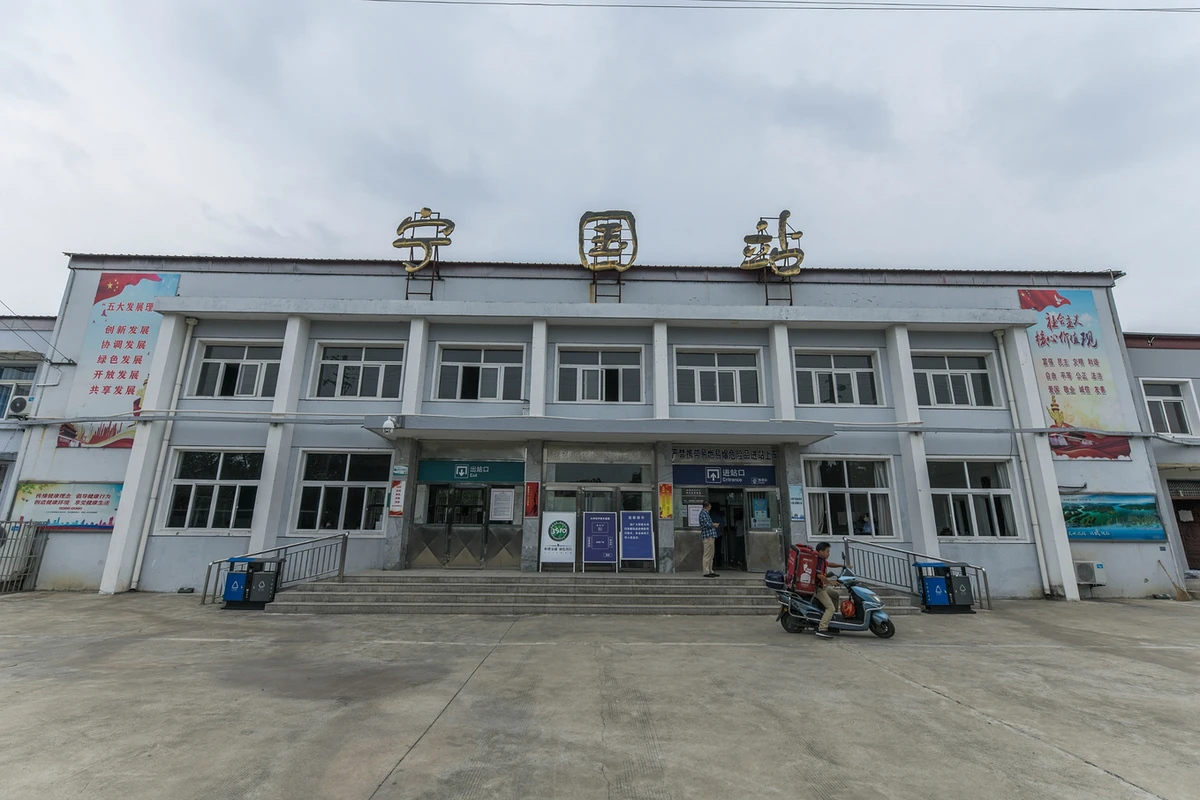
As the station with the second-strongest economic strength along the Wan-Gan Railway after Wuhu, and with considerable passenger traffic, the resumption of passenger services is very encouraging news for Ningguo Station! Do you also, like Shan Ye Jun, instinctively think that Ningguo is an underdeveloped national-level poverty-stricken county when you see its current state? Actually, that's not the case. Ningguo's total GDP is higher than that of Xuanzhou, the seat of Xuancheng city to the north, and Jixi County to the south, making it the county-level city with the highest GDP in the entire southern Anhui region. But why is this station so dilapidated? There are multiple reasons, which I won't elaborate on here.
The suspension of passenger services on the Wan-Gan Railway in April was due to the impact of the pandemic, lasting until May. Starting in June, the flood season in the Jiangnan area began, and all trains on the Wan-Gan Railway were suspended, leaving Ningguo Station nearly a ruin. Residents of Ningguo had to rely on buses, ride-sharing, or driving themselves. On the first day of resumed passenger services on the Wan-Gan Railway, Ningguo Station welcomed many passengers.
Ningguo Station is under the jurisdiction of the Shanghai Railway Bureau. Due to its extremely basic facilities, only three trains stop at Ningguo Station each day. Although this is far from meeting the needs of Ningguo's economic development, objective limitations prevent change. In other words, having three trains stopping here is better than none at all. Before resuming passenger services, the Shanghai Railway Bureau renovated some facilities at Ningguo Station and Jixi County Station (both regular-speed stations), enabling ID card entry and exit, which greatly facilitated passengers' movement in and out of the stations. Let's give the railway department a thumbs-up.
To experience the passenger trains on the Wan-Gan Railway that had been suspended for several months, Shan Ye Jun and a friend bought tickets from Ningguo Station to Jixi County Station for the K8381 train from Hefei to Huangshan, scheduled at 11:19 AM. This train broke the months-long silence at Ningguo Station, which immediately became bustling with activity upon its arrival. I grabbed my camera to capture this moment!
The platform layout at Ningguo Station on the Wan-Gan Railway is designed with 2 platforms and 4 tracks: 3 arrival/departure tracks and 1 main line, plus 1 basic platform and 1 island platform. Due to the design at that time, Ningguo Station had no passenger footbridge or underpass for entry and exit. Because of safety concerns, many trains cannot stop here, and the platforms are too short, preventing long-formation trains from stopping at Ningguo Station. For example, for this K8381 train from Hefei to Huangshan, passengers have to walk several minutes from the platform to a distant location to board.
From this position, it's clear that the boarding and alighting points are hundreds of meters apart on the platform at Ningguo Station. Given such extremely outdated facilities, it's not hard to understand why many trains cannot stop at Ningguo Station. When Shan Ye Jun saw this particularly old train station, it felt like an underdeveloped northwestern town—difficult to believe this is a county-level city with a population of 390,000, a GDP of nearly 40 billion yuan, fiscal revenue close to 5 billion yuan, and 8 listed companies. After seeing this station, would you believe that Ningguo City has achieved such development success?
With the Wan-Gan Railway passenger services just resumed after such a long suspension, Ningguo Station already saw many passengers boarding and alighting. Although passenger traffic is decent, considering safety issues, the railway company has tried its best to accommodate Ningguo. Whenever the train schedule is adjusted, the railway company makes every effort to include Ningguo Station in the timetable, even though its facilities often make it difficult to include. I recall the railway department saying that railways serve the people and cannot solely consider economic factors. Under such circumstances, Ningguo Station still has a few trains stopping. Therefore, whether locals of Ningguo or travelers passing through should be grateful to the railway department for making every effort to arrange trains to stop at Ningguo Station, despite its unsuitable conditions, to facilitate people's travel.
The K8381 train from Hefei to Huangshan that Shan Ye Jun and his friend took shares its train set with the K1109 (Beijing West to Huangshan), K1110 (Huangshan to Beijing West), and K8382 (Huangshan to Hefei) trains. The K8381 and K8382 both stop at Ningguo Station in both directions, facilitating travel between Ningguo and Xuancheng, Wuhu, Chaohu, Hefei, Jixi County, She County, and Huangshan. However, the K1109 and K1110 skip Ningguo Station in both directions, meaning there is no direct train from Ningguo to Beijing. Moreover, along the Wan-Gan Railway, except for Ningguo Station, all other cities have direct high-speed or regular trains to Beijing. For example, Xuancheng and Wuhu to the north have high-speed trains to Beijing, while Jixi County, She County, and Huangshan to the south also have high-speed trains to Beijing. It seems that this regular train from Beijing to Huangshan is specifically meant to serve Ningguo Station, yet it deliberately skips it—a great pity. We hope that in 3–4 years, the planned high-speed railway station in Ningguo will have direct high-speed trains to Beijing and beyond.
After more than two hours, we finally arrived at Jixi County Station, 87 kilometers from Ningguo Station. Although the train was slow, the scenery along the way was beautiful, making the time pass more quickly. With the opening of the Xuancheng-Ningguo-Jixi County high-speed railway in the next three years, Ningguo will enter the high-speed rail era, making travel more convenient for its residents. However, these regular trains have served southern Anhui for decades, silently recording the development and changes of these cities. In the future, passenger services on the old Wan-Gan Railway line may become increasingly scarce. For example, from October 9th, the K155 train from Nanjing to Kunming and the K156 train from Kunming to Nanjing will end their decades-long passenger service. The regular trains we are riding on the Wan-Gan Railway may become an indelible memory in the high-speed rail era of a few years from now. What do you think?


