Tracing Ancient Mysteries at the Source of the Qiantang River
At the end of November 2019, while chatting over tea, my classmate Zhiqiang mentioned that he planned to use up his annual leave for 2019 in December. So, we decided to take a trip together around Fujian's periphery. Huan'an, a photography and travel enthusiast, proposed a route: a self-driving tour along the source of the Qiantang River. Everyone agreed, and thus the plan to trace ancient mysteries at the source of the Qiantang River was set.
Day 1, December 18: Xiu Ning Wan'an Compass Culture Museum.
At 09:30, the four of us—myself, Zhiqiang, Huan'an and his wife—set off from Fuzhou by car. We arrived at Wan'an Old Street in Wan'an Town, Xiuning County, Anhui Province at 16:10 and visited the Wan'an Compass Culture Museum. The Wan'an compass is a Chinese national intangible cultural heritage and a national geographical indication product. It is widely used in astronomy, geography, military, navigation, divination, and as an important instrument for selecting house and tomb sites. It is a traditional folk craft developed from the compass. The production of Wan'an compasses began in the late Yuan Dynasty, developed during the Ming Dynasty, and flourished in the mid-Qing Dynasty, historically known as "Hui Luo" or "Hui Pan." The Wan'an compass is the only compass in China made using traditional handcraftsmanship and is regarded as the authentic compass tradition. It later declined due to the war between the Taiping Army and the Qing army in southern Anhui, revived in the early Republic of China, and continued until 1960. After a period of suspension, production resumed in 1982. The craft of making Wan'an compasses has a history of over 600 years. Zhiqiang and Huan'an each bought a tiger bone wood compass on the spot. At 17:29, we checked into Yunjian Hotel in Xiuning County, at 178 yuan per night per room; dinner at Yu Ji Restaurant cost 189 yuan.
Day 2, December 19: Visit Xiuning Zhuangyuan Museum, Pingshan Village in Yi County, and Xidi Village.
This is currently the only museum in China that combines the display of Zhuangyuan (top scholar) culture with traditional Chinese culture and local folk customs. Xiuning, known for respecting teachers and promoting education, produced 19 civil and military Zhuangyuan from the 10th year of the Jiading era of the Song Dynasty (1217) to the 6th year of the Guangxu era of the Qing Dynasty (1880), ranking first among all counties in the country.
At 10:00, after visiting the Xiuning Zhuangyuan Museum, we headed to Pingshan Village in Yi County. When we arrived at Pingshan Village, a light drizzle was falling from the sky. The mountains not far from the village were shrouded in mist, hazy and indistinct, perfectly reflecting the remote feel of the old dwellings. Because it was winter and drizzling with damp cold, the number of visitors to the ancient village could be counted on one hand, as if it were our private venue. Admission was 50 yuan per person.
After finishing Pingshan Village, we immediately moved on to Xidi Village. At Xidi Village, we encountered a few more tourists, so it felt a bit livelier. The overall Huizhou-style architecture appeared quite orderly. The main gates seemed like side doors, unlike the grand gates of Shanxi residences; Huizhou merchants appeared restrained and low-key. The interior decorations were exquisite and full of charm. Admission was 100 yuan per person.
We had planned to visit Hongcun Village, but considering its heavy commercialization and lack of the rustic simplicity of ancient dwellings, we gave up on this popular internet-famous spot and drove to Longchuan Village in Jixi to see the Shangshu Mansion (Mansion of Minister of War Hu Zongxian of the Ming Dynasty). At 20:30, we stayed at Wangfulou Inn in Longchuan Village. From chatting with the innkeeper, we learned that due to a disagreement between the mansion's operator and the government over ticket prices, the Shangshu Mansion was temporarily closed to the public. Upon hearing this news, Huan'an in particular felt disappointed.
Day 3, December 20: She County's Xin'an River Landscape Gallery
At 08:30, we headed to Shendu in She County for the Xin'an River Landscape Gallery. On the way, we stopped to visit the Jixi Hu Xueyan Museum and the Jixi County Museum. The Hu Xueyan Museum charged 18 yuan per person for admission, but there was little inside—not worth seeing at all, essentially a spot set up to collect money. The Jixi County Museum was free, and we took a serious look around to learn about Jixi's local customs. Then around 12:00, we arrived at Shendu Town Wharf and bought tickets for the 13:10 boat tour of the Xin'an River Landscape Gallery at 148 yuan per person. We had lunch near the wharf. Being the off-season, we seemed to enjoy exclusive boat treatment—the speedboat had only the four of us plus two other tourists. At 13:10, we departed on time. The boat cruised along the river, with green hills, clear waters, white walls, and black tiles presenting one exquisite landscape painting after another, a feast for the eyes. After the boat tour, we headed toward Longyou in Zhejiang. At 19:10, we checked into Longyou Qingshui Bay Hotel at 199 yuan per room.
Day 4, December 21: Longyou Grottoes and Longyou Jiming Mountain Folk Dwelling Garden.
After breakfast, at 09:10, we arrived at the Longyou Grottoes, admission 85 yuan per person. According to introductions, the Longyou Grottoes can be traced back to 212 BC or even earlier, and their construction date remains unknown. They are the largest ancient underground man-made structures discovered in the world to date. Located in Shiyanbei Village, Xiaonanhai Town, Longyou County, Zhejiang Province, from the hill in the village you can see the Qujiang River winding around in the distance, with a broad view. By the river at the edge of the village sits a bamboo grove temple, with Buddhist chants filling the air, giving a transcendent and ethereal feeling, exuding a mysterious aura. On June 9, 1992, villager Wu A'nai, along with three other villagers, used four water pumps to drain the legendary "bottomless pond" continuously for 17 days and nights, finally discovering the vast mysterious underground grottoes. Exploration revealed that this small hill, only a few li in circumference, contained 24 man-made caverns of varying sizes and exquisite layout, of which only 5 have been developed for visitors. Not only is the construction date unknown, but the cause and purpose of these grottoes are also widely debated, making them an unsolved eternal mystery, known as the "Ninth Wonder of the World." The many riddles within the grottoes lead visitors to say, "Entering the grotto, all are explorers; leaving the grotto, all become guessers."
After visiting the Longyou Grottoes, we moved on to the Longyou Jiming Mountain Folk Dwelling Garden to see ancient residences. To balance tourism development with the protection of ancient dwellings, Longyou County relocated scattered ancient residences from various locations (especially those about to be demolished) to this site, preserving their original proportions and components. The Jiming Mountain Folk Dwelling Garden is composed of such relocated ancient houses. I found this to be a feasible and commendable approach to protecting ancient dwellings.
Zhiqiang's wife, Chen Ying, took a high-speed train from Fuzhou to join our group, arriving at Jinhua Railway Station around 17:30. To pick her up, we chose a restaurant where we could rest for lunch, so we went to Longyou Lin Yu Cafe. After lunch, we stayed there until 14:20 before heading to Jinhua. After picking up Chen Ying at 18:00, we drove toward Lanxi City and checked into Lanxi International Hotel at 150 yuan per room per night at 19:00.
Day 5, December 22: Zhuge Bagua Village in Lanxi City and Huanghui Temple in Baikeng Village.
At 09:55, we arrived at Zhuge Bagua Village. It is the largest known settlement of descendants of Zhuge Liang. The village's architectural layout is arranged in the pattern of the "Eight Trigrams Battle Array," preserving many ancient Ming and Qing dwellings, making it a rare and unique ancient cultural village. The terrain around Zhuge Bagua Village is like the bottom of a pot, low and flat in the middle, gradually rising on all sides. Water from all directions converges at the bottom, forming a pond called Zhongchi. Zhongchi is the core of Zhuge Bagua Village and the base point for arranging the "Eight Trigrams Battle Array." Zhongchi is not large, but half of the pond is water and half is land, with a well on each side, resembling the Tai Chi symbol in the Nine Palaces and Eight Trigrams diagram, wonderfully ingenious. Centered on Zhongchi, eight alleys radiate outward in all directions, connecting to eight high earth mounds outside the village, forming a layout strikingly similar to the Bagua diagram, hence the village name Zhuge Bagua Village.
After visiting Zhuge Bagua Village, we drove to Huanghui Temple, located in Baikeng Village, Lingdong Township, Lanxi City. According to legend, Emperor Jianwen of the Ming Dynasty once took refuge in Huanghui Temple after the "Jingnan Rebellion." The temple was rebuilt in later periods.
After visiting Huanghui Temple, we headed to Pujiang County and checked into Pujiang Longting International Hotel at 180 yuan per room per night at 17:20.
Day 6, December 23: Zhengyi Gate in Zhengzhai Town, Pujiang County, also known as "The First Household South of the Yangtze River."
At 09:00, we arrived at Zhengyi Gate in Zhengzhai Town, Pujiang County, where Huan'an's relatives received us. We visited the ancestral hall with five courtyards. The frontage was modest, but the interior was quite grand, living up to the "title" of a renowned clan. The main gate did not directly face the main hall of the ancestral hall but entered from the side. It is said to express modesty. Above the gate hung a plaque reading "First Household South of the Yangtze River," recorded as having been personally bestowed by Emperor Zhu Yuanzhang of the Ming Dynasty in the 18th year of the Hongwu era to commend Zhengyi Gate for their "filial piety, integrity, loyalty, and righteousness." Through the Song, Yuan, and Ming dynasties, the Zheng clan lived together communally for 15 generations, over 360 years, reaching a scale where over 3,000 people shared meals. It was called "The First Household of Frugality, Filial Piety, and Righteousness," and has been famous for centuries. The 168-article family precepts, "Zheng Family Rules," are regarded as an important milestone in traditional Chinese family instructions. Their story is recorded in the History of Song, History of Yuan, and History of Ming. Over those 360 years, the Zheng clan lived harmoniously under the "Zheng Family Rules," adhering to the rule: "If a descendant becomes an official and is found corrupt, living members will be removed from the family tree, and deceased members' ancestral tablets will not be allowed in the ancestral hall." Among 173 officials produced, none were corrupt, and all were diligent and honest. The famous Ming dynasty scholar Song Lian highly praised this, and after his recommendation, the "Zheng Family Rules" spread to society and became widely known.
After visiting "The First Household South of the Yangtze River," Huan'an's relatives at Zhengyi Gate hosted a luncheon for our group of five. After several rounds of toasts and lively discussion, we dispersed at the height of the merriment, bid farewell to Zhengyi Gate, and moved on to Jinyun County in Lishui City, Zhejiang. At 18:10, we checked into Jinyun Mingmen Holiday Hotel at 180 yuan per room per night.
Day 7, December 24: Jinyun Xiandu Scenic Area.
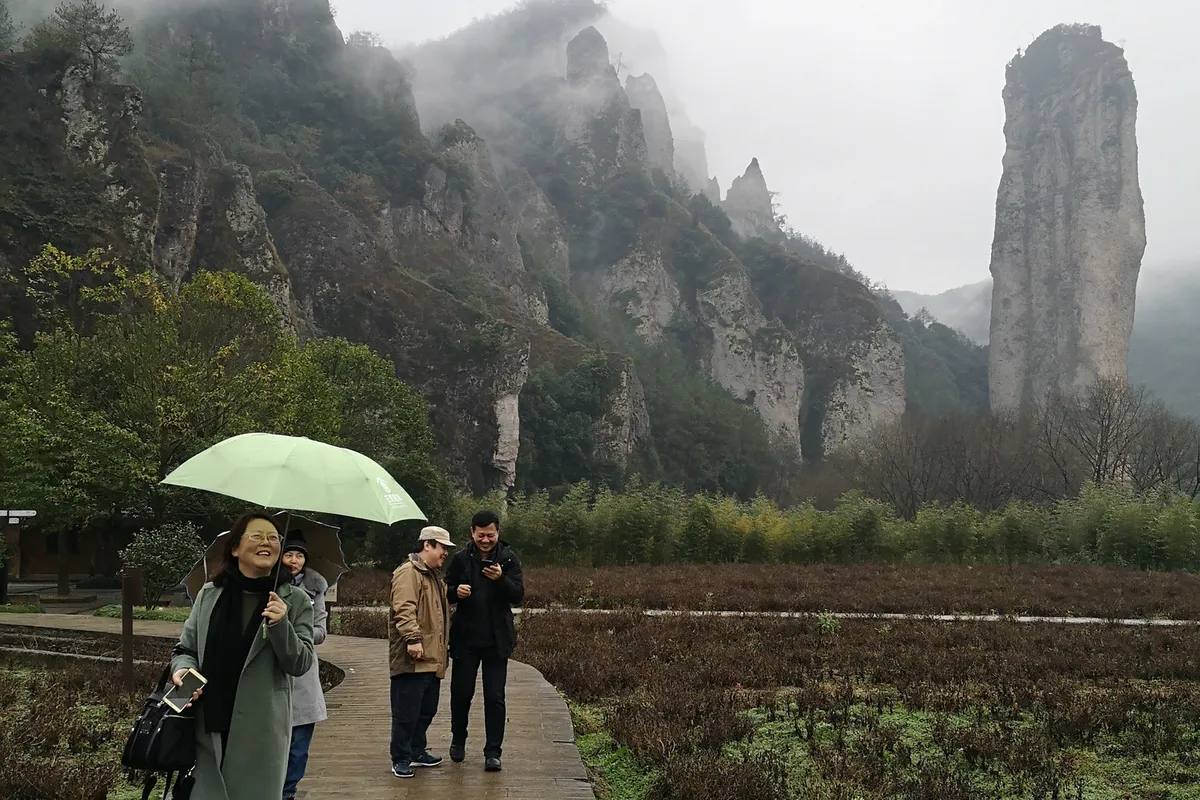
At 9:00 am, after breakfast, our group of four walked from the hotel to Dinghu Peak in the Xiandu Scenic Area. The sky was drizzling, and a layer of hazy mist lay over the winding Lian Stream. Looking into the distance, the white mist, green trees, and stream water formed a leisurely and ethereal landscape painting intoxicating us. We were so absorbed in photographing that we forgot to hold umbrellas to shield the drizzling rain, exclaiming that this trip was truly worthwhile.
After entering the Dinghu Peak scenic area, the sound of rushing water filled our ears. Before our eyes was a stone pier bridge; water cascaded between the stone piers, splashing white spray, like a silver chain inlaid on the beautiful Lian Stream. Walking across, we felt as if entering a fairyland, hazy and exquisite.
Jinyun Xiandu Scenic Area is renowned for its extraordinary peaks and rocks and picturesque landscapes. Among them, Dinghu Peak, a pillar piercing the sky, is a wonder of the world, known as the "Number One Stone Bamboo Shoot Under Heaven." Viewed from multiple angles, every perspective of Dinghu Peak presents a fine landscape painting.
Day 8, December 25: Yanshi Stone Village in Jinyun and Yangjiatang Ancient Village in Songyang.
As planned, we were to stay in Songyang on the 24th, but because the Xiandu Scenic Area in Jinyun had such a beautiful environment and fresh air, giving us a very pleasant feeling, we decided to change plans and stay one night within the Xiandu Scenic Area. We found a "Photography Theme Inn" to stay at, savoring the Xiandu Scenic Area, utterly enchanted, and agreed to come again. Chatting with the innkeeper, she recommended Yanshi Stone Village, saying it was worth a visit. After breakfast on the 25th, we drove to Yanshi Stone Village. A rustic ancient village unfolded before us.
After visiting Yanshi Stone Village, we immediately headed to the next stop: Yangjiatang Village in Songyang County. Around 4:00 pm, we arrived at Yangjiatang Village, which is about a 10-minute drive from Songyang county town. Most houses in this village are made of rammed earth, built on the hillside in layered tiers, earning it the nickname "Southern Potala Palace." After touring Yangjiatang Village, we found a hotel in Songyang county town for the night.
Day 9, December 26: Visit Longquan Celadon Museum and Celadon Town.
At 08:00, we set off from Songyang county town and arrived at the Longquan Celadon Museum about 1 hour and 50 minutes later. Longquan celadon has a long-standing reputation. To gain some understanding of celadon, it is essential to visit the celadon museum first.
Longquan is a famous historical and cultural city in Zhejiang Province, located in the southwestern part of Zhejiang, bordering Fujian Province, known for its production of celadon. Longquan celadon began in the Five Dynasties, flourished in the Southern Song Dynasty, and is characterized by elegance, dignity, simplicity, and pure green colors. Renowned for its fine porcelain body, smooth lines, dignified and simple shapes, and pure, brilliant colors, Longquan celadon is divided into "Ge Kiln" and "Di Kiln." Ge kiln wares are known for their purple mouth and iron feet, crackled glaze patterns, and iridescence; the glaze layer is full and thick, with a clear gray and elegant color, often called "golden threads and iron wires." The wares have an antique charm, solemn and elegant, considered treasures among ceramics. Di kiln is famous worldwide for its crystal clear, moist green glaze. With white body and thick glaze, soft luster, and warm like jade, where edges show slight white traces called "exposed ribs," and the foot is red called "cinnabar bottom," it is praised as the "flower of celadon." Longquan celadon originated in the Five Dynasties and flourished in the Song Dynasty, a brilliant pearl in the history of Chinese porcelain-making, known for being "jade-like in texture, mirror-like in brightness, and chime-like in sound." Longquan celadon was not only a tribute to the imperial palace but also a global commodity for China's foreign economic and cultural exchanges.
By the mid-to-late Ming Dynasty, as imperial tastes changed, Longquan celadon gradually declined. By the early 20th century, the Longquan celadon kilns were almost completely extinguished, and the once bustling kiln sites turned into wastelands, leaving only scattered shards. In 1957, following Premier Zhou Enlai's instruction "to revive celadon production," Zhejiang Province formed an antique research group of eight experts, who lit the first kiln to restore Longquan celadon in the spring of the following year. After fifty years of restoration and development, Longquan celadon entered a new period of prosperity. A distinctive and sizable Celadon Town emerged. We visited the Celadon Town in Shangyang Town, Longquan City, to see its beauty.
We strolled through Celadon Town, visiting many celadon workshops and shops. We carefully toured Master Liu's workshop, admired the exquisite celadon displayed, and learned the basic production process of celadon.
On the 26th, we returned to Fujian via Pucheng and stayed at a hotel in Songxi County that night. The next day, we returned to Fuzhou. This trip was completed safely and smoothly.
Travelogue Directory:
1. Content
2. 1. Xiuning Wan'an Compass Culture Museum
3. 2. Visit Xiuning Zhuangyuan Museum; Yixian Pingshan Village, Xidi Village
4. 3. Shexian Xin'an River Landscape Gallery
5. 4. Zhejiang Longyou Grottoes, Longyou Jiming Mountain Folk Dwelling Garden
6. 5. Lanxi Zhuge Bagua Village, Baikeng Village Huanghui Temple
7. 6. Pujiang Zhengzhai Town Zhengyi Gate, also known as "The First Household South of the Yangtze River"
8. 7. Jinyun Xiandu Scenic Area Dinghu Peak, etc.
9. 8. Jinyun Yanshi Stone Village, Songyang Yangjiatang Village
10. 9. Longquan Celadon Museum, Celadon Town
Travel Information:
Hotel Index | Tour Guide Index | Airfare Index | Website Navigation | Travel Index | Cruise Index | Corporate Travel Index | Alliance Cooperation | Distribution Alliance | Friendly Links | Enterprise Gift Card Procurement | Insurance Agency | Agency Cooperation | Hotel Franchise | Destination and Scenic Spot Cooperation | More Cooperation | About Ctrip | About Ctrip | Ctrip Hot Topics | Contact Us | Careers | User Agreement | Privacy Policy | Business License | Security Center | Ctrip Content Center | Intellectual Property | Trip.com Group | Algorithm Disclosure


