Anhui Tourism: A Tour of Jixi Longchuan Ziyuan (Photos)
There are many tourist attractions around Huangshan City, but in recent years, Longchuan in Jixi County, more than ten kilometers from Huangshan City, has attracted tourists from all over the country every day because it is the ancestral home of Comrade Hu Jintao.
Jixi Longchuan Scenic Area (Photo: Feng Ganyong)
On April 16, 2009, the reporter went to Huangshan City on a business trip and also took time to visit the Jixi Longchuan Tourist Scenic Area at the foot of Huangshan Mountain. Now it has become a provincial-level historical and cultural protection area in Anhui. Among them, the Hu Family Ancestral Hall in the scenic area was rated as a national key cultural relic protection unit by the State Council on January 13, 1988.
Entering Longchuan Village (Photo: Feng Ganyong)
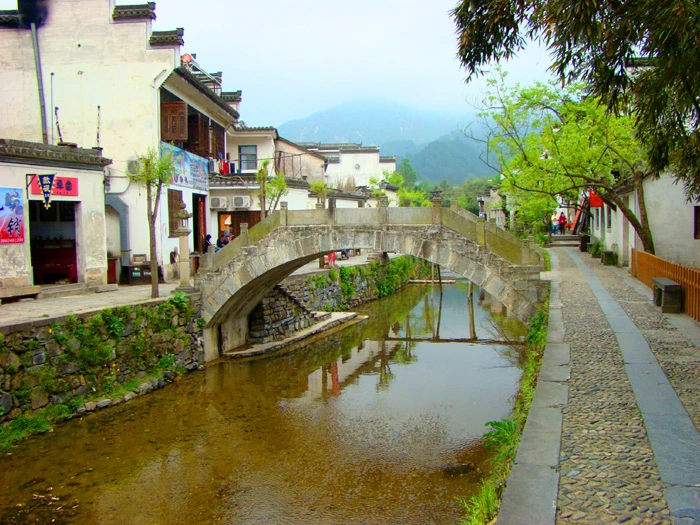
The reporter and team drove from Huangshan City and arrived at the entrance of Longchuan Scenic Area in less than an hour. Longchuan here is the name of a river and a village in southern Jixi County, Anhui. It is an ancient village where the Hu family lives together, with a history of more than 1,600 years. Entering the gate of Longchuan Scenic Area, a winding small street accompanied by a stream appears before people's eyes. Along both sides of the stream are well-arranged typical Huizhou-style residential buildings with white walls and black tiles, giving a taste of the Jiangnan water town.
Photo in Jixi (Photo: Li Xiaoping)
Standing on a small bridge made of bluestone and looking around, the mountains and rivers here are beautiful and magnificent. To the east stands Longfeng Peak, to the west faces Fengshan Mountain, to the north meanders the Dengyuan River, and to the south gallops the Tianma Mountain; the east, west, north, and south are connected by mountains and rivers, gathering the spirit of heaven and earth and the talents of humanity. At the water mouth of the village, there stands Zhaohu Mountain, reflecting in the mirror-like water. Looking down from above, the village resembles a dragon boat, heading for the river and sea, ready to set off by the water.
Scenery at the Village Entrance of Longchuan (Photo: Feng Ganyong)
According to historical records, "obtaining water as the priority" is the principle of the layout of ancient Huizhou residential buildings. Water is not only a factor in improving the ecological environment but also a touchstone for accumulating culture. The ancestors of Huizhou were ingenious in using water. Longchuan Stream flows through the village.
Long Corridor with Beauty Seats (Photo: Feng Ganyong)
Leaning on the "Beauty Seats" of the water street corridor in Longchuan Village, looking around, the horse-head walls of the Huizhou-style houses on both sides are reflected in the water, creating a delightful contrast with the reflections of village girls washing clothes. It makes people appreciate the harmony between man and nature in a small bridge, flowing water, and houses, returning to simplicity. The high eaves, mottled horse-head walls, heavy stone-paved roads, and shimmering waves form picturesque scenes at every step, and every step tells a history like a song.
Duxian Archway (Photo: Feng Ganyong)
Walking on the stone-paved street by Longchuan Stream is particularly pleasant, and soon we arrive at two stone archways. One is the "Duxian Archway" standing by the roadside, erected for Hu Zongming. Hu Zongming served as the Deputy Censor-in-Chief patrolling Liaodong, exercising supervisory duties and governing local affairs, being the highest local official, hence named after "Duxian," one of the ancient "Three Great Censors."
Yishi Shangshu Archway (Photo: Feng Ganyong)
Opposite the "Duxian Archway" is the "Yishi Shangshu Archway" nearby. It was built in the 41st year of Jiajing in the Ming Dynasty (1562 AD) for Hu Fu, Minister of Revenue, and Hu Zongxian, Minister of War. The archway has four pillars, three gates, and five eaves, with a total height of 10 meters, a width of 9 meters, and a depth of 3 meters. It is made of granite and tea garden stone. The stone archway features flying ridges, corbel brackets, flower wings, and beams, all decorated with hollow relief carvings of dragons, lions, cranes, deer, etc. The patterns are beautiful, symmetrical, exquisite in craftsmanship, and lifelike, making it a masterpiece of Huizhou stone carving.
Century-old Stone Bridge (Photo: Feng Ganyong)
Crossing the centuries-old stone bridge over the stream and continuing a short distance, we arrive at the Hu Family Ancestral Hall. On one side of the front gate, there is a monument erected by the Anhui Provincial People's Government on January 13, 1988, announced by the State Council of the People's Republic of China, marking the national key cultural relic protection unit "Longchuan Hu Family Ancestral Hall."
Viewing the Hu Family Ancestral Hall from a Distance (Photo: Feng Ganyong)
The Hu Family Ancestral Hall in Longchuan, known as the "First Ancestral Hall in Jiangnan," stands tall in the forest of ancient Chinese architecture with its strong Huizhou architectural charm. Its rich architectural cultural connotations are astonishing. The Hu Family Ancestral Hall was first built in the Song Dynasty and was renovated with donations from Hu Zongxian, Minister of War during the Jiajing period of the Ming Dynasty. It faces south with a north-south orientation, has three courtyards and seven bays, covering a total area of 1,564 square meters. It integrates Huizhou brick, wood, and stone carvings and colored paintings, especially the more than 600 wood carvings that are the most exquisite.
Cultural Relic Monument (Photo: Feng Ganyong)
The ancestral hall is a product of the patriarchal system in ancient Huizhou, where clans gathered to maintain lineage. Although it has lost its role and significance today, its wood carving art is the crystallization of the laboring people's wisdom. As a historical relic, it has unique archaeological and ornamental value. Especially its wood carvings are unique, forming their own artistic style, earning it the title of a "pearl" of wood carving art, and the meaning of "unique ancestral hall wonder" is contained within. The wood carvings of the ancestral hall are mainly distributed in four parts: the gate tower, the central hall's floor-to-ceiling windows, the beams and beam brackets, and the rear hall's windows. They are designed with themes such as dragons and phoenixes for good fortune, historical operas, landscapes, flowers and birds, and beautiful scenes. The carvings use a combination of relief, openwork, and line engraving techniques, making the patterns vivid and lifelike.
Two Door Gods Guarding the Gate (Photo: Feng Ganyong)
The carving of the high gate tower is mainly composed of patterns of historical operas and dragons and lions dancing. The gate tower is 22 meters wide with corbel brackets supporting the eaves, which soar into the air. The front and back rooms of the gate tower each have six stone pillars, five crescent beams, and square beams, with a tight structure and balanced layout. The square beams are carved with exquisite patterns of "nine lions rolling a ball covering the ground with brocade" and "nine dragons playing with a pearl filling the sky with stars"; on both sides are scenes of historical operas with various content, civil and military officials gathering together, the army receiving orders, and warriors on horseback with swords, presenting scenes of fierce battles. The ceremonial doors are painted with the two door gods Yuchi Gong and Qin Shubao guarding the gate, with stone drums on both sides and large lions facing each other.
Central Hall Courtyard (Photo: Feng Ganyong)
Crossing the large skywell of the ancient ancestral hall leads to the middle courtyard (the central hall), which is the main hall where the clan chief holds sacrificial ceremonies. It consists of 14 cylindrical pillars made of ginkgo wood with a diameter of 166 cm, with bases carved from jujube wood into lotus petal supports, supporting 54 large and small winter melon beams. The structure combines lifting beam and through-tenon styles, appearing majestic and spectacular. Each roof beam in the central hall has elliptical beam brackets at both ends, carved with colorful clouds and ribbons, and the middle is hollowed out into dragons, phoenixes, and tigers. The purlins are inlaid with flower carvings, and even the beam hooks are carved with coiled dragons, peacocks, daffodils, and evergreen plants. Looking up, they are exquisite and unique.
Lotus Theme Pattern (Photo: Feng Ganyong)
The flower carvings on both sides and the top of the central hall are particularly unique. The ten floor-to-ceiling windows on each side feature lotus flowers as the main pattern, symbolizing "emerging from muddy water unstained." The flowers have various postures—some are budding, some are just blooming; some stand gracefully, swaying in the wind; some spread flat on the water, like a painting; none are identical.
Description of Lotus Pattern (Photo: Feng Ganyong)
Even more delightful is that there are objects within the flowers and scenes within the objects. Lotus flowers sway in the pond water, with either rippling waves or splashing waves. Among the flowers, there are birds soaring in the blue sky, fish diving underwater, ducks playing in the clear waves, frogs leaping among the lotus leaves, and mandarin ducks with necks intertwined, depicting the entire lotus group vividly and interestingly. The flower carvings on the row of floor-to-ceiling windows at the top of the central hall form a "Hundred Deer Picture," set against various mountain and water scenes, bamboo, wood, flowers, and grass from all directions. The various forms of sika deer live freely here—some stroll leisurely, some dash in fright, some turn their heads with inviting smiles, some look up and cry out, some drink by the stream, some hold lingzhi in their mouths, and some are young deer suckling while mother deer lick them. Truly vivid and lifelike.
Portrait of Hu Yan, Hu Family Ancestor (Photo: Feng Ganyong)
Climbing the steps to the rear courtyard of the ancient ancestral hall, one enters another "fairyland." The rows of floor-to-ceiling windows are entirely a world of vase carvings, with hexagonal, octagonal, semi-circular, diamond, wide-mouthed, long-necked, and other shapes, finely carved and exquisitely lovely. The mouths of the vases are carved with seasonal flowers—plum, orchid, bamboo, chrysanthemum, peony, plantain lily, crabapple, etc.—truly "Nature's work can be replicated by man; man's art surpasses nature."
Photo on Longchuan Post Road (Photo: Li Xiaoping)
Exiting the central hall and entering the side room on the east side of the main ancestral hall, its structure is divided into upper and lower sections, only half the height of the main hall, with simple wood carvings and a different style. This is a subsidiary ancestral hall. Why was this subsidiary hall built? According to legend, Longchuan is shaped like a boat, and the entire village has only the Hu surname. If a boat sails on the sea without an anchor, it cannot stop or dock. Therefore, a person named Ding from another village was invited to live here and guard the ancestral hall. The Ding family is like an anchor that holds the big boat steady. Strangely, the Ding family has been single-line descent for 16 generations. What the reason is remains a "mystery." The ancient ancestral hall has more than one mystery.
Small Bridge, Flowing Water, and Houses (Photo: Feng Ganyong)
More than 400 years after the major renovation of the ancient ancestral hall, not a single spider can be found. Some say it is related to the use of high-quality wood, while others say the key lies in the ancestral hall being located in a feng shui treasure land. Although the mystery is unsolved, the absence of spider webs makes the flower carvings even more brilliant. Perhaps due to the love for Huizhou wood carving art and the fact that it is a blessed land with outstanding people, many domestic and foreign tourists and travelers, whether on business in southern Anhui or visiting Huangshan, come to this village for a tour and appreciation. The wood carving art of this ancient ancestral hall attracts tens of thousands of visitors each year, and in turn, it showcases the brilliance of the ancestral hall's "pearl."
Village Scenery (Photo: Feng Ganyong)
The architrave of the ancestral hall's gate tower is carved with scenes of Hu Zongxian's battles against Japanese pirates, with thousands of brave soldiers and thousands of galloping horses, magnificent and majestic. The partition boards on the east and west sides of the main hall use relief techniques to vividly depict Xu Wei's lotus, symbolizing "emerging from muddy water unstained." The row of "Hundred Deer Picture" partition boards in front of the shrine are lifelike in form and varied in posture, as well as the "Hundred Vase Picture" partition boards of the sleeping hall, with a hundred flowers and a hundred vases, none identical. The superb carving skills can be described as "Nature's work can be replicated by man; man's art surpasses nature." The ancestral hall also preserves plaques with handwritten inscriptions by famous artists such as Xu Wei and Wen Zhengming. Longchuan Hu Family Ancestral Hall enjoys the reputation of "Wood Carving Art Museum" and "National Art Palace."
Quiet Stream (Photo: Feng Ganyong)
According to the Hu family genealogy, the naming of the Hu family generations includes the five elements "metal, wood, water, fire, earth" in a cyclical generation sequence (metal generates water, water generates wood, wood generates fire, fire generates earth, earth generates metal). For example, the character "Jin" contains metal, and "Bing" contains fire. Xi (43rd generation) - Yi (44th) - Shu (45th) - Bing (47th)... These genealogical materials can be seen in the Hu Family Ancestral Hall.
Sketching at the Village Entrance (Photo: Feng Ganyong)
Walking a short distance from the Hu Family Ancestral Hall, we arrive at the village entrance. Longchuan is the ancient name of Kengkou Village. In front of the village is Longxu Mountain, and a small stream (called Chuan) flows through the village, anciently called Longchuan. Later generations believed that the small stream (also called Keng) flows into the Dengyuan River, where the dragon can swim freely, so they changed the name to Kengkou. This legend still circulates among the people.
Ziyuan Corridor (Photo: Feng Ganyong)
Not far from the Longchuan Scenic Area by car, there is a prominently featured building called Ziyuan by the roadside. This is another courtyard cultural landscape with rich Huizhou cultural characteristics, connected with the Longchuan Scenic Area with a single ticket. Ziyuan is located in Shangmashi Village, east of Jixi County, only 1.8 kilometers from Jixi County town.
Huanculi Bridge in Ziyuan (Photo: Feng Ganyong)
The entire garden covers an area of over 10,000 square meters. Ziyuan condenses various styles of Huizhou residential construction, gathering the essence of Huizhou residential buildings from the Ming and Qing dynasties in one garden, forming an architectural complex in the style of a classical garden. The garden is surrounded by mountains on all sides, with a pond of blue water. The mountains are shaded by pines and maples, and the houses at the foot are closely arranged.
Photo in Ziyuan (Photo: Li Xiaoping)
The entire Ziyuan consists of Wufeng Tower, Daiyun Pavilion, Huanculi Bridge, Gourd Pond, Songfeng Hall, Gaoyun Hall, and Boudoir Tower, concentrating Huizhou architectural elements such as pavilions, towers, residential houses, and ancestral halls. It is also the filming location of the movie "Huizhou Woman."
Daiyun Pavilion in Ziyuan (Photo: Feng Ganyong)
For the descendants of the Hu family, Jixi is a very glorious homeland. In the Tang Dynasty, Jixi produced General Sanqi Hu Mi; in the Song Dynasty, it produced the Imperial Censor Hu Shunzhi, who impeached Qin Hui twice and left his name in history; in the Ming Dynasty, there were ministers Hu Fu and Hu Zongxian who served as officials for generations; in the Qing Dynasty, there were famous ink maker Hu Kaiwen and prominent merchant Hu Xueyan; in modern times, there was the renowned scholar Hu Shi; in contemporary times, there is President Hu Jintao. These names have left their mark in history and brought honor to the Hu surname. According to historical records, at the end of the Qing Dynasty, there were 30 Hu family ancestral halls in Jixi County alone.
Corner of the Backyard in Ziyuan (Photo: Feng Ganyong)
In the Longchuan Scenic Area, there is also a natural landscape, Longxu Mountain, also known as Longfeng Peak, with an altitude of 1,048 meters. It has more than 20 peaks of various sizes, with abrupt peaks, grotesque rocks, towering ancient trees, lush vegetation, and silver waterfalls cascading down, forming a peculiar and charming scenery. Longxu Mountain is also rich in Longxu grass, the main raw material for the Chengxintang paper of the Tang and Song dynasties. The Longxu paper produced was favored by Li Yu, the Later Ruler of the Southern Tang, and highly appreciated by calligraphers and painters of all ages, praised as "millennium-long paper, treasure of the art world." The trip to Jixi Longchuan is truly unforgettable. (Text and photos: Feng Ganyong)


