Late Autumn in Anhui (Part 1)
Anhui Province (abbreviated as Wan) stretches along rivers to the sea, with terrain composed of plains, hills, and mountains; it flows with three major river systems: the Huai River, the Yangtze River, and the Qiantang River. It is an important part of the Yangtze River Delta. Its cultural development has a long history, consisting of four cultural circles: Huizhou culture, Huaihe culture, Wanjiang culture, and Luzhou culture. With beautiful mountains and clear waters, and a land known for its outstanding people, it has abundant tourism resources. The beauty of late autumn is all in Anhui.
Our group of 8 people in two cars traveled from November 3 to November 21, 2020, a total of 19 days, covering approximately 4,300 kilometers. The per capita cost was about 3,800 yuan (including food, accommodation, transportation, and scenic spot tickets, etc.). Mainly we visited ancient towns and villages around Huangshan, tasted local cuisine.
First stop: Departing from Beijing, we reached Bozhou, Anhui in one day (8 hours 33 minutes, 752.2 km, highway toll about 307 yuan). Stayed for 2 nights.
Key point: Bozhou Huaxilou (Flower Opera Tower): Located at the north gate of Bozhou city, on the south bank of the Guo River, originally known as the Great Guandi Temple, also called the Shanxi-Shaanxi Guild Hall. According to the 'Reconstruction of the Great Guandi Temple Stele Inscription' from the 32nd year of Qianlong (1767 AD), the Great Guandi Temple at Bozhou North Gate was built in the 13th year of Shunzhi (1656 AD). The wood carvings of the opera tower and brick carvings on the door walls, according to research, are no later than the 41st year of Qianlong (1776 AD). The existing Huaxilou original appearance should be the artistic architecture of this period, showing that drama was popular at that time, and the stage and theater construction were very exquisite. It is a national key cultural relic protection unit.
Also visited: Bozhou Old Street, Bozhou Museum, Cao Cao's Underground Military Tunnel, Nanjing Lane Bank, etc.
Bozhou is also one of China's four major distribution centers for medicinal herbs. The wholesale trade before 9 a.m. is spectacular and lively.
These are all fixed indoor stalls.
Bozhou to Sanhe Ancient Town (4 hours 2 minutes, 360.1 km, toll about 151 yuan)
Sanhe Ancient Town is located in Feixi County, Hefei City. It is named after three rivers that flow through it: Fengle River, Hangbu River, and Xiaonan River. It has a history of over 2,500 years. As early as the Spring and Autumn and Warring States periods, the town had already taken shape. Historically, the Battle of Wu and Chu took place here, and in 1858, the Taiping Army also fought fiercely here, leaving behind many historical relics such as city walls, the Tianwang Mansion courtyard, etc. Sanhe Town is also a typical water town ancient town, with scenery and atmosphere not inferior to Zhouzhuang in southern Jiangsu. It has formed the unique Jianghuai region landscape of 'ancient rivers, ancient bridges, ancient embankments, ancient streets, ancient residences, ancient tea houses, and ancient battlefields'.
Sanhe Town to Zhaji Village: crossing mountains and ridges with pastoral scenery along the way. Climbing up the mountain, there is a parking area; getting out you can see the road just ascended. Only after crossing this mountain can you reach Zhaji Village, hidden deep in the mountains.
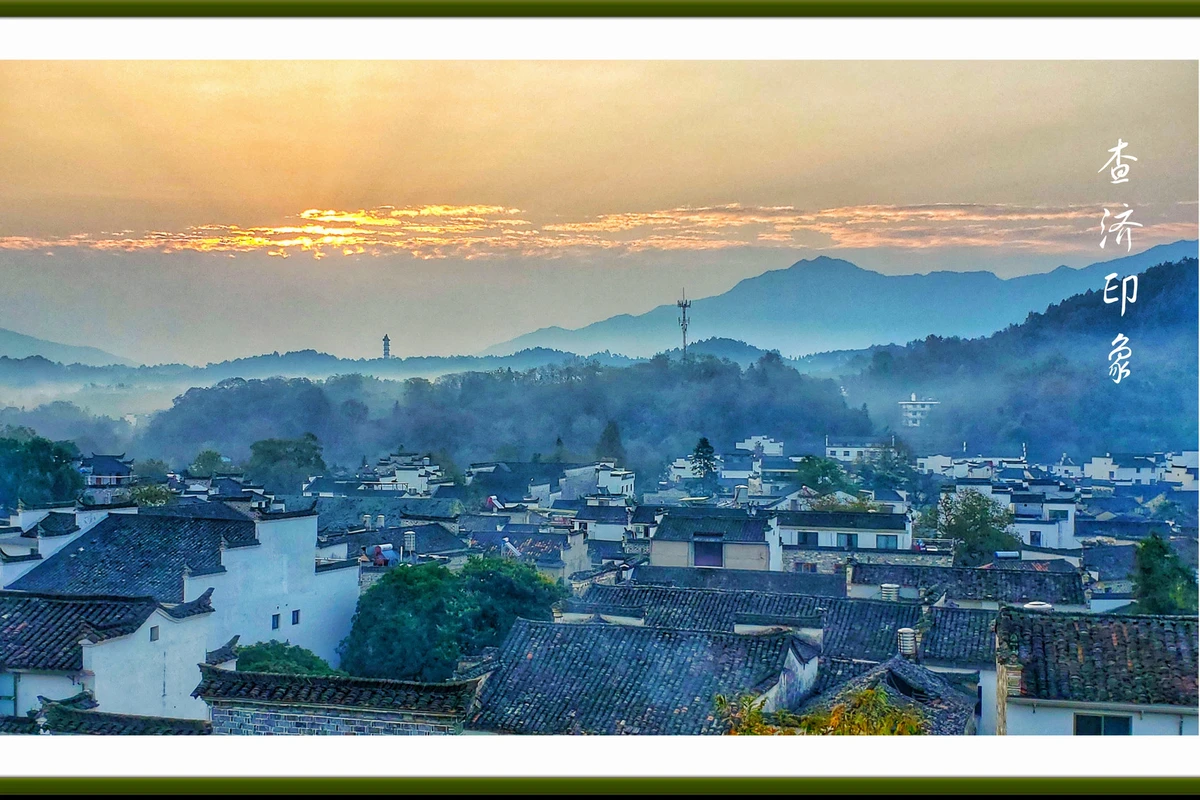
Zhaji (zhā jǐ) Village: A village under the jurisdiction of Taohuatan Town, Jing County, Xuancheng City, Anhui Province. It is a national key cultural relic protection unit and a 4A scenic spot, both a Chinese historical and cultural village and a traditional Chinese village. It is the best place for painting and sketching. So far, it is the largest existing Ming and Qing ancient village in China, with relatively well-preserved ancient building complexes. There are still more than 140 ancient buildings, including over 40 bridges, 30 ancestral halls, and 4 temples. There are more than 100 ancient residential houses from the Yuan, Ming, and Qing dynasties. The 'Degongting House' built in the Yuan Dynasty, the 'Yongqingtang' and 'Jinshi Gate' from the Ming Dynasty, have exquisite carvings and delicate structures. Zhaji Village is surrounded by mountains. The Cen River, Xu River, and Shi River merge into one and flow through the village. Across the rivers, there are flat bridges, arch bridges, and cave bridges.
The scenery of Zhaji is praised in a poem: 'Ten li of Zha village, nine li of mist; Three streams converge among ten thousand households; Under temples, pavilions, and pagoda shadows; Small bridges, flowing water, and apricot blossoms.'
It is very convenient to buy a ticket, enter the village, and find accommodation. Most farmhouses in the village have opened homestays or inns.
Special tip: Be sure to stay a few days in Zhaji Village to enjoy the tranquility brought by the ancient village.
Early morning in Zhaji, taken by fellow photographer Brother Wang on the third-floor terrace of the inn.
In Zhaji, it happened to be the Beginning of Winter (Lidong), and we made delicious and inexpensive dumplings ourselves.


