2021 Self-driving Tour of She County, Xiuning, Jingxian, Wuhu, Dangtu, Ma'anshan, and Hexian in Anhui
It is the season of spring blossoms again. According to online sources, the rapeseed flowers in southern Anhui have bloomed half a month earlier this year.
So, we set off.
Day 1, February 23, Shanghai to Qiandao Lake in Chun'an County, Zhejiang: 334 kilometers, 5:00.
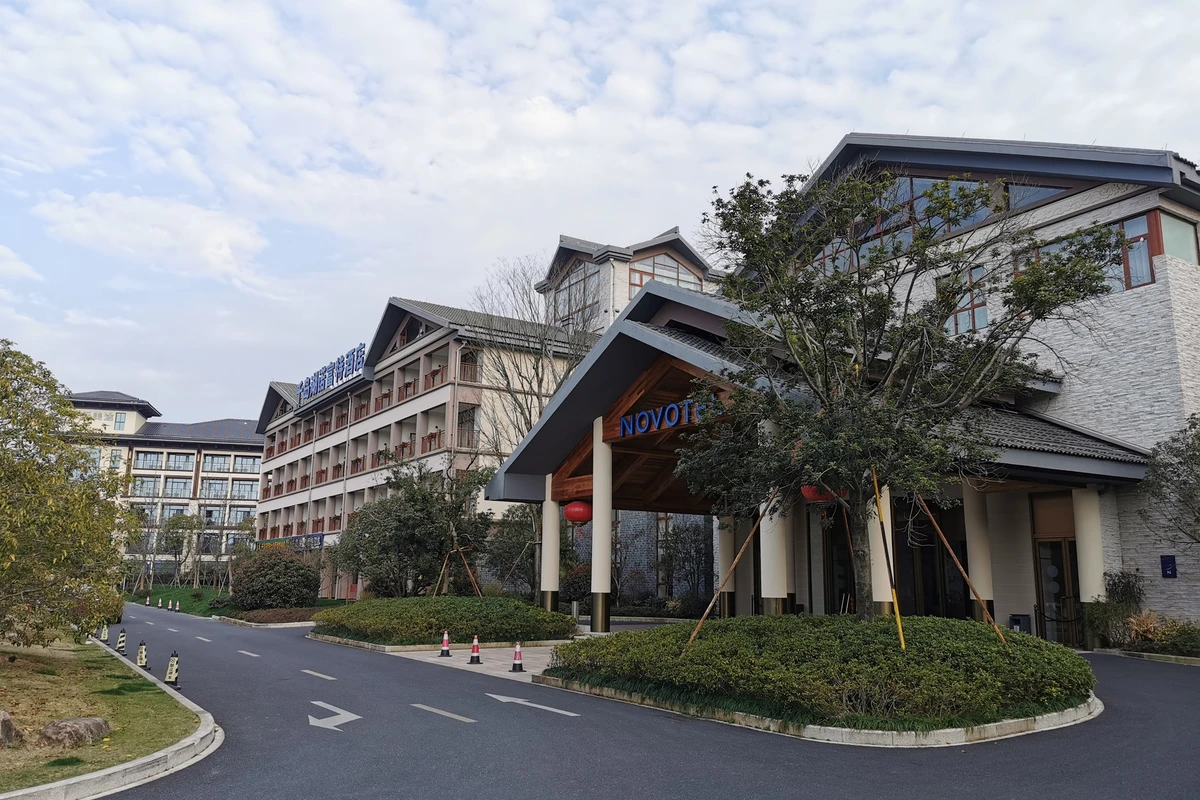
Checked into Novotel Qiandao Lake, a hotel facing Qiandao Lake.
Took a stroll along the Qiandao Lake:
Dinner: Qiandao Lake organic fish head, 388 yuan, had a meal.
Day 2, February 24, From Qiandao Lake to She County, Anhui.
First went to Tianyu Mountain Observation Deck.
Tianyu Mountain Observation Deck:
At the highest point of Qiandao Lake, you can climb high and look far, with a beautiful view of the lake. Drive up the mountain; the road is wide enough, and you can park on the roadside. Personally, I think this free spot is better than the paid island tours (I have been to Qiandao Lake twice and never taken a boat to the islands).
From Qiandao Lake, took provincial and county roads, along the lake and the Xin'an River to She County. The scenery along the way was nice, but the mountain roads were winding, so we couldn't drive fast. The roads in Zhejiang were wide and flat, but after entering Anhui, the road conditions were noticeably poorer.
Stayed at Vienna Hotel She County:
Visited the ancient city of She County:
This is the location of Huizhou Prefecture. This ancient city is said to be one of China's four best-preserved ancient cities, along with Pingyao in Shanxi, Lijiang in Yunnan, and Langzhong in Sichuan.
The ancient city is quite large, but not many historical relics seem to remain.
The ancient city requires an admission ticket, but residents still live there. So if you want to wander inside the ancient city, as long as you don't use the guarded city gates, there are several entrances you can use.
We asked the DiDi driver to drop us off at this street corner (just 100 meters in front of the ancient city gate), and we walked boldly into the ancient city.
Inside the ancient city, there is a famous memorial archway—the Xu Guo Memorial Archway, magnificent and unparalleled, the only surviving eight-legged archway in China.
Xu Guo was a famous politician of the Ming Dynasty, originally from She County, Anhui. He served through the Jiajing, Longqing, and Wanli eras, a veteran of three reigns.
He broke the established protocol between ruler and minister and built a majestic eight-legged memorial archway for himself in his hometown while still alive. This was a meritorious archway specially approved by the Ming Shenzong (Emperor Wanli) to record Xu Guo's achievements of "assisting loyalty, strategizing, and outstanding merits."
As for the Huizhou Prefecture, it is said to be a later restoration. I have seen many government offices, all similar, so I didn't spend money to enter.
Sanchaku Dang Street (Three-fork crotch street), with a bell tower at the street corner. This bell tower is just a clock on a building, so it's called a bell tower.
One of the city gates of the ancient city:
Another city gate of the ancient city:
The place names in this area are quite confusing, changed back and forth, making it hard for outsiders to understand.
I think Huangshan City should be renamed Huizhou City; having a "Huangshan District" is enough.
The county names She (pronounced shè) and Yi (pronounced yī) are not recognized by everyone; every time I come, I have to re-learn them. This shows how cultured the people here are.
Day 3, February 25, She County.
Tangyue Stone Archway Group: 5A, ticket 89 yuan, parking 10 yuan. Quite expensive!
Tangyue Archway Group, located in Tangyue Village, Zhengcun Town, She County, is a representative work of ancient Huizhou architecture from the Ming and Qing dynasties.
A group of seven connected archways, claimed to be the largest archway group in China.
It reflects the general picture of the ethical and moral concepts of "loyalty, filial piety, chastity, and righteousness" in Huizhou's Cheng-Zhu Neo-Confucianism.
Famous, so I checked in.
Qingyi Hall (Women's Ancestral Hall):
Shixiao Hall (World Filial Piety Hall): Qing Dynasty.
Dunben Hall (Men's Ancestral Hall):
Located 500 meters from the archway group.
Stayed at Qianbai Du Homestay in Shendu Town, She County:
Day 4, February 26, Lantern Festival, She County.
Xin'an River Landscape Gallery:
Braved the rain and drove along the Xin'an River from Shendu Town to Kengkou. It is said that this section is the essence of the Xin'an River landscape.
Did not take a cruise, so skipped the fishing performances, traditional wedding supplies, etc. Saved a lot of money.
Along the way, there were ink-wash landscape paintings, quite unique.
She County Wenfeng Tower and Fengshan Platform:
Xiuning County Wan'an Ancient Town:
Stayed at Qiyun Mountain Shengxiang Homestay in Xiuning County.
The Shengxiang Homestay is located in Qiyun Town. The facilities of the town in front of the door seem to be its配套设施. I was attracted by the pictures.
Day 5, February 27, Xiuning.
4A, along with Huangshan and Jiuhua Mountain, it is one of the three famous mountains in southern Anhui. However, in Anhui, Huangshan, Jiuhua Mountain, and Tianzhu Mountain are much more famous than Qiyun Mountain. But Qiyun Mountain, together with Wudang Mountain in Hubei, Qingcheng Mountain in Sichuan, and Longhu Mountain in Jiangxi, is known as one of the four famous Taoist mountains in China, and together with Jingfu Mountain in Shaanxi, they are called the five immortal mountains. Even so, it is low-key.
Qiyun Mountain mainly features Danxia landforms, sea of clouds, Taoist temples, Yunyan Lake, rapeseed flower seas, Bagua patterns, and Hengjiang River.
Ticket 108 yuan (ticket + cable car up the mountain).
Took the cable car up the mountain, toured Qiyun Mountain in a misty fairyland for 2 hours, then took a car down for 35 yuan.
Xu Xiake: "High and refreshing, flying and protruding, just like Changmen."
After finishing Qiyun Mountain, took S218, passing through Xidi, Yi County, Hongcun, Tachuan, Lucun ancient folk houses, and Huangshan District.
I have been to Hongcun and Xidi before; both are 5A scenic spots, each with tickets costing over a hundred yuan. No need to spend money again.
The county seat of Yi County has no attractions worth seeing.
Tachuan is said to have beautiful autumn scenery, but now it doesn't look special.
Along the way, arrived at Taohua Tan (Peach Blossom Pond) in Jingxian County, Xuancheng City.
Taohua Tan in Jingxian:
Ticket 65 yuan, parking 10 yuan.
Legend has it that Wang Lun, the county magistrate of Jingxian, wrote a letter to Li Bai: "Sir, do you like to drink? There is a ten-thousand-house hotel here; sir, do you like to travel? There is a ten-mile peach blossom here."
Li Bai, seeing scenery and wine, went there.
Only after arriving did he realize that the so-called ten-thousand-house hotel was actually a hotel run by a man named Wan; the ten-mile peach blossom referred to the rippling Taohua Tan.
It can be said that Wang Lun tricked Li Bai into coming, but he probably entertained him with good food and wine. When Li Bai left, Wang Lun organized the locals to send him off with "stomping songs" and gave gifts. This made Li Bai embarrassed, so he exaggerated and wrote a poem.
"Li Bai was about to travel by boat, when suddenly he heard stomping songs on the shore.
The Peach Blossom Pond is a thousand feet deep, but it cannot compare with Wang Lun's feelings for me."
Thus, this place became famous.
Thus, everyone goes to Taohua Tan to play, and Li Bai tricked everyone into going. There is no thousand-foot-deep peach blossom pond there; it is actually a section of the Qingyi River, a tributary of the Yangtze River originating from Huangshan, and it's not very deep.
This operation by Wang Lun made Taohua Tan, an ordinary place, famous, and his descendants can keep making money from tourists.
From this, it seems that Wang Lun was a far-sighted leader who thought for the people, the originator of the marketing strategy of leveraging celebrities. He deserves respect.
Wang Lun put so much effort, so we had to cooperate and check in!
Took a ferry to the opposite bank.
Wanjia Restaurant Ruins:
Collapsed in the 1970s due to age. Rebuilt. The worn threshold is an old artifact.
It is also a scenic spot within the scenic area, still contributing.
The tombstone reads: "Tomb of Wang Lun, Official Historian of the Tang Dynasty." It is said to be inscribed by Li Bai.
The place where they sang stomping songs to farewell Li Bai:
Stayed at Vienna 3 in Jingxian.
Day 6, February 28, From Jingxian to Wuhu.
Wuhu Xiangshui Jian:
A golden countryside. A mountain stream on the eastern foothills of Fushan Mountain in E'qiao Town, Sanshan District. 100,000 mu of rapeseed flowers are blooming in succession.
In the second year of Guangxu (1876), the Treaty of Yantai was signed between Britain and the Qing government. Wuhu was one of the ports opened for trade, and the British established a concession.
There are: Riverside Park. Jiuzi Square. Zhongshan Road Pedestrian Street. Jinghu Park. Guangji Temple. Zheshan Park. Jiuzi Ancient Town.
Catholic Church. Old Customs Bell Tower.
Built over 60 years, spanning Ming and Qing.
Old Customs Bell Tower: One of the over 40 customs houses in old China.
Pan Zanhua (Supervisor of Wuhu Customs) and Pan Zhang Yuliang:
Day 7, March 1, From Wuhu to Dangtu to Ma'anshan.
Dangtu County was quite famous in ancient times.
The Immortal Poet Li Bai spent his final years in Dangtu and was buried in Daqing Mountain in Dangtu.
Li Zhiyi's "You live at the head of the Yangtze River, I live at the tail of the Yangtze River" was written in Dangtu.
Taiping Prefecture refers to Dangtu.
The scenery of Dangtu includes three towers and two floating bridges. The three towers still exist.
Jinzhu Tower in the west of the city: Located in Baota Village, Gushu Town. First built in the 17th year of Wanli in Ming Dynasty. Brick and stone structure, 37 meters high, 9 meters in diameter at the base, 8-sided and 7-story. There is a temple called Fota Temple at the foot of the tower.
Huangshan Tower in the north of the city: On the top of Huangshan Mountain, five li north of the city. First built in the Liu Song Dynasty of the Southern Dynasties. A pavilion-style Buddhist pagoda, brick and wood structure, octagonal in plan, 5 external stories and 9 internal stories, 27 meters high.
Lingyun Tower in the east of the city: Inside Lingyun Mountain Park. First built in the Jiajing period of Ming Dynasty, restored in 2011. 7 stories, 8 sides, 35.4 meters high. At the foot of Lingyun Mountain, there is Dabei Nunnery.
Daqing Mountain Li Bai Cultural Tourism Area (Li Bai Tomb Park): Li Bai was poor and destitute in his later years, went to Dangtu County to seek refuge with his uncle, County Magistrate Li Bingyang, and died there. Ticket 30 yuan.
Jinzhu Tower in the west of the city:
Lingyun Tower in the east of the city:
Huangshan Tower in the north of the city:
Day 8, March 2, Ma'anshan.
One of China's ten major steel cities.
Legend says that during the Chu-Han War, Xiang Yu, the Hegemon-King of Chu, was besieged at Gaixia, heard Chu songs on all sides, and retreated to Wujiang in Hexian County. He asked a fisherman to ferry his beloved horse, the Black Dapple, across the river. Feeling ashamed to face his elders east of the river, he committed suicide. The Black Dapple, missing its master, rolled and killed itself, and its saddle fell to the ground and turned into a mountain, hence the name Ma'anshan (Saddle Mountain).
4A, special ticket 43 yuan, cable car 30 yuan, electric car 15 yuan.
Caishiji in Ma'anshan, together with Chenglingji in Yueyang and Yanziji in Nanjing, are known as the Three Rocks of the Yangtze River.
Caishiji is famous for its mountains and waters, and even more so for its strategic location guarding the north-south and east-west thoroughfares of the Yangtze River, making it a battleground for generations of military strategists. From the Three Kingdoms to the end of the Yuan Dynasty, heroes contended here, and Caishiji witnessed the heroic deeds of countless figures. Li Bai's "jumping into the river to catch the moon" and "riding a whale to heaven" added a romantic touch to Caishiji.
Taibai Tower: Along with Tengwang Pavilion in Jiangxi, Yellow Crane Tower in Hubei, and Yueyang Tower in Hunan, it forms one of the famous three towers and one pavilion along the Yangtze River.
Santaige Pavilion at the top of the mountain:
Chiwu Well: In the second year of Chiwu of Eastern Wu, when digging the Guangji Temple, a colorful stone was found and made into an incense burner, becoming the temple's treasure. "Cai" (color) is homophonic with "cai" (quarry), hence the name "Caishi" (quarrying stone).


