A Visit to Jingting Mountain in Xuancheng, Anhui
On the morning of October 3, 2013. Yesterday, my wife and I traveled a long distance, starting from Waigaoqiao in Shanghai, driving westward all the way. Last night we stayed in Xuancheng at a nice hotel. When checking out in the morning, the hotel staff recommended we visit Jingting Mountain, so we drove there. It was not far. We arrived at the parking lot, parked the car, and began our cultural journey of Jingting Mountain.
Jingting Mountain is a famous historical and cultural mountain in China and the soul of Xuancheng's culture. It is located in the northern suburbs of Xuancheng city. Originally named Zhaoting Mountain, it was renamed Jingting Mountain during the Western Jin dynasty to avoid the personal name of Emperor Sima Zhao. Jingting Mountain is not very tall, but it has rolling hills, glistening waters, blooming mountain flowers, and leisurely white clouds. Rising abruptly from the hilly terrain, from a distance it appears lush green with mist and clouds swirling, like a crouching tiger. Up close, the forests and valleys are deep and secluded, with springs gurgling, giving it an especially delicate beauty.
Since ancient times, Jingting Mountain has been favored by literati and famous figures, leaving behind a wealth of poems and writings. "A land also needs talented people to make it famous"—Jingting Mountain thus became renowned at home and abroad. The Southern Qi poet Xie Tiao wrote in his poem "A Visit to Jingting Mountain": "This mountain stretches for a hundred li, its peaks merge with the clouds. The recluses have already entrusted themselves here, the supernatural dwells in this place." This poem pioneered a new style of landscape poetry. The Tang dynasty poet Li Bai visited seven times and wrote 45 poems about Jingting Mountain, among which "Sitting Alone in Face of Peak Jingting" became an eternal masterpiece: "They and I look at each other and never get tired, only I and Jingting Mountain." As Xie Tiao's and Li Bai's poems spread, Jingting Mountain's fame grew rapidly, rivaling the Five Great Mountains, and it became a place of poetry in Jiangnan where "poems were recited every day." Throughout the Tang dynasty, literati followed in the footsteps of Xie and Li, coming to Jingting Mountain to write and paint. Bai Juyi, Du Mu, Han Yu, Liu Yuxi, Wang Wei, Meng Haoran, Li Shangyin, Yan Zhenqing, Wei Yingwu, Lu Guimeng; in the Song dynasty, Su Dongpo, Mei Yaochen, Ouyang Xiu, Fan Zhongyan, Yan Shu, Huang Tingjian, Wen Tianxiang, Wu Qian; in the Yuan dynasty, Gong Kui, Gong Shitai; in the Ming dynasty, Li Dongyang, Tang Xianzu, Yuan Zhongdao, Wen Zhengming; in the Qing dynasty, Shi Runzhang, Shi Tao, Mei Qing, Mei Geng, Yao Nai, and others. They successively used their brilliant pens to compose poems, essays, records, and paintings about Jingting Mountain, expressing their feelings through the mountain scenery. From the Tang to the Qing dynasties, the number of poems, essays, records, and paintings praising Jingting Mountain reached thousands, earning it the title "Mountain of Poetry in Jiangnan," renowned both at home and abroad.
Xie Tiao (464–499), courtesy name Xuanhui, was from Yangxia in Chen Commandery. He holds a high status in Chinese literary history, advocating that "good poetry should be round, beautiful, and flowing like a pellet." He was a pioneer of the "Yongming style." Xie Tiao served as the governor of Xuancheng, so he was also called Xie Xuancheng. Later he became the Minister of Personnel in the imperial secretariat. He was framed by Prince Xiao Yaoguang of Shian and died in prison. He wrote many beautiful landscape poems, which influenced the formation of regulated verse and quatrains, as well as the works of Tang poets like Li Bai. Because he shared the same clan as Xie Lingyun, he was called "Little Xie." During his tenure in Xuancheng, Xie Tiao's poetic creation reached its peak in both quantity and artistry, with the most famous being "A Visit to Jingting Mountain": "This mountain stretches for a hundred li, its peaks merge with the clouds. The recluses have already entrusted themselves here, the supernatural dwells in this place. Its upper reaches block out the sun, its lower parts embrace winding streams. Tangled vines are wild and overgrown, twisted branches rise and fall. A lone crane calls at dawn, a hungry flying squirrel cries at night. The clouds are vast and spreading, the rain is also dreary. Though I travel in official attire, I also seek secluded paths. Tracing the source is far from finished, the return path is deep and lost. I want to pursue strange wonders, so I climb the vermilion ladder. The emperor's favor is already gone, this principle should not be violated." Xuancheng is also called "Little Xie City," the city and the man reflecting each other. Xie Tiao had a profound influence on Tang poetry; Tang poets "often followed Xuancheng's methods." Du Fu said, "Every poem of Xie Tiao is worth reciting," and the great poet Li Bai "bowed his head to Xie Xuancheng all his life," visiting Jingting Mountain seven times.
"Sitting Alone in Face of Peak Jingting": "All birds have flown away, high; a lonely cloud drifts off, idle. We look at each other and never tire, only I and Jingting Mountain." This poem, written by Tang poet Li Bai, is a masterpiece expressing his inner world. On the surface, it describes the pleasure of sitting alone on Jingting Mountain, but its deeper meaning is the poet's profound loneliness in his life journey. With extraordinary imagination and clever构思, the poet endows the landscape with life, personifying Jingting Mountain vividly. The poet writes about his loneliness and unrecognized talent, but also his steadfastness, seeking comfort and solace in nature. This poem might not have been written in the thirteenth year of Tianbao but more likely in the second year of Shangyuan (761 AD) of Emperor Suzong of Tang. In the second year of Shangyuan, Li Bai was over sixty years old. After the turmoil of the An Lushan Rebellion, the disgrace of being falsely imprisoned, and the humiliation of exile, Li Bai came to Xuancheng for the seventh and last time. No longer were there gatherings of friends and farewells, nor the carefree drinking at the North Tower and poetic discussions at Jingting. Alone, he hobbled up Jingting Mountain, sat for a long time, moved by the scene and deeply saddened. Loneliness and desolation overwhelmed him, and he involuntarily recited this eternal masterpiece. This fits the time and place of Li Bai's creation. At the end of the following year, in December 762, Li Bai "died from excessive drinking in Xuancheng."
Li Bai wrote many poems in Xuancheng. Besides the well-known "Sitting Alone in Face of Peak Jingting," another poem widely circulated today is "Farewell to Uncle Yun, Imperial Librarian, at Xie Tiao's Pavilion in Xuanzhou": "Leave me! What yesterday went by is gone. Trouble me! Today's heart is full of sorrow. A thousand miles of wind blows the autumn geese away; let us drink our cups dry in this pavilion high! Your works, like those of Penglai, are strong and bold, with the fresh grace of Little Xie of old. Both of us have an ideal high and bright, eager to pluck the moon in the sky. But cutting water with a sword will make it faster flowing; drinking to drown sorrow will make it heavier growing. Since the world can never satisfy our desire, we'll loosen our hair and go boating tomorrow." When Li Bai met Li Yun and they ascended Xie Tiao's Pavilion together, Li Bai improvised this farewell poem. The poem of 92 characters does not directly speak of parting but heavily expresses the poet's intense indignation at his unrecognized talent, infused with generous and heroic feelings, expressing his strong dissatisfaction and persistent pursuit of a beautiful world. Although the poem writes about worry and depression, it is not gloomy or low. The language is clear and simple, the tone excited and lofty, like a song or a story. The strong emotional fluctuations rise and fall, twisting and turning, like a rushing river changing in an instant with waves surging. It perfectly combines with the artful structure of leaps and bounds, full of profound flavor, leaving no trace, reaching a harmonious union of boldness and nature. Ming critics praised this poem as "like a heavenly horse galloping in the sky, a divine dragon emerging from the sea."
My wife and I started our tour from Jingting Square, also called the Mountaineering Square. Jingting Square is a typical Huizhou-style building with white walls, black tiles, and horse-head walls. The square is named after the "Jingting" (pavilion) on it. The main carving on the ground is titled "Poetry Carries a Thousand Autumns." It selects representative poems from the Southern Qi Xie Tiao period through the Tang, Song, Yuan, Ming, and Qing dynasties, condensing the brilliant achievements of Jingting Mountain poetry over a thousand years, showcasing the development of Chinese poetry and the vastness of traditional culture. The central sculpture is a bronze casting of "A Panoramic View of Xuancheng." In the 16th year of Qianlong's reign (1751), when Emperor Qianlong first went to Jiangnan, the court painter Zhang Zongcang from Suzhou painted sixteen scenes of Wuzhong to present to the emperor, and "A Panoramic View of Xuancheng" was one of them.
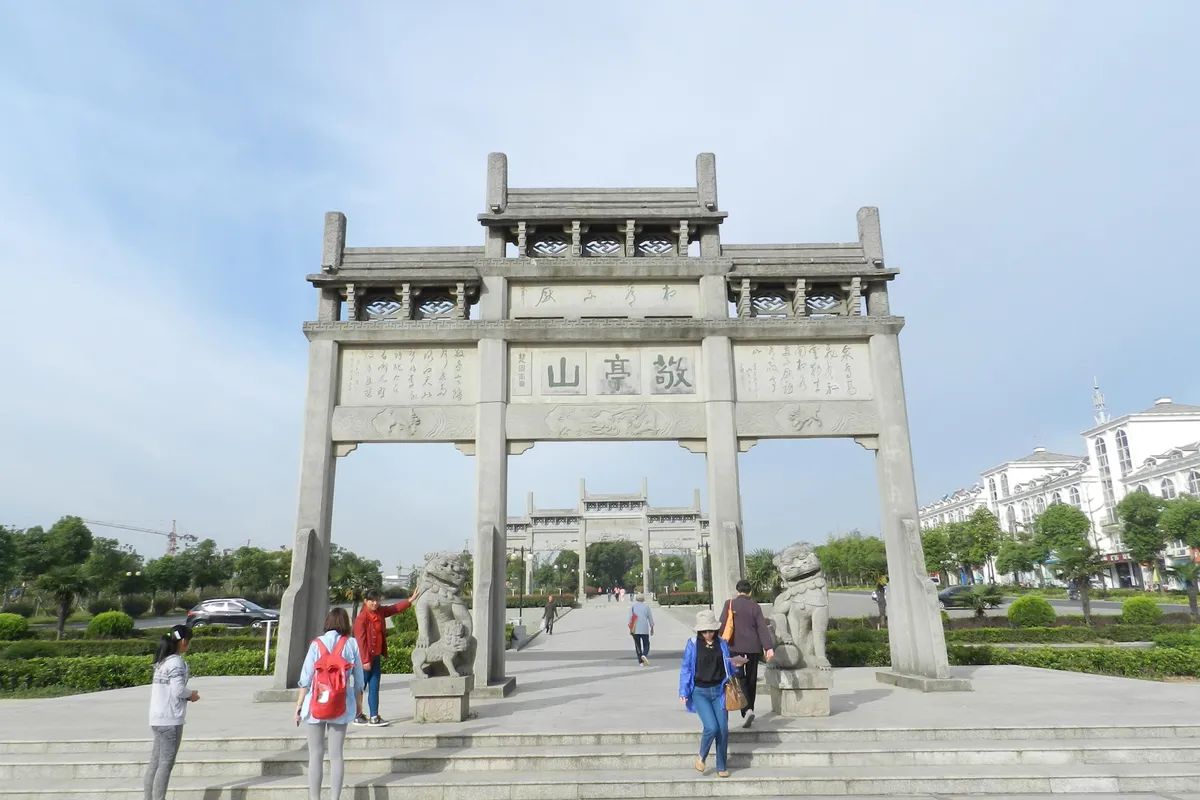
Standing before us is the stone archway of Jingting Mountain, inscribed with calligraphy by Chu Tunan and poems by Li Bai and Chen Yi. Passing through the archway, we see a statue of Li Bai standing by Zhaoting Lake, holding a sword, looking up at the sky, exuding extraordinary charm. Follow the tree-lined path to the Twin Pagodas scenic area. These surviving twin pagodas from the Northern Song dynasty are like two loyal guards. The Guangjiao Temple Twin Pagodas, also called Jingting Twin Pagodas, are national-level ancient architectural treasures. Located at the southern foot of Jingting Mountain, they have a history of over 800 years and are important cultural relics of Jingting Mountain National Forest Park. Built in the third year of Shaosheng of the Northern Song dynasty (1096 AD), the twin pagodas have the charm of Song dynasty pagodas but also reflect the traditional style of Tang pagodas. Both are square, about 20 meters high, seven-story square brick pagodas with straight well-shaped pagoda chambers simulating wood structures. "The two pagodas are like two old men, standing side by side as if decrepit." They face each other east and west, like ornamental columns, majestic and beautiful, attracting attention. The east pagoda is slightly larger than the west, each side 2.65 meters, while the west pagoda each side is 2.35 meters. The first floor of both pagodas has doors on three sides; the east side of the east pagoda and the west side of the west pagoda have no doors, while the upper floors have doors on all four sides. The outer walls are partly built with brick images of Buddha; even now, four pairs of Buddha images can be seen on the fifth floor of the east pagoda. The eaves are brick and wood, with wooden floors inside. The eaves have bracket sets projecting outward, and the walls are embedded with rosettes, presenting a solemn Buddhist atmosphere. The base has white reliefs, and there are no central pillars or other architectural decorations. These ancient pagodas are rare in the country and have always been valued by architectural historians. On the inner walls of the second floor of both pagodas is horizontally embedded a regular script stele by the Northern Song literatus Su Shi: "The Dharani Sutra of Avalokitesvara." At the end of the text is the inscription: "Written on the 27th day of February in the fourth year of Yuanfeng by Su Shi of Meiyang, Vice Regeant of Huangzhou, to give to the revered monk of Guangjiao Temple in Xuancheng." Su Shi's calligraphy has significant value in Chinese calligraphy history.
Guangjiao Temple was built in the third year of Dazhong of the Tang dynasty (849 AD) at the southern foot of Jingting Mountain. It was a famous ancient temple in Jiangnan, built by the famous prime minister Pei Xiu when he was the governor of Xuanzhou to welcome the monk Xiyun, also known as Huangbo Chan Master. Huangbo Chan Master was the founder of the Linji school, one of the five major schools of Chan Buddhism. The Linji school is also called the "Shouting and Beating School." This school later spread to Japan, Korea, and other places, becoming the mainstream of Chan Buddhism in those countries. Guangjiao Temple was once known as one of the four great temples along with Huacheng Temple on Mount Jiuhua, Cuifeng Temple on Mount Huangshan, and Kaihua Temple on Mount Langya. There was once a magnificent sight: "Temples linked like pearls before and after the mountain, green hills outside the temples form a picture scroll. Flowers in the mountain are often moist without rain, orchids in the forest are fragrant without people." Historical records state: "Emperor Taizong of Song bestowed 120 volumes of imperial writings to Guangjiao Temple; the Yuan dynasty emperor bestowed a gold kasaya on the abbot Rongyouya of Guangjiao Temple." The "Hundred-page Album of Arhats by Shi Tao" was created by the monk-painter Shi Tao while he was a monk at Guangjiao Temple in Xuancheng. He set the scenes against the background of Jingting Mountain. After completion, he donated the album to Guangjiao Temple. Twenty years later, the painter Fang Shishu saw it and loved it, and collected it. After several transfers, in the 1940s, the album fell into the hands of a Japanese collector. In the spring of 1999, Mr. Cui Ruzhu saw the album in Japan and purchased it back at a high price from the Japanese collector.
Jingting Mountain's Buddhist culture is distinctive. The two major temples on the mountain belong to two important schools of Chinese Buddhism: Chan and Pure Land. Hongyuan Temple is a site dedicated exclusively to the Pure Land school, covering over 100 mu with a total building area of 15,000 square meters, in Tang-style architecture. The three vigorous and ancient characters on the plaque, "Hong Yuan," are from the works of Master Shandao, meaning to promote Amitabha Buddha's great vow to save sentient beings.
The Ancient Zhaoting Archway was built in the Chongzhen period of the Ming dynasty (1636) by the Xuancheng county magistrate Chen Tailai. It was rebuilt in the second year of Xianfeng (1852). The archway is 4.5 meters high and 2.5 meters wide. The pond and pavilion on the left are called "Bright Moon Casting Shadows."
The statue of Princess Yuzhen is located in a bamboo grove at the southern foot of Jingting Mountain. Princess Yuzhen, Li Chiyin, courtesy name Xuanxuan (692-762), was the granddaughter of Empress Wu Zetian, the tenth daughter of Emperor Ruizong Li Dan of the Tang dynasty, and the younger sister of Emperor Minghuang Li Longji. She was initially enfeoffed as the Countess of Chongchang and later granted the title Shangqing Xuandu Dadong Sanjing Shi. Among Tang princesses, her influence was second only to Princess Taiping and Princess Anle. The statue of the princess has a Tang-style hair bun, holding a book in one hand and a round fan in the other. In addition to this 2.6-meter tall polyester statue, there is also a tomb of Princess Yuzhen and a black marble tombstone, 1.75 meters high, 0.71 meters wide, and 0.075 meters thick.
Historical records state: In the third year of Tianbao, she said: "The late emperor allowed me to leave the secular world. Now I still enjoy the privileges of a princess and receive rent and taxes. I sincerely wish to renounce the title of princess, disband the princess's household, and return to the imperial palace." Emperor Xuanzong did not permit it. She again said: "I am the granddaughter of Emperor Gaozong, the daughter of Emperor Ruizong, and the younger sister of Your Majesty. In the world, I am not considered lowly. Why must I be bound by the title of princess and rely on the income from the fief to be noble? Please allow me to return hundreds of households' property and extend my life for ten years." The emperor knew her sincere intention and permitted it. She died in the Baoying era. When Princess Yuzhen was born, her mother Lady Dou was executed by her grandmother Empress Wu Zetian, who held power. She was raised by her aunt Princess Taiping from childhood. Influenced by her father and aunt's veneration of Taoism, she became a Taoist nun in her youth, with the title Chiyang Fashi, later granted the title Shangqing Xuandu Dadong Sanjing Shi, and enfeoffed as the Countess of Chongchang with rent and tax income. After becoming a Taoist nun, she traveled widely to famous mountains, liked to associate with knowledgeable people, and especially favored the talented commoner Taoist friend Li Bai. She strongly recommended Li Bai to serve in the Hanlin Academy as a drafter of imperial edicts. When Li Bai, disdainful of the powerful, was slandered and given gold to leave, the princess became depressed and angrily submitted a petition to renounce her title. According to legend, after the An Lushan Rebellion, she pursued Li Bai and lived in seclusion on Jingting Mountain until her death, her soul resting there. The people called her resting place the Imperial Aunt's Tomb, and generations have worshiped there.
Taibai Tower, also known as Taibai Sitting Alone Tower, is located on the southern slope of Jingting Mountain. Built in the 12th year of Tianbao (753), it was originally a pavilion called "Yongcui Pavilion" built by later generations to commemorate Li Bai's famous poem "Sitting Alone in Face of Peak Jingting," and a stele was erected. This pavilion was commonly called "Taibai Pavilion." During the Qing dynasty, it was rebuilt into Taibai Tower, 33 meters high with 4 stories, in Tang-style architecture.
Jingting Mountain does not have the majesty of the Five Great Mountains, nor does it host the smoke of the Four Buddhist Mountains, but it has its own graceful and charming appearance, the reputation of a thousand-year mountain of poetry, and endless romantic appeal. From the overall arrangement of Jingting Mountain, it is indeed striving toward the direction of "Jiangnan Mountain of Poetry." As we walked along the mountain path, rocks and benches for resting were everywhere inscribed with poems and verses, creating a strong cultural atmosphere. Jingting Mountain has four major cultural characteristics: poetry, tea, Buddhism, and wine. These four correspond to four scenic areas: Twin Pagodas Scenic Area, Sitting Alone Tower Scenic Area, One Peak Scenic Area, and Wanling Lake Scenic Area, with poetry connecting these four cultures. Historical sites are mostly concentrated in the Twin Pagodas and Sitting Alone Tower areas. Following the order from the foot of the mountain to the top, we visited along the way: Jinting Mountain Gate Archway, Guangjiao Temple Twin Pagodas, Guangjiao Temple, Hongyuan Temple, Ancient Zhaoting Archway, Princess Yuzhen Statue, Imperial Aunt Spring, Taibai Sitting Alone Tower, and other pavilions, temples, and cliff inscriptions.
Jingting Mountain is also famous for tea, with written records of tea picking long ago. At the foot of Jingting Mountain, the Jingting Mountain Tea Plantation is a large tea enterprise in the Anhui farming and land reclamation area. It now has over 10,000 mu of high-quality tea gardens, 2,000 mu of orchards (pears, chestnuts, etc.), and 42,000 mu of forest. It produces 100,000 kilograms of Jingting Green Snow series famous teas and 2.6 million kilograms of regular teas (brow tea and pearl tea) annually. The ecological environment of the plantation area is excellent. Jingting Green Snow tea is a famous historical and cultural tea of China, known since the Ming dynasty, prosperous in the Qing dynasty, and listed as a tribute tea in the Ming and Qing dynasties. The "Xuancheng County Gazetteer" (Guangxu edition, volume six) records: "Luoluo tea is found everywhere, bitter and thin, but widely used. Only Jingting Green Snow is the highest grade." The literary giant Guo Moruo gladly inscribed its name. In the Qing dynasty, Shi Runzhang wrote a poem about Green Snow tea: "Jingting sparrow tongue tea is passed down through generations, hand-made after Grain Rain. Steeped in plain porcelain, it seems unchanged, as if flower fragrance springs from the mountain stream." Over the decades, Jingting Green Snow has sold well in Anhui, Shanghai, Jiangsu, Beijing, and other provinces and cities, with small amounts indirectly sold to Hong Kong, Taiwan, Japan, and other countries and regions.
Jingting Mountain is renowned far and wide for its poetry, and it is a place of outstanding people. Moreover, Jingting Mountain has even more miraculous aspects. For unknown reasons, historically, the promotion of Jingting Mountain seems deeply connected with emperors. It was renamed twice to avoid the personal names of two emperors and two emperors' biological fathers. Six emperors issued decrees to enshrine the folk god of Jingting Mountain. One emperor issued a decree naming Jingting Mountain the "Divine Mountain of the South." One emperor bestowed imperial writings to be stored in the temples on Jingting Mountain. Two eminent monks on Jingting Mountain were summoned by two emperors and given gold-embroidered kasayas. One emperor personally visited Jingting Mountain to pay respects to a recluse monk before ascending the throne, and after ascending, he specially ordered a temple to be built for him in the capital. On this point alone, not only the famous Mount Huang and Mount Jiuhua cannot compare, but it is also extremely rare in the history of Chinese mountains. Thus, "A mountain is not famous for its height but for its immortals; a water is not famous for its depth but for its dragons." What made Jingting Mountain famous? The famous Tang poet Liu Yuxi gave the answer: "A single poem by Xie of Xuancheng made its fame equal to that of the Five Great Mountains."


