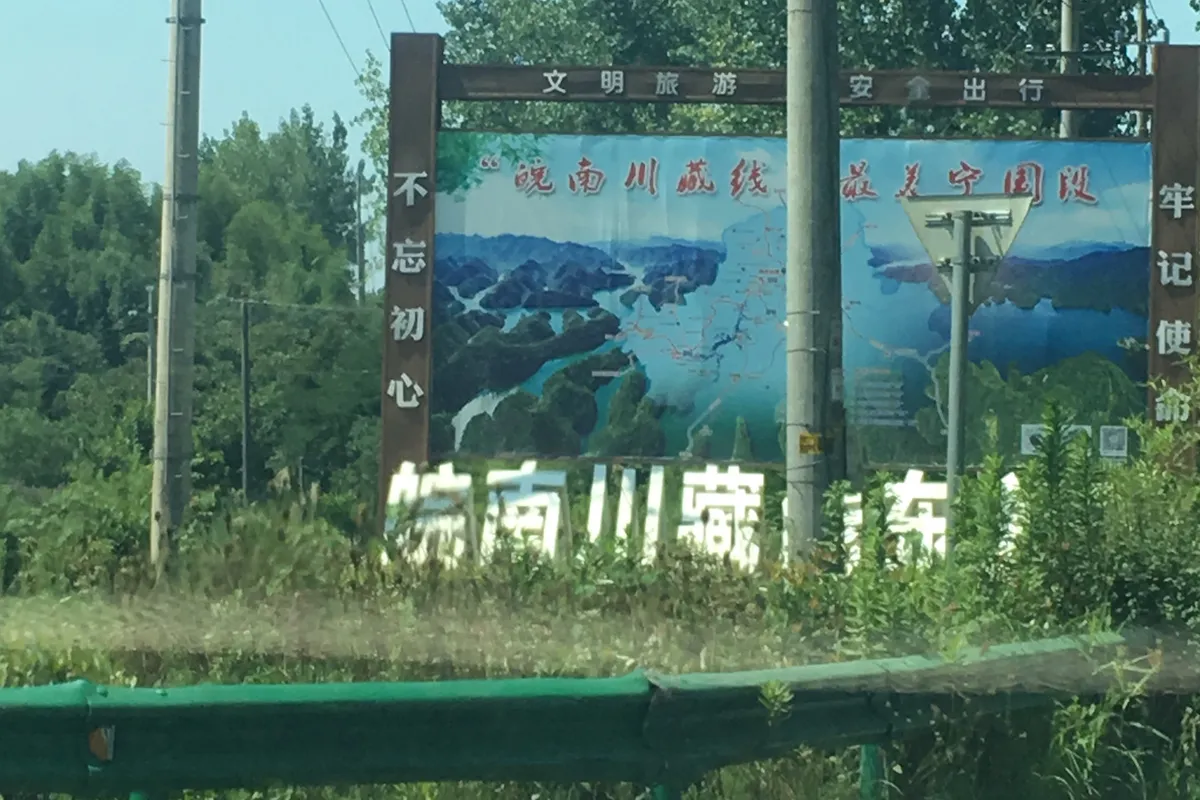
Self-driving Tour on the Wannan Sichuan-Tibet Highway
The self-driving tour in southern Anhui on July 15th (Thursday) had been planned since June 30th. Due to a sudden change at home, it eventually unexpectedly became a family trip for three. We set off from Suzhou at 7 a.m., arrived in Ningguo City at 10 a.m., and found a gas station to fill up. In fact, there is a gas station at the fork near Chujiatan about ten kilometers after entering from the east entrance of the Sichuan-Tibet Highway, and another one near Fangtang Township. But generally speaking, filling up whenever you see a gas station is always a good idea. After 14 kilometers, we arrived at Chujiatan at 10:40.
Chujiatan is located in Longge Village, Qinglong Township, downstream of Qinglong Bay, which is known as a 'National Water Conservancy Scenic Area' and 'National Forest Park'. It is surrounded by mountains and rivers, with beautiful scenery, misty rain, and a ten-mile gallery. It is not only a great place for tourism and camping but also an excellent spot for photography enthusiasts and film production teams to create and shoot. As the temperature exceeded 35°C today and the sun was blazing, we had to find a shaded spot to park and take some photos.
Continuing along the Sichuan-Tibet Highway, we soon saw a small parking lot for Guanhu Island by the roadside. We pulled over, walked 200 meters, and arrived at Guanhu Island in the middle of the lake.
It was a small place, with a panoramic view of mountains and water blending into one. Personally, I felt it was a great spot for fishing.
After 12 o'clock, feeling a bit hungry, we found a spacious area with tree shade, set up tables and chairs, and prepared for lunch. We had self-heating rice we bought earlier, duck feet and fried small fish from a deli we visited in the morning, and small packets of beef and yellow croaker. Although it was a bit simple, sitting together in the cool breeze under the shade, chatting while eating, it might have been a beautiful sight to others.
At 1 p.m., we arrived at the Redwood Forest Scenic Area in Fangtang Township. The Redwood Forest is located in the upper reaches of Qinglong Lake, consisting of six patches of redwood trees covering over 3,000 mu. From a distance, it was a sea of green. Autumn is probably when it looks its best.
We took a bamboo raft and drifted through the forest, feeling as if we were in a painting.
Further ahead was Banqiao Village. Turning right at Banqiao Village and driving over ten kilometers would lead to Shuimo Dingxi Scenic Area, while turning left and driving over 40 kilometers via Taoling Mountain Highway and Suhong Village would also reach Shuimo Dingxi. Generally, if you drive the Wannan Sichuan-Tibet Highway without taking the Taoling Mountain Road, you miss out on the driving pleasure and the challenge of self-discovery. At 1:40, we arrived at Shibishan Observation Deck.
Shibishan is a mountain that looks as if it has been cut in half by a knife. At 2:25, we arrived at the Xingfu Road Observation Deck on Taoling Highway, where we saw a great monument commemorating the completion of the 20-kilometer Taoling Highway in 1976 by the local people led by Secretary Wang Leping of Jing County, who took four years to build it on the winding mountain road with nine bends and eighteen turns.
Around another bend, we reached Liudaowan Observation Deck, the highest point of Taoling Highway.
This observation deck is the largest on the entire Wannan Sichuan-Tibet Highway. Along the observation railing, there was a row of about a dozen shops selling various crafts and snacks. Down from Liudaowan were Wudaowan, then Sidaowan, Sandao, and Erdaowan. At the roadside after descending Taoling Highway, we were lucky to see a few monkeys perched on the railing, begging for fruits from passing tourists.
They seemed well-practiced and not at all shy. The entire mountain road had many continuous S-curves and hairpin bends, with steep ascents and descents, testing the vehicle's power. Since it wasn't a weekend, there were not many cars, and there was parking available at the observation deck. From online videos, on weekends and holidays, traffic is heavy and often jammed. So if possible, it's better to avoid weekends and holidays when visiting the Wannan Sichuan-Tibet Highway.
At Suhong Village, we reset the navigation to the Daijiazhuang Farm Stay in Shuimo Dingxi Scenic Area. Setting navigation in segments was based on other netizens' advice, so we wouldn't be led onto side roads.
The distance from Suhong Village to Shuimo Dingxi is 20 kilometers, but since it was a mountain path, it took 40 minutes to reach the north gate of Shuimo Dingxi Scenic Area.
According to the scenic area, entrance is free after 5 p.m. when the staff get off work. But if you're just passing through, for example, to go to Taoling, you can get a temporary transit pass at the ticket office, valid for half an hour. Exceeding that time costs 50 yuan per person for the scenic area ticket. Driving along the north gate, we saw rows of unique guesthouses, some with outdoor karaoke. Daijiazhuang was relatively further in, quiet but convenient. We could park the car across the river from the farm stay, and there were surveillance cameras so it was safe. Crossing a small stream, we reached Daijiazhuang Farm Stay.
The usual price for the farm stay was about 150 yuan per night, with breakfast at 10 yuan per person. On weekends, it's a few dozen yuan more. In the stream, many tourists were happily playing on the stone steps in the water. After putting down our luggage and eating some watermelon, we couldn't wait to change into swimsuits and go catch fish in the river. But unfortunately, the weather turned bad—thunder and lightning followed by a heavy downpour. We could only sigh and regret not going into the water earlier.
Daijiazhuang Farm Stay in the heavy rain.
For dinner, the landlady cooked: a plate of braised small river fish and two vegetable dishes for 120 yuan, not cheap, but the taste was okay. After dinner, the rain stopped, but the stream had risen significantly and the current was swift. The originally clear water had turned turbid yellow. Unable to swim, we could only take a leisurely walk along the stream.
In the evening, chatting with the owner at the door, we learned that the upstream reservoir had opened its sluice gates. No wonder the stream's flow never seemed to diminish, and almost all night we heard the roar of water hitting the dam.
After a simple breakfast and breathing in the fresh mountain air, we continued strolling along the waterside boardwalk on both sides.
Perhaps because we arrived too early, we didn't see anyone doing the canyon zipline or the cliff crossing along the way. In fact, the entire Shuimo Dingxi Scenic Area stretches 5 to 6 kilometers from south to north. We only walked about 1 kilometer from the north gate southward. Further up, there were attractions like 'First Drift of Nanshan' and 'First Flight of Nanshan'. If you have enough time, you can take the scenic tram to explore.
When driving out of the Shuimo Dingxi Scenic Area gate, we were routinely questioned by staff. We just answered truthfully. Since most of the 30-kilometer mountain road to Yueliangwan Scenic Area was under reinforcement construction, we drove slowly. A few observation decks with few people and cars allowed for short rests.
After more than an hour, we finally arrived at Yueliangwan Scenic Area in Jing County. Yueliangwan is located 18 kilometers from Jing County town, in Dakang Village, Caicun Town, known as the 'First Town of Chinese Bamboo'. The scenic area is surrounded by green mountains and bamboo, with several suspension bridges connecting the village to the outside.
A clear river flows gently along the village. It is known as 'Beautiful mountains and clear waters Yueliangwan, bamboo sea and tea fragrance Jincai Village'. Films like 'The Laughter of Moon Bay' and 'Reconnaissance Across the Yangtze' were shot here. At 12:10, we parked in a slightly larger lot and started lunch. The lunch was the same as the previous day's noon meal. Though simple, the family enjoyed it, and that was enough. Looking around, people were washing cars by the river, swimming, picking stones, catching fish and shrimp with children—a joyful and leisurely summer water play scene.
Bamboo rafts drifting downstream brought tourists' laughter gradually to the shore.
When asked, the price was about a hundred yuan, and the drifting lasted 1.5 to 2 hours. If interested, you could give it a try. But due to yesterday's rain and sluice opening, the water was too muddy. Despite several impulses to get wet, I ultimately left with regret and never went into the river.
At 12:50, we started the return trip, heading to Wuzhen. After over three hours of driving, we arrived at Wuzhen Aishang Qianbaidu Homestay at 4 p.m. After checking in and resting briefly, we went out to find food. Quickly searching online, we found a nearby restaurant with good value. After dinner, we navigated to the East Scenic Area. Online sources said we could enter for free after 6 p.m., but at the gate, a guard told us it was exit-only. We walked along the right wall for quite a while but couldn't find an entrance.
So we gave up and returned to the homestay to rest. Later, the owner told us that by walking along the left side of the scenic area, we could enter the East Scenic Area. Since we went the wrong way, we couldn't find the entrance. But since we had visited the West Scenic Area a few years ago and stayed a night, not entering didn't matter much. Originally, we planned to visit Lili Ancient Town and Tongli Wetland Park on the third day, but because the weather was too hot, the family decided on the spot to sleep in, have breakfast, and then return to Suzhou.
For the third day's breakfast, we searched online again. The ancient town braised noodle shop at Songji Noodle House was recommended, so we drove there.
Some reviews said it was bad, but for people from Jiangsu, Zhejiang, and Shanghai, it should be fine. Personally, I thought the taste was good and the price reasonable, after all, it's in a tourist area. After breakfast, we drove home via the Suzhen-Taigong road safely.
Various expenses: Daijiazhuang accommodation 123 yuan, dinner and breakfast 150 yuan, Wuzhen accommodation free with membership, dinner 70 yuan, breakfast at noodle shop 45 yuan, highway tolls 190 yuan, gasoline 750 km × 0.70 = 525 yuan, self-brought food (rice, dishes, fruits, snacks) 200 yuan, total 1,300 yuan.


