Zhaji, the Largest Ancient Village in Anhui, Located in Taohuatan Town Where Li Bai Once Visited
From July 17 to 18, 2021, our family drove to Zhaji for a trip. Zhaji Ancient Village is located in Jing County, Xuancheng City, Anhui Province. It is an ancient village first built in the Tang Dynasty. Previously, I had seen online that it was described as an ancient town. Having lived in the countryside before, I felt that this ancient village might have been formed by clustering many small villages together, creating a large settlement that felt like a town. Unlike many villages where households are scattered in natural hamlets, not very concentrated. In fact, Zhaji is a large concentrated village, but administratively, it is just one village under Taohuatan Town. It is said that Zhaji is the largest ancient village in Anhui.
"Ten li of Zhai Village, nine li of mist, three streams converge among ten thousand households, temples and pavilions cast shadows under pagodas, small bridges over flowing water under apricot blossom skies." This poem praises the scenery of Zhaji. Zhaji Ancient Village is a cluster of Huizhou-style residential buildings built against the mountains and along the water, stretching for several kilometers. Here, nine out of ten residents are surnamed Zha. In the early Tang Dynasty, the ancestors of the Zha clan settled in this beautiful and peaceful place, multiplied and thrived. From the late Ming to early Qing dynasties, the Zha population peaked at over 70,000.
Zha Keding of the Zhaji Ming and Qing Ancient Architecture Protection Association said, "Why is it called Zhaji? Because we are surnamed Zha, and our ancestors were enfeoffed in the land of Zha, which is in present-day Jiyang County, Shandong. So, descendants of the Zha clan took one character from each place and named it Zhaji." There are several ancestral halls of the Zha family here, well-preserved and magnificent, such as Baogong Ancestral Hall and Erjia Ancestral Hall. The Zha family rules consist of 108 characters, forming 36 phrases of three-character verses. Presumably, Zha descendants recite them fluently from childhood. It is heartening to think that children, from the time they start learning to speak, can recite the ancestral rules, remembering them even in old age. The Zha family rules advocate caution, reverence, and harmony, requiring descendants to "value reading, engage in commerce, and master crafts." This shows a balanced approach, not insisting solely on studying for official positions.
Zhaji has a profound historical and cultural heritage. Originally, there were 108 bridges, 100 ancestral halls, and 108 temples. Currently, there are over 140 ancient structures from the Yuan, Ming, and Qing dynasties, including more than 40 bridges, 30 ancestral halls, and 4 temples. Relatively well-preserved ancient building complexes in Zhaji include the "Degong Hall" built in the Yuan Dynasty, located in Shuilang Lane in the village. It features a three-story gatehouse with a low front eave, column pillars made of nanmu wood, thick and round, with plinth bases in the shape of an inverted plate, undecorated. The Ming Dynasty's "Yongqing Hall" and "Jinshi Gate" are exquisitely carved with refined structures.
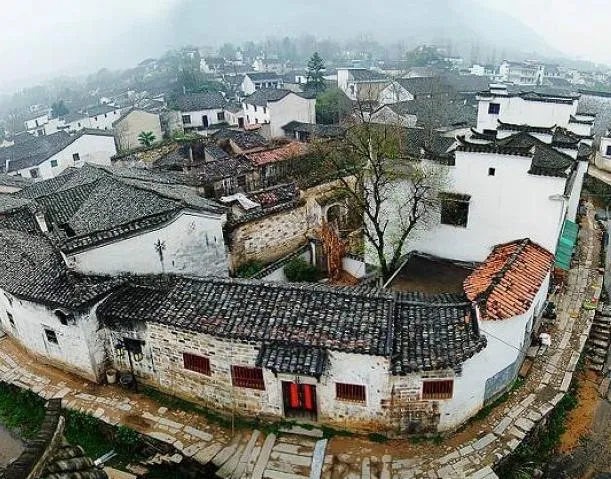
Zhaji Village is surrounded by mountains on all sides, with four gates (Zhongxiu Gate, Pingling Gate, Bashan Gate, and Shimen Gate), two pagodas (Qingshan Pagoda and Rusong Pagoda), and three rivers (Cen River, Xu River, and Shi River) converging and flowing through the village. From aerial photographs, the ancient village is encircled by streams, resembling a paradise.
Entering from the tourist entrance, walking along a long street lined with two- or three-story古朴 buildings, it feels like the 1990s. This street mainly features homestays and shops. At first, I was disappointed, thinking Zhaji was just this one street. After asking locals and turning toward Caishen Tower and Baogong Ancestral Hall, I was surprised to find a "hidden paradise." The real ancient village unveiled itself there. Then, following the stream clockwise, the scenery changed with every step.
Zhaji "builds houses against the mountains and forms the village along the water." The residential buildings are made of gray bricks and black tiles, ingeniously arranged using techniques from classical Chinese garden art, such as borrowing scenery and contrasting views. The layout embodies the harmony of "mountains outside the door are like indoors, and water from the eastern house flows into the western neighbor." The Ming and Qing ancient residential complexes in Zhaji are situated on both banks of the babbling Zhaji River, stretching for 10 li (about 5 kilometers). This 10-li path is circular, giving a sense of "roundness and unity," which is believed to gather energy. It is thought that the Zha ancestors, when designing the ancient village, considered factors such as accumulating wealth and fortune and ensuring enduring blessings.
The structures in Zhaji are mostly multi-courtyard houses, either three or four courtyards deep. Between the courtyards, there are "four waters returning to the hall" style patios, with "beauty rest" railings along the second-floor corridors. The foundations are made of stone strips, column bases are carved round stones, walls are of gray bricks, roofs of black tiles, with upturned eaves and flying corners. The traditional double-sloped roofs are half-hidden, sheltering behind layered gable walls. The gable walls, rising above the roofs, can prevent fire from spreading and also serve as防盗. The shapes of the gable walls are varied, including cloud shapes, bow shapes, and stepped forms, with the wall ends resembling horse heads looking up at the sky.
The door frames of ancient houses are all made of granite. The interior depth and width are large. The courtyards can be either "一"-shaped or "四"-shaped. Windows are mostly placed high up, ensuring good lighting and ventilation.
On the door lintels, wall bases, column plinths, window grilles, and door eyebrows, there are exquisite carvings. Lifelike figures, birds and beasts, elegant landscapes, flowers and plants all exude a scholarly atmosphere. What impresses most is the "three carvings" of Huizhou architecture: the proud flying-eave wood carvings, column base stone carvings, and tall gatehead brick carvings. Ancient stone carvings, brick carvings, and wood carvings can be seen everywhere in Zhaji. Almost all Ming and Qing buildings are richly ornamented. They are concentrated in the "Erjia Ancestral Hall."
Residences like Degong Hall, Songqing Hall, and Airi Hall are tall, grand, and finely structured. Degong Hall: a four-pillar, three-story archway-style gatehouse with five brackets supporting a slightly upturned roof covering the gatehouse in three layers, simple, elegant, and majestic. On the back, auspicious patterns like two dragons playing with a pearl, phoenix facing the sun, fish leaping over the dragon gate, and lions playing with embroidered balls are carved using openwork techniques, skillfully and delicately.
This well-preserved ancient village, once "hidden deep in the boudoir unknown to people," now not only attracts tourists but also has become a great place for art students from fine arts academies to sketch. By the roadside, you often see students absorbed in drawing. Many universities have set up sketching bases here.
Homestays are also a major feature of Zhaji, with almost every household running one. Their own houses, freshly renovated, are open to guests. Another characteristic of Zhaji is that the same ticket can be used for three consecutive days. This encourages more visitors to stay overnight and explore leisurely.
Zhaji belongs to Taohuatan Town, which is the Taohuatan that Li Bai once visited. Did Li Bai ever come to Zhaji? No. Because at that time, the Zha ancestors had not yet settled in Zhaji, or if they had just settled, the village had not developed to the scale of the Yuan, Ming, and Qing dynasties and was not famous.
"Peach Blossom Pool is a thousand feet deep, but not as deep as Wang Lun's feelings for me." Li Bai advertised Peach Blossom Pool. Little did he know that a thousand years later, Zhaji Ancient Village in Taohuatan Town would become a tourist attraction bustling with visitors.
This time, we stayed at Puyuan Art Homestay, which has great style and taste. The owner loves collecting wood carvings from Jiangnan, and the decoration style is fresh and elegant, with ingenuity in every shared space. From upstairs, you can see rolling mountains in the distance, shrouded in mist and clouds.


