Spring in Three Prefectures under Misty Rain on the River (Part 2): Jinshan Temple and Chaji Ancient Town
Today we will cross the Yangtze River and embark on a journey to the ancient villages of southern Anhui. On the way, we plan to visit Jinshan Temple in Zhenjiang—since we're passing through anyway, we shouldn't miss it.
Before eight in the morning, we had already left the hotel. Jingkou and Guazhou are separated only by a strip of water—two famous cities, Yangzhou and Zhenjiang, face each other across the river. After crossing the Runyang Bridge over the Yangtze, we arrived in Zhenjiang.
Whenever Zhenjiang comes to mind, for some reason the word "aromatic vinegar" jumps out first. I can only say that the name Zhenjiang is poorly chosen, far less evocative than its ancient names like Jingkou, Nanxu, or Runzhou, which roll off the tongue with a lingering fragrance and ancient charm.
Zhenjiang is indeed a place steeped in antiquity. Just think of the famous "Three Mountains and One Ferry"—the history, stories, legends, and embellishments behind them will astonish you. How could a place with such a illustrious history be so low-key today? If it were elsewhere, it would have already staged a grand spectacle, hastily linking Lady White Snake, Fahai, Liang Hongyu, Liu Bei, and his wife, and perhaps even bringing Wang Xizhi and Su Dongpo on stage to showcase its cultural heritage. The venue would certainly be by the Yangtze River, billed as "Impression of Zhenjiang"...
In this materialistic and overly sentimental world, Zhenjiang's "detached tranquility" is rather endearing.
Before nine o'clock, we had already arrived at the parking lot of Jinshan Temple.
Jinshan Temple, located on Jinshan Mountain northwest of Zhenjiang by the Yangtze River, was first built in the Eastern Jin dynasty, over 1,600 years ago. Hence the four large characters "Eastern Jin Ancient Temple" at the temple gate. Although Emperor Kangxi renamed it Jiangtian Zen Temple, people still call it Jinshan Temple—as the saying goes, "the emperor's decree stops at the county level."
There are too many legends associated with Jinshan Temple. If we were to rank them by familiarity, first place would undoubtedly be "Flooding the Golden Mountain" (Lady White Snake and Fahai); second might be Liang Hongyu beating the drum at Jinshan Mountain; third could be the stories of Su Dongpo and Foyin sparring in wit, evidenced by the temple's treasure—Su Dongpo's jade belt. But most of these "familiar tales" are probably legends or fabrications, best taken with a grain of salt. More reliable is a spring next to Jinshan Temple called Zhongling, rated by Tea Sage Lu Yu as the finest spring under heaven (just yesterday we saw the "Fifth Finest Spring under Heaven" at Daming Temple). It is said that Wen Tianxiang, after drinking from this spring, composed a poem:
At the heart of the Yangtze, the finest spring,
Southern gold here casts a literary fountain.
A man must first slay the Loulan foe,
Then leisurely savor tea and worship the tea immortal.
Suddenly it became clear: the saying "water from the heart of the Yangtze, tea from the top of Mount Meng" refers to water from this "finest spring," not just any water from the Yangtze! However, we did not go to see this "Scholar's Spring" because we did not want boring reality to spoil our beautiful imagination.
At Jinshan Temple, of course, we had to see the Cishou Pagoda.
Cishou Pagoda stands atop Jinshan Mountain. Looking up from the foot, you feel the mountain embraces the temple, the temple leans on the mountain, and the pagoda and mountain are intertwined, temple and mountain united. It is precisely because of the seamless integration of pagoda, temple, and mountain that the saying "Jinshan Temple wraps the mountain" arose.
According to records, Cishou Pagoda was first built during the Southern Qi and Liang dynasties, over 1,400 years ago. Of course, the pagoda before us cannot be a relic from that time. Cishou Pagoda, like many "historical sites" in Chinese history, was "first built" early on, then destroyed and rebuilt, destroyed and rebuilt again, cycling through natural and man-made disasters... Ultimately, if it can bear a plaque saying "Ming or Qing Dynasty architecture," it is already fortunate, having at least escaped that "catastrophe."
The wooden pagoda we see today was actually rebuilt during the Guangxu period of the Qing Dynasty, only about 120 years old. But because of its striking appearance, it has become a symbol of Jinshan Temple, Jinshan Mountain, and even Zhenjiang. Not far from the pagoda is a "Liuyun Pavilion," inside which stands a stele inscribed with four characters "Jiangtian Yilan" (A Panoramic View of River and Sky) by Emperor Kangxi (whether genuine or not is uncertain; I felt the calligraphy was not good). Hence it is also called Jiangtian Yilan Pavilion.
I imagine when Emperor Kangxi stood here, overlooking the vast rivers and mountains below, his mood must have been as clear as the breeze and the moon. Several hundred years later, we also stand here, admiring the beauty of the river and sky merging into one, our hearts equally bright and serene. Time changes much, yet remains much unchanged.
Descending Jinshan, a few minutes' drive brought us to the famous Xijin Ferry.
Xijin Ferry, anciently called "Jinling Ferry," is located at the foot of Yuntai Mountain, a historical site built along the Poshan Plank Road. During the Six Dynasties period, it was an important ferry landing on the Yangtze River. During the Eastern Jin's "Yongjia Southward Migration," many northern gentry and commoners moved south, many disembarking at this ferry.
What left a deep impression was not the various small shops on Xijin Ancient Street, nor the renovated old buildings, but the Yuan Dynasty Zhao Pass Stone Pagoda and the poem inscribed on the wall of a small building: "On Jinling Ferry":
At Jinling Ferry, a small mountain lodge,
A traveler lodging feels sorrow.
Tide falls at night under the slanting moon,
A few lights on the river come from Guazhou.
It is still the Tang poet Zhang Hu, reluctantly leaving the "blissful" Yangzhou, crossing the river and mooring at Xijin Ferry at night. Amid the river breeze and moonlight, he felt a touch of "homesickness"... Of course, this is just my imagination.
A hurried visit to Xijin Ferry counted as "asking for the ferry," though somewhat perfunctory.
Setting off again was already 11:30 a.m. We took the expressway, passing through Dantu, Jurong (brushing past Maoshan), bypassing the south of Nanjing to reach Ma'anshan. Thus we entered Anhui; after Wuhu came Xuancheng.
Unconsciously, large patches of plants appeared before our eyes—like rice but not rice, like grass but not grass, sharp as swords, mixed with some withered yellow among the green, growing haphazardly by the roadside... What kind of grass was this? In our confusion, many signs and advertisements for Xuan paper factories appeared outside the window. Only then did we realize we had entered Jing County. Could this be the unique raw material for making Xuan paper—sandy field rice straw?
Jing County is the birthplace of Chinese Xuan paper. Initially, the paper produced here was called "Jing County paper," later renamed "Xuan paper" because Jing County was under Xuan Prefecture. Some say the Wuxi River water in Jing County is the blood of Xuan paper, the green sandalwood bark is its bone, and the ubiquitous sandy field rice straw is its flesh. Without them, there would be no "snow-white, soft as silk" Xuan paper. So we felt a kinship with these unruly grasses.
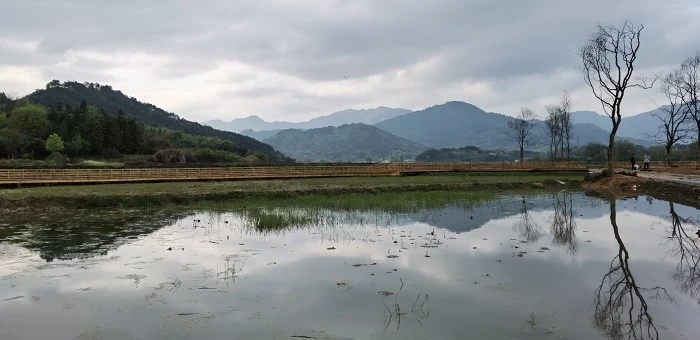
Passing Yunling Town, we saw the former site of the New Fourth Army Headquarters in southern Anhui. Further on, we turned onto County Road X064, and a large expanse of paddy fields appeared by the roadside. The clear ripples of water, the spring flat in the fields. The distant mountains and nearby trees reflected in the water, the curling smoke from distant villages—wasn't this exactly "Dimly seen distant villages, softly curling smoke from huts"?
In our elation, we hummed a forgotten old song: "...How much loneliness and melancholy, drift away with the evening breeze, forgotten on the country paths..."
"Only the setting sun approaches dusk," we drove toward today's destination—Chaji Ancient Town.
Chaji Ancient Town, located in Taohuatan Town, Jing County, is a historic Huizhou ancient village. Surrounded by mountains, it has a small basin in the middle suitable for living and farming. The mountains are lush with forests and dense bamboo groves. Several clear streams flow from the mountains, meandering through the ancient town.
Compared to the famous Hongcun and Xidi, Chaji is relatively unknown. In fact, Chaji Ancient Town is the largest and most well-preserved Ming and Qing Dynasty ancient village in China. Xu Stream, Cen Stream, and Shi Stream—three clear streams—flow through the village, with nearly 40 ancient bridges connecting over 100 Ming and Qing buildings, and 30 ancestral halls of various sizes scattered throughout.
Most residents here bear the surname Zha, descendants of Zha Wenxi, the Tang Dynasty prefect of Xuanzhou who founded the village. According to records, when Zha Wenxi was an official, he passed through this area and marveled at its beautiful scenery. After retiring, he moved his entire family here. Because the Zha family's ancestral home was Jiyang in Shandong, he named his village "Chaji" (Zha from Jiyang) as a reminder of his roots.
Entering Chaji Ancient Town felt like stepping into a not-so-distant forgotten past. "I build my hut amidst the human world, yet there is no noise of carriages and horses." Wuzhen, the water town, is too close to Shanghai—inevitably bustling and lively. Lijiang Ancient City, though beautiful, is increasingly flashy and noisy. Dali Shuanglang is bright and lovely but sometimes too crowded. By analogy, Chaji Ancient Town resembles Xizhou—both have an unassuming feel. But Xizhou is more refreshing, while Chaji is more tranquil.
Built along the water in a staggered arrangement, these white-walled, black-tiled ancient dwellings, layered and stacked, and the residents who have lived here for generations make Chaji a "living" ancient town, not a commercial street disguised as an ancient town.
Of course, there are many small shops and eateries here. But walking through the ancient town, you hear no loud hawking, no harassment of hard selling, and none of the pervasive smell of stinky tofu. The locals speak softly, with simple and warm eyes. Their words and demeanor reveal a kind of steadiness, a calm. If you greet them, you can step into the high-walled courtyards deep in the alleys. Wander at will, look slowly, explore the mottled traces of time, without worry of being disturbed.
Over the streams, there are still nearly 30 old bridges, each with a very distinctive name.
Xu Stream, a main stream in the village, flows from west to east through Chaji. At the mouth of Bianguan Alley, Xu Stream bends north, forming a curve. Here, a simple flat stone bridge connects the two banks. The household at the alley mouth ingeniously built half a pavilion against their gable wall. From a distance, the pavilion seems to cover the bridge, its eaves upturned, as if about to fly, adding a touch of charm to this otherwise ordinary stone bridge.
This stone bridge is Yuanlong Bridge.
Strolling slowly along Xu Stream, a stone arch bridge came into view. Above the bridge stands a Huizhou-style horse-head wall, a relatively uncommon sight. On the wall are written the four characters "Purple Air Comes from the East." On the north bank, a large tree shades the stone bridge; on the south bank, beside the path next to the horse-head wall, there is a two-story wooden archway. This is the God of Wealth Tower, with a small shrine housing the God of Wealth facing east—toward the rising sun. This small shrine embodies the villagers' hopes for abundance and happiness.
This bridge is the God of Wealth Bridge, on which is inscribed "The 15th Year of Jiaqing's Reign."
Then there is the Red Mansion Bridge, known as a sight in Chaji.
It is upstream, a flat-topped arch bridge. The circular opening of the bridge acts like a natural frame. Through the drooping green vines, looking downstream, you see a pool of emerald water, glistening ripples, and ivy-covered banks. On the stone steps in the stream, village women in red clothes wash clothes while chatting and laughing, a scene of harmony. The two-story building at the bridgehead is called Red Mansion.
The largest bridge in Chaji Ancient Town—Tianshen Bridge—is located midstream on Xu Stream. It is a flat arched bridge. At first glance it appears square, but on closer inspection, it is actually two bridges joined together with connected surfaces, also called "Twin Bridges Joined." The bridge's name comes from the Book of Songs: "Heaven protects and decrees, from heaven it extends, a thousand blessings, ten thousand descendants."
Right beside Tianshen Bridge, we found a small, clean, and spotless restaurant. We sat leisurely on the rooftop of the old house, ordered some spring seasonal vegetables, ate and chatted until the lights flickered and the crowd thinned.
For tonight's accommodation, we can recommend: The owner of the guesthouse is a professor at Tsinghua University, who bought this Huizhou-style old house years ago and hired an elderly local couple to manage it. It is a garden-style courtyard with a small bridge, flowing water, pavilions, towers, and every flower and plant shows careful thought.
Inside the garden are two Huizhou-style buildings: one new and one old, both two-story small structures. It is said that the old building, entirely wooden, is over a hundred years old.
Tonight, we stay in a century-old house, in Chaji Ancient Town, in Huizhou...
(To be continued)
Travel Journal Directory: 1. Day 3: Yangzhou → Zhenjiang Jinshan Temple → Jing County Chaji Ancient Town; 2. I. Jinshan Temple; 3. II. Chaji Ancient Town. Travel Information: Hotel Index, Guide Index, Ticket Index, Website Navigation, Travel Index, Cruise Index, Corporate Travel Index, Franchise Cooperation, Distribution Alliance, Friendly Links, Corporate Gift Card Purchase, Insurance Agency, Agency Cooperation, Hotel Franchise, Destination and Scenic Spot Cooperation, More Cooperation. About Ctrip: About Ctrip, Ctrip Hot Topics, Contact Us, Careers, User Agreement, Privacy Policy, Business License, Security Center, Ctrip Content Center, Intellectual Property, Trip.com Group Algorithm Announcement.


