One-Day Trip to Longxu Mountain
The reason we decided to climb Longxu Mountain was due to the word-of-mouth among outdoor enthusiasts and the numerous photos shared by netizens in recent years. Its unique geological features have attracted countless enthusiasts to come and explore. We believed this trip would be worthwhile and wanted to challenge ourselves.
Since we were staying in Longchuan, it made sense to go and see it. At 6 in the morning, our group of six walked to Rainbow Bridge and entered the scenic area. Everyone was full of energy, excited to be out and about.
Jixi Longchuan is an ancient village where the Hu clan has lived together for generations. The entire village is shaped like a boat, surrounded by beautiful mountains and rivers, rich in culture, and home to many remnants of Hui culture. It has a history of over 1,600 years. We walked onto a wooden arch bridge called "Shangguang Bridge," a new attraction added in October 2013. It spans the Dengyuan River, connecting Longchuan Village to Longxu Mountain. The bridge's entire body resembles a dancing dragon, full of vitality.
Longchuan Ancient Village is located in Jixi County, southern Anhui, also known as Kengkou. A yoga enthusiast had back muscles more developed than mine.
Longchuan has long been a place of flourishing culture and talented people. The Hu family in the village produced many talents throughout history and is a well-known "Jinshi Village" in Huizhou. During the Ming Dynasty, the village reached its peak, with over ten people passing the imperial examination to become Jinshi. The most famous among them was Hu Fu, who became a Jinshi in the 14th year of Chenghua (1478 AD) and rose to the position of Grand Tutor to the Heir Apparent and Minister of Revenue in Nanjing. Sixty years later, in the 17th year of Jiajing (1538 AD), Hu Zongxian became a Jinshi and later served as Grand Tutor to the Heir Apparent and Minister of War.
The village now houses the "Longchuan Hu Clan Ancestral Hall" (a National Key Cultural Relics Protection Unit), "Yishi Shangshu Archway" (a Provincial Cultural Relics Protection Unit), "Hu Bingheng's Residence" (a Hui merchant), and "Hu Zongxian's Former Residence" (a County-level Cultural Relics Protection Unit).
It is a National 5A-level scenic area and the ancestral home of Comrade Hu Jintao, former General Secretary of the Communist Party of China, President of the People's Republic of China, and Chairman of the Central Military Commission.
Longchuan's Longxi Bridge.
According to historical records, Longchuan was the ancient name of Kengkou Village. In front of the village lies Longxu Mountain, and a small stream (called "chuan") runs through the village, hence the name Longchuan. Later, people believed that the small stream (also called "keng") flowed into the Dengyuan River, allowing the dragon to swim freely, so the name was changed to Kengkou. This legend still circulates among the locals.
Longchuan is about 10 kilometers from Jixi County town. It is an ancient Huizhou village. Due to its special geographical environment and long historical and cultural origins, it has formed unique natural and human landscapes. It is now a protected historical and cultural area in Anhui Province.
After more than 1,600 years, it has passed down to the current "Jin" generation, totaling 48 generations. On September 13, 2013, Comrade Hu Jintao, former General Secretary of the Communist Party of China, President of the People's Republic of China, and Chairman of the Central Military Commission, returned to his hometown Longchuan, fulfilling his dream. Below is a photo of Hu Bingheng's former residence.
The Longchuan Hu Clan Ancestral Hall was first built in the Song Dynasty and underwent major repairs during the Jiajing period of the Ming Dynasty.
In the Tang Dynasty, Jixi produced Hu Mi, a General of the Scattered Cavalry; in the Song Dynasty, Hu Shunzhi, a Censor who impeached Qin Hui twice and earned a place in history; in the Ming Dynasty, there were Hu Fu and Hu Zongxian, both ministers for generations; in the Qing Dynasty, there were Hu Kaiwen, a famous ink maker, and Hu Xueyan, a red-top merchant; in modern times, there was the renowned scholar Hu Shi; and in contemporary times, President Hu Jintao... These names have left a mark in history and brought glory to the Hu surname.
Impressive! A woman performing an inverted pose added a touch of red to the scenic area.
Perhaps due to people's love for Huizhou woodcarving art and the fact that it is a blessed land with outstanding people, many domestic and international visitors, whether on business trips to southern Anhui or touring Huangshan, make a point to visit this village and savor it slowly.
Beside the two beauties is the Dengyuan River.
Longchuan in the morning was peaceful and serene. The early risers were full of spirit. Walking on this herringbone ancient wooden bridge, it creaked with every step, which was quite charming. After crossing the bridge, we arrived at Huli Village, the starting point of Longxu Mountain.
On the way back to Longxi Inn, a dog followed us closely, silent, not barking to disturb anyone. It looked at the tourists with gentle eyes, as if saying, "Welcome."
Ahead was where we stayed last night, quietly nestled in the valley.
We returned to the inn at 7:30, had breakfast, and packed enough dry food, fruit, and water (the guide told us to bring at least four bottles of water each because of the heat, but unfortunately we didn't take his advice seriously. Each of us brought at most three bottles. As a result, during the descent, we were extremely thirsty. Moreover, it hadn't rained for three months, so the mountain streams had dried up. Everyone was suffering from thirst. We hadn't experienced such a situation in decades, truly understanding that water is the source of life). Then we set off towards Longxu Mountain, starting an unexpected crossing journey that would last all day.
The bamboo gate of Longxu Mountain was very distinctive. I guessed it would look different in a few years, so I took a photo as a souvenir.
Longxu Mountain is located on the east bank of the Dengyuan River in Jixi, Anhui. To the east, it connects with Qigu Mountain. It has twin peaks. The main peak, Longfeng, is 1048.6 meters above sea level, with a dragon pond at the top that never dries up in any season. The secondary peak, Baisha Peak, features attractions such as Longtai Rock, Stone Gate, Stone Ladder, and Flying Waterfall.
Chen Zhang of the Ming Dynasty wrote a poem: "The great peak and small peak are like chiseled iron, the summit scraping the sky is even more extraordinary. Where does the Taoist build flying clouds? Straight to the peak to see the dragon's cave."
The entrance to Longxu Mountain Scenic Area. Most outdoor climbers enter through this gate. Individual visitors are not allowed entry for safety reasons, so a guide is required, and the guide must sign a confirmation.
Longxu Mountain is not yet developed. Reaching the highest peak requires completely relying on wild trails, which attracts many hiking enthusiasts to come and challenge themselves. It is praised by hikers as the "Hiker's Paradise" in Anhui. This was originally a developed mature tourist route, but now it is dilapidated and rarely used.
Usually, people start from Longchuan Village at the foot of the mountain, cross the Huchuan Official Bridge over the Dengyuan River to reach Huli Village on the opposite bank. From Huli Village, there is a countryside path heading southeast. After about 30 minutes, you arrive at Longxu Mountain.
We passed through a section of steps to enter the mountain gate.
This mountain is home to longxu grass (dragon beard grass), which is used to make fine paper, anciently called Longxu paper. Li Yu, the later ruler of the Southern Tang Dynasty, treasured it and stored it in his "Chengxin Hall," making Longxu paper famous throughout the land and more valuable than Shu paper. The mountain is named after this grass.
Chen Zhang of the Ming Dynasty wrote a poem: "The great peak and small peak are like chiseled iron, the summit scraping the sky is even more extraordinary. Where does the Taoist build flying clouds? Straight to the peak to see the dragon's cave."
After passing through the cultural corridor, it added a bit of cultural atmosphere.
At the start, Longxu Mountain was not much different from ordinary scenic spots. However, in such a dry autumn (it hadn't rained for three months), water was rarely seen on the mountain, which was quite regrettable.
Where does it look like a gourd?
The five heroes of "Roaming the World."
We experienced what it means to leave a footprint with every step.
This waterfall had also died of thirst.
The four women were all in great shape.
If there were water, we could enjoy the scenery. Unfortunately, not a drop was seen.
We arrived at the Maple Appreciation Pavilion.
We arrived at the Divine Turtle Listening to the Spring. We could compare it with the map earlier to see our exact location.
At this point, there was still a walking path.
We arrived at White Dragon Waterfall.
Dragon Palm, quite interesting.
From White Dragon Waterfall, we turned right and started climbing the wild trail. This photo was taken from above the waterfall looking down. There was still a little water.
Please let me know, don't say I didn't tell you. Is that what it means? See the picture below.
At this point, the initial section of the path was finished. Then came the vast mountains with no roads at all, only a wild trail often used by hikers. Friends who come here to hike need a local guide to lead the way. After all, there are no roads on the mountain, and getting lost would have dire consequences.
The climbing process was tough, tiring, and left us panting. But thinking about standing on the summit overlooking the sky, raising our arms and shouting, gave a great sense of achievement, and we perked up immediately. Hikers should wear professional gear, especially hiking boots, to avoid slipping and unnecessary injuries.
There were no more developed mountain paths. We entered the mode of using both hands and feet. The soil on the ground was very thin, making it easy to slip. More often, we had to rely on tree branches and weeds along the path to maintain balance. It was interesting to think that since the mountain allowed you to climb, there were always tree roots, vines, weeds, and rocks to rely on.
Rest: We were exhausted.
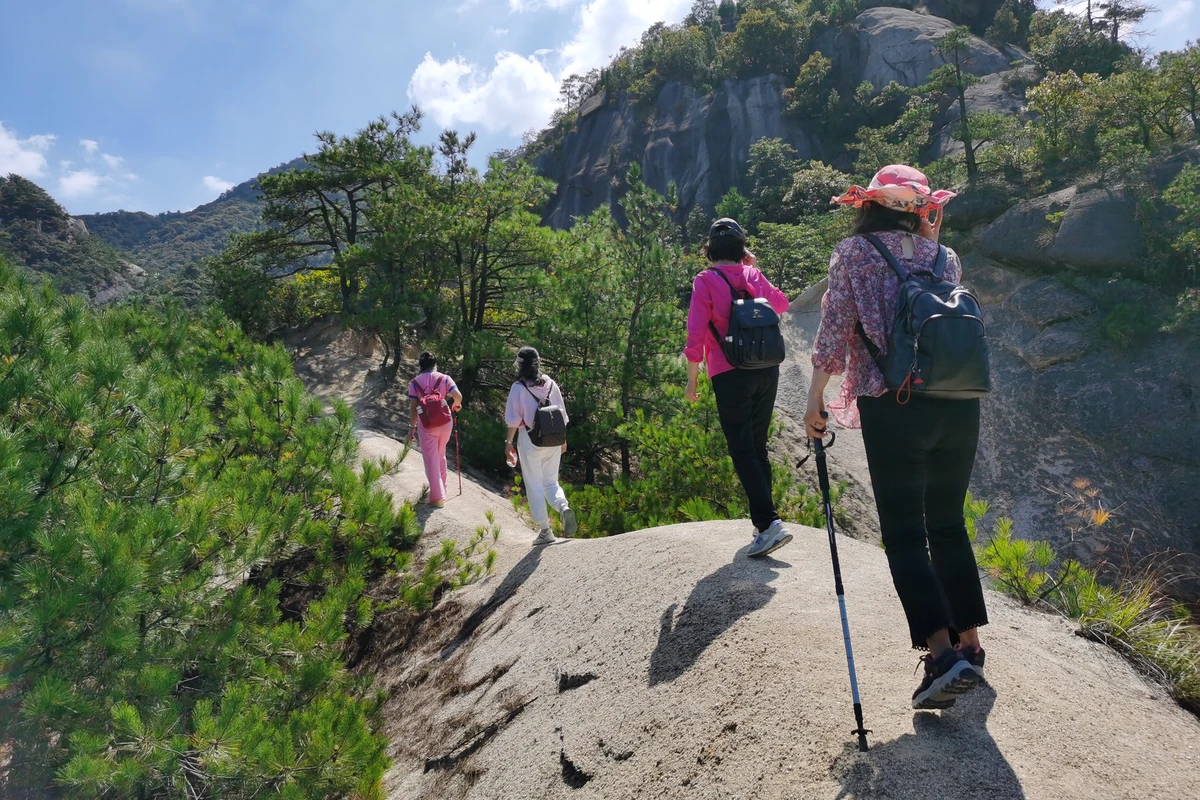
Some call Longxu Mountain a high-altitude desert. Ridges upon ridges, devoid of vegetation, covered with weathered small stones and fine sand on hard rock. This formed a huge contrast with the surrounding green valleys, magnificent and spectacular, like a series of dragon spines lying among the mountains.
Beauty implies danger. Walking on the dragon's spine, there was no protection on either side. Fine sand covered the hard rocks. While walking, we constantly felt we might slide down the mountain. After crossing the ridge, our legs were trembling.
Seeing this warning sign brought some joy, as it meant someone had been here.
The charm of the mountain lies in its heights. After overcoming difficulties and dangers, reaching the summit opens up a wide view, with all the world's beauty before your eyes. At that moment, the hardships of the journey are forgotten.
To traverse Longxu Mountain, you need courage, perseverance, and an unwavering belief. Who carved these little hollows? Good people.
Replenish energy to continue climbing.
The mountain split open a crack, allowing us to proceed. The first wooden ladder.
After conquering one peak after another, everyone beamed with joy. Minister...
The reward after hardship was the magnificent scenery of Longxu Mountain. Many beautiful sights are in places ordinary people can't reach. Caught a beautiful woman.
On Longxu Mountain, the rocks on the ridges are mostly weathered into sand and white gravel, starkly contrasting with the lush green mountains around, bearing the desolation and pride of long years.
Capturing your heroic and spirited figures. When you see this photo, you will be moved by yourselves.
Looking into the distance at the mountains, I couldn't help but marvel at the primordial power of nature, creating such extraordinary Longxu Mountain scenery.
This wooden ladder really needs repair. The guide said the farmhouse in Longchuan plans to organize maintenance. I hope it happens soon.
The minister dared not even look up.
Another narrow spot. I simply rolled over the rock quickly.
Finally, we used the rope. The guide's rope was professional grade. Thumbs up.
A view of all the lesser mountains. This is the sense of achievement. Looking back at the beautiful villages and fields below, gazing at the magnificent landscape beneath our feet, and admiring the uniquely shaped ancient pines before us, we fully enjoyed the beauty of nature.
This is the value of outdoor hiking: tired but happy.
The famous Pig Head Rock, quietly gazing at the mountains.
From this direction, Pig Head Rock resembles a lying lioness.
Time for lunch. Fragrant self-heating rice.
Due to limited stamina and time constraints for the big loop, we chose to descend near Pig Head Rock. The way down was not easy either.
Deep in the dense forest, a small group moved forward.
The descent was also quite intense. What does this rock look like?
In this deep mountain and old forest, without a guide, one would truly feel lost and helpless.
Rest for a bit. Dying of thirst. Water... water... water, where is the water? It felt like a scene from a movie.
After much hardship, we finally passed a small puddle. Without caring about anything else, we gulped down water. It was truly refreshing.
The fir trees soared into the sky. The ground was covered with leaves. Every step was slippery, as if we might fall at any moment.
We unexpectedly passed through a naturally formed vine tunnel, almost crawling through it. In all my outdoor experiences, this was the first time I encountered such a path. I was truly speechless. I needed a good drink tonight.
Even a wild boar would be scared and run back from this place. Yet there were people...
Even after reaching this gate, we didn't know how far it was to the bottom. The guide had confused us.
Finally, at 4:30 PM, we descended to the mountain gate (4 hours up, 3 hours down, utterly exhausted). On the way, we met some young people, I didn't know which group. One of the women saw my disheveled state and almost couldn't help laughing. But she still encouraged me: "Keep going!" ... Good person.
Look how disheveled I was, holding a stick, like the legendary ... Old Hu.
The route we took today was a bit punishing. Perhaps many people don't understand why we would seek such hardship for no reason. But those who understand will understand, and those who don't will rack their brains and think we have too much time on our hands and nothing better to do. People who like to carve "so-and-so was here" on historical sites will never understand our love for the primitive. Even if some people go hiking, they often leave behind only complaints and garbage everywhere. It's better to avoid them, since this isn't really a way to elevate one's status anyway. They might as well go to crowded tourist spots.
Returned to the inn, rested for 15 minutes, then drove to our accommodation for the night, Yuchuan Village in Fuling Town, Jixi County. The old house at the village entrance (parking lot).
The parking lot at the village entrance was originally the site of a large ancestral hall, which was destroyed by fire decades ago. Now only a small part of the ancestral hall has been rebuilt in the front area, and most of it has become a free parking lot for the village. Everyone looked full of energy, not like they had just climbed a wild mountain.
A 5-minute walk brought us to the accommodation. I lay down on the bed to rest, while the women were still busy. Impressive! This water bottle seemed to have a vintage feel.
In the evening, as the saying goes, "A nephew carrying a lantern — shining on the uncle (as usual)": we had some drinks.
1. Suitable hiking boots or trekking shoes (definitely not sneakers or brand-new shoes) and loose clothing.
2. A backpack (freeing your hands for photos), a headband (multi-functional), knee pads (to protect knees), hiking poles (saving 30% energy).
3. A small amount of fruit, snacks, four bottles of water, high-energy outdoor food, etc.
4. A good guide is also essential. We must thank the guide for completing a journey full of thrills but without accidents.
5. The hiking route on Longxu Mountain is quite intense. Although the distance is only about 11-12 kilometers, walking on the sandy sections is slow, and some parts require ropes and wooden ladders. Generally, a team takes 7-8 hours to complete this loop. It is suitable for hikers with strong outdoor experience.
6. The latest routes on Longxu Mountain include: Chai Gou Lang Jian, Luo Han Feng, Cao Xie Ba, Hou Zi Jian...
7. Hiking tourism not only relaxes the mind and body but also tempers the will. It is becoming a fashion for people to travel.


